AI Guided Selling in 2026: The Complete Playbook Guide
AI guided selling turns scattered CRM data into next-best-action nudges your reps actually follow. Here's how it works, what to buy, and where it breaks in 2026.
AI Guided Selling in 2026: The Complete Playbook Guide
AI guided selling is the practice of using machine learning to tell reps what to do next — which account to call, what to say, and when — instead of leaving them to guess from a messy CRM. Done right, it shrinks the gap between your best rep and your median rep. Done wrong, it's a glorified reminder system nobody trusts.
This guide breaks down how it actually works, what to look for in a platform, and how to roll it out without your team quietly ignoring every prompt.
TL;DR#
- AI guided selling layers signal detection, scoring, and next-best-action recommendations on top of your CRM so reps act on intent instead of intuition.
- It only works when the underlying contact and account data is clean — garbage signals produce garbage nudges.
- The market splits into three buckets: CRM-native (Salesforce Einstein, HubSpot), conversation intelligence (Gong, Salesloft), and signal/enrichment layers that feed them.
- Expect a realistic lift of 10–20% in win rate and faster ramp for new reps — not the 3x miracles vendors promise.
- Start narrow: pick one play (e.g., inbound speed-to-lead), instrument it, prove it, then expand.
What is AI guided selling?#
Think of AI guided selling like a GPS for your sales team. A map shows you every road and lets you figure out the route yourself. A GPS watches traffic, recalculates in real time, and just says "turn left in 200 meters." Guided selling is the GPS: it reads the live signals around a deal and tells the rep the single highest-value next move.
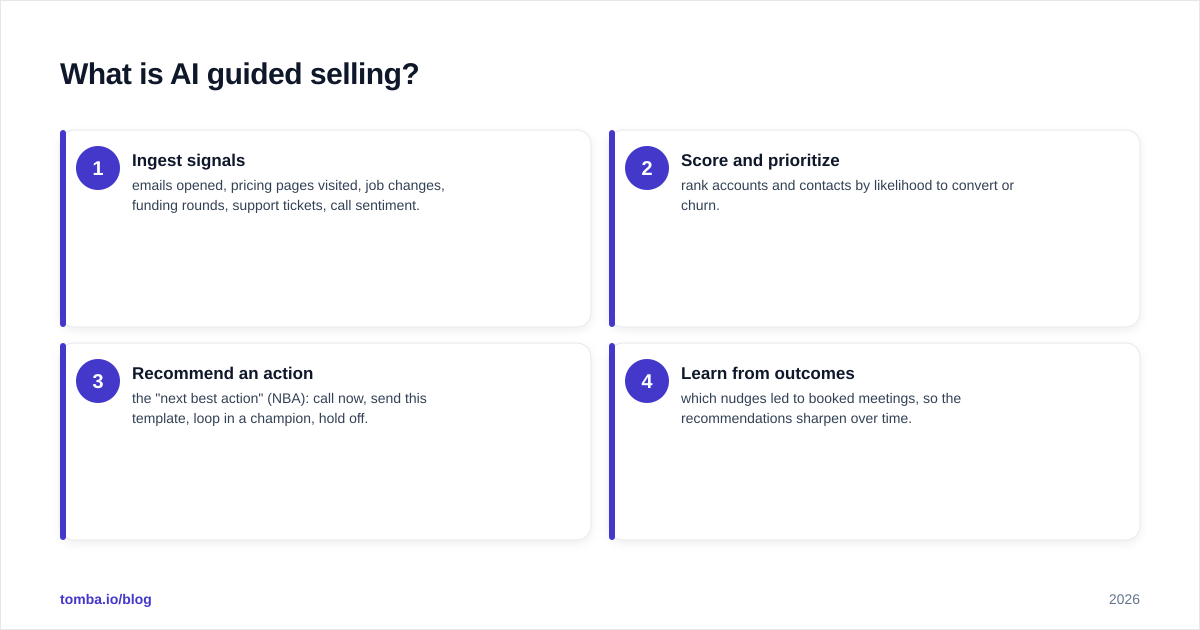
Technically, it's a stack of models sitting on top of your customer data that does four things:
- Ingest signals — emails opened, pricing pages visited, job changes, funding rounds, support tickets, call sentiment.
- Score and prioritize — rank accounts and contacts by likelihood to convert or churn.
- Recommend an action — the "next best action" (NBA): call now, send this template, loop in a champion, hold off.
- Learn from outcomes — which nudges led to booked meetings, so the recommendations sharpen over time.
The difference from plain sales automation is the judgment layer. Automation fires the same sequence at everyone. Guided selling decides who deserves a sequence at all, and which one.
How does AI guided selling actually work?#
The engine runs on a feedback loop. The more outcomes it sees, the better its recommendations — which is also why a brand-new deployment feels dumb for the first quarter.
Here's the loop in plain terms:
- Capture. Activity data flows in from email, calendar, dialer, and the CRM. Conversation intelligence tools transcribe calls and tag objections automatically.
- Enrich. Raw records get filled out with firmographics, technographics, and verified contact details. This is where a clean B2B database matters — a model can't act on a contact whose email bounces.
- Score. Each account gets a propensity score; each contact gets an engagement score. Stale or low-signal records sink to the bottom.
- Recommend. The rep opens their day to a ranked queue with reasons attached: "Acme visited pricing twice this week — book a call."
- Measure. Booked, won, ignored — every outcome trains the next round of suggestions.
The weakest link is almost always data quality. If 18% of your contacts have invalid emails, the model wastes its best recommendations on people who never receive the outreach. Running lists through an email verifier before they hit the scoring layer is unglamorous but it's the difference between trusted nudges and noise.
Is AI guided selling better than traditional CRM workflows?#
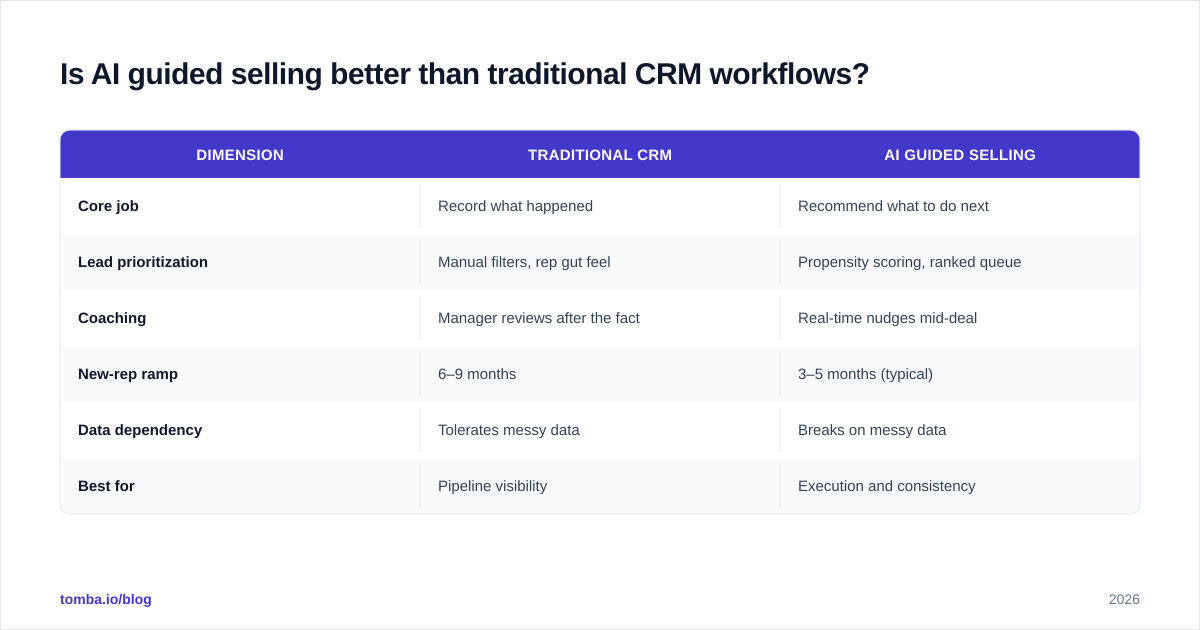
Yes — but only on the dimensions it's designed for. A traditional CRM is a system of record: it stores what happened. Guided selling is a system of action: it tells you what to do about it. They're complements, not competitors.
| Dimension | Traditional CRM | AI guided selling |
|---|---|---|
| Core job | Record what happened | Recommend what to do next |
| Lead prioritization | Manual filters, rep gut feel | Propensity scoring, ranked queue |
| Coaching | Manager reviews after the fact | Real-time nudges mid-deal |
| New-rep ramp | 6–9 months | 3–5 months (typical) |
| Data dependency | Tolerates messy data | Breaks on messy data |
| Best for | Pipeline visibility | Execution and consistency |
The honest caveat: guided selling amplifies whatever data and process you already have. If your sales process and pipeline stages are undefined and reps log activity inconsistently, the AI inherits that chaos. Fix the foundation first, then add the engine.
What are the best AI guided selling tools in 2026?#
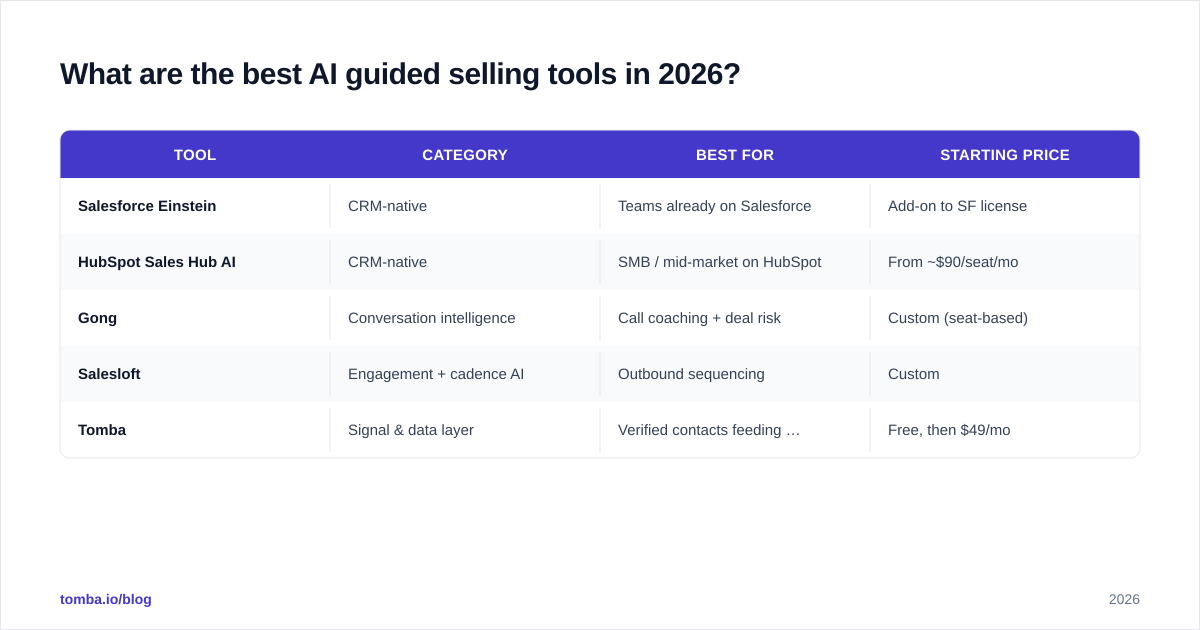
There's no single "best" — it depends on where your data already lives and what play you're optimizing. The market clusters into three layers, and most teams end up combining one from each.
| Tool | Category | Best for | Starting price |
|---|---|---|---|
| Salesforce Einstein | CRM-native | Teams already on Salesforce | Add-on to SF license |
| HubSpot Sales Hub AI | CRM-native | SMB / mid-market on HubSpot | From ~$90/seat/mo |
| Gong | Conversation intelligence | Call coaching + deal risk | Custom (seat-based) |
| Salesloft | Engagement + cadence AI | Outbound sequencing | Custom |
| Tomba | Signal & data layer | Verified contacts feeding the stack | Free, then $49/mo |
A few buying notes from the trenches:
- CRM-native first. If you're on Salesforce or HubSpot, start with their built-in AI before bolting on a third tool. Less integration pain, one less data silo.
- Conversation intelligence is the highest-ROI add-on for teams that live on calls — it surfaces objections and deal risk no human reviewer would catch at scale.
- The data layer is invisible but load-bearing. Tools like Gong and Einstein are only as good as the contacts they act on. This is where Tomba fits — finding and verifying the people the AI tells you to reach. Check current Tomba pricing if you're scoping a contact-enrichment layer.
Read third-party reviews on G2 before committing — guided-selling claims are notoriously inflated in vendor decks, and peer reviews surface the integration gotchas.
What ROI should you actually expect?#
Set expectations below the marketing. Across mid-market B2B teams, realistic outcomes look like:
- 10–20% improvement in win rate once the model has a quarter of outcome data.
- 20–40% faster ramp for new reps, because the queue teaches them what good prioritization looks like.
- Fewer dropped deals — automated risk flags catch deals going quiet before they're dead.
- More selling time — less manual list-building and CRM hygiene.
What you should not expect: a tripling of pipeline, or the AI replacing rep judgment. Guided selling raises the floor (your weakest reps improve most) more than it raises the ceiling. Track the lift against a control group if you can — half the team on guided selling, half on the old workflow — so you're measuring the tool, not the quarter.
How do you roll out AI guided selling without it failing?#
Most failures aren't technical. They're adoption failures — reps don't trust the nudges, so they ignore them, so the model never learns, so the nudges stay bad. Break that cycle with a narrow, instrumented start.
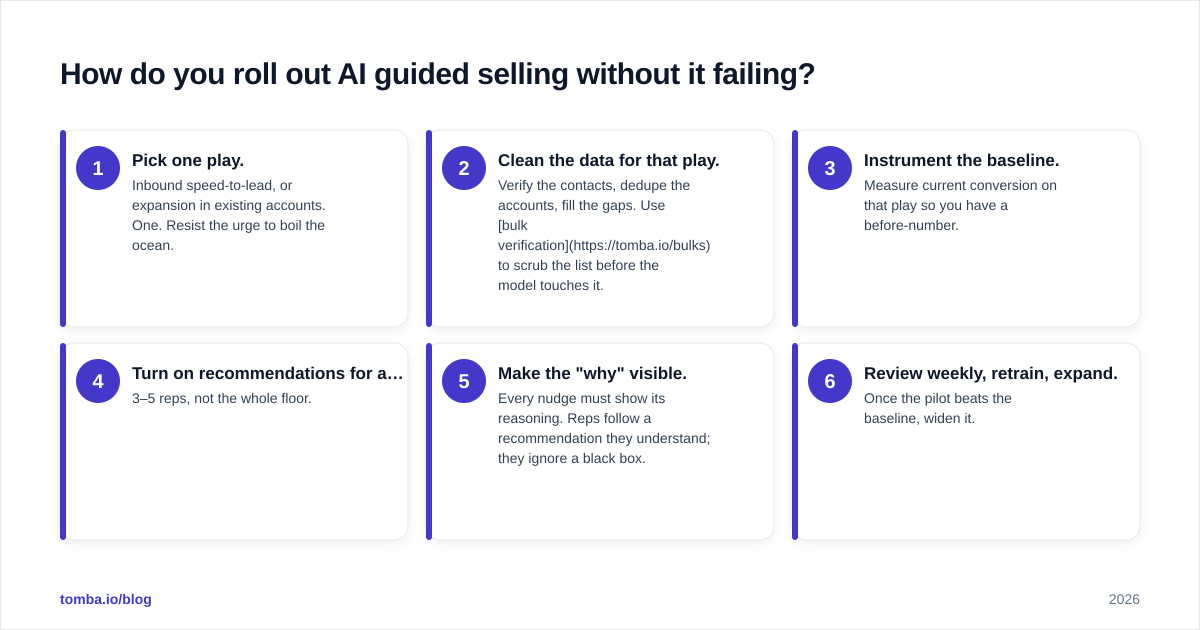
A phased rollout that works:
- Pick one play. Inbound speed-to-lead, or expansion in existing accounts. One. Resist the urge to boil the ocean.
- Clean the data for that play. Verify the contacts, dedupe the accounts, fill the gaps. Use bulk verification to scrub the list before the model touches it.
- Instrument the baseline. Measure current conversion on that play so you have a before-number.
- Turn on recommendations for a pilot pod. 3–5 reps, not the whole floor.
- Make the "why" visible. Every nudge must show its reasoning. Reps follow a recommendation they understand; they ignore a black box.
- Review weekly, retrain, expand. Once the pilot beats the baseline, widen it.
The teams that win treat guided selling as a habit-building exercise, not a software install. The data foundation underneath — accurate, verified, enriched contacts — is the part you control before any model gets involved, and it's the part vendors quietly assume you've already solved.
The bottom line#
AI guided selling is genuinely useful when two things are true: your sales process is defined enough to give the model structure, and your contact data is clean enough for it to act on. Get those right and you'll see steadier execution, faster ramp, and a real win-rate lift. Skip them and you've bought an expensive reminder app.
Whichever guided-selling platform you choose, it can only reach people whose details are correct. That's the layer worth fixing first. Tomba's Email Finder finds and verifies the professional emails behind the accounts your AI tells you to prioritize — start free with 25 searches a month, then scale to the Starter plan at $49/mo when your guided-selling motion is humming. Feed the engine clean data, and the nudges finally start to land.
Ready to find emails that actually work?
Join 150,000+ professionals who stopped guessing and started sending. Free credits on signup — no credit card required.
Get the Tomba newsletter
Practical outbound tactics and product updates — once every two weeks.
About the author