AI in B2B Marketing in 2026: Tools, Tactics & ROI Guide
AI in B2B marketing has moved from hype to pipeline. Here's where it actually works in 2026 — the use cases, the tooling, the ROI math, and the traps.
AI in B2B marketing stopped being a slide in a keynote and became a line item in the budget. The question in 2026 is no longer "should we use it" — it's "where does it actually move pipeline, and where is it burning credits for nothing."
TL;DR#
- AI in B2B marketing works best on narrow, repeatable jobs: research, segmentation, draft generation, lead scoring, and data enrichment — not "set it and forget it" campaigns.
- The biggest ROI comes from data quality plus AI, not AI alone. A model on top of a stale contact list just produces wrong answers faster.
- Content velocity went up, content trust went down. Generic AI copy is now a deliverability and brand liability, not an advantage.
- Buyers expect personalization at scale; the teams winning are pairing intent signals with verified contact data and human review.
- Start with one workflow, measure it against a control, and only then expand. Most failed AI rollouts skipped the measurement step.
What is AI in B2B marketing?#
AI in B2B marketing is the use of machine learning and large language models to do the parts of marketing that used to eat analyst hours: segmenting accounts, predicting which leads will convert, drafting and personalizing outreach, enriching records, and analyzing campaign performance.
Think of it like hiring a very fast junior analyst who never sleeps but also never double-checks their own work. The speed is real. The judgment is yours to supply. That framing matters because most disappointment with AI comes from treating it like a senior strategist instead of a tireless intern.
The category spans a few distinct jobs that often get lumped together:
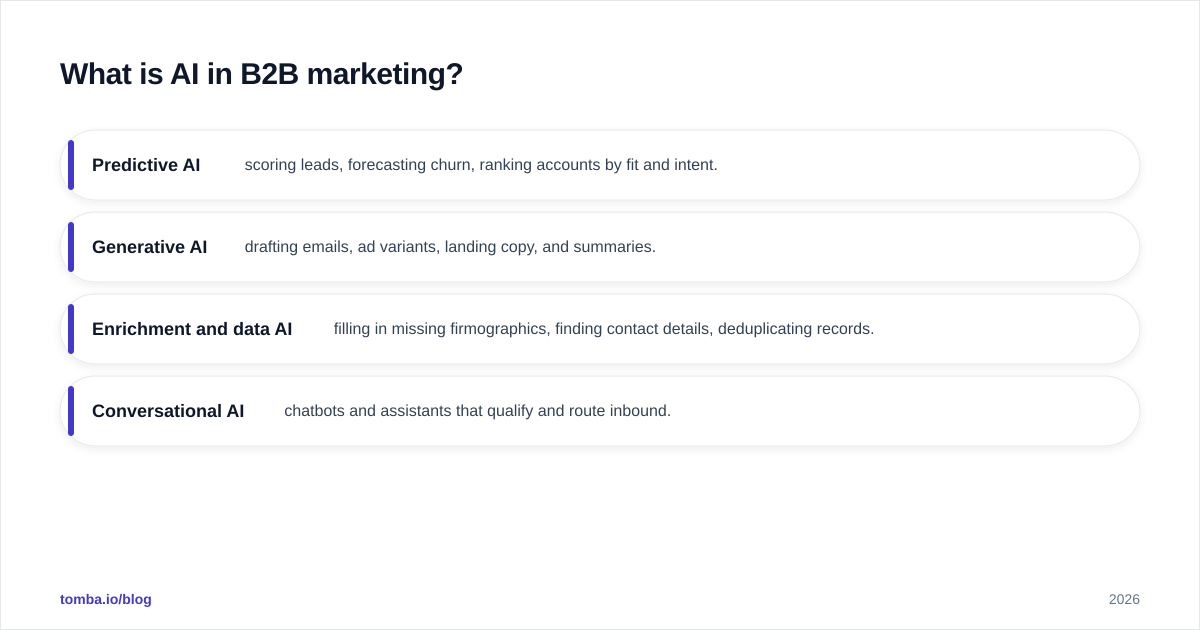
- Predictive AI — scoring leads, forecasting churn, ranking accounts by fit and intent.
- Generative AI — drafting emails, ad variants, landing copy, and summaries.
- Enrichment and data AI — filling in missing firmographics, finding contact details, deduplicating records.
- Conversational AI — chatbots and assistants that qualify and route inbound.
Each has a different ROI profile, a different failure mode, and a different data dependency. Bundling them into one "AI strategy" is how teams end up with a tool nobody uses.
Where does AI actually deliver ROI in B2B?#
Conclusion first: AI delivers the clearest return on research, enrichment, scoring, and first-draft generation — the high-volume, low-judgment tasks. It delivers the weakest return when you ask it to own strategy or hit "send" without a human in the loop.
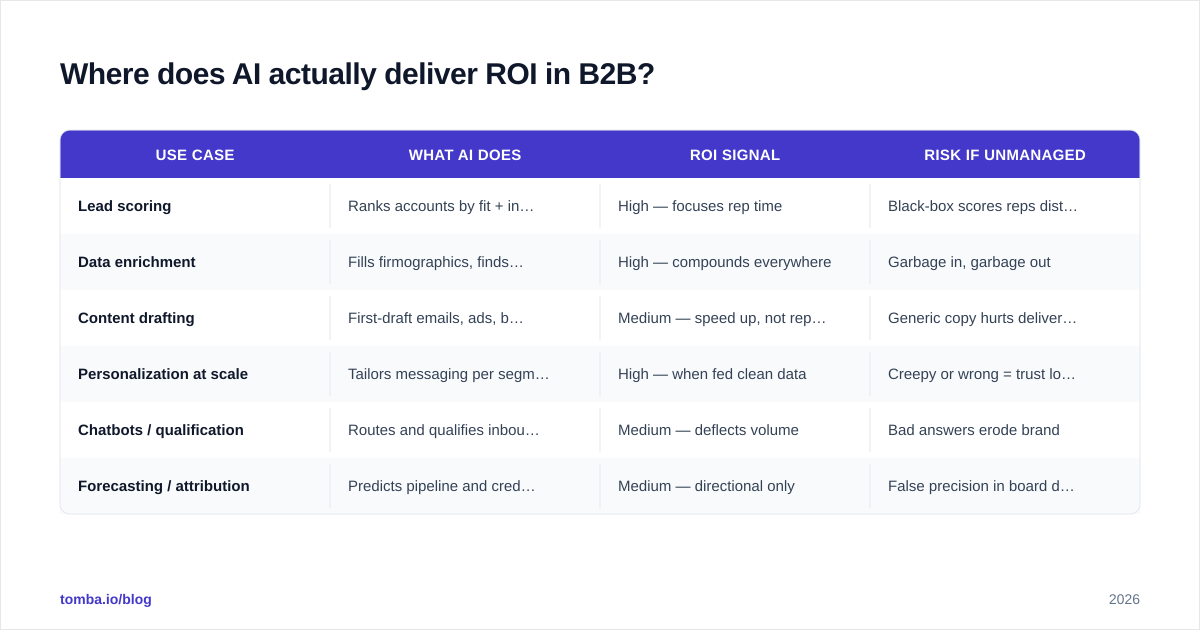
Here's how the major use cases stack up in practice.
| Use case | What AI does | ROI signal | Risk if unmanaged |
|---|---|---|---|
| Lead scoring | Ranks accounts by fit + intent | High — focuses rep time | Black-box scores reps distrust |
| Data enrichment | Fills firmographics, finds emails/phones | High — compounds everywhere | Garbage in, garbage out |
| Content drafting | First-draft emails, ads, blog outlines | Medium — speed up, not replace | Generic copy hurts deliverability |
| Personalization at scale | Tailors messaging per segment | High — when fed clean data | Creepy or wrong = trust loss |
| Chatbots / qualification | Routes and qualifies inbound | Medium — deflects volume | Bad answers erode brand |
| Forecasting / attribution | Predicts pipeline and credit | Medium — directional only | False precision in board decks |
The pattern is consistent: AI multiplies whatever you feed it. Feed it a clean, verified list of accounts and decision-makers and it sharpens your targeting. Feed it a list that's 30% bounced emails and outdated titles, and it confidently personalizes outreach to people who left the company two years ago.
That's why the unglamorous layer — data enrichment and verification — quietly drives more AI ROI than the flashy generative features. According to HubSpot's research on marketing AI adoption, data quality is the top blocker marketers cite when AI projects underperform.
)
Why does AI fail in B2B marketing (and how to avoid it)?#
Most AI failures in B2B marketing trace back to three causes, and none of them are the model's fault.
1. The data underneath is wrong. A predictive score is only as good as the firmographic and behavioral data it learns from. If your CRM is full of duplicate accounts, missing revenue figures, and unverified emails, the AI learns the noise. Fix the foundation first — clean, deduplicate, and verify before you layer prediction on top. A bulk email finder and verification pass on your existing database is usually the highest-leverage first move.
2. The output skips human review. Generative AI will produce a confident, fluent, completely wrong sentence with the same ease it produces a correct one. In B2B, where a single bad claim in an email to a CFO can kill a deal, the "human in the loop" isn't optional overhead — it's the quality gate. The teams getting burned are the ones who automated the review away.
3. There's no control group. If you can't compare the AI-run segment against a human-run control, you can't tell whether the lift came from the AI or from the fact that you finally cleaned up your targeting. Measurement discipline separates teams that scale AI from teams that quietly shelve it.
There's also a deliverability tax that nobody warned marketers about. Mailbox providers got very good at detecting templated, AI-generated bulk mail. If every prospect gets the same lightly-reworded paragraph, your sender reputation takes the hit and your whole domain's deliverability drops. AI volume without AI quality is a fast path to the spam folder.
How do you build an AI B2B marketing stack?#
Build it in layers, bottom-up, and don't buy the top layer before the bottom one is solid.
Layer 1 — Verified data foundation. Before any model touches your funnel, your contact and account data needs to be accurate. This means finding the right decision-makers and confirming their details are deliverable. Tools like the Tomba Email Finder and an email verifier sit here. Without this layer, everything above it is built on sand.
Layer 2 — Enrichment and segmentation. Append firmographics, technographics, and intent signals so your AI has features to reason about. This is where contact enrichment turns a name and email into a scoreable record.
Layer 3 — Predictive scoring. Now you can rank accounts and leads by fit and likelihood to convert. This layer earns its keep by telling reps where to spend the next hour.
Layer 4 — Generative output. First drafts of emails, ad copy, and sequences — always reviewed before sending. This is the most visible layer and the one teams wrongly start with.
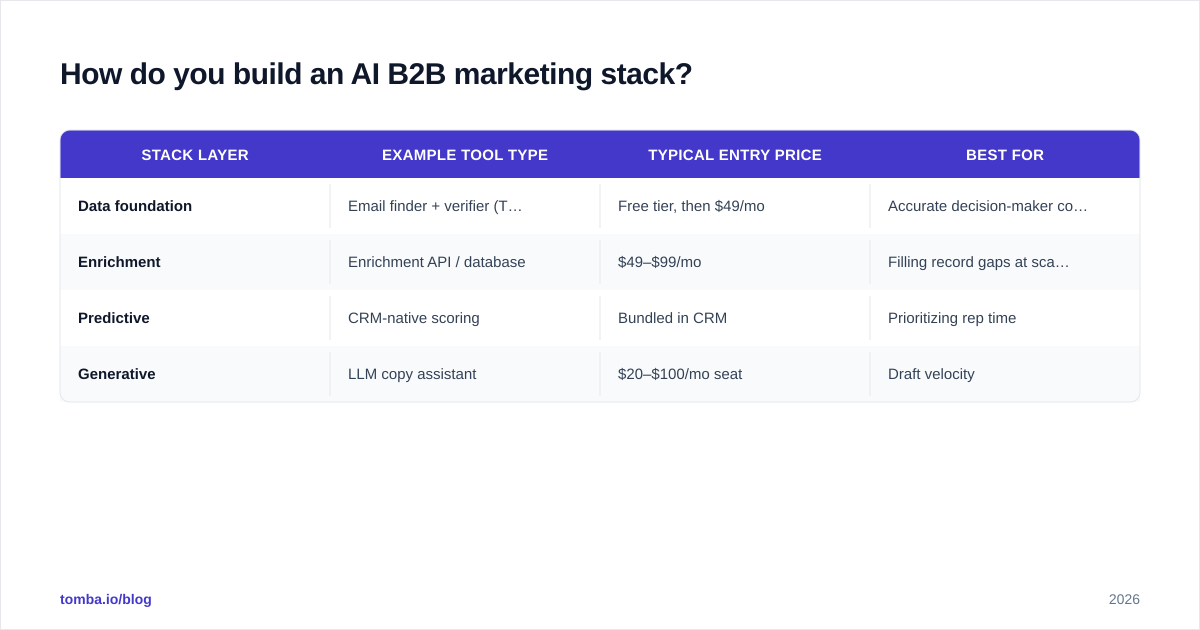
A quick comparison of where common tool categories fit and what they cost:
| Stack layer | Example tool type | Typical entry price | Best for |
|---|---|---|---|
| Data foundation | Email finder + verifier (Tomba) | Free tier, then $49/mo | Accurate decision-maker contacts |
| Enrichment | Enrichment API / database | $49–$99/mo | Filling record gaps at scale |
| Predictive | CRM-native scoring | Bundled in CRM | Prioritizing rep time |
| Generative | LLM copy assistant | $20–$100/mo seat | Draft velocity |
You'll notice the foundation layer is cheap relative to the value it unlocks. Tomba's pricing starts free at 25 searches a month and moves to $49/mo Starter, $99/mo Growth, and $249/mo Pro — which is rounding-error money next to the cost of a sales team chasing dead contacts. For a full picture of how AI fits the broader motion, the sales automation glossary entry maps the adjacent categories.
Is AI-generated content hurting or helping B2B brands?#
Both — and which one depends entirely on whether a human edits it.
AI-generated content helps when it's used as a first draft and an idea multiplier. A marketer who uses AI to outline ten blog angles, then writes the one that's actually good, ships faster and better. AI as a research and drafting accelerator is a clear win.
AI-generated content hurts when it's published or sent raw. Search engines have devalued thin, templated AI content. Buyers can smell a generic "I came across your company and was impressed" opener from a mile away. And as covered above, mailbox providers penalize bulk-identical mail. The brand cost of looking lazy is higher in B2B than B2C because your buyers are professionals who do this for a living.
The winning pattern, per Gartner's guidance on generative AI in marketing, is "AI-assisted, human-finished." Use AI for volume and variation; use humans for the claims, the judgment, and the final 20% that makes copy feel written by someone who understands the buyer.
)
If you're writing cold outreach, lean on tools that help with structure rather than full automation — a subject line tester and spam checker catch the deliverability problems AI copy tends to introduce, before they cost you a domain reputation.
How should a B2B team start with AI in 2026?#
Start narrow, measure honestly, expand only on proof. Here's a four-week rollout that avoids the usual traps.
Week 1 — Pick one workflow and one metric. Don't "adopt AI." Adopt AI for lead enrichment or for first-draft sequences — one job, one number you're trying to move (cost per qualified lead, reply rate, hours saved).
Week 2 — Fix the data feeding it. Run your target list through enrichment and verification. Remove duplicates, confirm emails are deliverable, fill missing titles. This single step often produces more lift than the AI itself.
Week 3 — Run with a control group. Split your segment. AI-assisted on one half, business-as-usual on the other. Same offer, same timing. Anything else and you can't attribute the result.
Week 4 — Read the numbers and decide. Did the AI-assisted half beat the control on your one metric? Keep it and expand to the next workflow. Did it tie or lose? Diagnose whether it was the data, the prompt, or the use case before you blame "AI."
This is deliberately unsexy. It's also the difference between a team that has three AI tools driving measurable pipeline and a team that has fifteen AI subscriptions nobody can justify at renewal. G2's marketing analytics category is full of tools that win on demos and lose on this exact measurement step.
Frequently asked questions#
Will AI replace B2B marketers? No, but it replaces specific tasks. The analyst hours spent on manual list-building, basic segmentation, and first-draft copy shrink dramatically. The strategy, judgment, and relationship work grow in relative importance. Marketers who treat AI as leverage win; those who treat it as a threat or a magic button lose.
What's the single highest-ROI AI use case in B2B? Data enrichment and verification feeding a predictive scoring model. It's invisible, it's cheap, and it compounds across every downstream campaign because it improves the input quality for everything else.
Is AI content bad for SEO? Raw AI content is. AI-assisted, human-edited content that adds genuine expertise and original data is fine — search engines target thin and unhelpful content, not the production method.
How much should a B2B team budget for AI tools? Less than you think for the foundation, more discipline than you think for measurement. A solid data layer starts around $49/mo; the expensive mistake is buying six generative seats before the data is clean.
The bottom line#
AI in B2B marketing rewards teams that treat it as leverage on a clean foundation, not as a replacement for judgment. The flashy generative layer gets the attention, but the enrichment-and-verification layer underneath is what actually decides whether your AI sharpens targeting or just produces wrong answers at scale.
Start there. If you want decision-maker contacts your AI stack can actually trust, the Tomba Email Finder finds and verifies professional emails by name, domain, or company — so the data feeding your models is accurate before you spend a credit on prediction. Build the foundation, measure one workflow, and expand on proof.
// get started
Find, verify and enrich your first contacts today
Start on the free plan with 25 searches a month, then scale when your team is ready.
Free plan · No credit card required · GDPR & CCPA
// about the author