AI in Sales 2026: How AI Transforms B2B Selling
AI in sales is no longer hype. See where it actually moves the needle in 2026 — prospecting, enrichment, forecasting — and where humans still win deals.
TL;DR
- AI in sales delivers the clearest ROI in three places: prospecting and list-building, lead enrichment, and forecasting — not in fully autonomous "AI closes the deal" fantasies.
- The teams winning in 2026 use AI as a copilot that removes grunt work, so reps spend more time in live conversations, not less.
- Data quality is the ceiling on every AI sales tool. Garbage contacts in means hallucinated pipeline out.
- A realistic AI sales stack costs far less than one SDR's monthly salary and pays back inside a quarter when it's wired to clean data.
- Start narrow: automate one painful step (finding verified emails, scoring inbound), prove the lift, then expand.
What is AI in sales, really?#
AI in sales is software that uses machine learning and large language models to do the repetitive, data-heavy parts of selling — researching accounts, finding contacts, drafting outreach, scoring leads, and predicting which deals will close. Think of it like power steering on a car: it does not decide where you drive, but it makes every turn take a fraction of the effort.
The mistake most teams make is treating AI as a replacement for the rep. It is not. In B2B, the buyer still wants a human who understands their problem. What AI removes is the 60-plus percent of a rep's week that gets eaten by manual data entry, list-building, and admin — the work that has nothing to do with persuasion. According to HubSpot's State of Sales research, reps consistently report that non-selling tasks are the biggest drag on quota attainment.
)
Where does AI actually help in the sales cycle?#
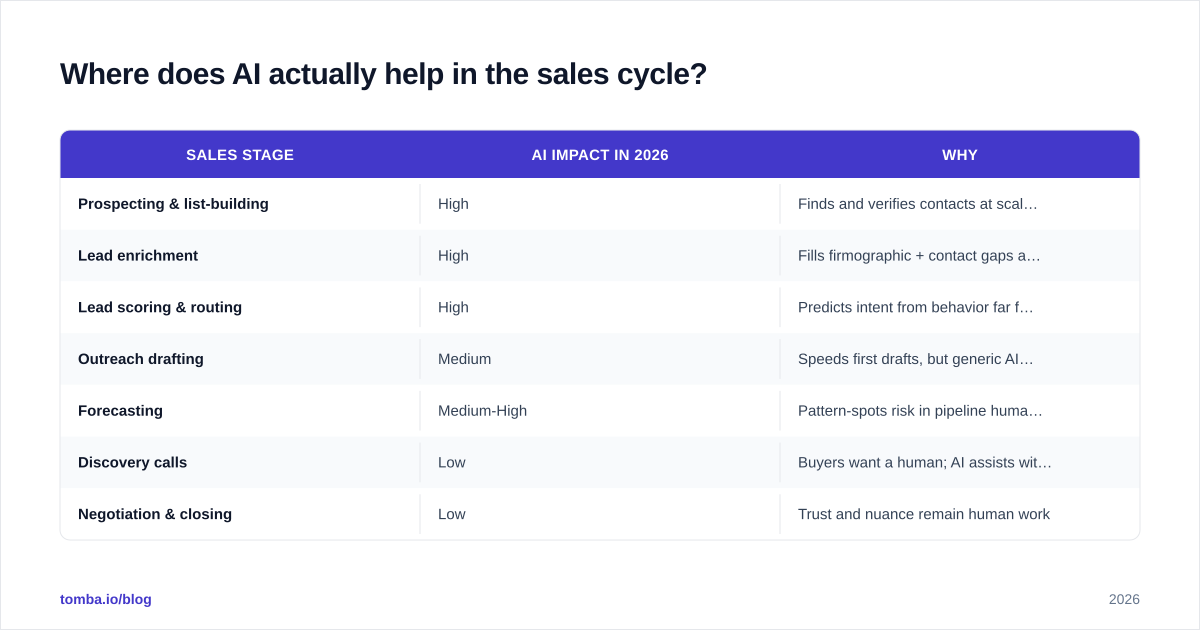
Not everywhere equally. Here is the honest breakdown of where AI earns its keep versus where it is still mostly marketing.
| Sales stage | AI impact in 2026 | Why |
|---|---|---|
| Prospecting & list-building | High | Finds and verifies contacts at scale, cuts hours per list |
| Lead enrichment | High | Fills firmographic + contact gaps automatically |
| Lead scoring & routing | High | Predicts intent from behavior far faster than manual rules |
| Outreach drafting | Medium | Speeds first drafts, but generic AI copy hurts reply rates |
| Forecasting | Medium-High | Pattern-spots risk in pipeline humans miss |
| Discovery calls | Low | Buyers want a human; AI assists with notes, not the conversation |
| Negotiation & closing | Low | Trust and nuance remain human work |
The pattern is clear: AI dominates the top of the funnel and the data layer, assists in the middle, and stays out of the way at the bottom. If a vendor promises AI that closes complex B2B deals end to end, treat it the way you would treat a self-driving car that has never seen a roundabout.
How does AI improve prospecting and data quality?#
This is the highest-ROI use case, and it is worth understanding why. Every downstream AI feature — scoring, personalization, forecasting — is only as good as the contact data feeding it. Feed an LLM a stale list and it will write a confident, personalized email to a person who left the company eighteen months ago.
Modern AI prospecting works in three steps:
- Discovery — identify accounts and roles that match your ICP using firmographic and intent signals.
- Contact finding — locate the actual decision-maker's professional email and phone, then verify it is deliverable.
- Enrichment — append job title, company size, tech stack, and social profiles so reps walk into conversations informed.
This is exactly the layer where an email finder and an email verifier sit. Finding a plausible email address is easy; confirming it will not bounce and torch your sender reputation is the hard part. Tools that combine discovery with real-time verification — checking MX records, catch-all status, and SMTP response — are what separate a clean list from a deliverability disaster. If you are pulling contacts by company, a domain search turns a single URL into a verified org chart of reachable people.
The deliverability link is not optional. A list that is 15 percent invalid will tank your domain reputation within a week of sending, and once that happens, even your good emails land in spam. Understanding email deliverability is what makes AI prospecting safe at scale.
What does an AI sales stack cost in 2026?#
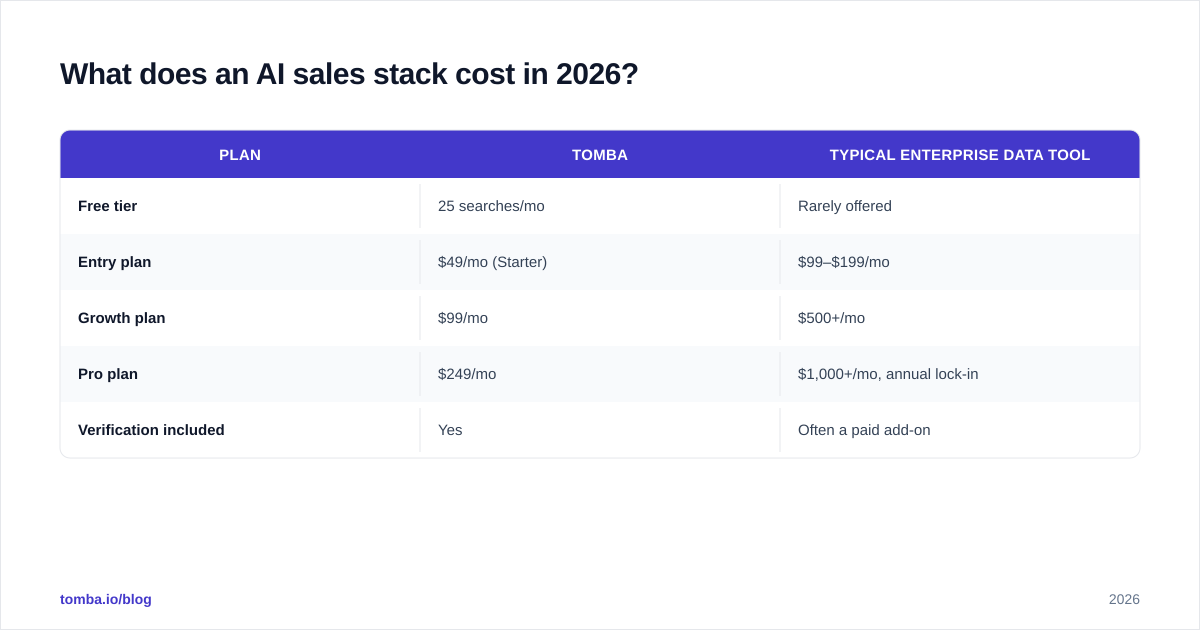
Less than people expect, and far less than the headcount it augments. Here is a representative comparison of the data-and-prospecting layer most teams start with.
| Plan | Tomba | Typical enterprise data tool |
|---|---|---|
| Free tier | 25 searches/mo | Rarely offered |
| Entry plan | $49/mo (Starter) | $99–$199/mo |
| Growth plan | $99/mo | $500+/mo |
| Pro plan | $249/mo | $1,000+/mo, annual lock-in |
| Verification included | Yes | Often a paid add-on |
The math that matters: if an AI prospecting and enrichment stack saves each rep five hours a week, and a rep's fully loaded cost is conservatively $50/hour, that is $1,000 per rep per month in recovered selling time. Against a tool that costs a fraction of that, the payback is not a quarter — it is the first week. You can see the full Tomba pricing breakdown to model your own numbers, and the data enrichment layer is what turns thin lists into rep-ready accounts.
Is AI sales outreach worth it, or does it hurt reply rates?#
Both, depending on how you use it. This is the most misunderstood corner of AI in sales.
Generic AI-written cold email is a net negative. Buyers in 2026 can smell a templated "I noticed your company is doing great things in [industry]" opener instantly, and it signals low effort. The result is lower reply rates than a thoughtful human email — sometimes worse than no email at all.
What works is AI-assisted, not AI-authored outreach:
- Use AI to research the prospect and surface a genuine, specific hook (a recent funding round, a product launch, a job posting).
- Let the rep write the actual message, using AI to tighten the draft and check tone.
- Use AI to handle the mechanical scale — sequencing, send timing, follow-up reminders — not the creative core.
The deliverability mechanics still apply. Even a perfectly written email fails if it lands in spam. Pair your outreach with sender-reputation hygiene and verified recipients; a clean list plus a human voice beats an AI-generated blast every time. For the research-to-contact step, pulling a verified address from a LinkedIn finder keeps your prospecting grounded in real people rather than guessed patterns.
How accurate is AI lead scoring and forecasting?#
More accurate than manual rules, but only with enough clean data behind it. AI lead scoring works by learning which past behaviors and attributes correlated with closed deals, then ranking new leads against that pattern. It is genuinely good at this — far better than a static "MQL if they downloaded two PDFs" rule that a human dreamed up in a meeting.
The caveats:
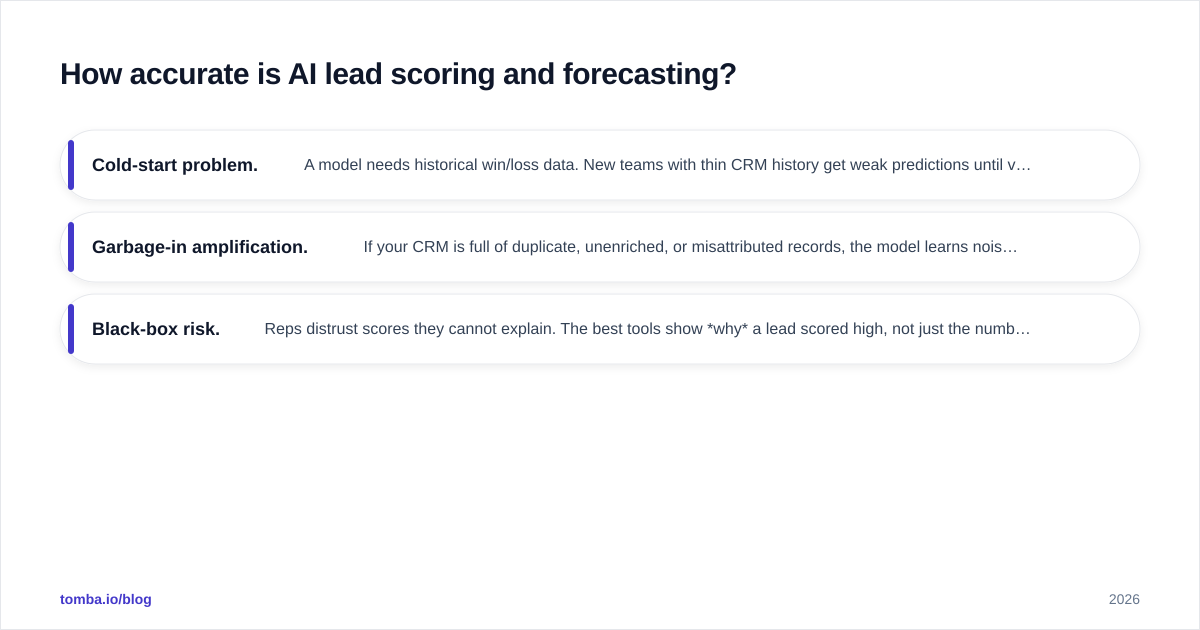
- Cold-start problem. A model needs historical win/loss data. New teams with thin CRM history get weak predictions until volume builds.
- Garbage-in amplification. If your CRM is full of duplicate, unenriched, or misattributed records, the model learns noise. This is why deduplication and enrichment matter before you turn on scoring.
- Black-box risk. Reps distrust scores they cannot explain. The best tools show why a lead scored high, not just the number.
For forecasting, AI shines at flagging at-risk deals — spotting that a "commit" deal has had no buyer activity in three weeks, something a busy manager misses across forty open opportunities. Independent analysts like Gartner have tracked steady gains in forecast accuracy as AI-assisted pipeline review has matured. Treat AI forecasts as a second opinion that never gets tired, not as gospel.
What are the risks and limits of AI in sales?#
Worth naming plainly, because the hype skips them.
- Data privacy and compliance. Scraping and enriching contact data has legal limits (GDPR, CCPA). Use vendors transparent about their data sources and consent posture.
- Hallucinated contacts. LLMs will confidently invent an email format if asked. Always verify before sending — guessing is not finding.
- Over-automation. Automate the human out of discovery and you lose the relationship that closes the deal. Keep AI in the back office.
- Model drift. Buyer behavior changes; a scoring model trained on 2024 patterns degrades. Retrain and audit regularly.
- Rep adoption. The best tool is worthless if reps do not trust it. Roll out narrow, show the time saved, then expand.
The teams that get burned are the ones that bought a flashy "autonomous AI SDR" and pointed it at a dirty database. The teams that win bought a sharp tool for one painful step, fed it clean verified data, and grew from there.
How do I start with AI in sales without overcommitting?#
Start with the data layer, because it is the foundation everything else stands on. A simple, low-risk path:
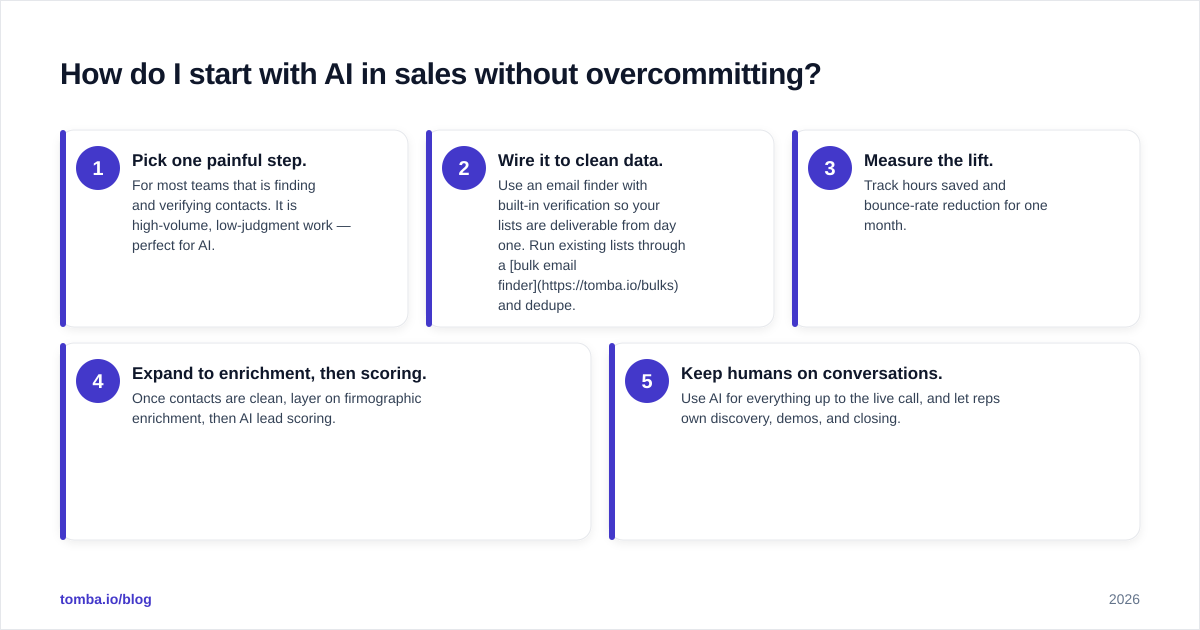
- Pick one painful step. For most teams that is finding and verifying contacts. It is high-volume, low-judgment work — perfect for AI.
- Wire it to clean data. Use an email finder with built-in verification so your lists are deliverable from day one. Run existing lists through a bulk email finder and dedupe.
- Measure the lift. Track hours saved and bounce-rate reduction for one month.
- Expand to enrichment, then scoring. Once contacts are clean, layer on firmographic enrichment, then AI lead scoring.
- Keep humans on conversations. Use AI for everything up to the live call, and let reps own discovery, demos, and closing.
This sequencing matters because each step makes the next one work better. Scoring on enriched data beats scoring on raw data. Outreach to verified contacts beats outreach to guessed ones. You are building a foundation, not bolting on gadgets.
The bottom line#
AI in sales in 2026 is real, useful, and profitable — when you point it at the right problems. It is a copilot for the data-heavy, repetitive work at the top of the funnel, and a quiet analyst watching your pipeline for risk. It is not a replacement for the rep who builds trust and closes the deal. Buy it for what it is good at, feed it clean data, and keep your humans where humans win.
The fastest, lowest-risk place to start is the contact-data layer. Tomba's email finder finds professional email addresses by name, company, or domain and verifies them in the same step — so the AI you layer on top is working from real, deliverable contacts instead of guesses. Start on the free tier with 25 searches a month, prove the time savings, and scale into enrichment and bulk workflows when you are ready. Clean data first; everything else AI does gets better from there.
// get started
Find, verify and enrich your first contacts today
Start on the free plan with 25 searches a month, then scale when your team is ready.
Free plan · No credit card required · GDPR & CCPA
// about the author