AI in Sales and Marketing: The 2026 Playbook for Revenue Teams
AI in sales and marketing has moved from hype to pipeline. Here's where it actually works in 2026, a tool comparison, ROI benchmarks, and a rollout plan you can run this quarter.
TL;DR
- AI in sales and marketing is no longer experimental — in 2026 it runs lead scoring, enrichment, copy drafting, and forecasting inside most mid-market GTM stacks.
- The biggest wins are unglamorous: cleaning and enriching data, prioritizing the right accounts, and removing manual research from a rep's day.
- AI does not replace SDRs or marketers. It compresses the busywork so humans spend time on judgment, relationships, and offers.
- Tool sprawl is the real risk. Pick AI that plugs into your CRM and data layer instead of adding ten disconnected point solutions.
- Start with one measurable use case (data enrichment or scoring), prove ROI in 60 days, then expand.
What does "AI in sales and marketing" actually mean in 2026?#
The short version: AI in sales and marketing means using machine learning and large language models to do the research, prioritization, drafting, and analysis that used to eat your team's calendar.
Think of it like power tools on a construction site. A hammer still needs a carpenter, but a nail gun lets that carpenter frame ten houses in the time one used to take. AI is the nail gun. Your reps and marketers are still the carpenters deciding what gets built and for whom.
In practice, the term covers a few distinct layers that often get blended together in vendor pitches:
- Generative AI — drafting cold emails, ad copy, landing pages, call summaries, and follow-ups.
- Predictive AI — scoring leads, forecasting deals, and flagging churn risk before it shows up in revenue.
- Data/enrichment AI — finding and validating contact data, deduplicating records, and filling gaps in your CRM.
- Conversational AI — chatbots, voice agents, and meeting copilots that capture and route intent in real time.
Most teams already touch all four without calling it "AI." The shift in 2026 is that these layers now talk to each other, and the data quality underneath them finally matters enough that buyers ask about it first.
Where is AI genuinely useful versus overhyped?#
Conclusion first: AI delivers the most reliable ROI on data and prioritization, solid ROI on content drafting, and the shakiest ROI on fully autonomous selling.
Here's the honest breakdown by function.
Marketing wins
- Generating first drafts of ad variants, subject lines, and nurture emails at volume.
- Segmenting audiences and predicting which content a segment will convert on.
- Summarizing campaign performance and suggesting reallocation across channels.
Sales wins
- Enriching inbound leads instantly so reps don't waste time on manual lookups.
- Scoring and routing leads by fit and intent instead of by gut feel.
- Auto-summarizing calls, updating the CRM, and drafting the follow-up before the rep leaves the meeting.
Still overhyped
- "Autonomous AI SDRs" that book qualified meetings with zero human review. They send volume, but reply quality and deliverability suffer when nobody supervises.
- AI that promises perfect forecasts. It improves the inputs; it does not see the future.
The pattern is consistent. AI is excellent at the narrow, repetitive, data-heavy tasks and weak at the open-ended, relationship-driven ones. Use it accordingly.
)
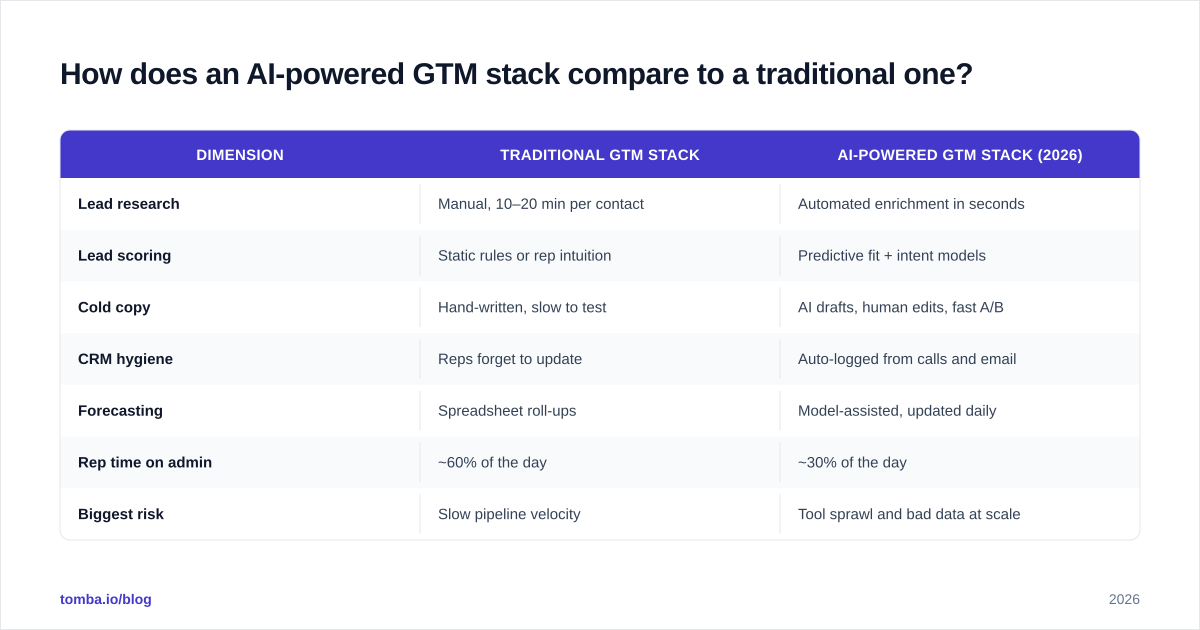
How does an AI-powered GTM stack compare to a traditional one?#
The difference is less about new headcount and more about where your existing team spends its hours. A traditional stack burns time gathering and cleaning data. An AI stack pushes that to the background and frees the human for the parts buyers actually care about.
| Dimension | Traditional GTM stack | AI-powered GTM stack (2026) |
|---|---|---|
| Lead research | Manual, 10–20 min per contact | Automated enrichment in seconds |
| Lead scoring | Static rules or rep intuition | Predictive fit + intent models |
| Cold copy | Hand-written, slow to test | AI drafts, human edits, fast A/B |
| CRM hygiene | Reps forget to update | Auto-logged from calls and email |
| Forecasting | Spreadsheet roll-ups | Model-assisted, updated daily |
| Rep time on admin | ~60% of the day | ~30% of the day |
| Biggest risk | Slow pipeline velocity | Tool sprawl and bad data at scale |
The last row matters most. AI does not fix bad data — it accelerates it. If you feed an AI scoring model a CRM full of duplicates and dead emails, you get confident, fast, wrong decisions. That is why data quality, not the model, is the real bottleneck. Clean inputs with a reliable email verifier and enrichment layer before you trust any prediction on top of them.
Which AI sales and marketing tools should you actually compare?#
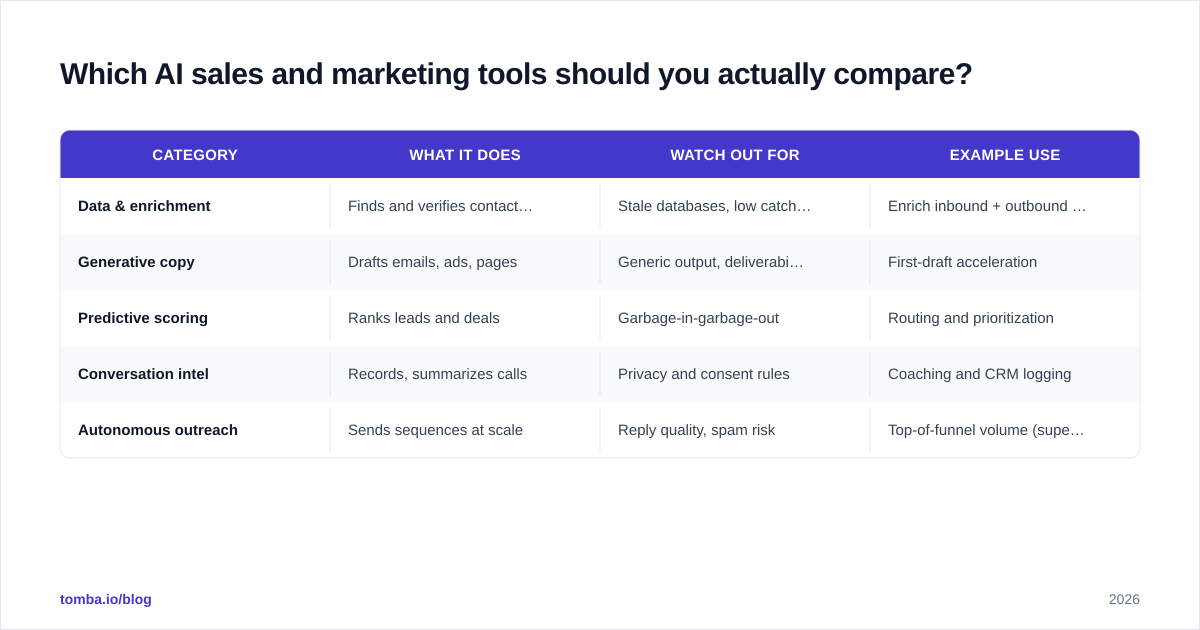
There is no single "AI sales platform" that does everything well. The smart move is to map tools to the four layers above and check how cleanly they integrate. Below is a category-level comparison to frame your shortlist — evaluate specific vendors on G2 before committing.
| Category | What it does | Watch out for | Example use |
|---|---|---|---|
| Data & enrichment | Finds and verifies contacts, fills CRM gaps | Stale databases, low catch-all accuracy | Enrich inbound + outbound lists |
| Generative copy | Drafts emails, ads, pages | Generic output, deliverability hits | First-draft acceleration |
| Predictive scoring | Ranks leads and deals | Garbage-in-garbage-out | Routing and prioritization |
| Conversation intel | Records, summarizes calls | Privacy and consent rules | Coaching and CRM logging |
| Autonomous outreach | Sends sequences at scale | Reply quality, spam risk | Top-of-funnel volume (supervised) |
When you evaluate the data layer specifically, accuracy and freshness beat raw database size every time. A provider with 500 million records that are two years stale is worse than a smaller, continuously validated source. Ask any vendor where their data sources come from and how often records are re-verified — if they dodge the question, move on.
For teams already running HubSpot or Salesforce, prioritize tools with native integrations so enriched data flows into the system of record automatically instead of living in yet another silo.
How do you measure ROI on AI in sales and marketing?#
Pick metrics you already track, then attribute the delta. Vanity stats like "emails generated" prove nothing. Tie AI to pipeline and time saved.
A practical scorecard:
- Speed-to-lead — minutes from form fill to first touch. AI enrichment and routing should cut this sharply.
- Reply and meeting rates — measured against a human-only control group, not against zero.
- Rep selling time — percentage of the day spent in conversations versus admin.
- Data accuracy — bounce rate and CRM duplicate rate before and after.
- Forecast accuracy — variance between predicted and actual close, tracked over quarters.
Run AI as an experiment, not a religion. Keep a control cohort for at least one full sales cycle. If the AI-assisted group doesn't beat the control on a metric that matters, kill that use case and reinvest the budget. The teams that win with AI are the ones disciplined enough to measure it like any other channel — the same way you'd track response rate on a cold campaign.
)
What are the risks and how do you avoid them?#
Three risks sink most AI rollouts. None are about the technology being "too smart."
1. Deliverability collapse. When AI lets you send 10x the volume, spam traps and bounces scale with you. Protect your domain reputation: verify every address, warm up sending, and never blast unverified lists. Good email deliverability discipline is what separates a working AI outbound motion from a blacklisted domain.
2. Generic, detectable copy. Buyers can smell a mass-AI email. Use AI for the first draft and structure, then add the specific, human detail — a real trigger event, a relevant number, a genuine reason for reaching out. AI gets you to 70%; the last 30% is what earns the reply.
3. Tool sprawl and data fragmentation. Ten AI point solutions that don't share data create more cleanup work than they remove. Anchor your stack on a clean data layer and a single CRM of record, then add AI on top — not the reverse.
There's also a governance layer: respect privacy laws (GDPR, CCPA), get consent for call recording, and keep a human in the loop on anything customer-facing. Regulators and buyers both reward teams that use AI transparently.
How should you roll out AI without blowing up your stack?#
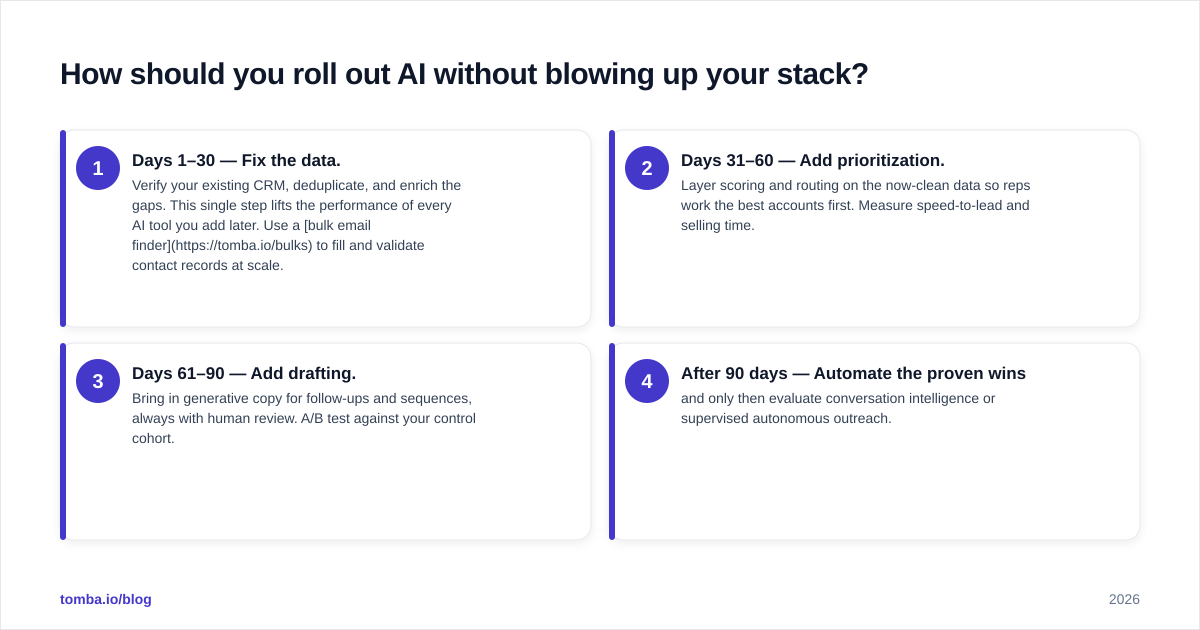
Start narrow, prove value, expand. The teams that fail try to "transform GTM with AI" in one quarter. The teams that win ship one use case at a time.
A 90-day sequence that works:
- Days 1–30 — Fix the data. Verify your existing CRM, deduplicate, and enrich the gaps. This single step lifts the performance of every AI tool you add later. Use a bulk email finder to fill and validate contact records at scale.
- Days 31–60 — Add prioritization. Layer scoring and routing on the now-clean data so reps work the best accounts first. Measure speed-to-lead and selling time.
- Days 61–90 — Add drafting. Bring in generative copy for follow-ups and sequences, always with human review. A/B test against your control cohort.
- After 90 days — Automate the proven wins and only then evaluate conversation intelligence or supervised autonomous outreach.
Notice that generative AI — the flashiest layer — comes third, not first. Data and prioritization create the foundation that makes the generative stuff actually convert. Skip the foundation and you're just producing polished messages to the wrong people faster.
What's next for AI in sales and marketing?#
Three shifts are already underway heading into the back half of 2026:
- Agentic workflows — AI that chains tasks (research a lead, draft an email, log the activity, schedule the follow-up) instead of doing one step. Still needs supervision, but the orchestration is maturing fast.
- Unified data layers — the winning stacks consolidate enrichment, verification, and intent into one clean source feeding every AI on top.
- Buyer-side AI — your prospects now use AI to filter outreach. Generic sequences get auto-archived. Relevance and signal beat volume more decisively than ever.
The throughline across all of it: AI raises the floor on speed and lowers the tolerance for sloppiness. The teams that pair fast AI with clean data and real human judgment pull ahead. The teams that automate noise just create more noise, faster.
Start with the data layer#
If you take one thing from this playbook: AI in sales and marketing is only as good as the data underneath it. Before you buy another AI copilot, make sure the contacts feeding it are real, current, and complete.
That's where Tomba Email Finder fits. It finds professional email addresses by domain, name, or company, verifies them, and pushes clean records straight into your CRM and AI stack — so every model and message downstream runs on data you can trust. Start free with 25 searches a month, and scale up on the Starter plan at $49/mo once you've proven the lift. Build the foundation first; let the AI do the rest.
Ready to find emails that actually work?
Join 150,000+ professionals who stopped guessing and started sending. Free credits on signup — no credit card required.
Get the Tomba newsletter
Practical outbound tactics and product updates — once every two weeks.
About the author