AI in Sales Cadences: A 2026 Guide to Smarter Outreach
AI in sales cadences is shifting outreach from rigid day-by-day templates to adaptive sequences that personalize, time, and route every touch. Here's how to build one in 2026.
AI in Sales Cadences: A 2026 Guide to Smarter Outreach
Most sales teams still run cadences the same way they did in 2018: a fixed list of seven to nine touches, spaced across two weeks, sent to everyone in the sequence regardless of who they are or how they behave. AI in sales cadences changes that. Instead of a static script, you get a sequence that reads signals, rewrites copy per prospect, picks send times, and decides who gets a call versus another email — automatically.
This guide breaks down what an AI-driven cadence actually is, where it helps (and where it doesn't), how to build one, and how to pick tools without lighting your budget on fire.
TL;DR#
- AI in sales cadences means using machine learning and LLMs to personalize copy, time touches, route channels, and prioritize prospects inside an outreach sequence — not just automate sends.
- The biggest wins are in personalization at scale and timing, not replacing reps. Teams report higher reply rates when AI drafts the first version and a human edits.
- A modern cadence is signal-driven: it reacts to opens, replies, site visits, and job changes instead of firing on a fixed calendar.
- Data quality decides everything. An AI cadence built on stale or unverified contacts amplifies your bounce rate. Clean, verified data is the prerequisite.
- Start small: pick one segment, one channel mix, and measure reply rate and meetings booked before scaling.
What is an AI sales cadence?#
A sales cadence is the scheduled series of touchpoints — emails, calls, LinkedIn messages, voicemails — a rep uses to reach a prospect. An AI sales cadence layers automation and machine intelligence on top of that schedule so the sequence adapts to each prospect rather than treating them identically.
Think of it like the difference between a paper map and a GPS. A paper map gives everyone the same route. GPS reroutes around traffic, recalculates when you miss a turn, and adjusts the arrival estimate in real time. A traditional cadence is the map; an AI cadence is the GPS.
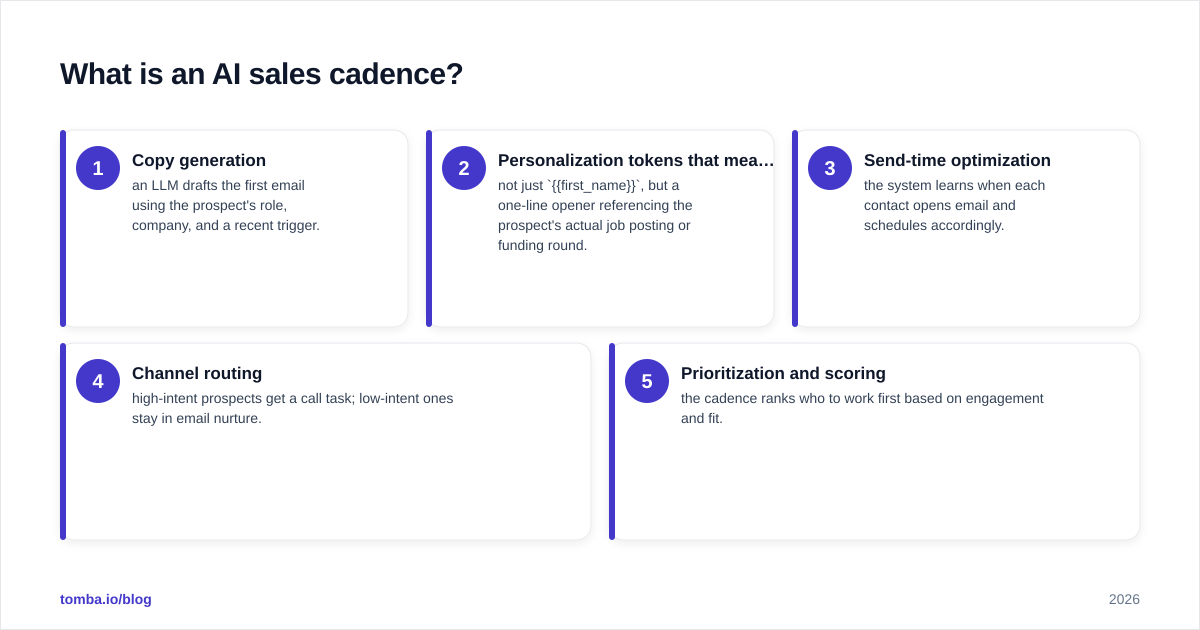
Concretely, "AI in sales cadences" usually shows up in five places:
- Copy generation — an LLM drafts the first email using the prospect's role, company, and a recent trigger.
- Personalization tokens that mean something — not just
{{first_name}}, but a one-line opener referencing the prospect's actual job posting or funding round. - Send-time optimization — the system learns when each contact opens email and schedules accordingly.
- Channel routing — high-intent prospects get a call task; low-intent ones stay in email nurture.
- Prioritization and scoring — the cadence ranks who to work first based on engagement and fit.
This is distinct from plain sales automation, which simply executes predefined steps on schedule. AI adds a feedback loop: the cadence observes outcomes and changes its own behavior.
)
Why are static cadences failing in 2026?#
Reply rates on generic cold sequences have been sliding for years, and the reasons compound:
- Inbox saturation. The average B2B buyer gets more cold email than ever. Templated "I noticed you're the VP of..." openers are pattern-matched and ignored.
- Spam filters got smarter. Gmail and Outlook now weight engagement heavily. A cadence that blasts the same copy to 500 people generates low engagement, which tanks deliverability for everyone on the domain.
- Buyers expect relevance. According to HubSpot's sales research, personalization and timing consistently rank among the strongest drivers of response. Generic outreach reads as noise.
A static cadence can't fix any of this because it has no mechanism to adapt. It sends touch four on day six whether or not the prospect already replied "not interested" or visited your pricing page twice. AI cadences close that gap by making each step conditional on what the prospect actually did.
How does AI improve each part of a cadence?#
Here's where the intelligence actually moves the needle, step by step.
Research and personalization. Before AI, a rep spent five to ten minutes researching each prospect to write one good line. AI compresses that to seconds by pulling role, company news, tech stack, and recent triggers, then drafting an opener. The rep's job shifts from writing to editing — faster and more consistent. The catch: AI-written openers still need a human pass. Unedited, they drift into the same bland phrasing across hundreds of prospects.
Timing. Send-time optimization models learn per-contact open patterns. Someone who opens at 6:40 a.m. gets your email at 6:35. Multiply across a list and you recover meaningful reply lift with zero extra effort.
Channel orchestration. AI scoring decides the mix. A prospect who opened three emails and clicked a link is worth a call; the system creates that task automatically and demotes cold contacts to a lighter nurture track. This stops reps from burning call time on unresponsive leads.
Reply handling. Modern tools classify replies — interested, objection, out-of-office, unsubscribe — and route them. Out-of-office replies pause the cadence and reschedule; objections surface to the rep with suggested responses.
The throughline: AI doesn't replace the cadence structure, it makes each node smarter and conditional.
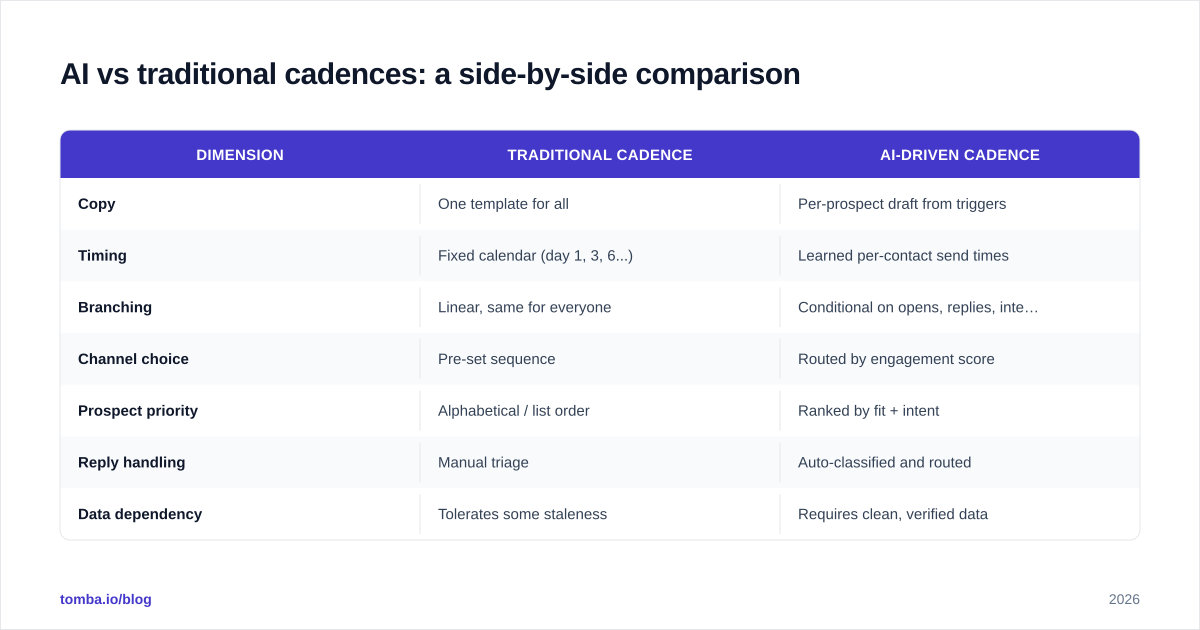
AI vs traditional cadences: a side-by-side comparison#
| Dimension | Traditional cadence | AI-driven cadence |
|---|---|---|
| Copy | One template for all | Per-prospect draft from triggers |
| Timing | Fixed calendar (day 1, 3, 6...) | Learned per-contact send times |
| Branching | Linear, same for everyone | Conditional on opens, replies, intent |
| Channel choice | Pre-set sequence | Routed by engagement score |
| Prospect priority | Alphabetical / list order | Ranked by fit + intent |
| Reply handling | Manual triage | Auto-classified and routed |
| Data dependency | Tolerates some staleness | Requires clean, verified data |
| Setup effort | Low | Moderate (needs signals + integration) |
The table makes the trade-off clear: AI cadences win on relevance and efficiency but demand better data and a bit more setup. That last row matters most — and it's the one teams skip.
Does AI cadence quality depend on your data?#
Yes — completely. This is the single biggest failure point, so it's worth being blunt about it.
An AI cadence is a multiplier. If you feed it accurate, verified contacts, it multiplies good outcomes: relevant copy reaching real inboxes. If you feed it a list scraped six months ago with guessed email patterns, it multiplies the bad: personalized, perfectly-timed messages bouncing off dead addresses and dragging your sender reputation down with them.
Three data prerequisites before you turn on any AI cadence:
- Verified email addresses. Run every contact through an email verifier so you're not sending into traps or dead boxes. A 3% bounce rate is the rough ceiling before mailbox providers start throttling you.
- Accurate role and company data. AI personalization is only as good as the inputs. Wrong title, wrong opener.
- Fresh enrichment. People change jobs constantly. Data enrichment keeps role, company, and contact fields current so triggers fire on real events.
If you're sourcing net-new contacts to feed the cadence, the cleanest path is finding addresses directly from the company domain rather than buying aging lists. An email finder that returns a confidence score lets you filter to high-certainty contacts before they ever enter a sequence.
)
What tools power AI in sales cadences?#
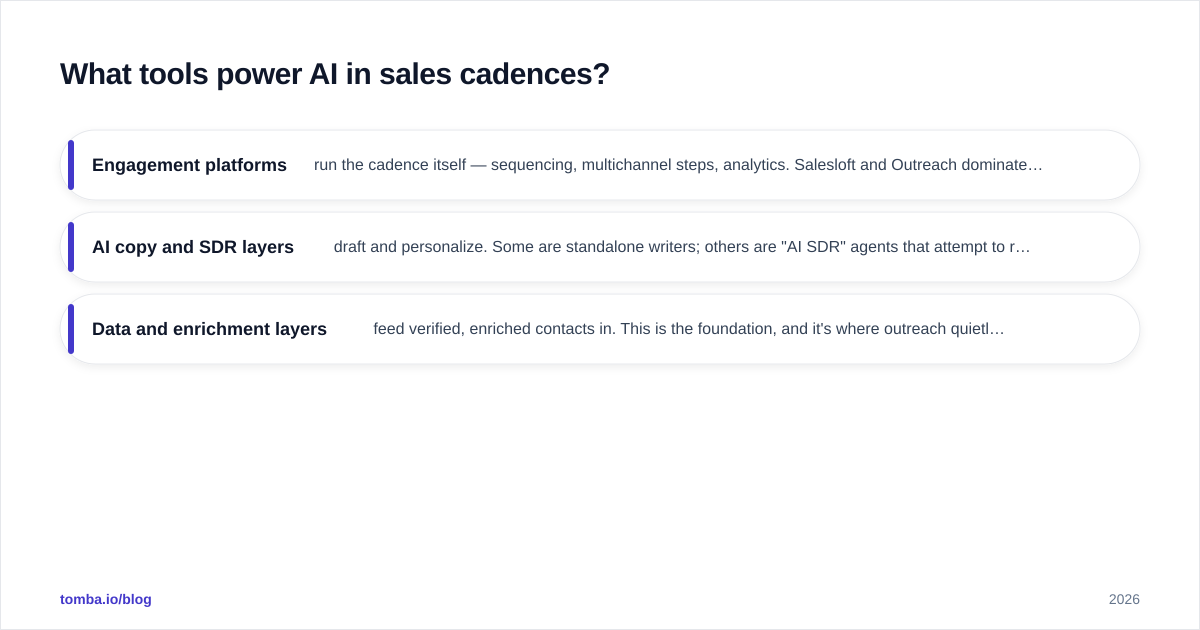
The landscape splits into three layers, and most teams stitch together one from each.
- Engagement platforms run the cadence itself — sequencing, multichannel steps, analytics. Salesloft and Outreach dominate the enterprise tier; their AI features now include reply classification and send-time optimization.
- AI copy and SDR layers draft and personalize. Some are standalone writers; others are "AI SDR" agents that attempt to run the whole sequence autonomously.
- Data and enrichment layers feed verified, enriched contacts in. This is the foundation, and it's where outreach quietly succeeds or fails.
For a sense of where the category is heading, analyst coverage from Gartner tracks the consolidation of these layers into unified revenue platforms — but for most teams in 2026, a best-of-breed stack still wins on flexibility and cost.
A note on "AI SDR" agents: they're improving fast, but fully autonomous cadences still tend to over-send and under-personalize without supervision. The reliable pattern in 2026 is AI drafts, human approves, AI executes timing and routing. Keep a person in the loop on copy and you get the speed without the brand damage.
How do you build an AI sales cadence step by step?#
Here's a practical build sequence you can run this quarter.
Step 1 — Pick one segment. Don't AI-ify everything at once. Choose a single ICP segment with at least 200 contacts so you have enough volume to measure.
Step 2 — Clean the data. Verify every email, confirm titles, enrich missing fields. This is non-negotiable. Source any gaps with a domain-based company email search so you're starting from real, current contacts.
Step 3 — Design the skeleton. Map the touch structure first as a human: e.g., email → email → LinkedIn → call → break-up email across 12 business days. AI personalizes within this skeleton; it doesn't invent the strategy.
Step 4 — Layer in AI copy. Use an LLM to draft openers from one strong trigger per prospect (job change, funding, hiring, tech adoption). Have a rep edit the first 20 to set the voice, then let the model match it.
Step 5 — Turn on timing and routing. Enable send-time optimization and engagement-based branching. Set the rule: score above threshold → call task; below → continue email.
Step 6 — Add reply intelligence. Auto-classify replies so objections and interested signals surface immediately and out-of-office responses reschedule.
Step 7 — Measure and iterate. Track reply rate, positive reply rate, meetings booked, and bounce rate. Compare against your old static cadence as the control. Scale only what beats it.
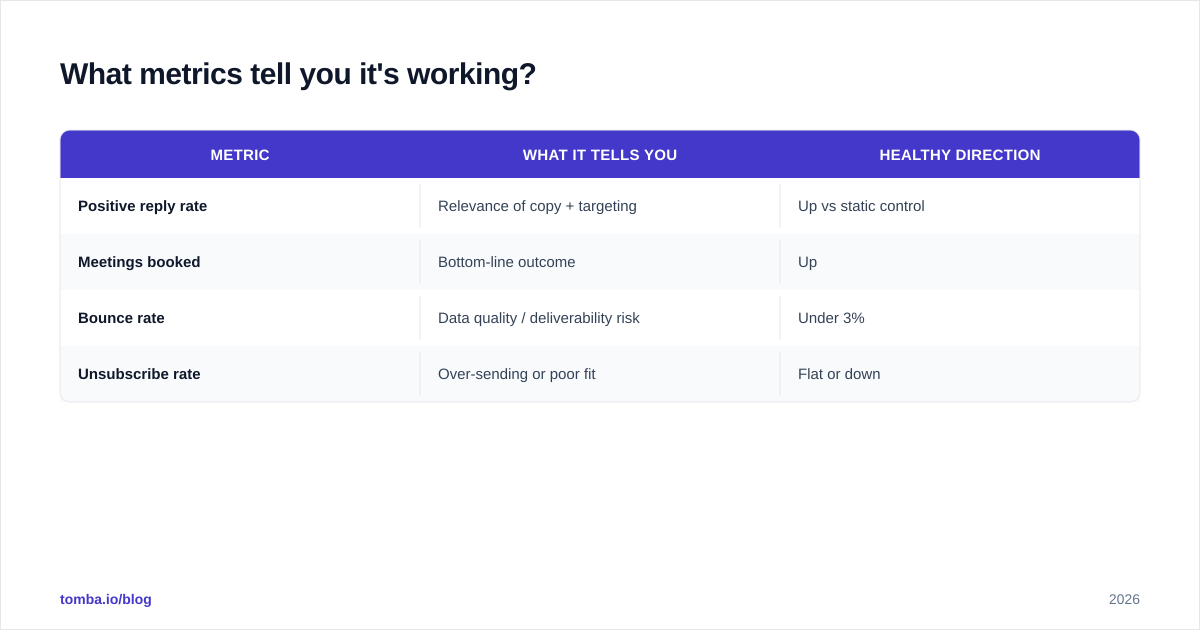
What metrics tell you it's working?#
Watch four numbers, in priority order:
| Metric | What it tells you | Healthy direction |
|---|---|---|
| Positive reply rate | Relevance of copy + targeting | Up vs static control |
| Meetings booked | Bottom-line outcome | Up |
| Bounce rate | Data quality / deliverability risk | Under 3% |
| Unsubscribe rate | Over-sending or poor fit | Flat or down |
Positive reply rate is the truth-teller. Total reply rate can rise from annoyance ("stop emailing me"), so segment replies by sentiment. If positive replies and meetings climb while bounces and unsubscribes stay flat, the cadence is working. If bounces creep up, stop and fix data before scaling — no amount of AI copy survives a bad list.
What are the common mistakes to avoid?#
- Skipping verification. The number-one killer. AI amplifies whatever data you give it.
- Full autonomy too soon. Letting an AI agent send unsupervised in week one. Earn trust with a human-approval gate first.
- Over-personalization theater. Stuffing five "personalized" lines into one email reads as creepy, not relevant. One sharp, true line beats five generic-personalized ones.
- Ignoring the skeleton. Treating AI as the strategy instead of the executor. You still need a deliberate touch structure and channel mix.
- No control group. Rolling out AI cadences everywhere with nothing to compare against, so you can't prove lift.
Avoid these five and you're ahead of most teams adopting AI outreach this year.
The bottom line#
AI in sales cadences is not about removing reps from the loop — it's about removing the busywork so reps spend their time on the prospects most likely to convert, with copy that's relevant and timing that's smart. The strategy stays human. The execution gets intelligent. And none of it works without clean, verified contact data underneath.
That's the part you control before you spend a dollar on AI tooling. Start your outreach on accurate, confidence-scored contacts pulled straight from company domains with the Tomba Email Finder — find real decision-maker emails, verify them in the same workflow, and feed your AI cadence the one input that makes everything else perform. Compare Tomba pricing (free tier with 25 searches, Starter at $49/mo) and build your next cadence on data you can trust.
// get started
Find, verify and enrich your first contacts today
Start on the free plan with 25 searches a month, then scale when your team is ready.
Free plan · No credit card required · GDPR & CCPA
// about the author