AI Lead Gen in 2026: Tools, Workflows & Real Tactics
AI lead gen promises pipeline on autopilot. Here's what actually works in 2026 — the workflow, the tool stack, and where AI still needs a human.
TL;DR
- AI lead gen is not "set it and forget it." It compresses the boring 80% — research, scoring, enrichment, list-building — so your reps spend time on conversations, not spreadsheets.
- The biggest wins come from three layers working together: signal capture (intent + visitor data), scoring (ranking who to contact), and enrichment (turning a name into a reachable contact).
- Data quality decides everything. An AI model fed stale or fake emails just sends bad outreach faster.
- A realistic 2026 stack costs far less than one SDR's monthly salary and runs in the background.
- Tools change; the workflow doesn't. Capture signal, score it, enrich it, verify it, then let a human write the first line.
What is AI lead gen, really?#
AI lead gen is using machine learning to find, rank, and prepare prospects so your team talks to the right people first. Think of it like a metal detector on a beach. You could dig every square foot by hand, or you could sweep first and dig only where it beeps. AI is the sweep — it tells you where the buying signals are buzzing so you stop wasting shovel time on cold sand.
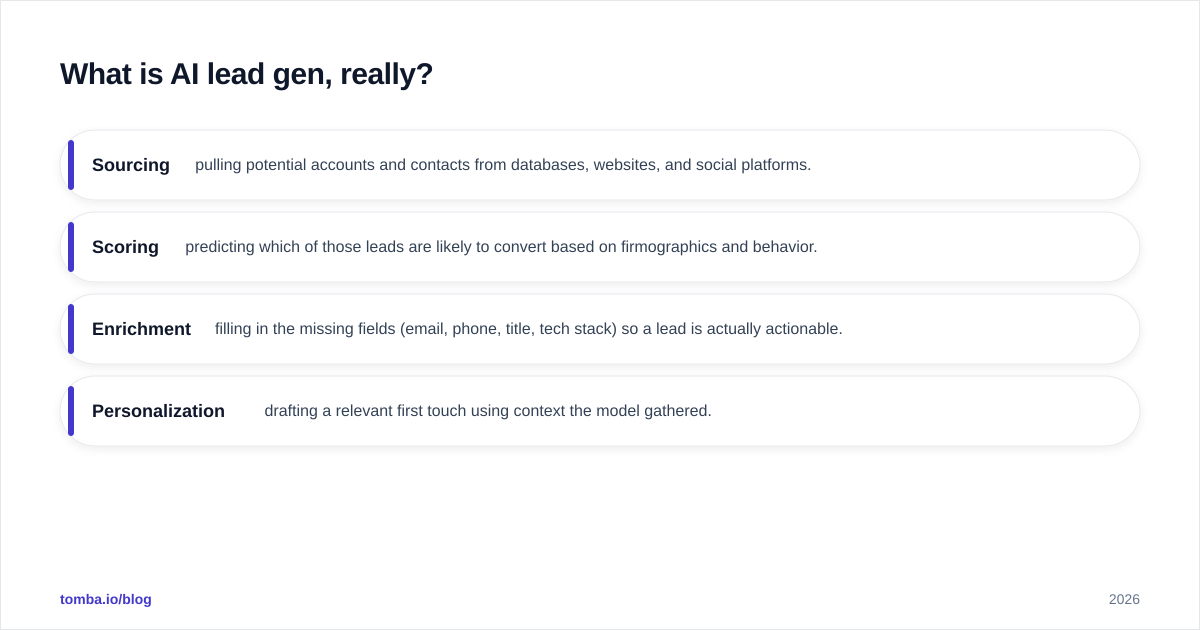
Technically, "AI lead gen" bundles a few distinct jobs that used to be separate manual tasks:
- Sourcing — pulling potential accounts and contacts from databases, websites, and social platforms.
- Scoring — predicting which of those leads are likely to convert based on firmographics and behavior.
- Enrichment — filling in the missing fields (email, phone, title, tech stack) so a lead is actually actionable.
- Personalization — drafting a relevant first touch using context the model gathered.
None of these are new ideas. What changed by 2026 is that each step is now fast, cheap, and chainable through APIs. According to Gartner research on sales tech, the teams pulling ahead aren't the ones with the most tools — they're the ones who connected a few tools into one clean flow.
Why does AI lead gen matter in 2026?#
Because the cost of a wrong guess went up. Inbox providers got stricter, buyers got noisier, and a sloppy list now tanks your sender reputation instead of just wasting a few minutes. AI lead gen matters because it moves effort from volume to precision.
Here's the shift in plain numbers. A traditional SDR might research 25–40 accounts a day by hand. A well-built AI pipeline can surface, score, and enrich thousands overnight, then hand the rep a short list of the 30 that actually deserve a human. The rep's job stops being "find someone" and becomes "say something worth reading."
That precision compounds. Better targeting means higher reply rates, higher reply rates mean better deliverability, and better deliverability means your future emails land too. It's a flywheel — or a death spiral if you feed it garbage. Which brings us to the part most "AI lead gen" pitches skip.
Where does AI lead gen actually break?#
It breaks at data. Every time.
An AI scoring model is only as smart as the records it reads. If your enrichment source guesses an email with a pattern-matcher and never verifies it, you get a confident-looking lead that bounces. Multiply that by a few thousand and the model has now optimized you straight into a spam folder. The model didn't fail — the fuel did.
This is why the unglamorous middle of the pipeline — finding a real email and verifying it's deliverable — is the load-bearing wall. You can swap the AI writer, the CRM, or the sequencer. You cannot swap out "is this address real." A tool like an email verifier sits exactly here, catching the bounces before they ever leave your domain.
The second failure mode is over-automation. AI can draft a first line, but it still hallucinates context, misreads a job title, or congratulates someone on a funding round that was actually a layoff. Treat AI output as a strong draft, never a send-ready final. The human edit is cheap insurance.
What does a modern AI lead gen stack look like?#
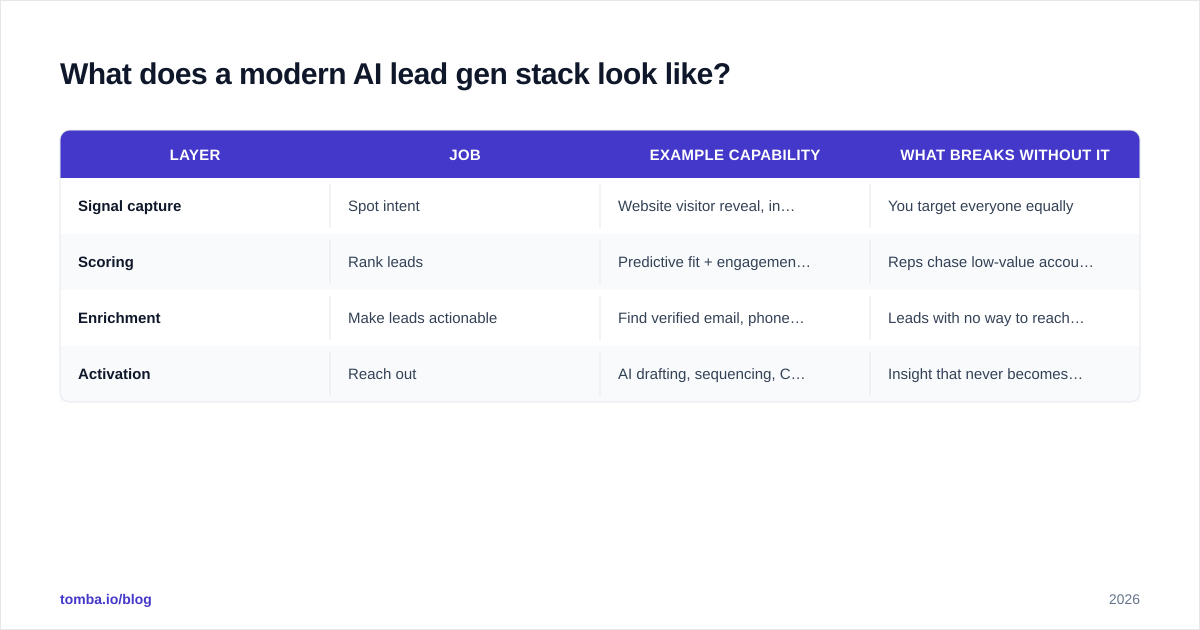
A working stack has four layers. You don't need a separate vendor for each — many tools span two — but every layer has to be covered.
| Layer | Job | Example capability | What breaks without it |
|---|---|---|---|
| Signal capture | Spot intent | Website visitor reveal, intent data, social triggers | You target everyone equally |
| Scoring | Rank leads | Predictive fit + engagement scoring | Reps chase low-value accounts |
| Enrichment | Make leads actionable | Find verified email, phone, title, company data | Leads with no way to reach them |
| Activation | Reach out | AI drafting, sequencing, CRM sync | Insight that never becomes a conversation |
Notice the order. Most teams buy the activation layer first — a shiny AI sequencer — then wonder why results are flat. They automated the last mile while the first three were broken. Build from the left.
For the enrichment layer specifically, the math is simple: you need a name-to-contact engine that returns addresses you can trust. That's the core job of an email finder, and pairing it with verification is what separates a deliverable list from a hopeful one. If you want to enrich an entire account at once rather than one person, domain search pulls every reachable contact at a company in a single query.
How do AI lead gen tools compare?#
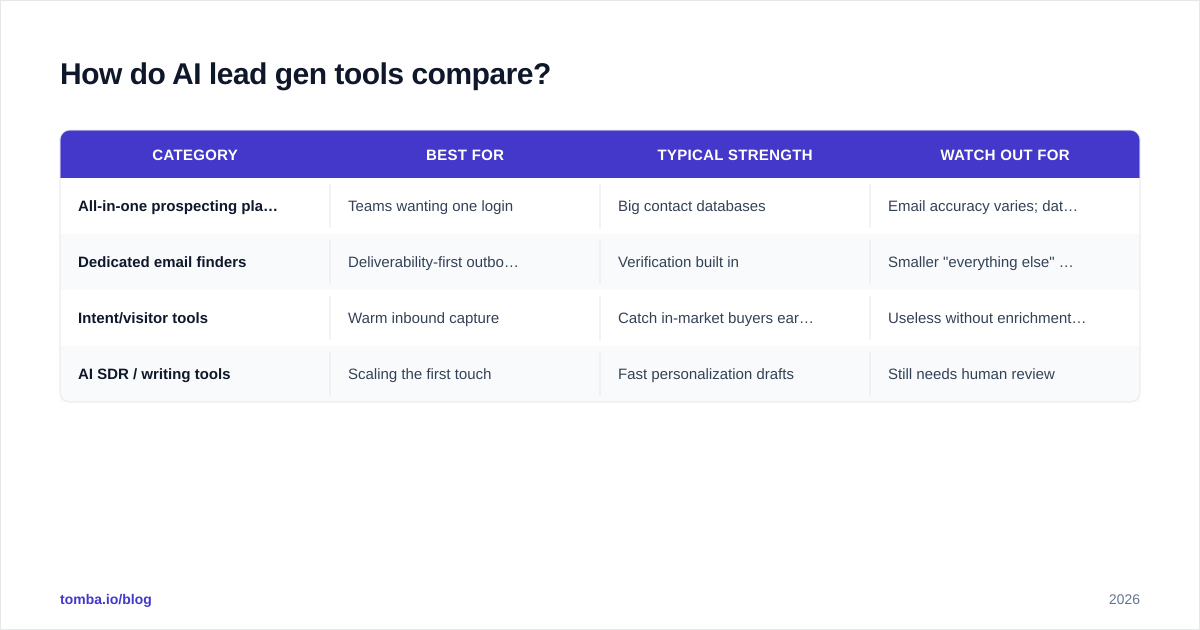
There's no single "best" tool because the layers do different jobs. The honest comparison is by role in the stack, not by brand. Here's how the common categories stack up on the things that actually decide outcomes.
| Category | Best for | Typical strength | Watch out for |
|---|---|---|---|
| All-in-one prospecting platforms | Teams wanting one login | Big contact databases | Email accuracy varies; data ages fast |
| Dedicated email finders | Deliverability-first outbound | Verification built in | Smaller "everything else" feature set |
| Intent/visitor tools | Warm inbound capture | Catch in-market buyers early | Useless without enrichment behind it |
| AI SDR / writing tools | Scaling the first touch | Fast personalization drafts | Still needs human review |
The pattern across every honest review on G2 is the same: buyers rank data accuracy and deliverability above feature count. A platform with 200 features and a 60% valid-email rate loses to a focused tool that returns clean, verified contacts.

A note on price, since it's where "AI lead gen" pitches get slippery. Compare cost per verified, usable contact, not per credit. A cheap plan that returns half-bad data is the expensive one. You can see how transparent per-tier pricing looks on the Tomba pricing page — Free covers 25 searches a month, Starter is $49/mo, and it scales from there without the "call us for a quote" wall on entry tiers.
What's the step-by-step AI lead gen workflow?#
Here's a workflow you can copy this week. It assumes you already know your ideal customer profile (ICP) — AI sharpens targeting, it doesn't invent your strategy.
- Define the trigger. Decide what makes a lead worth contacting now — a new hire in a relevant role, funding, tech-stack change, or a visit to your pricing page. This is your signal.
- Capture accounts that fire the trigger. Use intent data and website visitor reveal to build a raw account list. Don't filter hard yet.
- Score the list. Let your scoring layer rank accounts by ICP fit plus signal strength. Cut the bottom half. Ruthlessly.
- Enrich the survivors. For each account, find the right person and pull a verified email. Run data enrichment to fill title, company size, and other fields your message will reference.
- Verify before you send. Push every address through verification. Drop anything risky or catch-all that you can't confirm. This single step protects your domain.
- Draft, then edit. Let AI write a first line from the enriched context. A human reads it, fixes the one weird sentence, and approves.
- Sync and sequence. Hand the clean, verified, personalized list to your CRM and sequencer. Measure reply rate, not send volume.
The whole loop can run on a schedule. The only manual gates are step 1 (strategy) and step 6 (the human edit) — exactly the two places where judgment beats automation.
Can you automate AI lead gen end to end?#
Mostly, yes — and you should automate the plumbing while keeping humans on the two judgment gates above.
The connective tissue is an API. Instead of exporting CSVs between tools, you wire the enrichment step directly into your pipeline. A request goes out with a name and domain; a verified contact comes back; your scoring and sequencing tools pick it up automatically. The Tomba API is built for exactly this — drop it into a workflow tool like Make or Zapier and your "find + verify" step runs without anyone clicking a button.
For teams not ready to write code, the same outcome is reachable through native integrations. Connecting your finder to HubSpot or your CRM of choice means enriched contacts flow straight into the records your reps already live in. The goal isn't "no humans." It's "no copy-paste."
What you should not fully automate: the send decision on borderline data and the first line of the message. Those are cheap to keep human and expensive to get wrong.
What metrics tell you AI lead gen is working?#
Watch four numbers, in this order:
- Valid-email rate — the share of enriched contacts that verify as deliverable. Below 90% and your data source is the problem, not your copy.
- Reply rate — the real signal of targeting quality. Rising reply rate means scoring and personalization are landing.
- Cost per meeting — total stack spend divided by booked meetings. This is the number that justifies the budget.
- Bounce rate — your early-warning light. A creeping bounce rate means verification is slipping and your domain is at risk.
If reply rate climbs while bounce rate stays low, your AI lead gen engine is healthy. If you're sending more but replies are flat, you automated volume without precision — go back and fix the scoring and enrichment layers before touching the copy.
Is AI lead gen worth it for small teams?#
Yes — arguably more than for big ones. A two-person team can't afford to research by hand, and they can't afford bounced sends wrecking a single shared domain. AI lead gen lets a small team punch at enterprise weight on targeting, as long as they protect data quality.
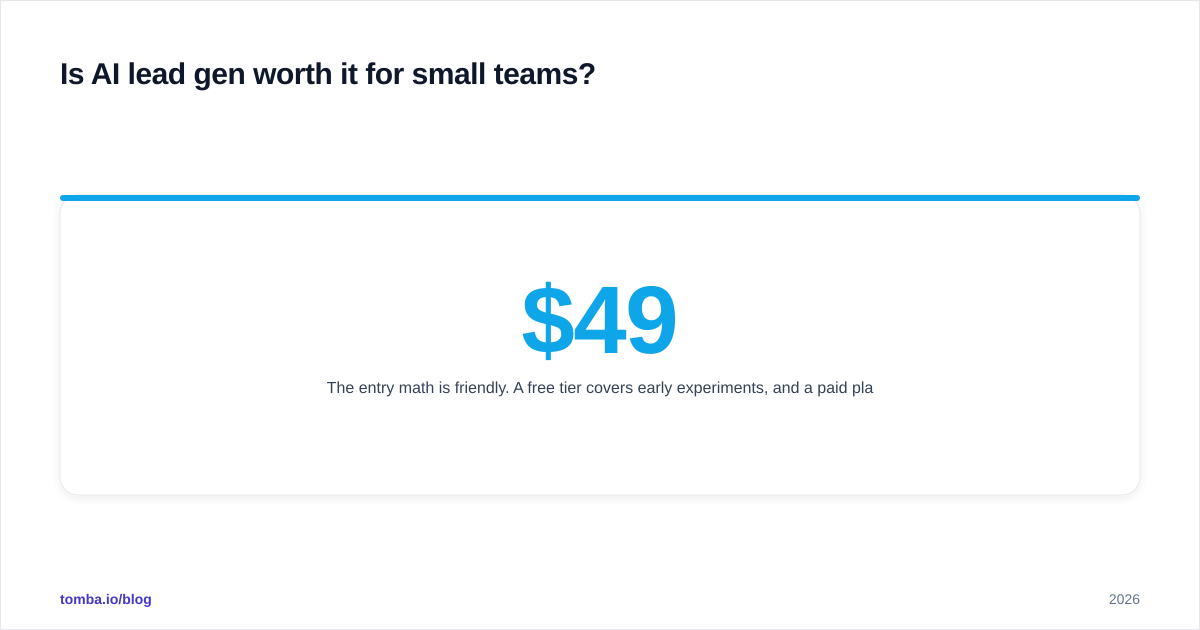
The entry math is friendly. A free tier covers early experiments, and a paid plan in the $49–$99 range handles a serious outbound motion — less than a fraction of one hire's cost. You're not buying an AI miracle; you're renting the boring 80% of the job so your scarce human hours go to selling.
The bottom line#
AI lead gen in 2026 is a precision tool, not a magic faucet. It works when you build from the left — capture real signal, score honestly, enrich with verified data, and keep a human on the first line. It fails the instant you let it run on bad data, because then it just makes mistakes at scale.
Start with the layer that everything else depends on: getting a real, verified contact for the right person. If you nail that, the AI writer and the sequencer downstream have something true to work with. Spin up the Tomba Email Finder on the free tier, wire it into your workflow, and let your reps spend their day on conversations instead of guesswork. Find the person, verify the address, then let AI do the rest.
// get started
Find, verify and enrich your first contacts today
Start on the free plan with 25 searches a month, then scale when your team is ready.
Free plan · No credit card required · GDPR & CCPA
// about the author