AI Lead Generation 2026: Tools, Tactics, and ROI Guide
AI lead generation is no longer a buzzword. Here's how modern teams use AI to source, score, and convert B2B leads in 2026 — with a framework, a tool comparison, and honest ROI math.
TL;DR
- AI lead generation uses machine learning to find, score, enrich, and prioritize prospects automatically — replacing the manual list-building that eats most SDR hours.
- The biggest wins are not "AI writes my cold emails." They are intent detection, predictive scoring, and real-time data enrichment that put the right 50 accounts in front of a rep instead of 5,000 random ones.
- A clean data foundation matters more than the model. Garbage contacts in means confidently wrong scores out.
- Expect 20-40% more meetings per rep when AI handles sourcing and prioritization — but only if a human still owns messaging and qualification.
- Stack-wise, you do not need one giant platform. A focused data tool plus a scoring layer plus your CRM usually beats an all-in-one suite on both price and accuracy.
What is AI lead generation?#
AI lead generation is the use of machine learning to automate the parts of finding and qualifying prospects that humans are slow and inconsistent at: scanning millions of data points, spotting buying signals, scoring fit, and enriching incomplete records.
Think of a traditional SDR as a librarian searching the shelves one book at a time. AI lead generation is the search index that reads every book overnight and hands the librarian a ranked shortlist before they sit down. The librarian still decides what to do with the list — AI just removes the shelf-walking.
Technically, "AI lead generation" is an umbrella over several distinct jobs:
- Sourcing — pulling contacts and companies that match your ideal customer profile (ICP) from large data sets.
- Enrichment — filling missing fields (job title, company size, tech stack, verified email) so a half-record becomes actionable.
- Scoring — ranking leads by likelihood to convert, using historical win/loss patterns.
- Intent detection — flagging accounts showing buying behavior right now (research, hiring, funding, site visits).
- Routing and outreach — assigning leads to the right rep and drafting a first-touch message.
Most vendors sell one or two of these well and bolt on the rest. Knowing which job you actually need is the whole game.
How does AI lead generation actually work?#
It runs as a pipeline, not a single magic button. Each stage feeds the next, and the quality of stage one caps the quality of everything after it.
- Define the ICP. You give the system examples of good customers. Modern tools infer the pattern (industry, headcount, region, tech, seniority) instead of making you hand-write filters.
- Source candidates. The model pulls matching companies and contacts from a database or live web crawl.
- Enrich and verify. Missing fields get filled and emails get validated so you are not paying to email dead inboxes. This is where a dedicated data enrichment layer earns its keep.
- Score and rank. A classifier weighs each lead against your closed-won history and outputs a probability, not a gut feel.
- Detect intent. Behavioral and firmographic signals bump accounts that are in-market today.
- Route and engage. The top slice goes to reps with a suggested opener; the long tail goes to nurture.
The trap teams fall into is starting at step 4. Predictive scoring on dirty, unverified data produces confident nonsense. Fix the foundation first.
Is AI lead generation better than manual prospecting?#
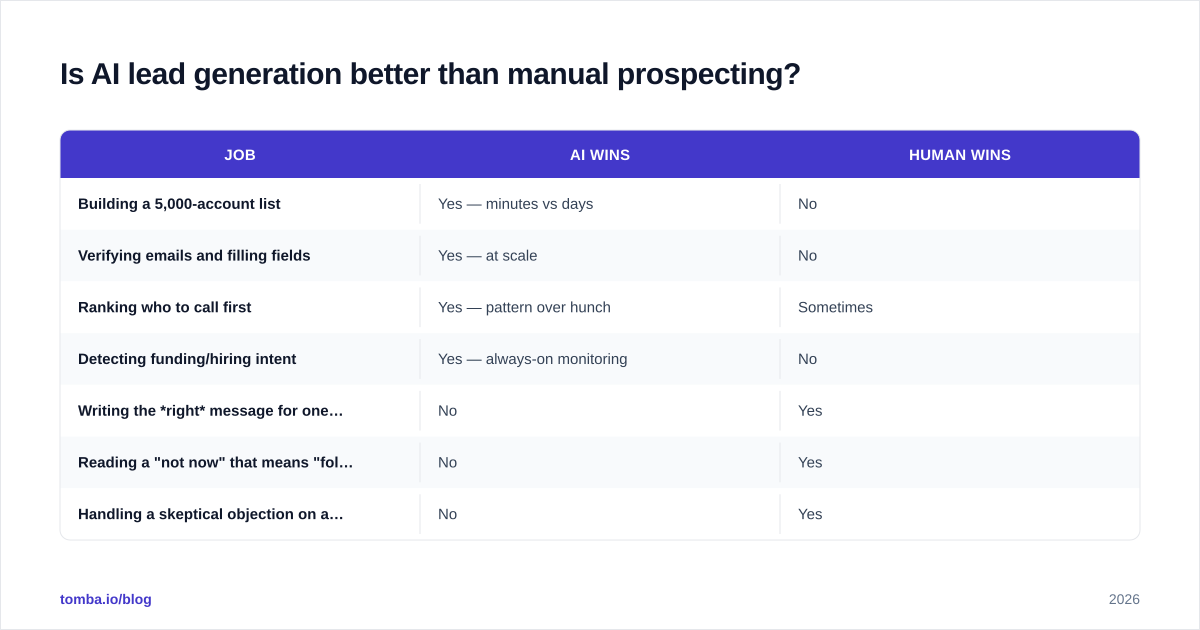
For volume and prioritization, yes — clearly. For judgment and relationship-building, not yet. The honest answer is that AI changes which work humans do, not whether humans are needed.
Here is the split that holds up in practice:
| Job | AI wins | Human wins |
|---|---|---|
| Building a 5,000-account list | Yes — minutes vs days | No |
| Verifying emails and filling fields | Yes — at scale | No |
| Ranking who to call first | Yes — pattern over hunch | Sometimes |
| Detecting funding/hiring intent | Yes — always-on monitoring | No |
| Writing the right message for one VP | No | Yes |
| Reading a "not now" that means "follow up in Q3" | No | Yes |
| Handling a skeptical objection on a call | No | Yes |
The teams getting real lift treat AI as a force multiplier on the front of the funnel and keep humans on the back half. The ones disappointed by AI usually automated the conversation instead of the research — and prospects can tell.

What can you automate today (and what you shouldn't)?#
Safe to automate now:
- Account and contact sourcing against your ICP
- Email verification and bounce prevention
- Field enrichment (title, seniority, company size, tech stack)
- Lead-to-rep routing rules
- First-draft personalization tokens (not the whole email)
- Re-scoring leads as new signals arrive
Keep a human in the loop:
- Final messaging and tone for high-value accounts
- Qualification calls and discovery
- Anything touching pricing or contractual promises
- Deciding when a low-score lead is worth a manual exception (your best logo might have looked terrible on paper)
A useful mental model: automate the inputs to a conversation, not the conversation. When you understand what a marketing qualified lead actually represents in your funnel, it gets easier to decide which handoffs can be machine-made and which need a person.
Which AI lead generation tools should you compare in 2026?#
There is no single "best" — there is best-for-your-bottleneck. Below is a neutral comparison of the common categories, with representative pricing. Always confirm current numbers on each vendor's site, since plans shift quarterly.
| Category | What it's for | Typical starting price | Best when |
|---|---|---|---|
| All-in-one sales platform (e.g., Apollo,ZoomInfo) | Sourcing + sequences + dialer in one | $49-$99/mo (ZoomInfo is quote-only, often 5 figures/yr) | You want one login and have budget |
| Data + email finder (e.g., Tomba) | Accurate contacts, verified emails, enrichment, API | Free tier (25 searches), $49/mo Starter | Data accuracy and cost are the priority |
| Intent data provider (e.g., 6sense, Bombora) | In-market account signals | Quote-only, enterprise | You run account-based motions at scale |
| Predictive scoring (often native to CRM) | Ranking existing leads | Bundled with CRM tier | You already have volume, need triage |
| AI SDR / autonomous outreach | Drafts and sends sequences | $300-$1,000+/mo | You accept lower personalization for reach |
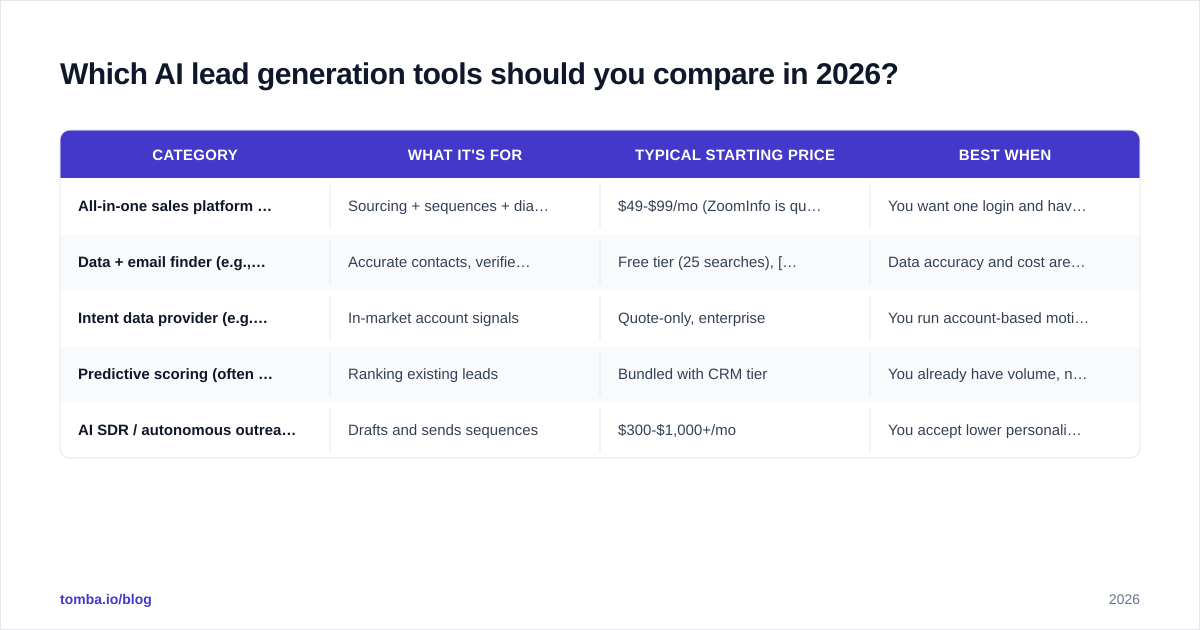
A few honest notes. All-in-one suites are convenient but you pay for modules you may not use, and their data accuracy is frequently the weakest link versus focused providers. Intent platforms are powerful but priced for enterprise — small teams rarely recoup the cost. And "AI SDR" tools that fully automate sending are improving, but reply rates still favor human-finished messaging.
If your bottleneck is simply finding accurate, verified contact data without overpaying, a focused tool plus your existing CRM beats a six-figure suite. Tomba's email finder and bulk lead generation cover sourcing and verification, and the Tomba API lets you wire scoring or enrichment on top without changing vendors.
For deeper, peer-reviewed comparisons across categories, G2 and Gartner Peer Insights are the least biased starting points.
What does the ROI of AI lead generation really look like?#
The math is simpler than vendors make it sound. AI lead generation pays off when the time it saves a rep, plus the deals it surfaces, exceeds its cost. Run it on your own numbers before signing anything.
A realistic mid-market example:
- An SDR spends ~10 hours/week building and verifying lists. AI cuts that to ~2.
- That returns ~8 hours/week, or roughly 35 hours/month, to actual selling.
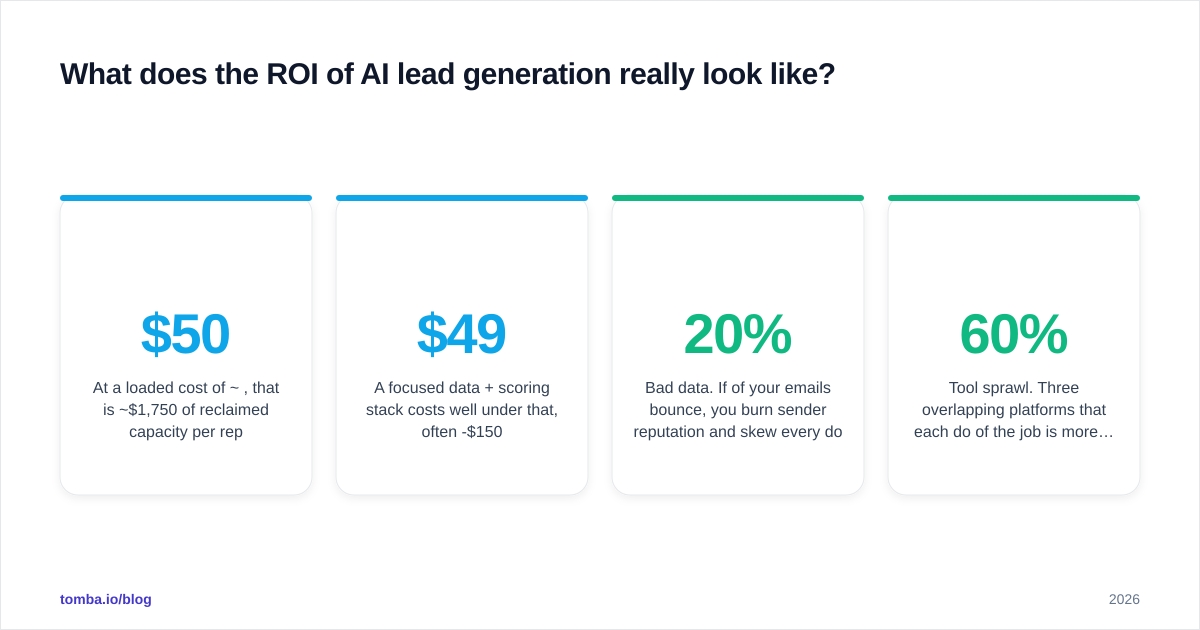
- At a loaded cost of ~$50/hour, that is ~$1,750/month of reclaimed capacity per rep.
- A focused data + scoring stack costs well under that, often $49-$150/mo per seat.
Even before counting incremental deals from better prioritization, the time arbitrage alone usually clears the bar. The incremental-revenue upside — better leads worked first — is the part that makes finance happy, but treat it as a bonus, not the justification.
Where ROI quietly leaks:
- Bad data. If 20% of your emails bounce, you burn sender reputation and skew every downstream score.
- Over-automation. Fully automated sequences that tank reply rates cost you the pipeline you were trying to build.
- Tool sprawl. Three overlapping platforms that each do 60% of the job is more expensive and less accurate than one focused stack.

How do you build an AI lead generation stack without overspending?#
Start from your bottleneck, add one layer at a time, and verify each layer earns its cost before adding the next. A lean, effective 2026 stack usually looks like this:
- Accurate data layer — a verified email finder and enrichment source. Everything downstream depends on this being clean. Verify emails before they enter your CRM, not after.
- Your CRM's native scoring — most modern CRMs (HubSpot, Salesforce) include predictive scoring on mid-tier plans. Use it before buying a standalone scorer. See HubSpot's predictive scoring docs for what's included.
- An intent or trigger feed — even a lightweight signal (funding, hiring, job changes) routed via automation beats spray-and-pray.
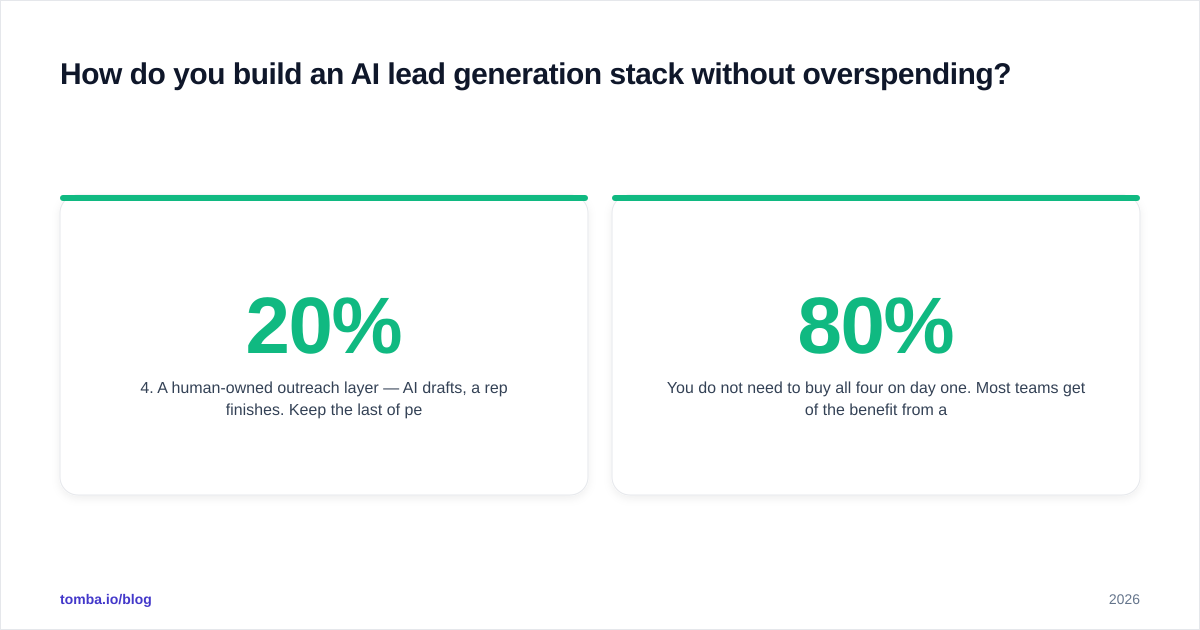
- A human-owned outreach layer — AI drafts, a rep finishes. Keep the last 20% of personalization manual on your top accounts.
You do not need to buy all four on day one. Most teams get 80% of the benefit from a clean data layer plus native CRM scoring — total cost under $150/seat/month. Add intent and outreach automation only once the basics are paying off.
For the data layer specifically, watch verification quality, not just database size. A provider claiming "500 million contacts" means nothing if a third of those emails bounce. Tomba's data enrichment and verification exist precisely to keep that foundation clean, and you can start on the free tier to test accuracy on your own ICP before committing to a paid plan.
What are the common mistakes to avoid?#
- Automating the conversation. AI is great at research, weak at rapport. Don't ship fully autonomous sequences to your best accounts.
- Trusting scores on dirty data. Verify and enrich first, score second. Order matters.
- Buying the suite for one feature. If you only need accurate contacts, don't pay enterprise platform prices.
- Ignoring deliverability. Sending to unverified emails wrecks sender reputation, which silently lowers every future campaign's results.
- Set-and-forget scoring. Buying behavior shifts. Re-train or re-tune your model periodically against fresh closed-won data.
- No human exception path. Always let a rep override a low score. Your unicorn customer often looks unremarkable in the data.
Where is AI lead generation heading?#
Three shifts are worth planning for. First, intent signals are getting cheaper and more granular, moving account-based prospecting downmarket to teams that could never afford enterprise intent data before. Second, enrichment is becoming real-time via API rather than batch uploads, so records stay current instead of decaying. Third, the "AI SDR" category will keep improving, but the durable advantage stays with teams that pair automated sourcing with human judgment on messaging.
The pattern underneath all three: AI keeps absorbing the mechanical front of the funnel, and the human edge keeps moving toward relationships, timing, and trust. Build your stack so a person spends their hours on those, not on copy-pasting from LinkedIn.
Get the data layer right first#
The fastest, cheapest win in AI lead generation isn't a fancy model — it's accurate, verified contact data feeding everything downstream. Start there. Use the Tomba Email Finder to source and verify professional emails by domain, name, or company, then layer your CRM scoring and intent signals on top. The free tier gives you 25 searches a month to test accuracy on your own ICP, and the API scales it into whatever stack you build next. Clean data in, confident scores out — that's the whole game.
// get started
Find, verify and enrich your first contacts today
Start on the free plan with 25 searches a month, then scale when your team is ready.
Free plan · No credit card required · GDPR & CCPA
// about the author