AI Lead Generation Agent: The Complete 2026 Buyer's Guide
An AI lead generation agent finds, qualifies, and enriches prospects on autopilot. Here's how the tech actually works in 2026 and how to build one that books meetings.
TL;DR
- An AI lead generation agent is software that runs the prospecting loop on its own: it finds target accounts, locates contacts, verifies their data, enriches it, and hands sales a ready-to-work list — with little human babysitting.
- It is not one model. It's an orchestration layer (planner + tools + memory) wired to data sources like email finders, enrichment APIs, and intent signals.
- The hard part isn't the AI. It's the data quality feeding it. A clever agent on top of stale contacts just sends bad emails faster.
- Expect to pay for two things separately: the agent/orchestration tooling and the underlying data credits. Budget both.
- Build vs. buy: most teams should buy the data layer (email finding, verification, enrichment) and assemble the agent logic on top via API.
What is an AI lead generation agent?#
An AI lead generation agent is a system that automates the full prospecting workflow — from "who should we sell to" all the way to "here is a verified contact with context, ready for outreach."
Think of it like a junior SDR who never sleeps and never forgets a step. You give it an ideal customer profile (ICP), and it goes hunting: it identifies matching companies, finds the right people inside them, confirms their contact details are real, layers on enrichment data, and drops the result into your CRM or sequencing tool. The difference from old-school automation is that an agent makes decisions — which source to query next, whether a result is trustworthy, when to retry — instead of just running a fixed script.
The word "agent" matters. A workflow runs the same steps every time. An agent has a goal, a set of tools, and the latitude to choose how to reach the goal. That distinction is why 2026's tooling feels different from the rule-based "growth hacks" of a few years ago.
How does an AI lead generation agent actually work?#
Under the hood, almost every credible agent has the same four parts. Understanding them tells you exactly where things go right or wrong.
1. The planner (the brain). An LLM that breaks your goal ("find 200 RevOps leaders at Series B SaaS companies in the US") into ordered steps and decides which tool to call for each one.
2. The tools (the hands). APIs the agent can invoke: a company search, an email finder, an email verifier, a phone lookup, an enrichment endpoint, a CRM writer. The agent is only as capable as the tools you connect.
3. Memory (the notebook). State about what it has already tried, which accounts are done, what failed, and which contacts were rejected — so it doesn't loop or duplicate work.
4. The data layer (the fuel). The actual contact and company records. This is the part people underestimate. The smartest planner in the world produces garbage if the email finder behind it guesses addresses instead of verifying them.
A typical run looks like this: the agent receives an ICP, queries a company database for matches, runs a domain search on each company to surface people in target roles, finds and verifies their emails, enriches each record with title/seniority/location, deduplicates against your CRM, and writes the clean rows back. If a verification fails, a good agent retries with a catch-all verifier or flags the record as risky instead of shipping it.
What can an AI lead generation agent do that humans can't?#
Not magic — scale and consistency. Here's the honest breakdown of where agents win and where they don't.
Where agents win:
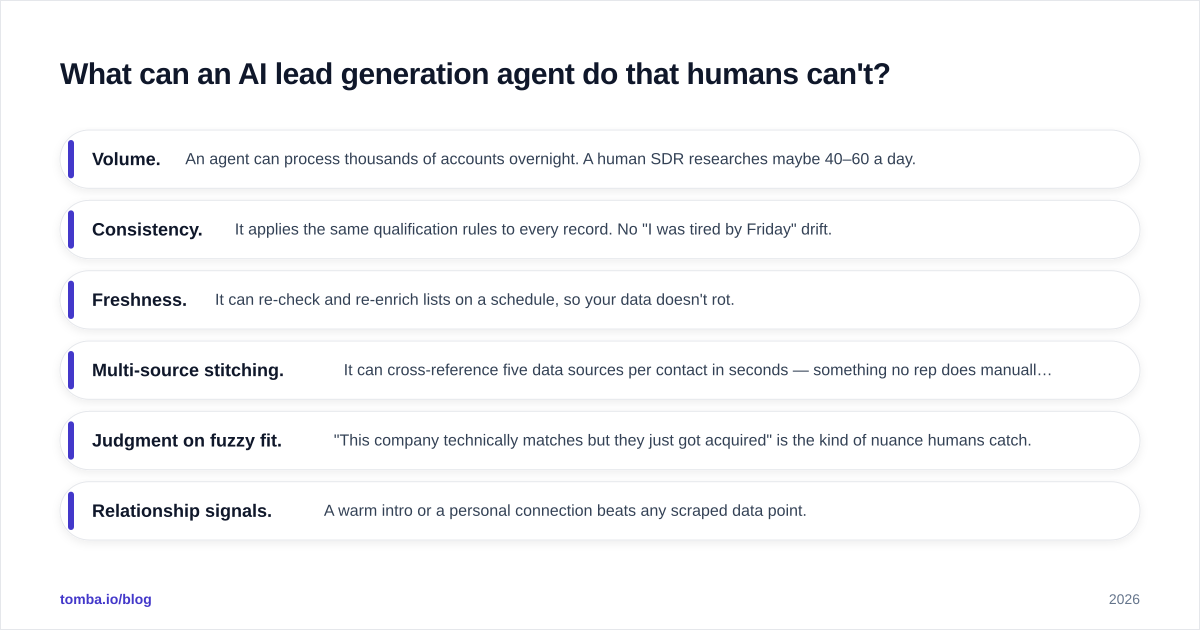
- Volume. An agent can process thousands of accounts overnight. A human SDR researches maybe 40–60 a day.
- Consistency. It applies the same qualification rules to every record. No "I was tired by Friday" drift.
- Freshness. It can re-check and re-enrich lists on a schedule, so your data doesn't rot.
- Multi-source stitching. It can cross-reference five data sources per contact in seconds — something no rep does manually.
Where humans still win:
- Judgment on fuzzy fit. "This company technically matches but they just got acquired" is the kind of nuance humans catch.
- Relationship signals. A warm intro or a personal connection beats any scraped data point.
- Message craft. Agents can draft, but the highest-reply outreach still needs a human editor.
The right framing isn't "agent replaces SDR." It's "agent does the 80% of prospecting that is mechanical, so the SDR spends time on the 20% that needs a brain."
What should you look for in an AI lead generation agent?#
Most buyers fixate on the AI demo and ignore the boring stuff that determines whether the leads are usable. Score tools on these dimensions, in order:
| Criterion | Why it matters | What "good" looks like |
|---|---|---|
| Data accuracy | Bad emails kill deliverability and burn your domain | Verified emails with a confidence score, catch-all handling |
| Verification built in | Finding ≠ valid; you need SMTP-level checks | Every contact verified before delivery, bounces flagged |
| Coverage | Thin databases miss your niche | Multiple sources, global coverage, role-level targeting |
| Enrichment depth | Sales needs context, not just an email | Title, seniority, company size, tech stack, location |
| API + integrations | Agents live or die on connectivity | Documented API, CRM +Zapier/Make connectors |
| Transparent pricing | Surprise overages wreck budgets | Clear credit model, free tier to test |
| Compliance | GDPR/CCPA exposure is real | Documented data sourcing, opt-out handling |
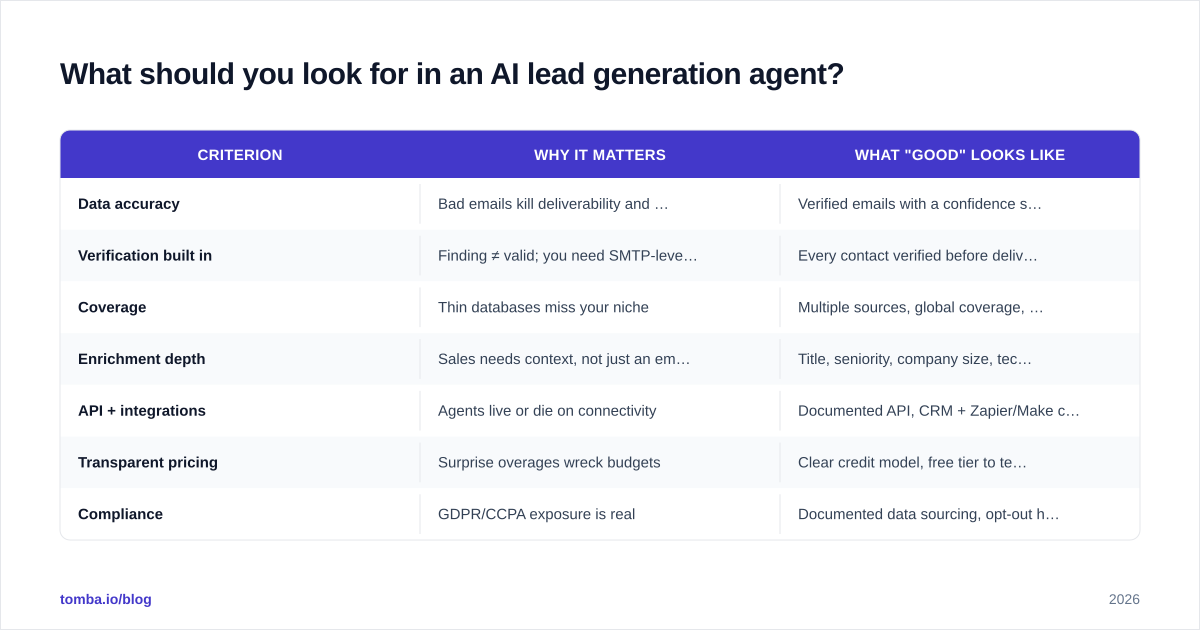
The single biggest predictor of success is the first two rows. According to research summarized by Gartner and echoed across vendor benchmarks on G2, data decay runs roughly 20–30% per year — people change jobs, companies rebrand, domains lapse. An agent that doesn't verify on the way out is shipping decay straight into your sequencer.
Build vs. buy: should you build your own AI lead generation agent?#
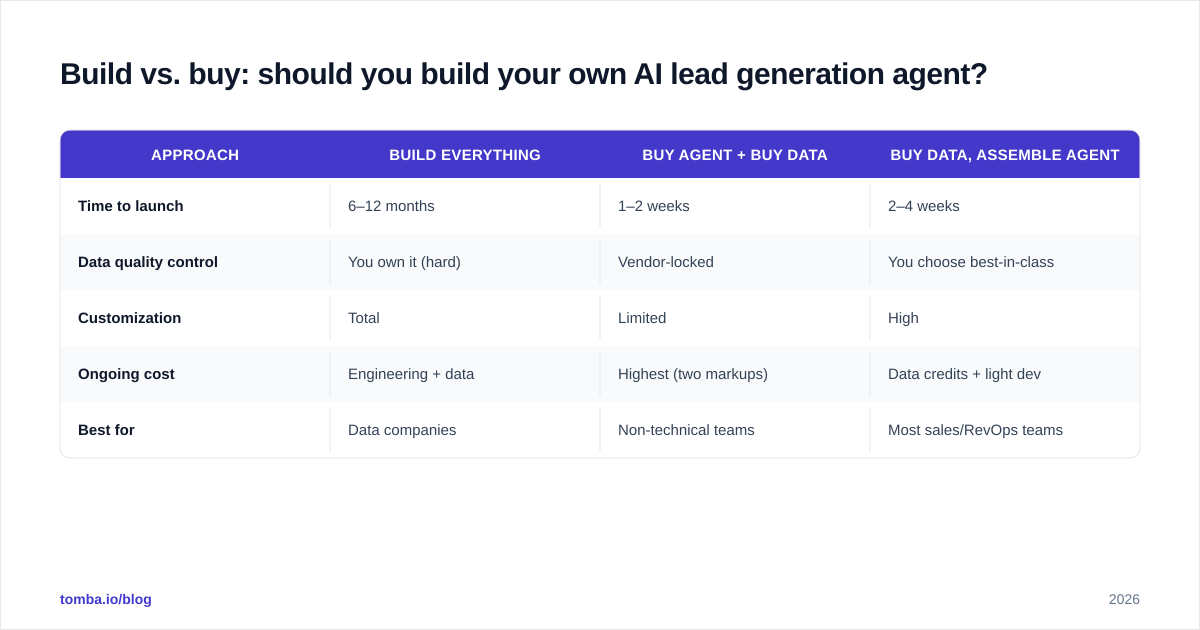
Buy the data layer; assemble the agent logic. That's the answer for ~90% of teams.
Here's the reasoning. The agent orchestration — a planner that calls tools in a loop — is now a few hundred lines of code with any modern LLM framework. What you cannot cheaply build is a verified, continuously refreshed contact database with global coverage. That takes years and infrastructure. So you rent the hard part (data via API) and own the easy, customizable part (your specific qualification rules and CRM logic).
| Approach | Build everything | Buy agent + buy data | Buy data, assemble agent |
|---|---|---|---|
| Time to launch | 6–12 months | 1–2 weeks | 2–4 weeks |
| Data quality control | You own it (hard) | Vendor-locked | You choose best-in-class |
| Customization | Total | Limited | High |
| Ongoing cost | Engineering + data | Highest (two markups) | Data credits + light dev |
| Best for | Data companies | Non-technical teams | Most sales/RevOps teams |
If you go the assemble route, the Tomba API gives the agent its core tools — email finding, verification, domain search, and enrichment — as clean endpoints. You wire those into your planner, add your ICP rules, and point the output at your CRM. For non-developers, the bulk email finder covers the "process a big list at once" job without writing code.

How do you set up an AI lead generation agent step by step?#
A practical build sequence that won't blow up in your face:
- Write a tight ICP. Industry, company size, geography, and the exact job titles you sell to. Vague ICP = vague leads. This is the agent's instruction set.
- Pick your data tools. At minimum: company/domain search, email finder, email verifier, and an enrichment source. Test each against a known sample before committing.
- Define qualification rules. Hard filters (must be in the US, must be Director+) and soft scores (bonus for using a competitor's tech). The agent enforces these.
- Wire in verification as a hard gate. No contact leaves the pipeline unverified. Catch-all domains get a catch-all check, risky ones get flagged, not shipped.
- Add enrichment. Layer on title, seniority, and firmographics with data enrichment so reps open each record with context.
- Deduplicate against your CRM. Stop the agent from re-surfacing existing customers or open opportunities.
- Set a schedule. Run nightly or weekly. Re-verify older records on a cadence to fight data decay.
- Put a human checkpoint before outreach. The agent builds the list; a person approves the messaging. This protects your sender reputation.
Notice that exactly one of these eight steps is "AI." The other seven are data and process discipline. That ratio is the whole lesson.
How much does an AI lead generation agent cost in 2026?#
You pay on two axes: orchestration tooling and data credits. Don't let a low headline price hide the credit burn underneath.
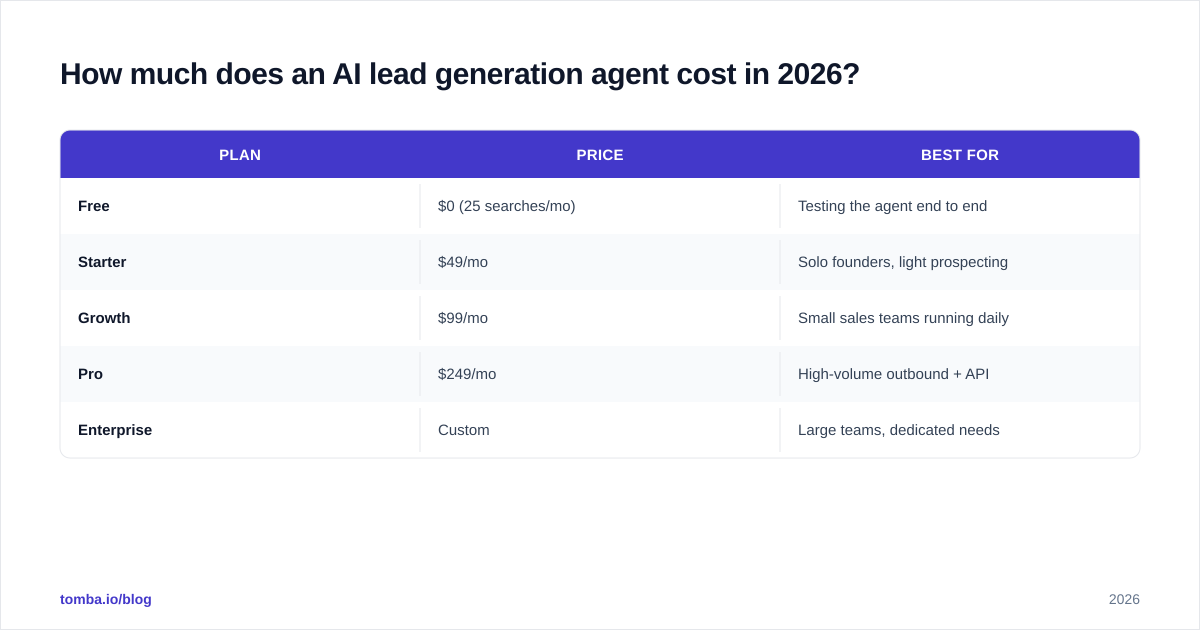
For the data layer, here's how transparent pricing looks using Tomba's plans as a reference point:
| Plan | Price | Best for |
|---|---|---|
| Free | $0 (25 searches/mo) | Testing the agent end to end |
| Starter | $49/mo | Solo founders, light prospecting |
| Growth | $99/mo | Small sales teams running daily |
| Pro | $249/mo | High-volume outbound + API |
| Enterprise | Custom | Large teams, dedicated needs |
A few budgeting rules of thumb:
- Estimate credits per lead. Finding + verifying + enriching one contact may cost several credits. Multiply by your monthly lead target.
- Account for retries. Failed lookups and re-verification consume credits too. Pad your estimate by 20–30%.
- Watch for double markups. All-in-one "agent" platforms that bundle data often charge a premium over buying the data layer directly via API.
Start on a free tier, run a real batch of 25–50 leads through your full pipeline, and measure the cost-per-verified-lead before you scale. That number — not the sticker price — is what matters.
What mistakes kill AI lead generation agents?#
The failure modes are predictable. Avoid these four and you're ahead of most teams:
- Skipping verification. The fastest way to torch your domain reputation is to let an agent send to unverified, guessed addresses. Verify everything. Tools like the email verifier exist precisely for this gate.
- No human in the loop on messaging. Fully autonomous send is how you end up in spam folders and apology threads. Let the agent build; let a person approve outreach.
- Treating the ICP as set-and-forget. Markets shift. Re-tune the ICP quarterly or the agent optimizes for a customer you no longer want.
- Ignoring compliance. Scraped data without documented sourcing and opt-out handling is a legal liability. Vendors like HubSpot and Salesforce publish guidance on permission-based outreach worth reading before you scale.
Is an AI lead generation agent worth it?#
Yes — if you treat it as a data problem with an AI front end, not an AI product with a data afterthought.
The teams that win with these agents are the ones who obsess over verification, enrichment depth, and clean CRM hygiene, then let the agent handle the tedious orchestration on top. The teams that struggle are the ones who buy the flashiest demo, skip the data fundamentals, and wonder why their reply rates crater.
An agent multiplies whatever you feed it. Feed it verified, enriched, well-targeted data and it becomes a tireless prospecting engine. Feed it junk and it becomes a very efficient junk distributor.
Getting started#
If you're assembling an AI lead generation agent, start with the layer that decides everything downstream: finding and verifying real contacts. Tomba's Email Finder gives your agent accurate, verified professional emails by name, company, or domain — with verification and enrichment available through the same API, so your agent gets clean data on the first call instead of shipping decay into your pipeline. Spin up the free tier (25 searches), run a real batch through your full agent loop, and measure your cost-per-verified-lead before you scale. Build the agent logic you want; let Tomba handle the part that's genuinely hard to get right — the data.
// get started
Find, verify and enrich your first contacts today
Start on the free plan with 25 searches a month, then scale when your team is ready.
Free plan · No credit card required · GDPR & CCPA
// about the author