AI Lead Generation for Agencies: The 2026 Playbook
Agencies live or die by pipeline. Here's how AI lead generation actually works in 2026 — the stack, the workflow, the data sources, and what it costs.
TL;DR
- AI lead generation for agencies means using machine learning to source, enrich, score, and personalize outreach to prospects — so your team spends time selling, not scraping.
- The winning 2026 stack is layered: a data/enrichment engine, an intent signal source, an AI scoring model, and an outreach sequencer wired together with automation.
- Accurate contact data is the foundation. A clever AI model trained on bad emails just bounces faster.
- Agencies that productize lead gen (offering it as a retainer service) need verified data and audit trails, not black-box scraping.
- Start with one tight ICP, one verified data source, and one measurable channel before you scale the automation.
What is AI lead generation for agencies?#
AI lead generation for agencies is the use of machine learning to handle the repetitive, judgment-light parts of prospecting: finding companies that match your ideal client profile, pulling verified contact details, ranking those contacts by how likely they are to convert, and drafting personalized first-touch messages at scale.
Think of it like a sous-chef in a busy kitchen. The head chef (your closer) still plates the dish and talks to the guest. But the sous-chef does the prep — chopping, sorting, labeling — so the chef never stands around waiting for ingredients. AI does the prep work of pipeline building. Technically, that means embedding models for similarity matching, classification models for lead scoring, and large language models for copy generation, all sitting on top of a contact database.
For agencies specifically, the stakes are different than for a single in-house team. You are often running lead generation for yourself (winning new clients) and as a service (running campaigns for clients). Both need the same backbone: clean data, repeatable workflows, and reporting you can defend in a client meeting.
Why do agencies need AI for lead generation in 2026?#
Three pressures pushed agencies past manual prospecting.
Margins. Agency profit lives in billable hours. Every hour a strategist spends copy-pasting emails from LinkedIn into a spreadsheet is an hour not billed. AI collapses that prep time from hours to minutes.
Deliverability. Inboxes got stricter. Google and Yahoo's bulk-sender rules now punish sloppy lists hard. Sending to unverified addresses tanks your sender reputation, and once that happens, even your good emails land in spam. AI-driven verification keeps bounce rates low before you ever hit send.
Scale without headcount. Clients expect more touches across more channels, but they don't want to pay for a bigger SDR team. Automation is the only way to widen the funnel without widening payroll.
The agencies losing in 2026 are not the ones without AI — they are the ones who bolted AI onto a broken process. A faster way to email the wrong people at bad addresses is not progress.

How does the AI lead generation stack work?#
A real agency stack has four layers. Skip any one and the others underperform.
1. Data and enrichment. This is where you turn a company name into a reachable human. You need verified work emails, job titles, company size, tech stack, and ideally direct phone numbers. Tools like Tomba's email finder and data enrichment sit here, converting thin lead lists into complete, contactable records.
2. Intent and signals. Who is in-market right now? Signals include funding rounds, new hires, job postings, website visits, and technology changes. Website visitor reveal turns anonymous traffic into named accounts you can pursue.
3. Scoring and prioritization. Not every matching lead is worth the same effort. An AI scoring model ranks leads so your team works the hottest 20% first. This is the single biggest lever on win rate that most agencies ignore.
4. Outreach and orchestration. AI drafts personalized first lines, sequences the follow-ups, and routes replies. The human steps in when a prospect engages.
The mistake is buying four disconnected tools and calling it a stack. The value is in the wiring — passing a scored, enriched, verified lead from layer one to layer four without manual handoffs.
Which AI lead generation approach fits your agency?#
There is no single "best" tool — there is a best fit for your model, ICP, and budget. Here is how the common approaches compare.
| Approach | Best for | Data accuracy | Starting price | Watch out for |
|---|---|---|---|---|
| All-in-one platform (Apollo,ZoomInfo) | Agencies wanting one login | Medium–High | $49–$1,000+/mo | Lock-in, stale records, per-seat costs |
| Specialist data + finder (Tomba) | Teams who value verified email data | High | Free tier, then $49/mo | Pair with your own sequencer |
| Scraper + LLM (custom build) | Technical agencies | Variable | Dev time | Compliance risk, brittle, no support |
| Managed lead-gen service | Agencies outsourcing entirely | Depends on vendor | $1,500+/mo retainer | Black box, no data ownership |
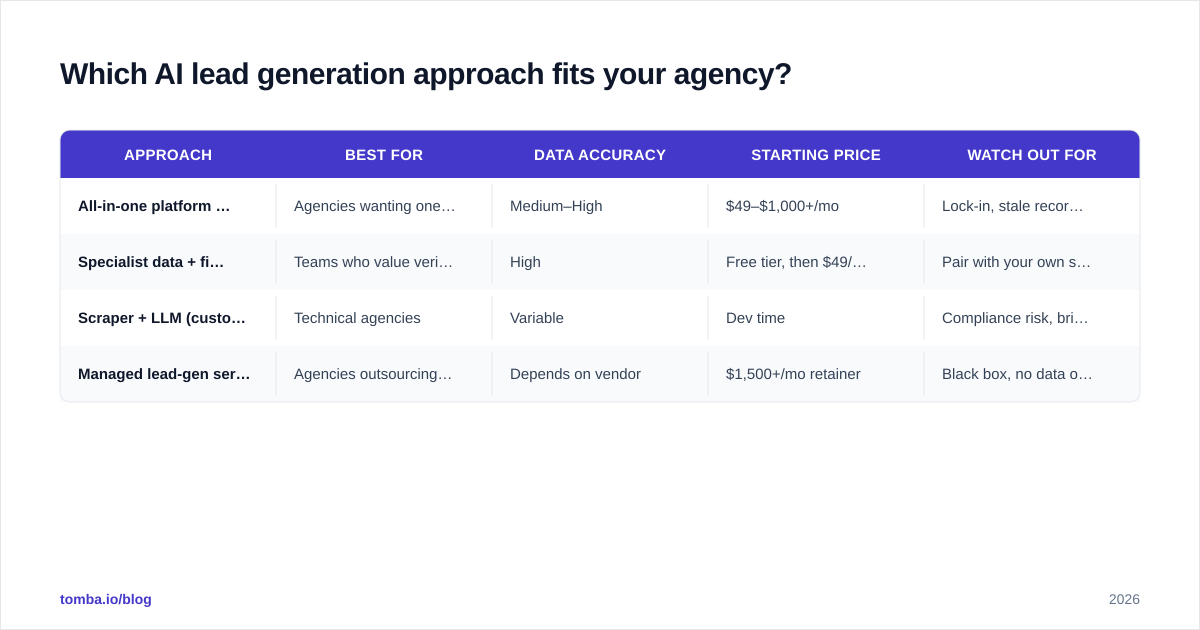
A focused stack — a high-accuracy email finder and email verifier feeding a sequencer you control — beats the all-in-one for most boutique and mid-size agencies. You own the data, you control deliverability, and you are not paying for fifty features you never open. You can check current Tomba pricing against the per-seat models of the big platforms; the gap is usually wide once you add three or four seats.
For agencies running outreach as a productized service, also weigh independent reviews on G2 before committing — client-facing work needs vendors that survive scrutiny.

How do you build an AI lead generation workflow that actually converts?#
Here is a workflow that survives contact with real campaigns. Run it for your own pipeline first, then templatize it for clients.
Step 1 — Lock the ICP. Define one ideal client profile in writing: industry, company size, region, and the specific trigger that makes them a buyer. "Marketing agencies, 10–50 staff, US, that just hired a head of growth" beats "B2B companies" every time.
Step 2 — Source matching companies. Use domain search to pull the right contacts at target companies, or feed a company list into a bulk email finder to enrich hundreds of accounts at once.
Step 3 — Verify before you enrich further. Run every address through an email verifier. Drop the invalids and flag catch-all domains for a separate, careful track. This single step protects your sender reputation more than any clever subject line.
Step 4 — Score the list. Layer intent signals and firmographic fit into a simple score. Even a basic A/B/C tier, applied consistently, raises response rate because your best reps work the best leads.
Step 5 — Personalize at the first line, automate the rest. Let AI draft a relevant opener from the prospect's company news or role. Keep the value proposition human and consistent. Generic AI spam is obvious and it kills trust.
Step 6 — Measure, prune, repeat. Track reply rate, positive reply rate, and meetings booked per 100 contacts. Kill the segments that don't convert. Double down on the ones that do.
The discipline is in steps 3 and 4. Most agencies rush to send. The ones with high deliverability slow down at verification and scoring, then send faster because their lists are clean.
What does AI lead generation cost an agency?#
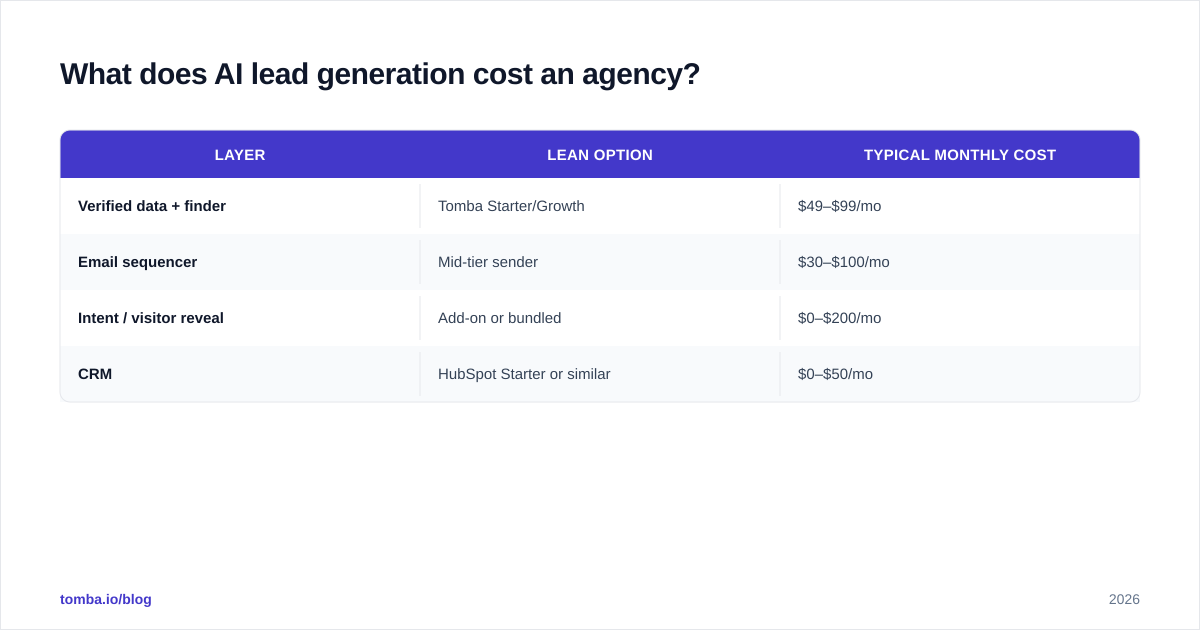
Budget realistically across the stack, not per tool. A lean, effective setup for a boutique agency in 2026 looks like this.
| Layer | Lean option | Typical monthly cost |
|---|---|---|
| Verified data + finder | Tomba Starter/Growth | $49–$99/mo |
| Email sequencer | Mid-tier sender | $30–$100/mo |
| Intent / visitor reveal | Add-on or bundled | $0–$200/mo |
| CRM | HubSpot Starter or similar | $0–$50/mo |
That puts a credible, deliverability-first stack under a few hundred dollars a month — a fraction of one closed retainer. Compare that to enterprise platforms that start in the four figures per month and charge per seat. For a five-person agency, the per-seat math alone often justifies a specialist data provider plus a sequencer you control.
If you are reselling lead generation, price the data and tooling as a pass-through line item or bake it into the retainer — and keep the verification reporting, because clients increasingly ask to see bounce and deliverability numbers. Tools that expose data sources and verification status give you something defensible to show.
For CRM and pipeline mechanics, HubSpot's own sales resources and the analyst view from Gartner's digital markets are solid neutral references when you are educating a client on why clean data matters.
What mistakes should agencies avoid with AI lead gen?#
Treating AI as a strategy instead of a tool. AI executes a strategy faster. If your targeting is wrong, AI just helps you fail at scale.
Skipping verification to save credits. A 5% bounce rate is the line where mailbox providers start throttling you. Unverified lists cross it fast. Verification is the cheapest insurance you can buy.
Over-automating the human moment. Automate sourcing, enrichment, and scoring. Do not automate the reply to a warm prospect. The handoff from machine to human is where deals are won or lost.
Ignoring data ownership. If your lead data lives only inside a managed service or a closed platform, you don't own your pipeline — you rent it. Keep an exportable, owned source of truth.
No feedback loop. AI scoring only improves if you feed closed-won and closed-lost outcomes back into it. Set up that loop in month one, not month six.
How do you get started this week?#
Pick one ICP. Pull 100 target accounts. Find and verify the right contacts, score them into three tiers, and send a personalized sequence to tier A only. Measure meetings booked. That single, tight loop teaches you more than any six-month tooling evaluation — and it produces pipeline while you learn.
The foundation under all of it is accurate, verified contact data. Without it, every downstream AI step compounds the same bad input. With it, your scoring, personalization, and deliverability all get sharper.
If you want that foundation in place today, start with the Tomba Email Finder. Find professional email addresses by domain, name, or company, verify them before you send, and feed clean, contactable leads straight into your agency's outreach engine. The free tier gives you 25 searches a month to test the workflow, and the $49/mo Starter plan scales it once you see the meetings land. Build the pipeline on data you can trust — then let the AI do the prep.
Ready to find emails that actually work?
Join 150,000+ professionals who stopped guessing and started sending. Free credits on signup — no credit card required.
Get the Tomba newsletter
Practical outbound tactics and product updates — once every two weeks.
About the author