AI Lead Generation Tool Guide: Best Picks for 2026
AI lead generation tools promise pipeline on autopilot. Here's how they actually work, where they break, and how to pick one that fills your funnel in 2026.
(title rendered separately)
TL;DR
- An AI lead generation tool uses machine learning to find, score, enrich, and prioritize prospects so your reps spend time on the contacts most likely to buy.
- The category splits into four jobs: sourcing (who exists), enrichment (what we know about them), scoring (who's worth a call), and outreach (how we reach them). Most tools only do one or two well.
- AI doesn't fix bad data. Garbage contacts scored by a model are still garbage — accuracy of the underlying records matters more than the algorithm.
- Budget realistically: usable plans start around $49–$99/mo per seat; "free" tiers are trials, not strategies.
- Use the buyer framework below before you sign anything. The best tool for a 3-person startup is rarely the best tool for a 50-rep sales org.
What is an AI lead generation tool?#
An AI lead generation tool is software that automates the hunt for qualified buyers using machine learning instead of manual research. Think of it like the difference between panning for gold by hand and running a sorting machine: you still need a river with gold in it, but the machine processes far more gravel per hour and flags the nuggets.
In practice, "AI" in this category covers a handful of distinct capabilities that vendors bundle together:
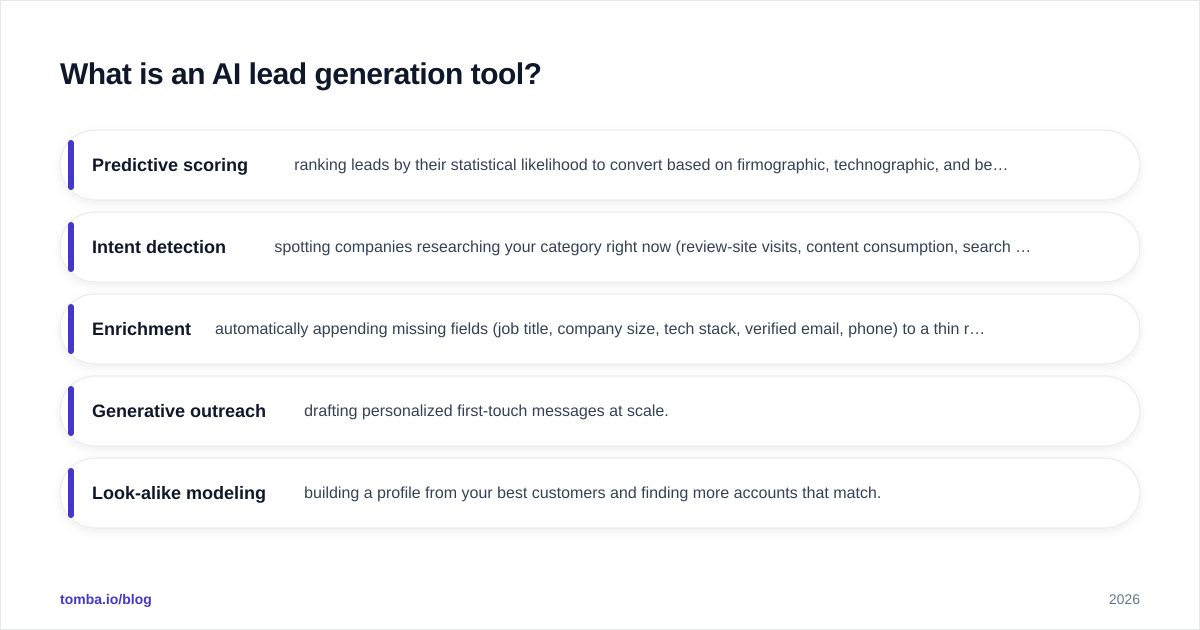
- Predictive scoring — ranking leads by their statistical likelihood to convert based on firmographic, technographic, and behavioral signals.
- Intent detection — spotting companies researching your category right now (review-site visits, content consumption, search behavior).
- Enrichment — automatically appending missing fields (job title, company size, tech stack, verified email, phone) to a thin record.
- Generative outreach — drafting personalized first-touch messages at scale.
- Look-alike modeling — building a profile from your best customers and finding more accounts that match.
The trap is treating these as interchangeable. A tool that's excellent at generative outreach can be useless at sourcing accurate contacts, and vice versa. Before comparing logos, decide which of these jobs is actually your bottleneck.
How does AI actually generate leads?#
The pipeline behind most AI lead generation tools runs in four stages, and understanding them tells you exactly where each product adds value — and where it quietly relies on the same shared data everyone else uses.
1. Sourcing. The tool pulls candidate companies and contacts from a database (web-crawled, partner-sourced, or user-contributed). This is where coverage and freshness live or die. A model can only score people it can see.
2. Enrichment. Thin records get fattened. A name and a domain become a verified work email, a LinkedIn URL, a direct dial, a headcount band, and a funding stage. Quality here depends on the vendor's underlying data, not the AI — a point worth repeating because marketing pages blur it. Tools like data enrichment APIs handle this layer specifically.
3. Scoring. With enriched records, a model ranks leads. Good scoring blends fit (does this account look like your ICP?) with intent (are they showing buying behavior?). The output is a prioritized list, not a magic "these will close" verdict.
4. Engagement. Generative AI drafts the opener, suggests send times, and sometimes manages multi-step sequences. This is the flashiest layer and the easiest to overrate — personalization at scale still loses to genuine relevance.
The uncomfortable truth: stages 1 and 2 determine 80% of your results. If the contacts are wrong or stale, no amount of clever scoring or AI-written copy saves the campaign. That's why teams obsessing over the "smartest" model often underperform teams that simply start with a clean, accurate email finder and verified data.
)
What should an AI lead generation tool include in 2026?#
Feature checklists balloon fast, so here's the short list that actually moves pipeline. Anything beyond this is nice-to-have.
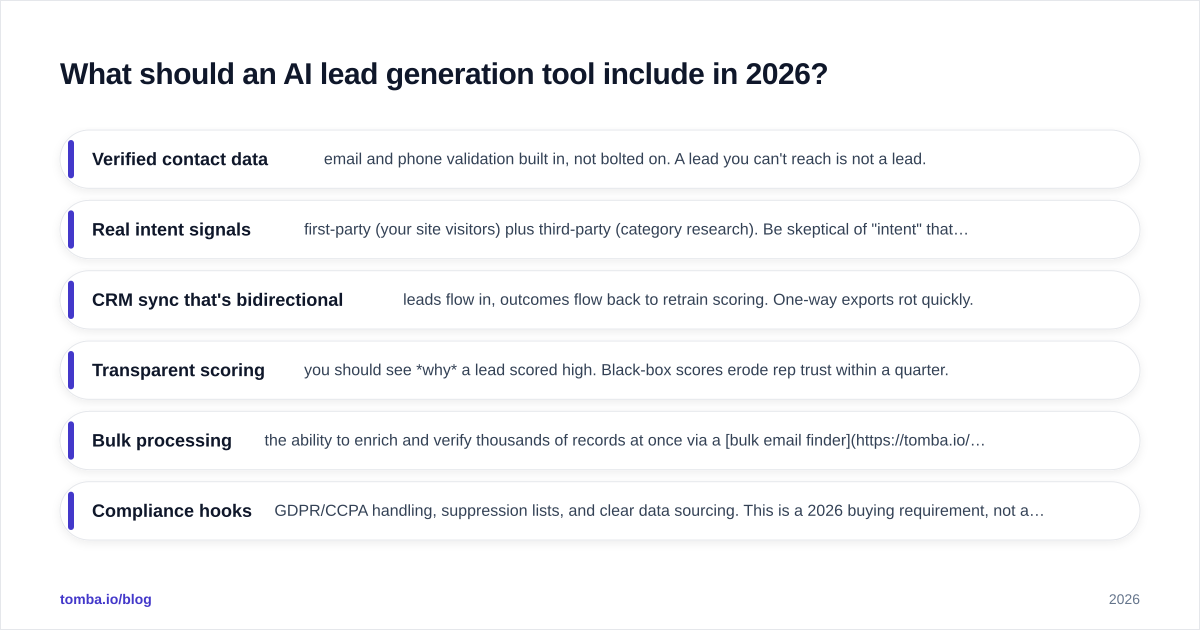
- Verified contact data — email and phone validation built in, not bolted on. A lead you can't reach is not a lead.
- Real intent signals — first-party (your site visitors) plus third-party (category research). Be skeptical of "intent" that's just firmographic guessing.
- CRM sync that's bidirectional — leads flow in, outcomes flow back to retrain scoring. One-way exports rot quickly.
- Transparent scoring — you should see why a lead scored high. Black-box scores erode rep trust within a quarter.
- Bulk processing — the ability to enrich and verify thousands of records at once via a bulk email finder or API.
- Compliance hooks — GDPR/CCPA handling, suppression lists, and clear data sourcing. This is a 2026 buying requirement, not a footnote.
Which AI lead generation tool is right for you?#
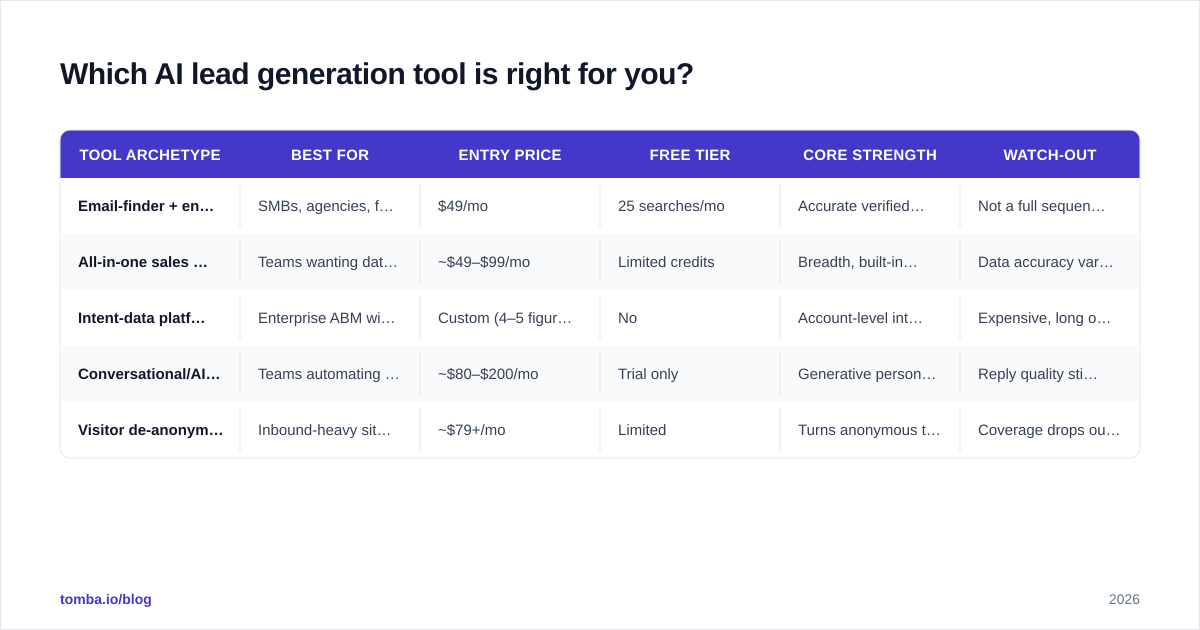
There's no single winner — there's a winner for your stage and motion. The table below compares the common archetypes you'll evaluate, using realistic 2026 entry pricing per seat.
| Tool archetype | Best for | Entry price | Free tier | Core strength | Watch-out |
|---|---|---|---|---|---|
| Email-finder + enrichment (e.g. Tomba) | SMBs, agencies, founders doing targeted outbound | $49/mo | 25 searches/mo | Accurate verified contacts, API-first | Not a full sequencing suite |
| All-in-one sales platform (e.g. Apollo) | Teams wanting database + sequencing in one | ~$49–$99/mo | Limited credits | Breadth, built-in dialer/email | Data accuracy varies by region |
| Intent-data platform (e.g. 6sense, Demandbase) | Enterprise ABM with big ad budgets | Custom (4–5 figures) | No | Account-level intent at scale | Expensive, long onboarding |
| Conversational/AI SDR tools | Teams automating first-touch outreach | ~$80–$200/mo | Trial only | Generative personalization | Reply quality still needs human edit |
| Visitor de-anonymization (e.g. reveal tools) | Inbound-heavy sites converting traffic | ~$79+/mo | Limited | Turns anonymous traffic into leads | Coverage drops outside major markets |
A few honest reads on this table:
- If your bottleneck is accurate contacts, start narrow. A focused email finder with strong verification beats a sprawling platform whose database is thin in your niche. You can layer sequencing on later.
- If your bottleneck is reach into a fixed account list, intent platforms earn their cost — but only above a certain deal size. Below ~$15k ACV, the math rarely works.
- If your bottleneck is converting existing traffic, a website visitor reveal tool solves a problem the other categories don't touch.
For a deeper neutral comparison of broad sales platforms, G2's lead intelligence category and Gartner's peer reviews are useful starting points before you trust any vendor's own benchmark.
)
How accurate is AI lead scoring, really?#
Scoring accuracy depends almost entirely on two things you can measure before buying: the freshness of the data and the volume of your own closed-won/closed-lost history.
Here's the analogy: an AI scoring model is a weather forecaster. A forecaster with decades of local data and live sensors is genuinely useful. One with a stale almanac and no thermometer is guessing in a lab coat. The "AI" is identical — the inputs are what separate a 70%-precision model from a coin flip.
Three questions cut through vendor claims:
- What's the data recency? Ask when records were last re-verified. Contact data decays roughly 2–3% per month as people change jobs. A database refreshed quarterly is already meaningfully stale.
- Does the model learn from my outcomes? Generic scoring trained on "buyers in general" underperforms a model fed your actual win/loss data. Bidirectional CRM sync is the prerequisite.
- Can I see the features? If the vendor won't tell you which signals drive a score, you can't debug bad predictions — and you will get bad predictions.
This is also where verification matters more than people expect. Scoring a list full of invalid emails wastes model attention on contacts you can't reach. Running candidates through an email verifier before scoring keeps the model focused on reachable humans, which lifts effective accuracy without touching the algorithm at all. The same logic applies to phone outreach — validate numbers before your reps burn hours on dead lines.
Does an AI lead generation tool replace SDRs?#
No — and any vendor implying otherwise is selling you a story. What AI reliably replaces is the grunt work inside the SDR role: list building, data entry, research, and first-draft copy. The judgment, the discovery questions, the objection handling, and the relationship still belong to people.
The realistic 2026 split looks like this:
- AI owns: sourcing candidates, enriching records, prioritizing the queue, drafting openers, logging activity, and flagging intent spikes.
- Humans own: qualifying nuance, multi-thread strategy, handling the "we already use a competitor" curveball, and reading whether a prospect is actually a fit beyond what the model can see.
Teams that frame AI as an SDR amplifier — more good conversations per rep — consistently outperform teams that try to delete the human and let a bot run unattended. The second group usually torches their domain reputation and their brand within a quarter. If you want the deeper mechanics of why automated sending damages email deliverability, the short version is: volume without relevance trains spam filters to hate you.
How do you roll out an AI lead generation tool without wasting budget?#
Most failed deployments fail for non-technical reasons: no clean ICP, no data hygiene, and no feedback loop. Here's a sequence that avoids the common money pits.
Week 1 — Define the ICP precisely. Pull your last 20 closed-won deals and find the shared firmographics. This becomes the target the AI optimizes toward. Skip this and the tool optimizes toward noise.
Week 2 — Clean before you enrich. De-duplicate your CRM and verify existing contacts. Enriching a messy database just produces a bigger messy database. Tools that handle dedup and verification in bulk save weeks here.
Week 3 — Run a scoped pilot. Pick one segment, one rep team, and one motion. Measure reply rate and meeting rate against your pre-AI baseline. A pilot that can't beat the baseline isn't ready to scale.
Week 4 — Close the loop. Feed outcomes back into the tool so scoring improves. Set a standing monthly review of which scored leads actually converted.
Two budget guardrails worth stating plainly. First, real Tomba pricing and comparable tools put usable plans in the $49–$99/mo range per seat — "free forever" tiers are trials, not strategies, and building a motion on 25 free searches a month is planning to fail. Second, don't buy enterprise intent data until your ACV justifies it; for most SMBs, accurate contacts plus disciplined outreach outperform a five-figure intent contract you can't fully use. HubSpot's own research on lead response reinforces the boring truth that speed and relevance beat sophistication.
What questions should you ask before buying?#
Send these to any vendor's sales team and judge them by how directly they answer:
- Where does your data come from, and how often is it re-verified?
- What's your match and bounce rate for my target geography and industry — not your global average?
- Is CRM sync one-way or bidirectional?
- Can I export my data if I leave, and do I own enriched records?
- How do you handle GDPR/CCPA and suppression?
- What does scoring use as inputs, and can I see per-lead reasons?
Vague answers to data-sourcing and accuracy questions are the single biggest predictor of buyer's remorse in this category. A vendor confident in its data sources will tell you exactly where records come from.
The bottom line#
An AI lead generation tool is a force multiplier, not a substitute for strategy. The teams that win in 2026 aren't the ones with the flashiest model — they're the ones starting from accurate, verified contact data, scoring against their own outcomes, and keeping humans on the parts that need judgment. Pick the narrowest tool that solves your actual bottleneck, prove it on a scoped pilot, and scale only what beats your baseline.
If your bottleneck is finding real, reachable people — the foundation everything else is built on — start with the Tomba Email Finder. Find verified professional emails by name, company, or domain, validate them before you ever hit send, and feed clean records into whatever scoring or sequencing layer you choose. The free tier gives you 25 searches a month to test accuracy on your own ICP before you commit a dollar. Get the data layer right first, and every AI feature you bolt on afterward actually works.
// get started
Find, verify and enrich your first contacts today
Start on the free plan with 25 searches a month, then scale when your team is ready.
Free plan · No credit card required · GDPR & CCPA
// about the author