AI Lead Nurturing in 2026: A Practical Playbook & Tools
AI lead nurturing turns a static drip sequence into a system that reads buyer signals and adapts in real time. Here's how it works, what to automate, and where to start in 2026.
TL;DR
- AI lead nurturing replaces fixed drip sequences with systems that read buyer behavior and adjust messaging, timing, and channel automatically.
- The biggest wins come from three jobs: scoring intent, personalizing content, and triggering the right next action — not from "AI writes my emails."
- Clean contact data is the precondition. A smart sequence aimed at a wrong or dead address still fails, so enrichment and verification sit upstream of any nurture engine.
- Expect a measured 20-40% lift in reply and meeting rates when AI nurturing is layered on top of a working playbook — not a magic 10x.
- Start small: pick one segment, wire signals to actions, measure reply rate, then expand.
What is AI lead nurturing?#
AI lead nurturing is the practice of using machine learning to decide what to send a prospect, when to send it, and through which channel — based on that prospect's behavior, fit, and stage, rather than a fixed calendar.
Think of traditional nurturing as a vending machine: a lead drops in, and the same five emails come out on days 1, 4, 8, 15, and 30 regardless of what the buyer does. AI nurturing is more like a good waiter who notices you pushed the bread aside, reads the table, and adjusts what they bring next. Technically, it's a feedback loop: signals in (opens, clicks, site visits, replies, firmographic fit), a model that ranks and routes, and actions out (a message, a task for a rep, a channel switch, or a pause).
The shift matters because buyers no longer move in straight lines. A prospect might read three blog posts, go quiet for a month, then return to your pricing page at 11 p.m. A static sequence can't see that. A signal-driven one can fire a relevant follow-up the next morning.
Why does AI nurturing beat traditional drip campaigns?#
The conclusion first: AI nurturing wins because it allocates attention. Most pipelines are full of leads that will never buy and a handful that are ready now. A static drip treats them identically. AI sorts them.
Here's where the lift actually comes from:
- Timing. Models predict the window when a lead is most likely to engage and schedule sends accordingly, instead of blasting everyone at 9 a.m. Tuesday.
- Relevance. Content blocks are selected per-lead based on the pages they viewed, the role they hold, and the problem they signaled — not one generic template.
- Routing. Hot leads get handed to a human with context; cold ones stay in automated nurture until a signal wakes them up.
- Suppression. Just as important as sending — AI knows when to stop emailing someone who's annoyed or already in a deal.

The honest caveat: AI nurturing amplifies whatever system you already have. If your messaging is weak and your data is dirty, automation just makes the failure faster and bigger. That's why the data layer below comes before the model layer.
What are the building blocks of an AI nurturing system?#
Four layers stack on top of each other. Skip the bottom one and the rest collapses.
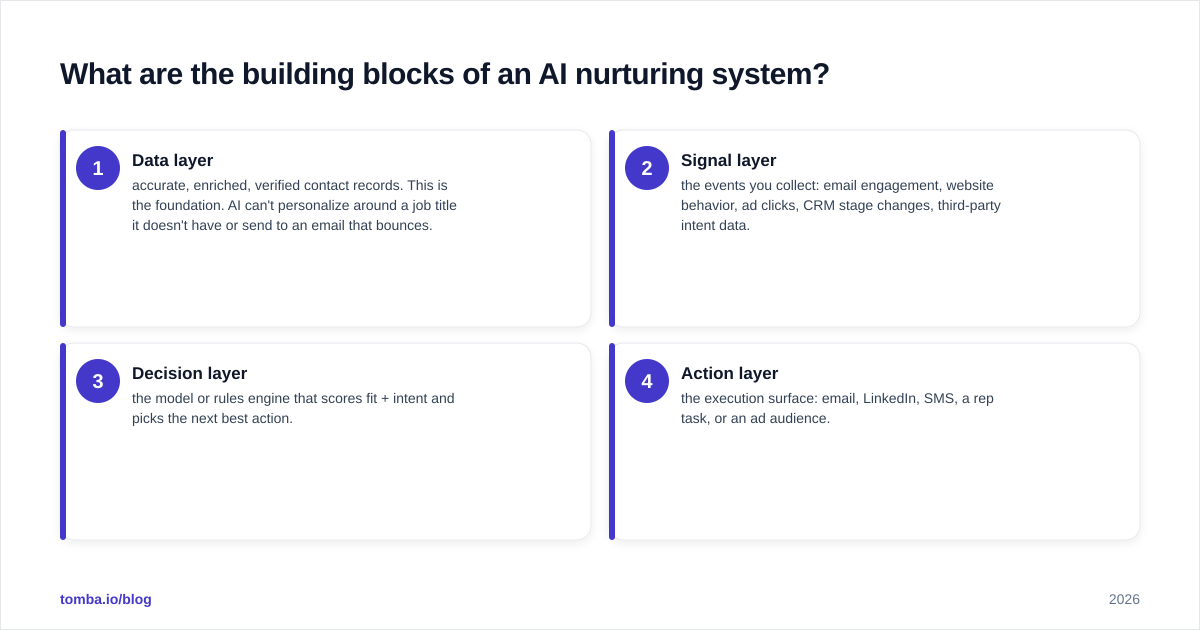
- Data layer — accurate, enriched, verified contact records. This is the foundation. AI can't personalize around a job title it doesn't have or send to an email that bounces.
- Signal layer — the events you collect: email engagement, website behavior, ad clicks, CRM stage changes, third-party intent data.
- Decision layer — the model or rules engine that scores fit + intent and picks the next best action.
- Action layer — the execution surface: email, LinkedIn, SMS, a rep task, or an ad audience.
The data enrichment step is where most teams underinvest. A nurture model that knows a lead's company size, industry, tech stack, and seniority can branch intelligently. One that only has a first name and an email guesses. Before you nurture, make sure the record is complete and the address is real — run new contacts through an email verifier so your sequences don't burn sender reputation on dead inboxes.
For a refresher on how scoring fits the broader funnel, the marketing qualified lead definition is a useful anchor — AI nurturing is largely the work of moving an MQL toward sales-ready without a human babysitting every step.
How do you score and segment leads with AI?#
Score on two axes and you've solved most of the problem: fit (do they match your ICP?) and intent (are they showing buying behavior?).
Fit is mostly static and comes from firmographic + technographic data — company size, industry, role, stack. Intent is dynamic and comes from behavior — content consumed, frequency, recency, and depth of engagement. A model combines both into a single priority that updates continuously.
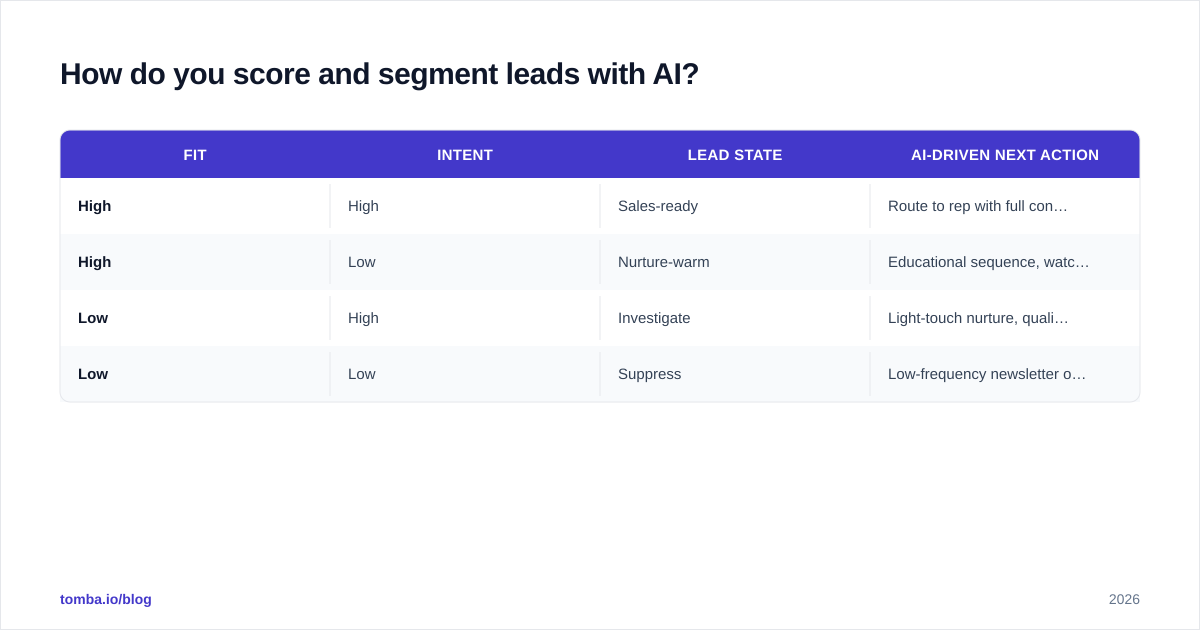
Here's a simplified scoring matrix that maps the two axes to an action:
| Fit | Intent | Lead state | AI-driven next action |
|---|---|---|---|
| High | High | Sales-ready | Route to rep with full context + alert |
| High | Low | Nurture-warm | Educational sequence, watch for signal spike |
| Low | High | Investigate | Light-touch nurture, qualify before rep time |
| Low | Low | Suppress | Low-frequency newsletter or archive |
The model's job isn't to replace this logic — it's to keep the scores fresh and to spot patterns a human rule would miss, like "leads who view the integrations page twice within 48 hours close 3x faster." Feed it outcomes (closed-won, closed-lost, ghosted) and it learns which signals actually predict revenue versus which just look busy.
Which tools do the work? An honest comparison#
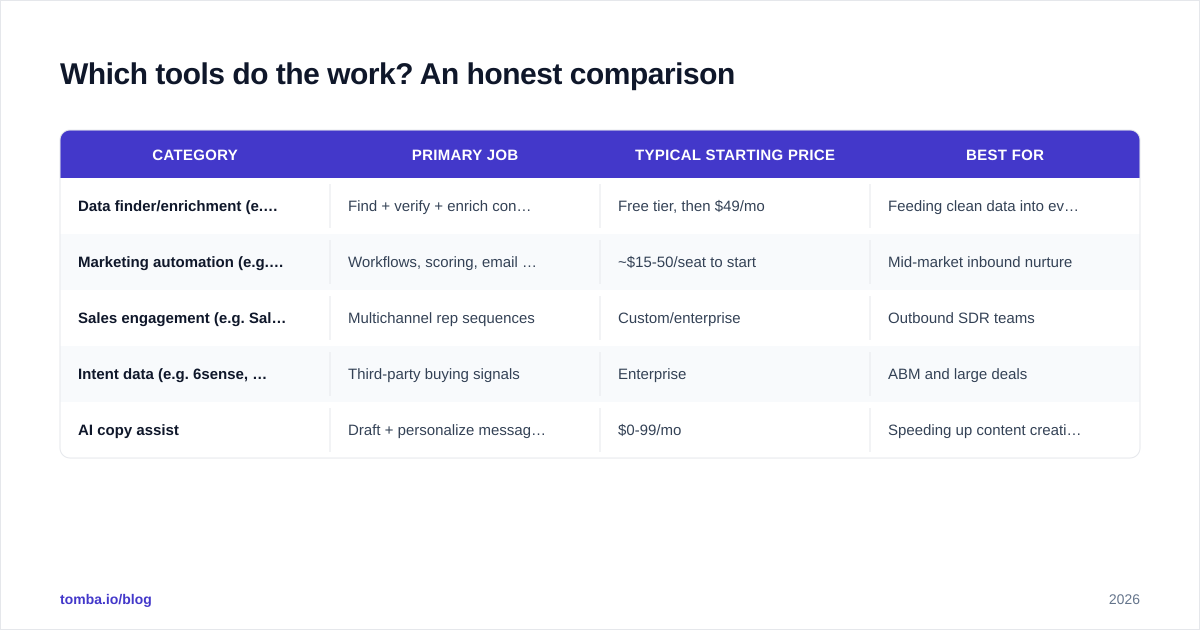
There's no single "AI lead nurturing tool" — you assemble a stack. Below is how the main categories compare on what they actually do, so you can avoid paying for overlap.
| Category | Primary job | Typical starting price | Best for |
|---|---|---|---|
| Data finder/enrichment (e.g. Tomba) | Find + verify + enrich contact records | Free tier, then $49/mo | Feeding clean data into everything else |
| Marketing automation (e.g. HubSpot) | Workflows, scoring, email nurture | ~$15-50/seat to start | Mid-market inbound nurture |
| Sales engagement (e.g. Salesloft, Outreach) | Multichannel rep sequences | Custom/enterprise | Outbound SDR teams |
| Intent data (e.g. 6sense, Bombora) | Third-party buying signals | Enterprise | ABM and large deals |
| AI copy assist | Draft + personalize messages | $0-99/mo | Speeding up content creation |
A few honest notes. Marketing automation platforms like HubSpot bundle scoring and nurture, but their data is only as good as what you feed them. Intent-data vendors are powerful but priced for enterprise — most teams under 50 reps get more ROI from clean first-party data than from a six-figure intent subscription. And AI copy tools are useful but commoditized; the differentiator is the data and signals behind the message, not the wording.
If you're standardizing your follow-up logic, it helps to understand sales automation as a category first — AI nurturing is one application of it, not a separate universe.

How do you build an AI nurturing workflow step by step?#
Start narrow. Pick one segment, one goal, and one metric. Here's a workflow you can ship in a week:
- Define the segment. One ICP slice — say, "marketing leaders at 50-200 person SaaS companies." Resist the urge to boil the ocean.
- Clean the list. Enrich every record and verify every email. Drop or quarantine anything that won't verify. This is non-negotiable; deliverability dies on dirty lists.
- Map signals to stages. Decide which behaviors mean "warming up" (e.g. opened twice + visited a feature page) and which mean "ready" (e.g. visited pricing + replied).
- Write the branches, not a sequence. Instead of five fixed emails, write content blocks for each problem and let the engine assemble them per lead.
- Set the handoff rule. Define exactly when a human takes over and what context they receive. A hot lead with no context handed to a confused rep is a wasted signal.
- Instrument the metric. Track response rate and meetings booked, not opens. Opens are noisy; replies are truth.
- Review and retrain. Weekly, look at what the model promoted and whether those leads converted. Correct the obvious misses.
The mistake teams make is step 4 — they bring AI to a sequence problem instead of a decision problem. AI shines when it's choosing among options, not when it's just spitting out the next templated email on schedule.
What metrics prove AI nurturing is working?#
Measure outcomes, not activity. The danger with any automation is that it looks productive — lots of sends, lots of opens — while pipeline stays flat.
Watch these:
- Reply rate by segment. The cleanest signal that messaging + targeting work.
- MQL-to-SQL conversion. Is nurturing actually advancing leads, or just touching them?
- Time-to-first-meaningful-response. AI should compress this; if it doesn't, your timing model is off.
- Pipeline contribution. Sourced and influenced revenue from nurtured leads versus a holdout group.
- Suppression accuracy. How often the system correctly pauses on disengaged or in-deal contacts.
Always run a holdout. Keep a small slice of leads on your old process so you can prove the lift is real and not seasonal. Analyst groups like Gartner consistently find that teams who measure against a control beat teams who measure against last quarter — because last quarter is a moving target and a control is not.
Where does data quality fit in all of this?#
It's the whole game. A model trained on garbage learns garbage. A perfectly tuned sequence aimed at jsmith@oldcompany.com — where the prospect left 18 months ago — produces a bounce, not a meeting.
Three data jobs gate everything downstream:
- Find the right contact. You can't nurture someone you haven't identified. Use a reliable email finder to get verified, role-correct addresses instead of guessing patterns.
- Verify before you send. Bad addresses tank deliverability and poison your sender reputation, which then suppresses delivery to your good leads too.
- Enrich for branching. Title, seniority, company size, and tech stack are the variables your decision layer branches on. No attributes, no intelligence.
This is the unglamorous part, and it's exactly why so many "AI nurturing" rollouts disappoint. The model gets the headlines; the data does the work. Platforms like Salesforce can orchestrate beautiful workflows, but they sit on top of whatever record quality you give them.
Is AI lead nurturing worth it for small teams?#
Yes — arguably more than for enterprises, because small teams can't brute-force follow-up with headcount. A two-person sales team physically cannot manually nurture 2,000 leads. AI lets them behave like a team of ten by automating the routine touches and reserving human time for the leads that earn it.
The trap for small teams is over-tooling. You do not need an enterprise intent platform on day one. You need: clean data, one automation surface, and a tight feedback loop. Add layers only when you've maxed out the simple version. Check current Tomba pricing and similar tools' free tiers before committing — most of what a sub-50-person team needs to start is available without an enterprise contract.
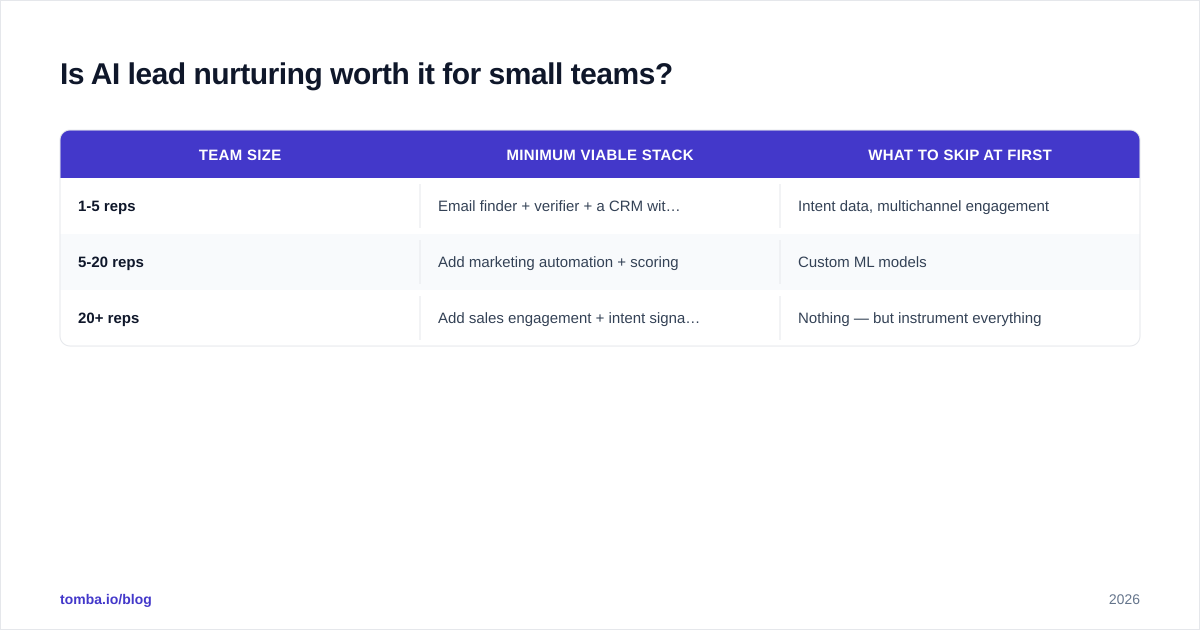
| Team size | Minimum viable stack | What to skip at first |
|---|---|---|
| 1-5 reps | Email finder + verifier + a CRM with basic workflows | Intent data, multichannel engagement |
| 5-20 reps | Add marketing automation + scoring | Custom ML models |
| 20+ reps | Add sales engagement + intent signals | Nothing — but instrument everything |
Common mistakes that kill AI nurturing#
- Automating before validating. If a human can't make the sequence work manually on 20 leads, AI won't fix it across 2,000.
- Ignoring suppression. Sending to everyone who hasn't unsubscribed is not nurturing; it's spamming with extra steps.
- Optimizing opens. Apple Mail Privacy Protection broke open tracking years ago. Build your logic on clicks, replies, and site behavior.
- No human handoff. The point of scoring is to get a person to the right lead at the right moment. If hot leads die in automation, the system failed.
- Stale data. Records decay ~25-30% per year. A nurture program without ongoing verification slowly poisons itself.
The bottom line#
AI lead nurturing is not a product you buy; it's a system you assemble — data, signals, decisions, actions — with a tight measurement loop on top. The teams that win treat AI as the decision layer and invest first in the boring foundation: accurate, verified, enriched contact data. Get that right and a modest automation setup outperforms an expensive one built on dirty records.
Start with the foundation. Before you wire up a single workflow, make sure the contacts feeding it are real and complete. Tomba's Email Finder gives you verified, role-correct professional emails by name, company, or domain — the clean input every AI nurturing engine depends on. Spin up the free tier (25 searches/month), feed your first segment, and let your nurture system work with data it can actually trust.
// get started
Find, verify and enrich your first contacts today
Start on the free plan with 25 searches a month, then scale when your team is ready.
Free plan · No credit card required · GDPR & CCPA
// about the author