AI Lead Prospecting in 2026: The Complete Sales Playbook
AI lead prospecting replaces guesswork with signal-driven targeting. Here's how it works in 2026, what stack you need, and where it still fails.
TL;DR
- AI lead prospecting uses machine learning to find, score, and prioritize accounts based on buying signals — not just static firmographics — so reps spend time on the 5% of contacts most likely to reply.
- The biggest gains come from signal timing (hiring, funding, tech changes, intent), not from "AI" writing your emails.
- A working stack has four layers: signal capture, enrichment, scoring, and verified contact data. Skip any one and the others underperform.
- AI still hallucinates titles, invents emails, and overweights noisy signals. A verification step is non-negotiable.
- You can run a credible AI prospecting motion on a $49–$99/mo budget if you pair the right tools instead of buying one bloated platform.
What is AI lead prospecting?#
AI lead prospecting is the practice of using machine learning to identify, rank, and enrich potential buyers before a human ever touches the list. Think of it like a metal detector on a beach. Manual prospecting is walking the sand and digging holes at random; AI prospecting is sweeping the detector first and only digging where it beeps. The sand is the same — millions of companies and contacts — but you stop wasting energy on empty ground.
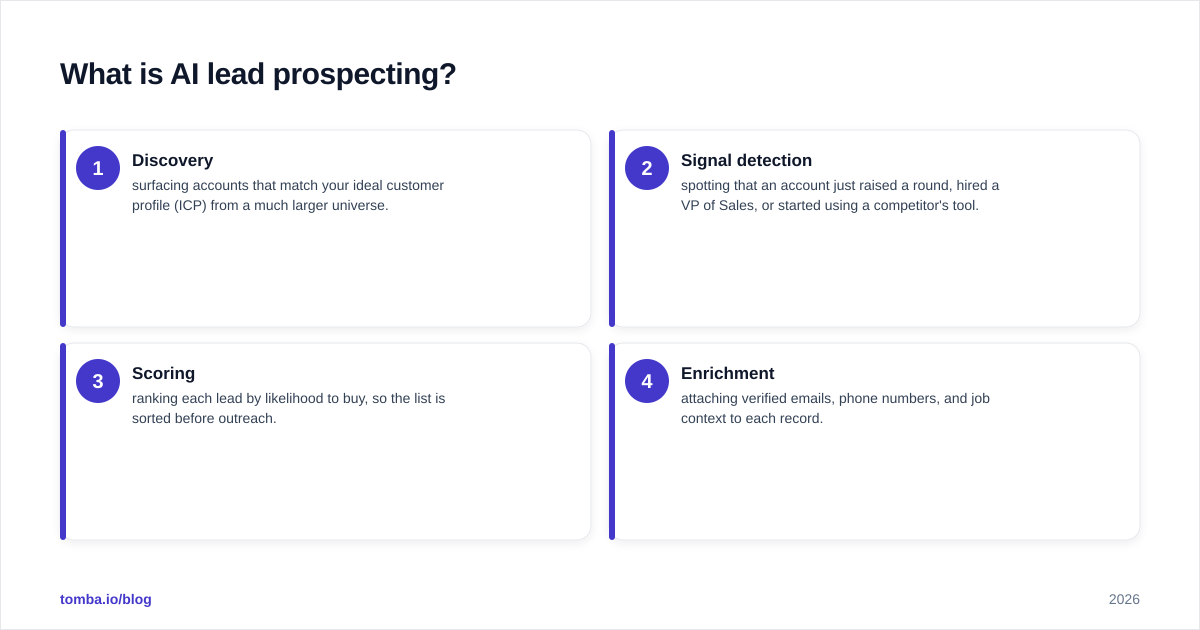
Concretely, AI handles four jobs that used to eat an SDR's morning:
- Discovery — surfacing accounts that match your ideal customer profile (ICP) from a much larger universe.
- Signal detection — spotting that an account just raised a round, hired a VP of Sales, or started using a competitor's tool.
- Scoring — ranking each lead by likelihood to buy, so the list is sorted before outreach.
- Enrichment — attaching verified emails, phone numbers, and job context to each record.
The "AI" part matters most in steps 2 and 3. Anyone can pull a list of SaaS companies with 50–200 employees. The edge is knowing which of those companies showed a buying signal in the last 14 days — and reaching them while the signal is warm.
How is AI prospecting different from traditional list-building?#
Traditional list-building is static. You define a filter — industry, headcount, geography — export a few thousand rows, and work them top to bottom. The list is outdated the moment you download it, and everyone using the same database is hitting the same contacts.
AI prospecting is dynamic and probabilistic. Instead of "give me all fintech companies in Texas," you ask "give me fintech companies in Texas that are acting like buyers right now." The system watches for change — a new job posting, a funding event, a technology install — and pushes those accounts to the top.
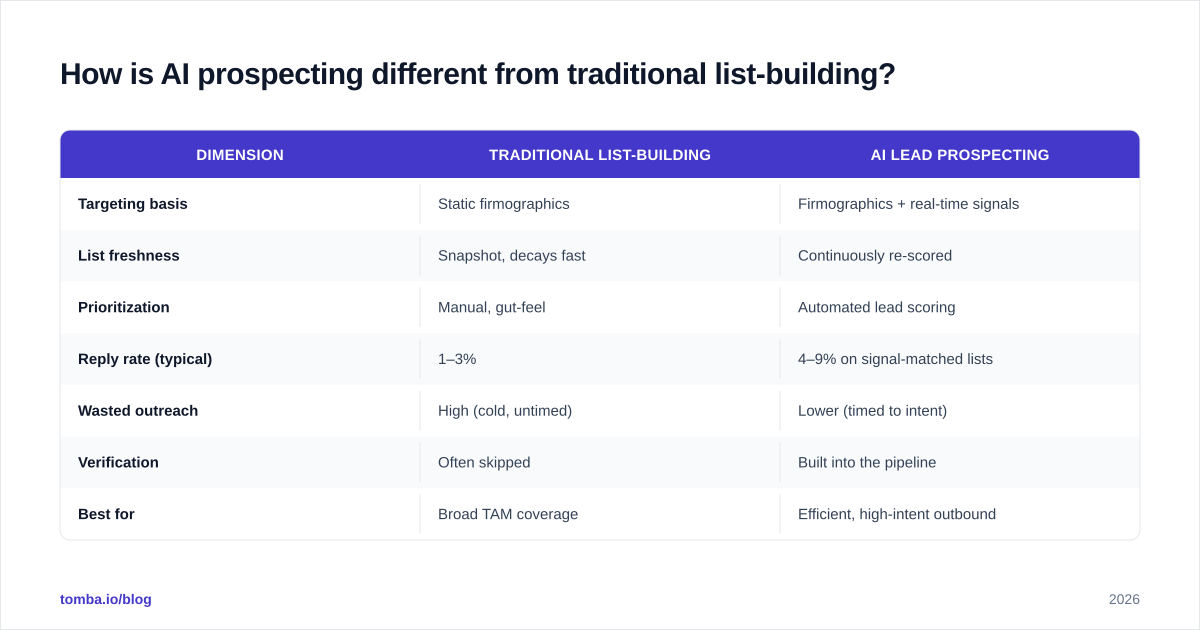
Here's the practical difference in one table.
| Dimension | Traditional list-building | AI lead prospecting |
|---|---|---|
| Targeting basis | Static firmographics | Firmographics + real-time signals |
| List freshness | Snapshot, decays fast | Continuously re-scored |
| Prioritization | Manual, gut-feel | Automated lead scoring |
| Reply rate (typical) | 1–3% | 4–9% on signal-matched lists |
| Wasted outreach | High (cold, untimed) | Lower (timed to intent) |
| Verification | Often skipped | Built into the pipeline |
| Best for | Broad TAM coverage | Efficient, high-intent outbound |
The reply-rate figures vary wildly by market, but the direction is consistent across teams: timing your outreach to a real signal beats spraying a static list. AI doesn't make your message better — it makes your timing better, and timing is most of the game.

What signals does AI lead prospecting actually use?#
A signal is any observable change that correlates with buying intent. The art is collecting enough of them and weighting them sensibly. The most reliable categories:
- Hiring signals — A company posting for roles your product supports (e.g., "Demand Gen Manager" if you sell marketing software) is staffing up a problem you solve.
- Funding signals — A fresh Series A or B means new budget and pressure to grow. These accounts buy faster.
- Technographic signals — Knowing a company runs a specific CRM, cloud, or competitor tool tells you about fit and displacement opportunities.
- Intent data — Third-party signals that an account is researching your category (review-site visits, content consumption). Treat this as directional, not gospel.
- Trigger events — Leadership changes, office openings, M&A, product launches.
- Engagement signals — Site visits, content downloads, and email opens from your own funnel.
No single signal is decisive. A funding round with no hiring and no category intent is weaker than a smaller account showing three converging signals. Good AI scoring is about convergence: stacking independent signals so the false positives cancel out. If you want a primer on how intent feeds the broader funnel, the concept of a marketing qualified lead is the bridge between a raw signal and a sales-ready contact.
What does an AI prospecting stack look like?#
You don't need one monolithic platform. In fact, the teams getting the best results in 2026 assemble a thin stack of focused tools. There are four layers, and each has a clear job.
Layer 1 — Signal capture. Tools or feeds that watch for hiring, funding, technographic, and intent changes. This is where intent platforms and job-board scrapers live.
Layer 2 — Account enrichment. Once an account is flagged, you attach firmographics, the org chart, and the right decision-makers. This is where data enrichment turns a company name into a buying committee.
Layer 3 — Lead scoring. A model — sometimes a vendor's, sometimes your own — ranks the enriched accounts so reps work the list in priority order.
Layer 4 — Contact data. None of the above matters if you can't reach the person. You need a verified work email and, ideally, a phone number. This is the layer most teams under-invest in, and it's the one that silently kills campaigns through bounces and spam complaints.
The reason to keep these layers separate is leverage. If your signal source improves, you swap Layer 1 without rebuilding everything. If your email accuracy drops, you fix Layer 4 in isolation. Bundling everything into one suite feels tidy but locks you into that vendor's weakest component.
Which tools fit each layer?#
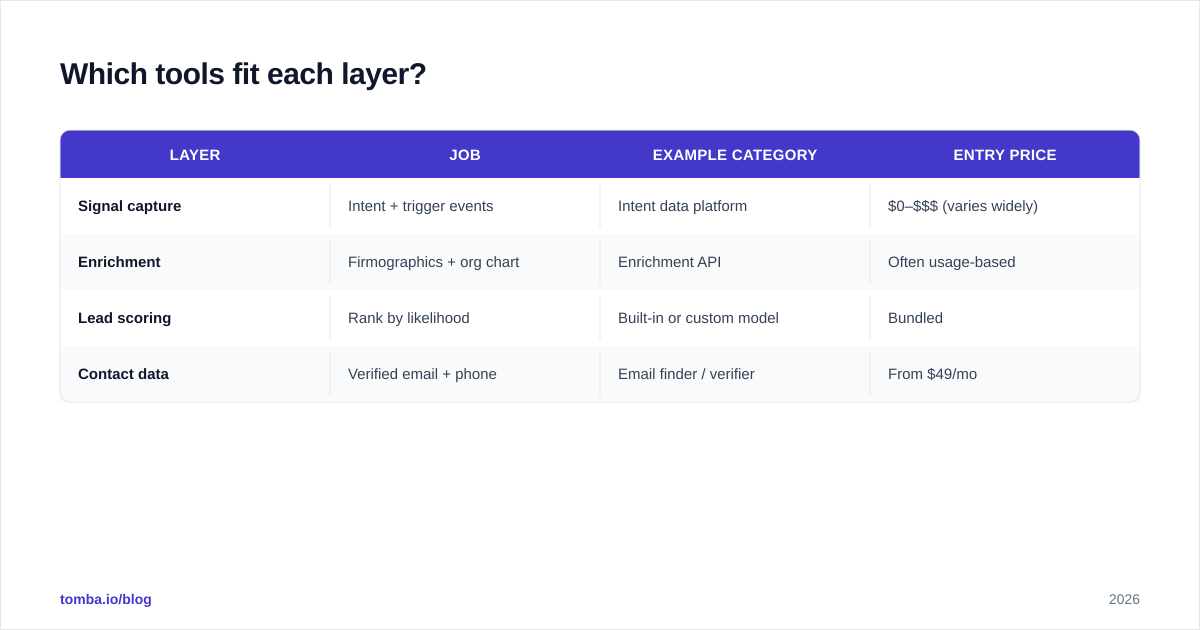
Below is a representative pairing of categories and what they cost to start. Prices are entry tiers and change often — check vendor pages before budgeting.
| Layer | Job | Example category | Entry price |
|---|---|---|---|
| Signal capture | Intent + trigger events | Intent data platform | $0–$$$ (varies widely) |
| Enrichment | Firmographics + org chart | Enrichment API | Often usage-based |
| Lead scoring | Rank by likelihood | Built-in or custom model | Bundled |
| Contact data | Verified email + phone | Email finder / verifier | From $49/mo |
For the contact-data layer specifically, Tomba pricing starts with a free tier (25 searches/mo), then Starter at $49/mo, Growth at $99/mo, and Pro at $249/mo. That covers the email finder, email verifier, and domain search in one account — which is most of Layer 4 for a small outbound team.
If you're evaluating broader all-in-one prospecting suites, it's worth reading independent reviews on G2 and comparing how each platform actually sources and refreshes its data rather than trusting the marketing claims. Many "AI prospecting" suites are reselling the same underlying database, and the differentiator is verification quality, not the AI veneer.

How do you build an AI prospecting workflow step by step?#
Here's a workflow you can stand up in a week. It assumes you already know your ICP — if you don't, fix that first, because no amount of AI rescues a vague target.
Step 1 — Define the trigger. Pick one or two signals that map cleanly to your product. "Hiring a sales role" for a sales tool. "Recently funded" for an expansion-stage product. Resist the urge to track everything on day one.
Step 2 — Capture matching accounts. Feed those triggers into your signal layer and let it produce a daily or weekly list of flagged companies. Keep the volume small enough to act on — 50 high-signal accounts beat 5,000 cold ones.
Step 3 — Enrich and find the buying committee. For each flagged account, identify the 2–4 people who actually decide. Use domain search to map a company's email pattern and surface roles, then narrow to the right titles.
Step 4 — Get verified contact data. Run each contact through an email verifier before sending. A bounce rate above 3–5% damages your sender reputation and pushes future mail to spam. This step is boring and entirely non-optional.
Step 5 — Score and sequence. Sort by score, then load the top accounts into your sequencer. Personalize the first line around the signal — "Saw you're hiring three AEs" lands far harder than "Hope you're well."
Step 6 — Measure and feed back. Track which signals produced replies and meetings, and weight the winners higher next cycle. The model gets smarter only if you close the loop.
The discipline that separates good AI prospecting from expensive list-buying is Step 4 and Step 6: verify before you send, and learn after. Most teams skip both and then blame "AI" for the poor results.
Where does AI lead prospecting still fail?#
AI prospecting is powerful, not magic. Knowing the failure modes keeps you from trusting it blindly.
- Hallucinated contacts. Generative tools will confidently invent an email address that follows a plausible pattern but doesn't exist. Always verify; never send to an unverified guess.
- Stale or wrong titles. People change jobs constantly. An "AI-enriched" record can be 18 months out of date. Cross-check against a recent source.
- Signal noise. Intent data is probabilistic and often noisy. A spike in "research activity" can be a competitor, a job seeker, or a student. Use intent to prioritize, not to prove.
- Over-automation. Fully automated, AI-written sequences at scale are the fastest way to torch your domain reputation. Volume without verification and relevance is just faster spam.
- Compliance blind spots. Scraped data and automated outreach run into GDPR, CAN-SPAM, and regional rules. The tool won't keep you compliant; your process has to.
The honest summary: AI handles the scale and timing problems well, and the judgment problems poorly. Keep a human reviewing the top of the list and writing the angle, and let the machine do the sweeping.
Is AI lead prospecting worth it for small teams?#
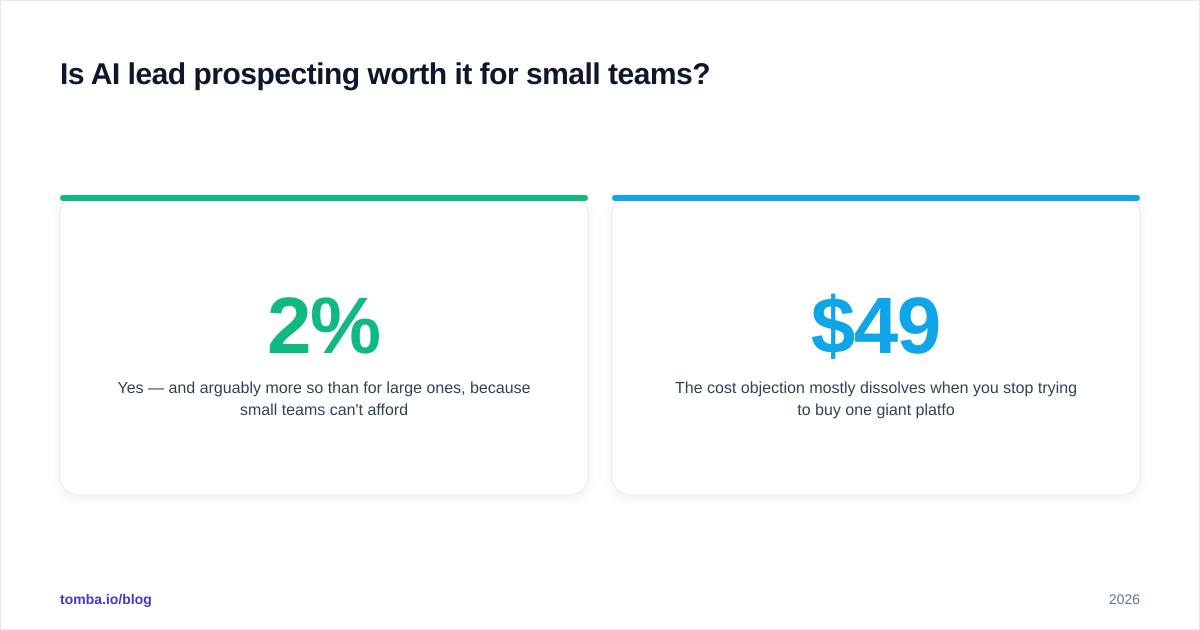
Yes — and arguably more so than for large ones, because small teams can't afford wasted reps' time. The math is simple. If AI prospecting lifts your reply rate from 2% to 5%, you've roughly 2.5x'd your meeting volume from the same number of sends. For a two-person SDR team, that's the difference between hitting quota and missing it, with no new headcount.
The cost objection mostly dissolves when you stop trying to buy one giant platform. A focused stack — a signal source, an enrichment layer, and a verified email finder around $49–$99/mo — gets a lean team most of the value of the enterprise suites at a fraction of the price. You can always add intent platforms once the basic motion is paying for itself.
What you should not do is buy AI prospecting to avoid thinking about your ICP, your message, or your follow-up. AI amplifies whatever motion you already have. Amplifying a bad motion just produces bad results faster.
Getting started#
Start narrow. Pick one trigger signal, build a list of 50 high-intent accounts, enrich the buying committee, verify every email, and write outreach that references the signal directly. Measure replies, weight the winning signals, and repeat. That single loop — done with discipline — outperforms most six-figure "AI prospecting platforms" run carelessly.
When you're ready to wire up the contact-data layer, the Tomba Email Finder is built exactly for this job: find professional email addresses by domain, name, or company, verify them before you send, and keep your bounce rate low enough to protect your sender reputation. Pair it with your signal source of choice, start on the free tier, and scale into Growth at $99/mo once the motion is working. Find the right people, reach them while the signal is warm, and let the machine handle the sweeping.
// get started
Find, verify and enrich your first contacts today
Start on the free plan with 25 searches a month, then scale when your team is ready.
Free plan · No credit card required · GDPR & CCPA
// about the author