AI Lead Qualification in 2026: Score Leads Faster
AI lead qualification scores and routes leads in real time so reps spend their hours on deals that actually close. Here's how it works, what to buy, and where to start.
TL;DR
- AI lead qualification uses machine learning to score, rank, and route leads automatically — replacing the static point-based rules most teams still run in their CRM.
- It works by learning from your closed-won and closed-lost history, then scoring new leads on fit and intent signals in real time.
- Teams that adopt it typically cut response time, raise conversion on "A" leads, and stop reps from wasting hours on prospects that were never going to buy.
- It is only as good as your data. Garbage contact records and missing firmographics produce confident, wrong scores.
- You don't need a data-science team to start. Most modern CRMs and scoring tools ship predictive models you can turn on this quarter.
What is AI lead qualification?#
AI lead qualification is the use of machine learning to predict how likely a lead is to convert, then score and route that lead without a human manually grading it.
Think of it like a credit score for your pipeline. A bank doesn't read every loan application from scratch and guess; it feeds applicant data into a model trained on millions of past loans that did or didn't default, and gets a number. AI lead qualification does the same thing with your deals: it studies every lead you've ever won or lost, finds the patterns that separated them, and applies those patterns to the new lead that just filled out a form.
The technical version: a model ingests features about each lead — company size, industry, job title, page views, email engagement, product usage — and outputs a probability of conversion. That probability becomes a score, the score drives routing, and routing decides which rep gets the lead and how fast.
The contrast with the old way is the whole point. Traditional lead scoring is a spreadsheet of rules someone invented: +10 for a demo request, +5 for opening an email, -20 for a free email domain. Those rules are guesses, they go stale, and nobody updates them. AI replaces the guessing with measurement.
)
How does AI lead qualification actually work?#
It runs in four stages, and understanding them tells you exactly where your implementation will succeed or break.
1. Data collection. The model needs signals. These split into two buckets: fit (who the lead is — firmographics, technographics, job title, region) and intent (what the lead does — site visits, content downloads, email opens, demo requests, product trial activity). Most teams already collect both; they just don't connect them.
2. Feature engineering and enrichment. Raw data is rarely model-ready. A lead who typed "VP Sls" needs to be normalized to "VP Sales." A company with only a domain needs headcount, industry, and revenue appended. This is where data enrichment earns its keep — a model scoring on half-empty records is scoring on noise.
3. Scoring. The trained model assigns each lead a probability or a grade (A/B/C/D, or 0–100). Good systems update the score continuously as new behavior arrives, so a lead that goes quiet decays and a lead that suddenly visits your pricing page three times jumps.
4. Routing and action. The score triggers something: assign to an AE, drop into a nurture track, fire a Slack alert, or book a meeting. A score nobody acts on is a vanity metric.
The loop closes when outcomes feed back. Every deal that closes or dies becomes new training data, and the model gets sharper. That feedback loop is the difference between AI qualification and a fancier static rule — it learns from being wrong.
AI lead qualification vs. traditional lead scoring: what's the difference?#
Here's the honest side-by-side. Neither is magic, but the gap is real once your lead volume passes what a human can read by hand.
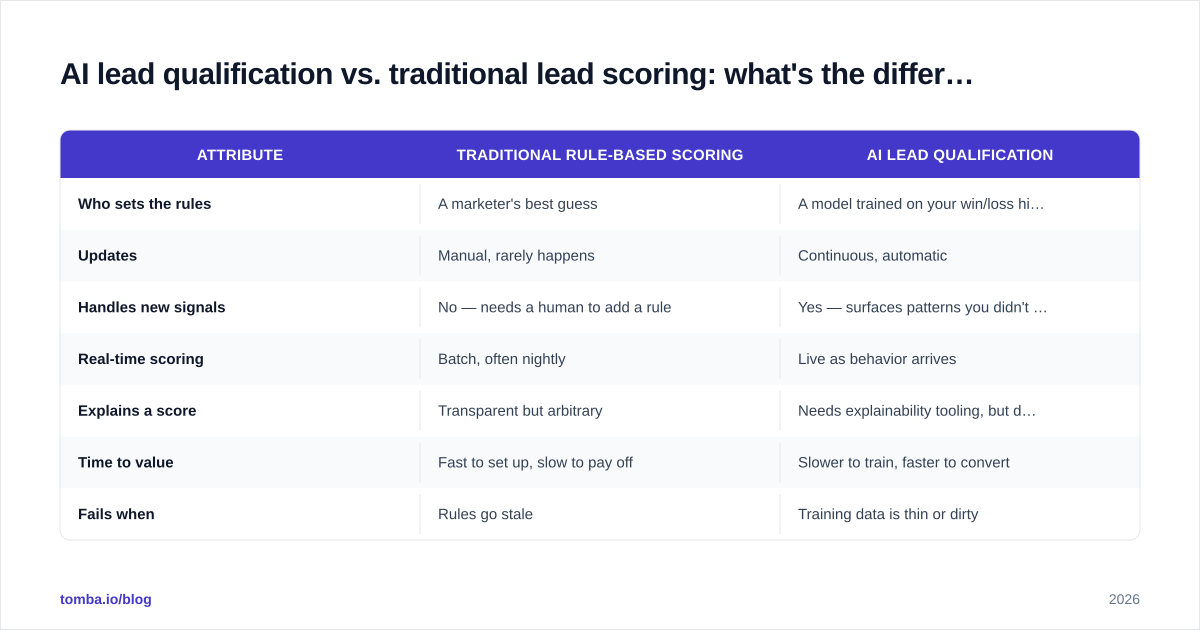
| Attribute | Traditional rule-based scoring | AI lead qualification |
|---|---|---|
| Who sets the rules | A marketer's best guess | A model trained on your win/loss history |
| Updates | Manual, rarely happens | Continuous, automatic |
| Handles new signals | No — needs a human to add a rule | Yes — surfaces patterns you didn't know mattered |
| Real-time scoring | Batch, often nightly | Live as behavior arrives |
| Explains a score | Transparent but arbitrary | Needs explainability tooling, but data-backed |
| Time to value | Fast to set up, slow to pay off | Slower to train, faster to convert |
| Fails when | Rules go stale | Training data is thin or dirty |
The takeaway: rule-based scoring is fine when you have low volume and a tight ICP you understand cold. The moment you're generating more leads than your reps can personally judge — or your ICP is fuzzy — AI starts winning because it sees correlations a human never encodes. HubSpot's research on marketing data maturity makes the same point: teams drowning in leads convert better when machines do the first pass.
What signals does AI use to qualify a lead?#
Not all signals carry equal weight, and the best models weight them for you. But you should know the raw material going in.
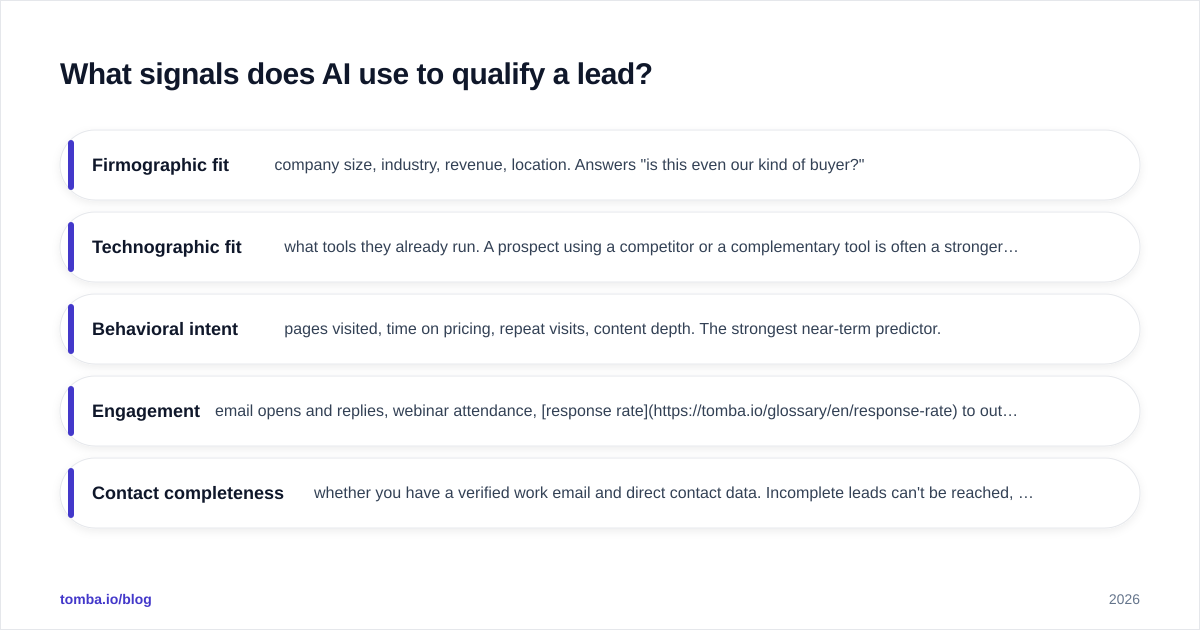
- Firmographic fit — company size, industry, revenue, location. Answers "is this even our kind of buyer?"
- Technographic fit — what tools they already run. A prospect using a competitor or a complementary tool is often a stronger lead.
- Behavioral intent — pages visited, time on pricing, repeat visits, content depth. The strongest near-term predictor.
- Engagement — email opens and replies, webinar attendance, response rate to outreach.
- Contact completeness — whether you have a verified work email and direct contact data. Incomplete leads can't be reached, so they can't convert regardless of fit.
That last point is quietly the most important. A model can flag a perfect-fit lead, but if the only contact you have is a generic info@ address, the lead is dead on arrival. This is why qualification and contact data sit so close together — you qualify and you need a way to reach the people you qualified. Tools like the Tomba email finder and data enrichment exist to fill that gap before the score is even calculated.
)
Which tools handle AI lead qualification in 2026?#
You have three broad options, and most teams blend them rather than pick one.
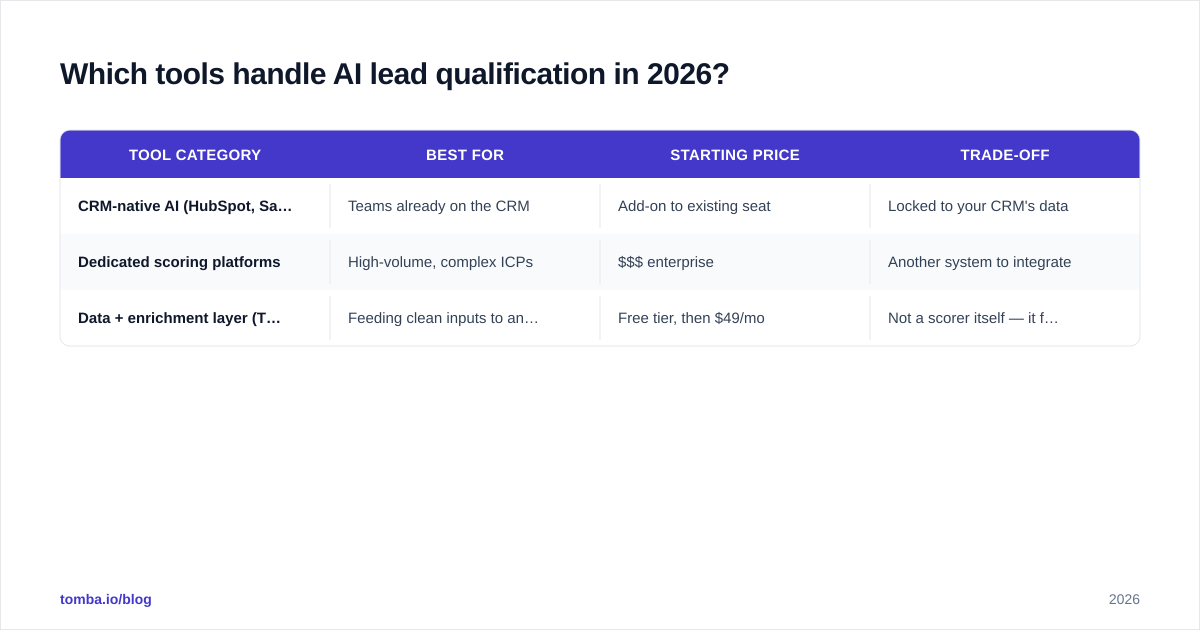
| Tool category | Best for | Starting price | Trade-off |
|---|---|---|---|
| CRM-native AI (HubSpot, Salesforce Einstein) | Teams already on the CRM | Add-on to existing seat | Locked to your CRM's data |
| Dedicated scoring platforms | High-volume, complex ICPs | $$$ enterprise | Another system to integrate |
| Data + enrichment layer (Tomba) | Feeding clean inputs to any model | Free tier, then $49/mo | Not a scorer itself — it fuels one |
The mistake teams make is shopping for a scorer before fixing their inputs. Salesforce's Einstein lead scoring is genuinely good, but it scores on the data in your CRM — and if half your leads are missing job titles and company size, you're paying for confident guesses.
That's the role a data layer plays. Before a lead ever hits the model, you want a verified work email, a normalized company, and appended firmographics. You can do this in bulk with the bulk email finder and clean addresses with the email verifier so bounced, fake, and catch-all addresses don't pollute your training set. Pricing across these tiers is laid out on the Tomba pricing page — the free tier (25 searches/mo) is enough to test the workflow before you commit.
For pricing and feature parity on the scoring platforms themselves, G2's lead-scoring category is the least-biased place to compare current options.
How do you roll out AI lead qualification without breaking your pipeline?#
Start small and prove it before you let a model touch routing. Here's a sequence that doesn't blow up your funnel.
Step 1 — Audit your data. Pull 200 recent leads and check how many have a verified email, a job title, and company size. If it's under 80%, fix data before anything else. A model trained on holes learns the holes.
Step 2 — Define your outcome. Decide what "qualified" means in revenue terms. Closed-won? Opportunity created? A booked demo that showed up? The model optimizes for whatever you label, so label the thing that actually makes money.
Step 3 — Run AI in shadow mode. Let the model score leads for 30–60 days without changing routing. Compare its grades against what actually closed. If its "A" leads convert noticeably better than its "D" leads, it's working.
Step 4 — Automate routing for the obvious tiers. Start by auto-routing only the clearest "A" leads to AEs and the clearest "D" leads to nurture. Keep humans in the loop on the messy middle until you trust it.
Step 5 — Close the loop. Feed every outcome back. Review the model quarterly. Watch for drift — if your ICP shifts and the model doesn't, scores degrade quietly.
Plenty of teams plug enrichment into this loop through the HubSpot integration or Salesforce integration, so freshly qualified leads land in the CRM already enriched and verified. That keeps your CRM clean enough for the next scoring cycle.
What are the risks and limits of AI lead qualification?#
It's not a set-and-forget machine. Four failure modes show up repeatedly.
Dirty data in, confident garbage out. This is the dominant risk. A model will happily score a lead with a typo'd company name and a fake email — and it'll sound sure. Verification and enrichment aren't optional pre-work; they're the foundation.
Bias toward your past. The model learns from who you've won before. If your historical wins skew toward one industry, the model may under-score a great lead from a new segment you're trying to break into. Watch for it, and override deliberately when you expand your ICP.
The black-box problem. When a rep asks "why is this an A lead?" and the answer is "the model said so," trust erodes. Pick tools with explainability — at minimum, the top factors behind each score. Gartner's analysts flag explainability as the top blocker to sales-AI adoption, and they're right.
Over-automation. A score is a recommendation, not a verdict. The teams that win keep a human checkpoint on high-value deals. The model handles volume; people handle judgment.
None of these kill the value. They just mean AI qualification is a system you run, not a button you press.
Is AI lead qualification worth it for a small team?#
Yes — arguably more than for a big one, because small teams can least afford wasted rep hours.
If you have two reps and 500 leads a month, your reps physically cannot give each lead a fair read. They'll cherry-pick the obvious ones and let real opportunities rot in the queue. AI does the triage so your reps spend their limited hours on the leads most likely to close. That's not a luxury at small scale; it's survival.
The cost objection mostly dissolves once you separate the two spends. The scoring model might be a free add-on in your CRM. The data layer that feeds it — verified emails, enrichment, contact discovery — starts free and scales with you. You can validate the entire workflow on a free email checker and the free tier before paying a cent.
The honest caveat: if you generate 20 leads a month and know each one personally, skip it. AI qualification pays off when volume exceeds human attention. Below that line, a sharp human and a simple rule beat a model every time.
Where do you start this week?#
Start with the input, not the algorithm. The fastest, lowest-risk move is making sure every lead entering your funnel arrives with a verified work email and complete firmographics — because that's the one fix that improves every downstream model, rule, and rep decision at once.
The Tomba Email Finder finds and verifies professional email addresses by name, company, or domain, and pairs with enrichment to fill in the firmographic gaps your scoring model needs. Start on the free tier (25 searches/mo), connect it to your CRM, and feed your qualification engine clean data from day one. Your model is only as smart as what you feed it — so feed it well.
Ready to find emails that actually work?
Join 150,000+ professionals who stopped guessing and started sending. Free credits on signup — no credit card required.
Get the Tomba newsletter
Practical outbound tactics and product updates — once every two weeks.
About the author