AI Lead Qualification Agent: The Complete 2026 Guide
An AI lead qualification agent scores, routes, and enriches inbound and outbound leads in real time. Here's how it works, what to evaluate, and how to deploy one without breaking your pipeline.
TL;DR
- An AI lead qualification agent is software that ingests a new lead, enriches it with firmographic and contact data, scores it against your ICP, and routes or disqualifies it — usually in seconds, without a human touching it.
- It replaces the slowest part of the funnel: SDRs manually researching and triaging leads that mostly never convert.
- The agent is only as good as its data. Garbage enrichment in means garbage scoring out, so your contact and company data layer matters more than the model.
- Expect to qualify leads 5–20x faster, but keep humans on edge cases, high-value accounts, and final routing decisions.
- Start narrow: one channel, one scoring model, one routing rule. Expand once you trust the outputs.
What is an AI lead qualification agent?#
An AI lead qualification agent is an autonomous (or semi-autonomous) system that decides whether a lead is worth your sales team's time — and what to do with it next. Think of it as a tireless junior SDR who reads every inbound form fill, looks up the company, checks it against your ideal customer profile, and either books it for a rep or politely sets it aside.
The difference between this and old-school lead scoring is agency. A traditional scoring model assigns points and stops. An agent takes the next step: it enriches missing fields, queries external data sources, applies reasoning to ambiguous cases, and triggers an action — assign, nurture, or disqualify. Gartner groups this under the broader shift toward agentic AI in go-to-market workflows, where software doesn't just recommend but executes.
Here's the everyday analogy: classic lead scoring is a smoke detector that beeps. An AI qualification agent is a smart home system that detects the smoke, checks whether it's a real fire or burnt toast, and calls the fire department only when it matters.
How does an AI lead qualification agent actually work?#
Most agents follow the same four-stage loop, regardless of vendor.
1. Ingest. A lead arrives — a demo request, a webinar signup, a list upload, a website visitor reveal. The agent captures whatever fields exist, which is usually just an email and a name.
2. Enrich. This is where thin leads become useful. The agent appends company size, industry, revenue, tech stack, job title, seniority, and verified contact details. A form that captured only jane@acme.com becomes "Jane Doe, VP Engineering at Acme (450 employees, SaaS, uses AWS)." Quality data enrichment is the single biggest lever on accuracy here — the model can't score what it can't see.
3. Score. The enriched profile is graded against your ICP and behavioral signals. Modern agents blend rule-based thresholds (must be in North America, must be 50+ employees) with model-based reasoning (this title is decision-making-adjacent even though it's not an exact match).
4. Route or disqualify. The agent acts. High-fit, high-intent leads get assigned to a rep and pushed into the CRM with context. Mid-fit leads enter a nurture sequence. Poor-fit leads are disqualified with a logged reason so you can audit later.
The loop closes when outcomes feed back in. Did the "hot" lead convert? Did the disqualified one come back six months later and buy? Good agents use that signal to recalibrate.

Why not just keep using manual SDR qualification?#
Because the math stops working at scale. An SDR researching a single lead — opening LinkedIn, checking the company site, guessing the email, logging notes — burns 5 to 10 minutes. At 200 inbound leads a week, that's most of a full-time role spent on triage, before a single conversation happens.
Worse, humans triage inconsistently. The same lead gets a different verdict depending on who's tired, who's behind on quota, and who skimmed the form. An MQL that one rep ignores, another chases for a week.
The agent fixes three specific failures:
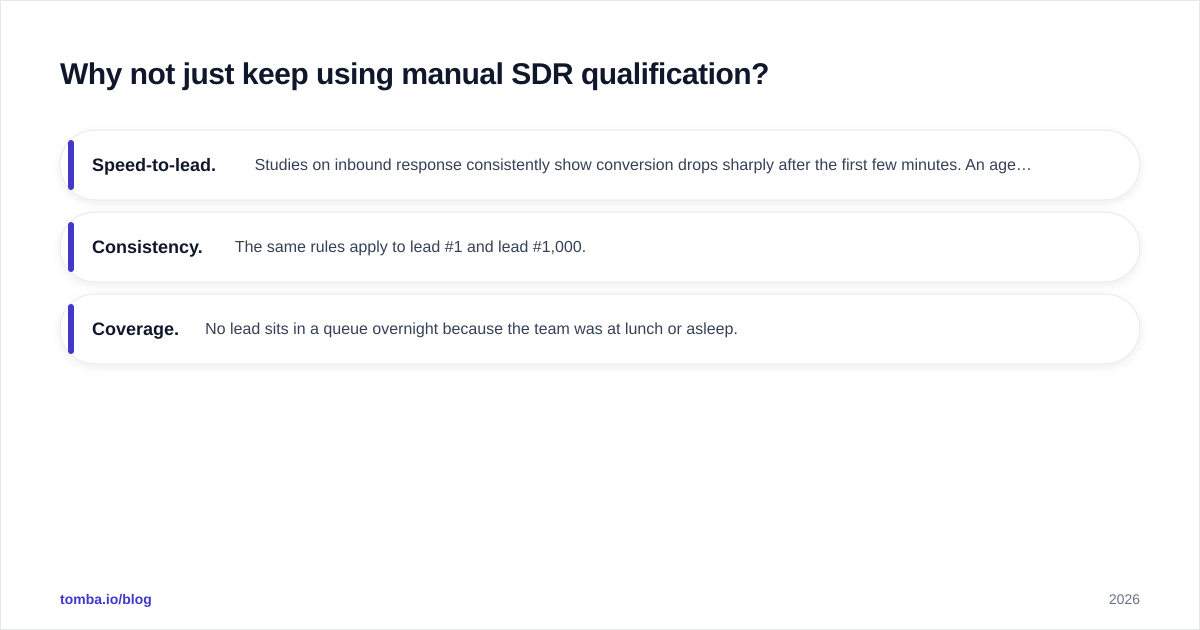
- Speed-to-lead. Studies on inbound response consistently show conversion drops sharply after the first few minutes. An agent qualifies and routes before a human has refilled their coffee.
- Consistency. The same rules apply to lead #1 and lead #1,000.
- Coverage. No lead sits in a queue overnight because the team was at lunch or asleep.
That said — qualification is a place to augment reps, not delete them. The agent handles volume; humans handle judgment, relationships, and the six-figure accounts where being wrong is expensive.
What should you look for in an AI lead qualification agent?#
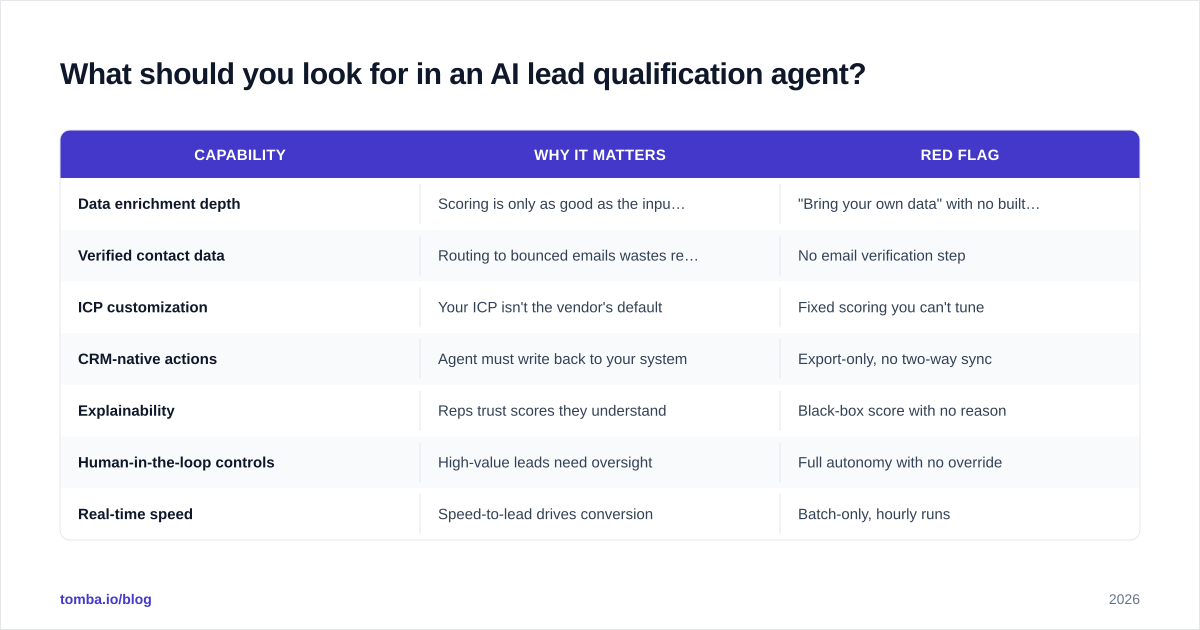
Not all agents are equal, and the demos all look the same. Evaluate on these axes.
| Capability | Why it matters | Red flag |
|---|---|---|
| Data enrichment depth | Scoring is only as good as the inputs | "Bring your own data" with no built-in enrichment |
| Verified contact data | Routing to bounced emails wastes rep time | No email verification step |
| ICP customization | Your ICP isn't the vendor's default | Fixed scoring you can't tune |
| CRM-native actions | Agent must write back to your system | Export-only, no two-way sync |
| Explainability | Reps trust scores they understand | Black-box score with no reason |
| Human-in-the-loop controls | High-value leads need oversight | Full autonomy with no override |
| Real-time speed | Speed-to-lead drives conversion | Batch-only, hourly runs |
A practical buyer's checklist on top of the table:
- Test it on your own leads, not the vendor's sample set. Sample data is curated. Your messy inbound is the real exam.
- Check the enrichment match rate. If the agent can only enrich 40% of your leads, it's guessing on the other 60%.
- Verify the contact data. An agent that finds an email but doesn't confirm it's deliverable is just generating bounces. Pair qualification with email verification before anything hits a rep's queue.
- Demand a reason code on every decision. "Disqualified: company under 10 employees" is auditable. A bare score of 12 is not.
How do AI agents compare to traditional lead scoring tools?#
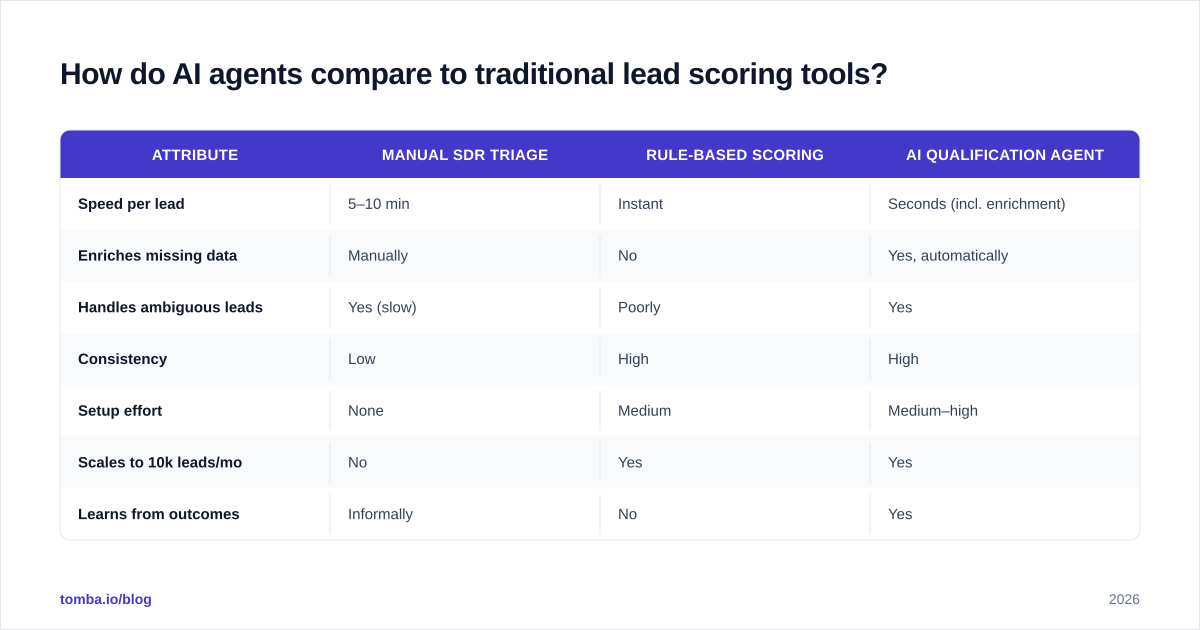
The categories overlap, but the gap is widening. Here's how the three common approaches stack up.
| Attribute | Manual SDR triage | Rule-based scoring | AI qualification agent |
|---|---|---|---|
| Speed per lead | 5–10 min | Instant | Seconds (incl. enrichment) |
| Enriches missing data | Manually | No | Yes, automatically |
| Handles ambiguous leads | Yes (slow) | Poorly | Yes |
| Consistency | Low | High | High |
| Setup effort | None | Medium | Medium–high |
| Scales to 10k leads/mo | No | Yes | Yes |
| Learns from outcomes | Informally | No | Yes |
| Cost at scale | High (headcount) | Low | Medium |
Rule-based scoring inside a CRM is still fine if your funnel is simple and your data is clean. The moment you have inbound volume, dirty data, and ambiguous titles, the agent earns its keep. Platforms like HubSpot and Salesforce now ship AI scoring layers on top of their classic rule engines precisely because static rules can't keep up with messy real-world leads.

What data does an AI lead qualification agent need to be accurate?#
This is the part teams underestimate. The model is rarely the bottleneck — the data feeding it is.
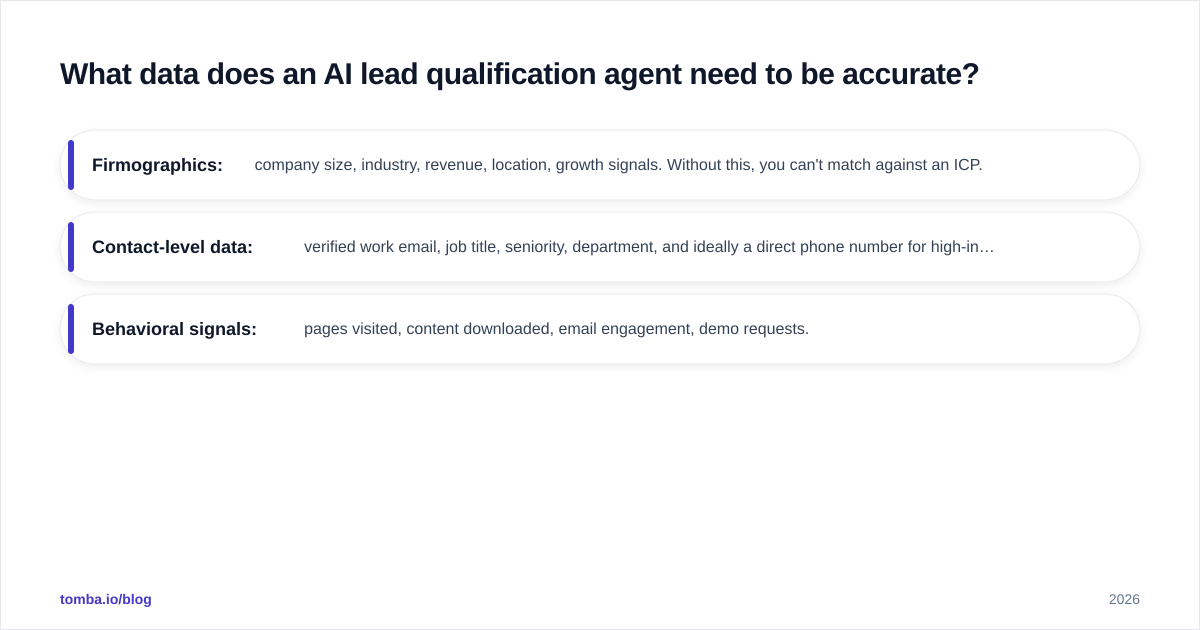
A reliable agent needs three data layers:
- Firmographics: company size, industry, revenue, location, growth signals. Without this, you can't match against an ICP.
- Contact-level data: verified work email, job title, seniority, department, and ideally a direct phone number for high-intent routing.
- Behavioral signals: pages visited, content downloaded, email engagement, demo requests.
The first two layers are where most pipelines leak. If your enrichment provider can't reliably turn a name and domain into a verified, deliverable contact, your agent will confidently route garbage. This is why a strong contact-data foundation — an accurate email finder plus verification — underpins the whole system. You can read more about where that data comes from and why source quality drives match rates.
A simple rule: audit your enrichment match rate and verification rate before you blame the scoring model. If 30% of leads come back with no verified contact, fix the data layer first.
How do you deploy an AI lead qualification agent without breaking your pipeline?#
Roll it out in stages. The fastest way to lose your team's trust is to flip on full autonomy on day one and let it disqualify a whale.
Phase 1 — Shadow mode. Run the agent in parallel with your current process. It scores and logs decisions but takes no action. Compare its verdicts to your reps' for two to four weeks.
Phase 2 — Assisted mode. Let the agent enrich and score, but a human approves routing. This builds trust and surfaces edge cases in your ICP rules.
Phase 3 — Autonomous for the safe band. Let the agent fully handle the clear cases — obvious disqualifications and obvious high-fit leads — while flagging the ambiguous middle and all high-value accounts for human review.
Phase 4 — Continuous tuning. Feed conversion outcomes back in. Review disqualification reasons monthly. Watch for drift, where the agent starts over- or under-qualifying as your market shifts.
Throughout, keep two guardrails: a hard override so reps can reverse any decision, and a logged reason on every action so you can audit what happened and why.
What are the limits and risks?#
Be honest with yourself about what an agent can't do.
- It inherits your biases. If your historical "good leads" skew toward one industry, the agent will too. Audit for that.
- It can be confidently wrong. A bad enrichment match produces a clean-looking but false profile. Verification is your safety net.
- It won't fix a broken ICP. If you don't actually know who buys, no agent will discover it for you. Define the ICP first.
- Edge cases need humans. Champions who switched companies, unusual buying committees, and strategic accounts deserve a person.
The teams that win with these agents treat them as a force multiplier on a clean data foundation, not a magic box that excuses sloppy targeting.
Frequently asked questions#
Is an AI lead qualification agent the same as lead scoring? No. Scoring assigns a number. An agent enriches, scores, reasons about ambiguous cases, and takes an action — routing, nurturing, or disqualifying — automatically.
How fast can it qualify a lead? Typically seconds, including enrichment, versus 5–10 minutes for manual SDR research. The speed advantage is the main driver of higher conversion.
Will it replace SDRs? It replaces the triage grind, not the role. Reps move from researching leads to working the qualified ones and handling the judgment-heavy accounts.
What's the biggest reason these agents fail? Bad data. If enrichment and verification are weak, the agent scores and routes confidently on wrong information.
Putting it together#
An AI lead qualification agent is one of the highest-leverage upgrades in a modern funnel — but only when it sits on accurate, verified contact and company data. Get the data layer right and the agent turns a slow, inconsistent triage process into something instant and repeatable.
That data layer is exactly what Tomba is built for. Before you wire up any qualification agent, make sure every lead arrives with a verified, deliverable contact: use the Tomba Email Finder to turn names and domains into accurate work emails, layer in verification and enrichment, and feed your agent inputs it can actually trust. Plans start free (25 searches/mo) and scale from $49/mo — see full Tomba pricing to match a tier to your lead volume.
// get started
Find, verify and enrich your first contacts today
Start on the free plan with 25 searches a month, then scale when your team is ready.
Free plan · No credit card required · GDPR & CCPA
// about the author