AI Lead Scoring Tools in 2026: A Buyer's Guide & Ranking
AI lead scoring tools promise to tell your reps which leads to call first. Here's how the 2026 platforms actually work, what they cost, and how to pick one.
TL;DR
- AI lead scoring tools rank your inbound and outbound leads by likelihood to convert, using machine learning trained on your historical wins and losses — not the static point rules you set up once and forget.
- The category splits into three groups: CRM-native scoring (HubSpot, Salesforce Einstein), dedicated predictive platforms (MadKudu, Default), and data-enrichment layers that feed the model good inputs.
- The model is only as good as its data. Bad emails, stale firmographics, and missing intent signals quietly wreck accuracy — fix the inputs before you buy a fancier algorithm.
- Expect to pay anywhere from "included in your CRM tier" to $1,000+/mo for standalone predictive platforms. Most teams under 20 reps get 80% of the value from native scoring plus clean enrichment.
- Below: a feature-by-feature comparison table, a decision framework, and where a clean data foundation (like Tomba) fits into the stack.
What are AI lead scoring tools?#
AI lead scoring tools are software that predict how likely a lead is to become a customer, then rank your list so reps work the best opportunities first. Instead of a human assigning "+10 points for opening an email, +20 for a demo request," a machine-learning model studies thousands of your closed-won and closed-lost records and learns which combinations of signals actually predicted revenue.
Think of it like a weather forecast. A rule-based system says "dark clouds mean rain" — one signal, one rule. A predictive model looks at humidity, pressure, wind, and a decade of past storms at once, then gives you a probability. It is messier under the hood but far more accurate, and it updates as conditions change.
The practical payoff: your reps stop spraying attention evenly across 500 leads and start with the 40 the model flags as hot. That shifts your win rate without adding headcount.
How does AI lead scoring actually work?#
Every scoring model blends two families of signals:
Fit signals (who they are). Firmographics like company size, industry, revenue, and tech stack. Plus the person's role, seniority, and department. Fit answers: does this account look like my best customers?
Intent signals (what they're doing). Email opens and clicks, page visits, demo requests, content downloads, third-party intent data (G2 category research, ad engagement), and product usage for PLG motions. Intent answers: are they in-market right now?
The AI layer weighs these against your outcome history. If your closed-won deals skew toward 50–200-person SaaS companies where a VP visited the pricing page twice, the model learns that pattern and scores new leads accordingly — even ones a human would overlook.
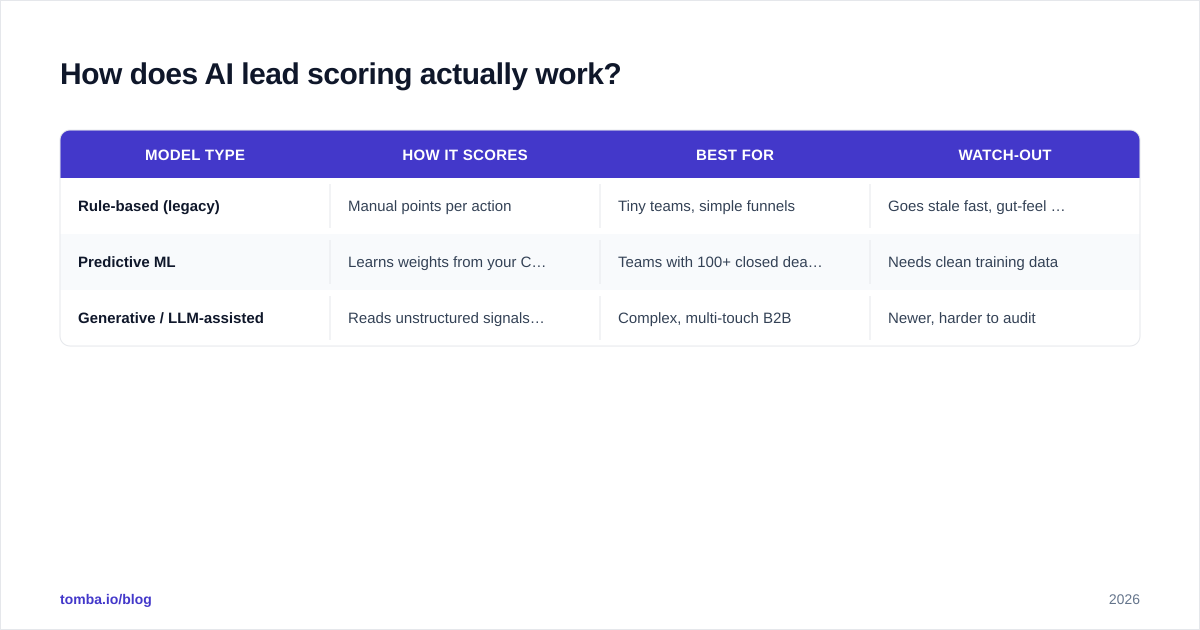
Three model types dominate in 2026:
| Model type | How it scores | Best for | Watch-out |
|---|---|---|---|
| Rule-based (legacy) | Manual points per action | Tiny teams, simple funnels | Goes stale fast, gut-feel weights |
| Predictive ML | Learns weights from your CRM history | Teams with 100+ closed deals | Needs clean training data |
| Generative / LLM-assisted | Reads unstructured signals (emails, notes, calls) | Complex, multi-touch B2B | Newer, harder to audit |
A key requirement most buyers underestimate: predictive models need a meaningful training set. If you have fewer than ~100 closed-won deals, the model can't find a reliable pattern, and you're better off with thoughtful rules plus good data enrichment until volume catches up.
What are the best AI lead scoring tools in 2026?#
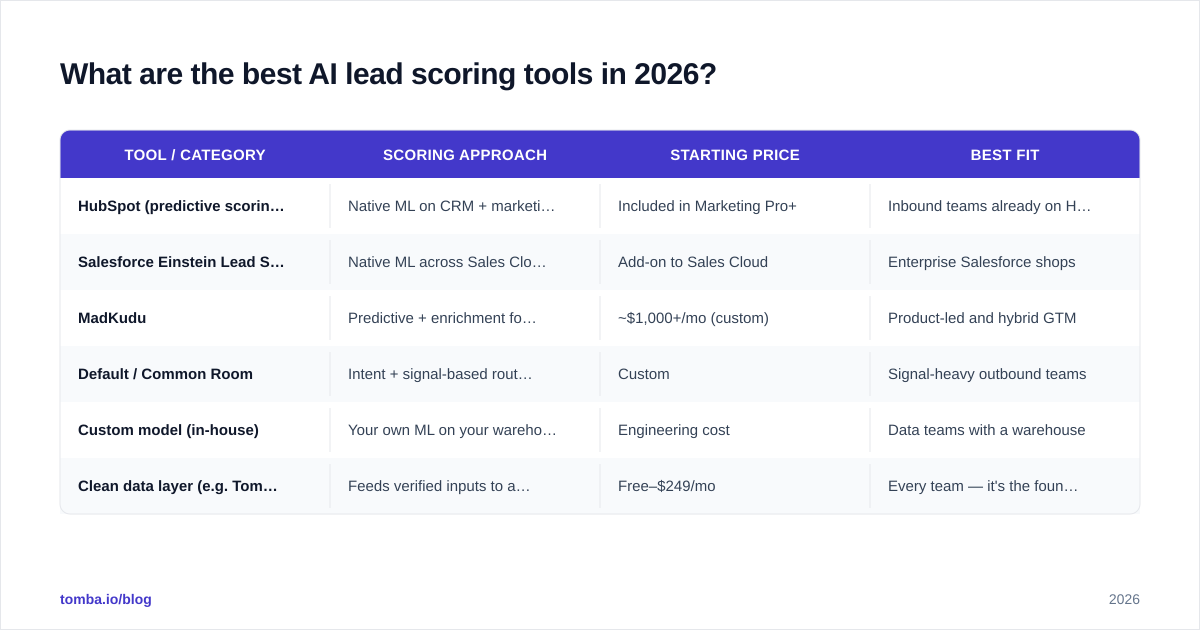
There's no single winner — the right tool depends on your CRM, your motion (inbound vs. outbound vs. PLG), and your data maturity. Here's how the main categories stack up.
| Tool / category | Scoring approach | Starting price | Best fit |
|---|---|---|---|
| HubSpot (predictive scoring) | Native ML on CRM + marketing data | Included in Marketing Pro+ | Inbound teams already on HubSpot |
| Salesforce Einstein Lead Scoring | Native ML across Sales Cloud | Add-on to Sales Cloud | Enterprise Salesforce shops |
| MadKudu | Predictive + enrichment for PLG/SLG | ~$1,000+/mo (custom) | Product-led and hybrid GTM |
| Default / Common Room | Intent + signal-based routing | Custom | Signal-heavy outbound teams |
| Custom model (in-house) | Your own ML on your warehouse | Engineering cost | Data teams with a warehouse |
| Clean data layer (e.g. Tomba) | Feeds verified inputs to any model | Free–$249/mo | Every team — it's the foundation |
A few honest notes:
- HubSpot and Salesforce give you "good enough" predictive scoring bundled with software you likely already pay for. Start here before buying anything standalone. See HubSpot's lead scoring docs for what's included.
- MadKudu is the reference standard for product-led and hybrid teams that need to score free-trial behavior alongside firmographics. Check the MadKudu site and verified G2 reviews before committing.
- Building in-house only pays off when you have a data warehouse, a steady deal volume, and an analyst who can maintain the model. Otherwise maintenance debt eats the savings.
Why does data quality matter more than the algorithm?#
Because garbage in, garbage out — and lead scoring is the most expensive place to learn that lesson. A model that scores a lead "hot" off a bounced email address or a wrong company size sends your best rep chasing a ghost.
Three data problems silently degrade every scoring model:
- Invalid contact data. If 20% of your emails bounce, the model is learning from — and scoring — records that can never convert. Run lists through an email verifier before they hit the funnel.
- Thin firmographics. Fit scoring needs accurate company size, industry, and role. Missing fields force the model to guess. Filling them with contact enrichment raises fit-signal accuracy directly.
- Stale records. People change jobs every ~3 years. A "VP of Marketing" who left 18 months ago is noise. Periodic re-verification keeps your training data honest.
This is the unglamorous part nobody demos, but it's where most scoring projects actually fail. The teams that win treat enrichment and verification as a continuous process, not a one-time cleanup. Sourcing verified contacts up front with an email finder means the model trains on records that are real, complete, and current.
How do you choose the right AI lead scoring tool?#
Work through this in order — it'll save you from buying a platform you can't feed.
Step 1 — Count your closed deals. Under ~100 closed-won? Stick with native rule-based or starter predictive scoring and invest in data quality. Over a few hundred? Predictive ML will earn its keep.
Step 2 — Match the tool to your motion. Pure inbound on HubSpot? Use native. Product-led with free trials? MadKudu-class tools that read product usage. Signal-based outbound? Intent-routing platforms.
Step 3 — Audit your inputs before you buy. Pull a sample of 200 leads and check: what % have valid emails, complete firmographics, and a known role? If that number is low, fix data first — the model can't outperform its inputs.
Step 4 — Pilot on one segment. Run the tool on a single source or region for 60–90 days. Compare conversion of high-scored vs. low-scored leads. If high-scored leads don't convert noticeably better, the model isn't calibrated to your business yet.
Step 5 — Measure lift, not vanity. The only metric that matters is whether reps working high-scored leads close more, faster. Track response rate and win rate by score band, not just "the dashboard looks busy."
A useful sanity check: most analysts (see Gartner's research on sales tech) emphasize that scoring is a process discipline, not a plug-in. The tool ranks; your team still has to act on the ranking and feed outcomes back so the model improves.
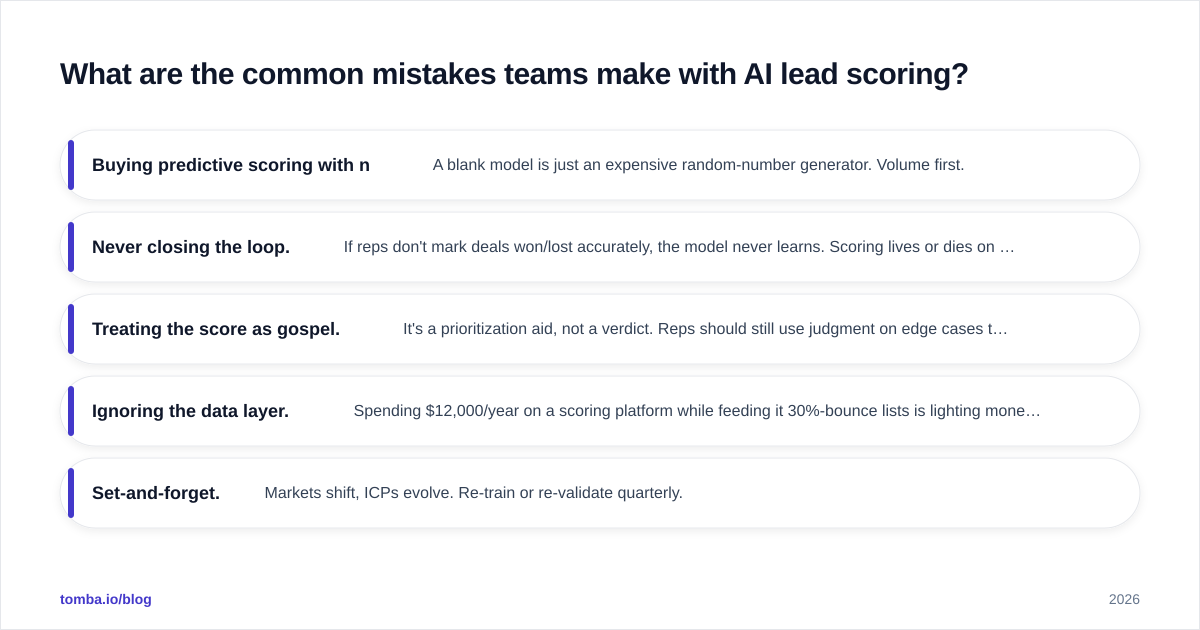
What are the common mistakes teams make with AI lead scoring?#
- Buying predictive scoring with no training data. A blank model is just an expensive random-number generator. Volume first.
- Never closing the loop. If reps don't mark deals won/lost accurately, the model never learns. Scoring lives or dies on CRM hygiene.
- Treating the score as gospel. It's a prioritization aid, not a verdict. Reps should still use judgment on edge cases the model hasn't seen.
- Ignoring the data layer. Spending $12,000/year on a scoring platform while feeding it 30%-bounce lists is lighting money on fire. Verify and enrich first.
- Set-and-forget. Markets shift, ICPs evolve. Re-train or re-validate quarterly.
The pattern across all five: the algorithm gets the attention, but the inputs and the feedback loop decide whether scoring works. You can check current Tomba pricing to see how affordable the data-foundation piece is relative to standalone scoring platforms — it's often a rounding error by comparison.
Is AI lead scoring worth it for small teams?#
Yes, but probably not the standalone enterprise tools. For a team under 20 reps, the high-ROI move is: native CRM scoring (which you already pay for) plus a disciplined data pipeline that keeps contacts verified and enriched. That combination captures most of the available lift without a five-figure platform commitment.
Bigger, data-rich teams with hundreds of monthly deals and a complex multi-touch motion are where dedicated predictive platforms genuinely pull ahead — they can model subtleties native scoring smooths over, and they have the volume to keep the model sharp.
Either way, the foundation is identical: real people, valid emails, complete firmographics, refreshed regularly. Get that right and even a modest model performs. Get it wrong and the best algorithm on the market still ranks noise.
Where Tomba fits in your lead scoring stack#
Before any model can rank a lead, something has to find and verify that lead's real contact details — and that's the layer Tomba owns. Use the Tomba Email Finder to source verified professional emails by name, company, or domain, then feed those clean, enriched records into HubSpot, Salesforce Einstein, MadKudu, or whatever scoring engine you run. Cleaner inputs mean a model that trains on reality, scores with confidence, and sends your reps after leads that can actually close. Start free with 25 searches a month, and scale up only when your pipeline does.
// get started
Find, verify and enrich your first contacts today
Start on the free plan with 25 searches a month, then scale when your team is ready.
Free plan · No credit card required · GDPR & CCPA
// about the author