AI Lead Scoring vs Traditional Lead Scoring: 2026 Guide
AI lead scoring vs traditional lead scoring, compared head-to-head: how each model works, what it costs, where rules still win, and when to switch in 2026.
TL;DR
- Traditional lead scoring assigns fixed points to attributes and actions you choose by hand; AI lead scoring learns patterns from your closed-won and closed-lost history and outputs a probability to convert.
- AI usually wins on accuracy and scale, but only when you have clean data and enough conversion volume to train on. Below ~500 closed deals, rules often beat a thin model.
- Traditional scoring is transparent, cheap, and instant to deploy. AI scoring is adaptive, hard to game, and surfaces signals you would never think to weight.
- The best 2026 setup is rarely either/or. Most teams run a rules baseline and layer a predictive model on top once data maturity allows.
- Both models are only as good as the contact data underneath. Garbage emails and stale firmographics sink either approach.
What is lead scoring, and why does the method matter?#
Lead scoring is ranking your leads by how likely they are to become customers so sales works the best ones first. Think of it like triage in an emergency room: you do not treat patients in the order they walked in, you treat them by severity. Lead scoring is the severity score for your pipeline.
The method you use to calculate that score changes everything downstream — how many deals reps chase, how fast marketing-qualified leads convert, and how much budget you waste on no-hopers. That is why the ai lead scoring vs traditional lead scoring debate is not academic. Picking the wrong model for your stage can cost a small team an entire quarter of misdirected effort.
Before either model can rank anything, it needs reliable inputs: verified email addresses, accurate job titles, real company data. If your CRM is full of marketing qualified leads built on guessed emails and outdated titles, no scoring engine — rules or neural net — will save you.
How does traditional lead scoring work?#
Traditional lead scoring is a points system you design by hand. You decide which attributes matter, assign each a value, and the CRM tallies them. It splits into two buckets:
- Explicit (fit) scoring — who the lead is. Job title, company size, industry, region. A VP of Engineering at a 500-person SaaS firm might earn +20; a student email earns -10.
- Implicit (behavior) scoring — what the lead does. Opened an email (+2), visited the pricing page (+10), booked a demo (+25), unsubscribed (-50).
When the total crosses a threshold you set — say 75 points — the lead becomes sales-ready and routes to a rep. It is the same logic HubSpot and Salesforce have shipped for over a decade, and it is still the default for most B2B teams.
The appeal is control. You can read the scorecard, explain exactly why a lead scored 80, and change a rule in thirty seconds. The weakness is also the control: every weight is a guess. You think pricing-page visits matter more than blog reads, but you are assigning numbers based on gut, not evidence — and you have to maintain those guesses forever as your market shifts.
How does AI lead scoring work?#
AI lead scoring flips the direction of the logic. Instead of you telling the system which signals matter, the system learns it from your history. You feed a model your past leads — both the ones that closed and the ones that died — and it finds the statistical patterns that separated winners from losers.
The output is usually a probability (0–100% likely to convert) or a letter grade, refreshed continuously as new behavior arrives. Under the hood it is supervised machine learning: gradient-boosted trees or logistic regression trained on hundreds of features at once, many of which you would never weight by hand — time-of-day of first touch, the sequence of pages viewed, how email domain age correlates with deal size.
Two things make AI scoring powerful:
- It finds non-obvious combinations. A title of "Manager" alone is weak, but "Manager" plus a Tuesday demo request plus a company that just raised a Series B might be your strongest segment. Rules struggle to encode interactions; models eat them for breakfast.
- It is hard to game and self-correcting. As your ICP drifts, the model re-weights on the next training run. No human has to remember to update the scorecard.
The catch: it is a black box to most stakeholders, it needs volume to train, and it inherits every bias in your historical data. If your reps only ever called enterprise leads, the model learns enterprise = good and starves your mid-market pipeline.
AI lead scoring vs traditional lead scoring: the head-to-head#
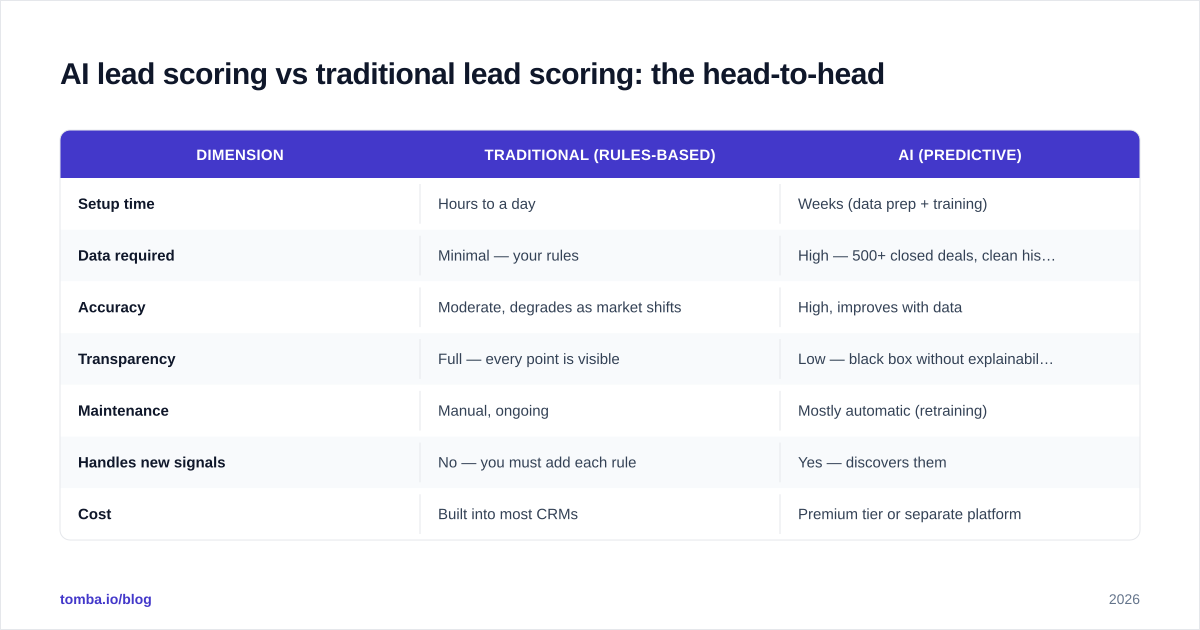
Here is the comparison that matters when you are choosing between the two.
| Dimension | Traditional (rules-based) | AI (predictive) |
|---|---|---|
| Setup time | Hours to a day | Weeks (data prep + training) |
| Data required | Minimal — your rules | High — 500+ closed deals, clean history |
| Accuracy | Moderate, degrades as market shifts | High, improves with data |
| Transparency | Full — every point is visible | Low — black box without explainability layer |
| Maintenance | Manual, ongoing | Mostly automatic (retraining) |
| Handles new signals | No — you must add each rule | Yes — discovers them |
| Cost | Built into most CRMs | Premium tier or separate platform |
| Best for | Early-stage, low volume, regulated | Scale-up+, high volume, mature data |
| Failure mode | Stale weights, gaming | Bias amplification, opacity |
The pattern is clear: traditional scoring is the better starting point, and AI is the better scaling point. The crossover happens when two things are true at once — you have enough conversion history to train on, and your lead volume is high enough that manual rule-tuning can no longer keep up.
Which is more accurate in practice?#
AI wins on accuracy when the data supports it — and loses badly when it does not. That nuance gets lost in vendor marketing, so be precise about your own situation.
Analyst data backs the upside. Gartner and multiple G2 category reports consistently show predictive scoring lifting conversion rates and shortening sales cycles for teams that adopt it correctly. The keyword is correctly. A predictive model trained on 5,000 clean, well-labeled deals will outperform any hand-built scorecard. The same model trained on 120 deals with inconsistent stage definitions will confidently produce noise.
Traditional scoring has a quieter strength: it never embarrasses you. A rules engine is predictable. It will not suddenly down-rank your best segment because of a spurious correlation in last quarter's data. For regulated industries or any context where you must explain a score to a customer or auditor, that transparency is not a nice-to-have, it is a requirement.
A practical accuracy checklist before you trust any AI score:
- Do you have at least 500 clearly labeled closed-won and closed-lost records?
- Are your stage definitions consistent across the whole history?
- Is your contact and firmographic data verified, not guessed?
- Can the vendor show you feature importance or SHAP-style explanations?
If you answered no to the first three, fix your data before you fix your scoring model. This is where data enrichment and email verification do the unglamorous heavy lifting — a model fed accurate titles, verified emails, and current company size will out-predict a fancier model fed garbage every single time.
When should you stick with traditional lead scoring?#
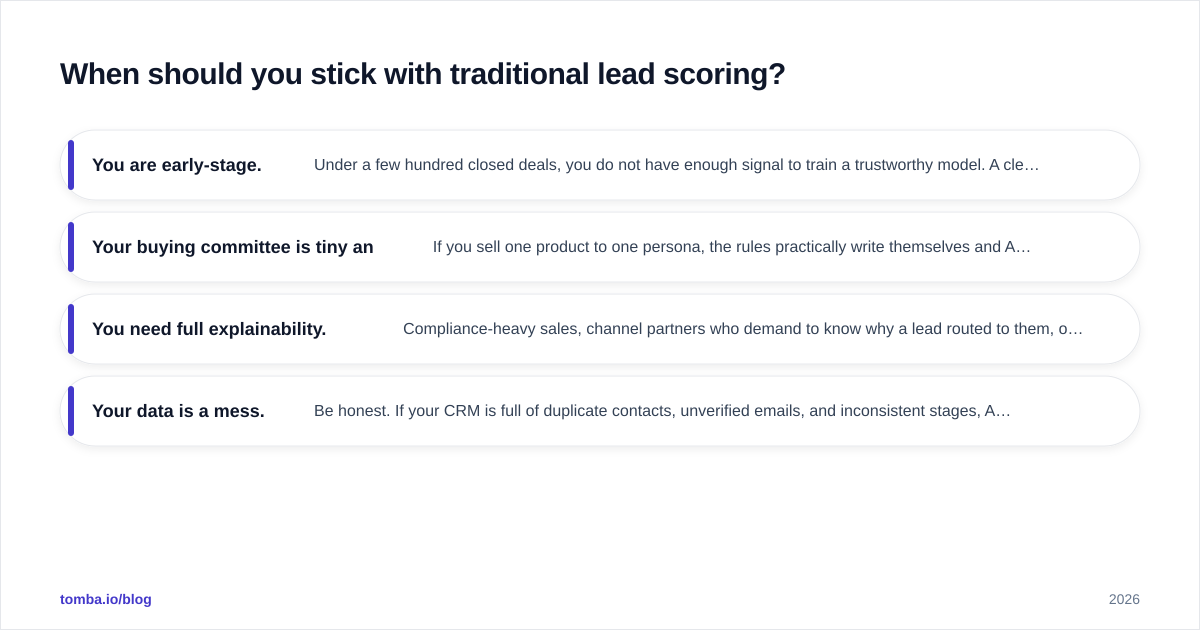
Stay rules-based — for now — if any of these describe you:
- You are early-stage. Under a few hundred closed deals, you do not have enough signal to train a trustworthy model. A clean scorecard will serve you better and you can ship it this afternoon.
- Your buying committee is tiny and obvious. If you sell one product to one persona, the rules practically write themselves and AI adds complexity without much lift.
- You need full explainability. Compliance-heavy sales, channel partners who demand to know why a lead routed to them, or a skeptical sales leader who will not trust a black box.
- Your data is a mess. Be honest. If your CRM is full of duplicate contacts, unverified emails, and inconsistent stages, AI will learn your mess. Clean first.
There is no shame in rules. Plenty of nine-figure-revenue teams run sophisticated rules-based models indefinitely because they are transparent, cheap, and good enough. You can also get most of the AI upside by adding negative scoring and decay rules — subtracting points for inactivity — without touching machine learning at all.
When should you move to AI lead scoring?#
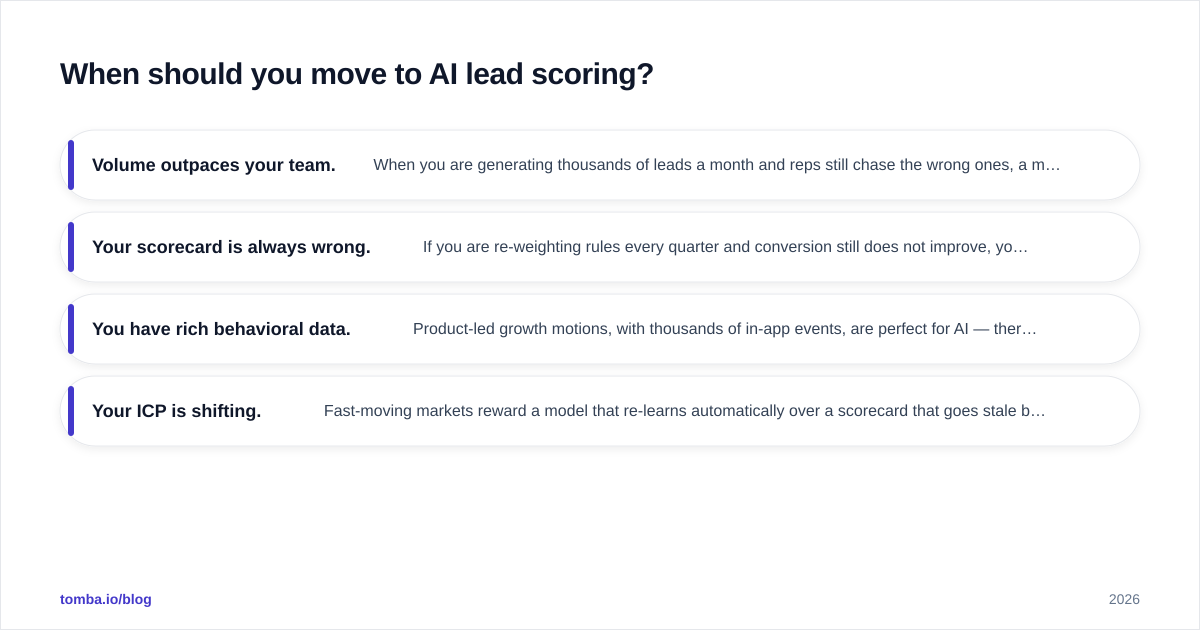
Make the switch when manual rule-tuning becomes the bottleneck. Concrete triggers:
- Volume outpaces your team. When you are generating thousands of leads a month and reps still chase the wrong ones, a model that ranks the full list every night pays for itself fast.
- Your scorecard is always wrong. If you are re-weighting rules every quarter and conversion still does not improve, you have hit the ceiling of what gut-feel weights can do.
- You have rich behavioral data. Product-led growth motions, with thousands of in-app events, are perfect for AI — there is far too much signal for any human to weight by hand.
- Your ICP is shifting. Fast-moving markets reward a model that re-learns automatically over a scorecard that goes stale between manual updates.
Most teams do not rip and replace. They run the rules engine as a transparent baseline and layer a predictive score alongside it, then compare which routes better leads over a quarter before fully trusting the model. That hybrid is the pragmatic 2026 default — you keep the explainability of rules and gain the adaptiveness of AI.
Does the scoring model matter more than the data?#
No. The data matters more than the model — and this is the single most expensive mistake teams make.
Picture two companies. Company A buys a top-tier predictive scoring platform and feeds it a CRM where 30% of emails bounce and half the job titles are two years stale. Company B runs a basic rules engine on verified, enriched, deduplicated contacts. Company B wins. Every time. The model is the engine, but the data is the fuel — a Formula 1 car runs nowhere on dirty fuel.
That is why your scoring project should start upstream of scoring. Before you debate algorithms, make sure every lead entering the system has a verified, deliverable email and accurate firmographics. Use an email finder to source decision-maker contacts directly instead of buying stale lists, verify deliverability so bounces do not poison your behavioral signals, and enrich each record with current company and role data so your fit-scoring inputs are real. Do that, and whichever scoring model you pick — rules, AI, or hybrid — starts from a position of strength. Skip it, and you are tuning a model on noise.
You can see exactly how source data quality flows into both models in the framework diagram above: the scoring engine is the last step, not the first.
The verdict#
There is no universal winner in ai lead scoring vs traditional lead scoring — there is only the right fit for your stage. Start with rules when you are small, transparent-by-requirement, or data-poor. Move to AI when volume, data maturity, and shifting ICPs make manual weights a losing game. And whichever you choose, treat your contact data as the real foundation, because both models collapse on bad inputs.
If your scoring is only as good as the contacts feeding it, start there. Tomba Email Finder sources verified, decision-maker email addresses by name, company, or domain — so your scoring model, rules-based or AI, trains and runs on data you can trust instead of guesses. Pair it with email verification and enrichment to clean the pipeline before it ever reaches your scorecard. Try the free tier (25 searches a month) and feed your scoring engine the fuel it actually needs.
// get started
Find, verify and enrich your first contacts today
Start on the free plan with 25 searches a month, then scale when your team is ready.
Free plan · No credit card required · GDPR & CCPA
// about the author