AI Outreach Automation in 2026: A Practical B2B Playbook
AI outreach automation promises hands-off pipeline, but most teams wire it wrong. Here's the 2026 stack, a workflow framework, and where automation actually pays off.
Most teams adopting AI outreach automation in 2026 are not under-tooled. They are mis-sequenced: they bolt an AI writer onto a dirty list and wonder why reply rates fall. This guide fixes the order of operations.
TL;DR#
- AI outreach automation means using machine learning to handle the repetitive parts of prospecting — research, list-building, personalization, send timing, and reply triage — so reps spend their hours only on conversations that move revenue.
- The single biggest predictor of success is data quality before automation, not the cleverness of the AI copy. Garbage contacts scale into garbage at volume.
- A workable 2026 stack has four layers: data and enrichment, an AI personalization engine, a multichannel sequencer, and a deliverability/guardrail layer.
- Automation lifts efficiency, not strategy. AI can draft 500 variants; it cannot decide who is worth contacting or what your offer is.
- Start narrow: automate one channel, one ICP segment, measure positive reply rate, then expand.
What is AI outreach automation?#
AI outreach automation is the use of artificial intelligence to run the mechanical stages of B2B prospecting at scale, while keeping a human in the loop for judgment calls.
Think of it like cruise control on a long highway drive. Cruise control handles the steady-state work — maintaining speed so your leg doesn't cramp — but you still steer, change lanes, and decide where to exit. AI outreach handles the steady-state work of research, drafting, and follow-up timing. You still decide who to target, what to say at the strategic level, and when a deal needs a human touch.
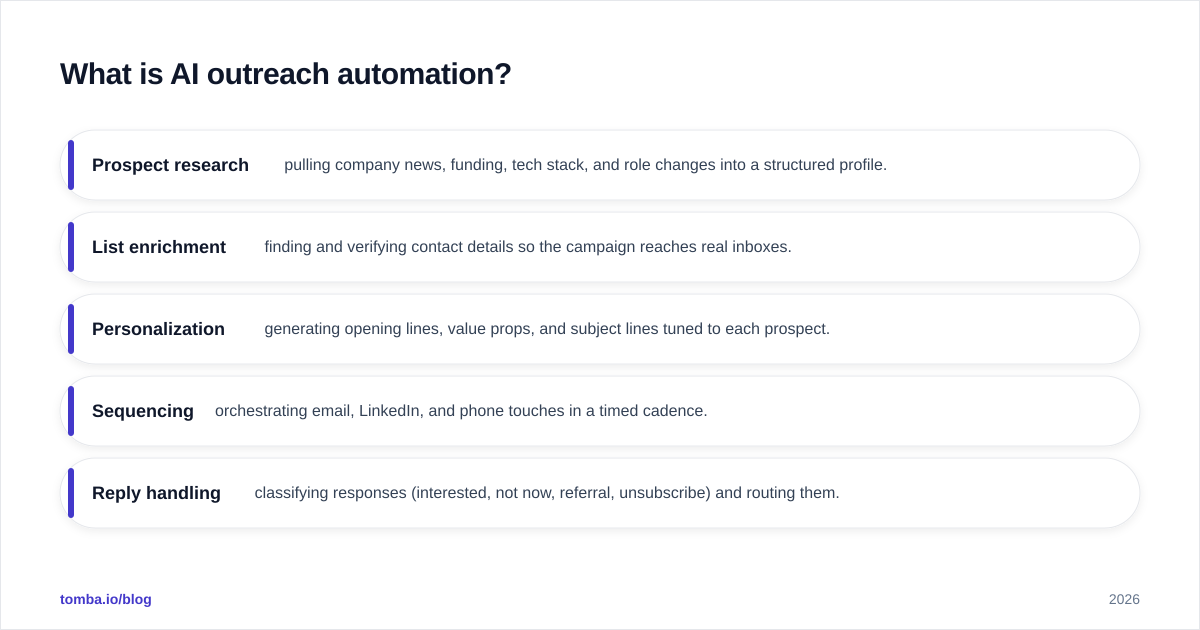
In practice, "AI outreach automation" bundles several capabilities that used to be separate jobs:
- Prospect research — pulling company news, funding, tech stack, and role changes into a structured profile.
- List enrichment — finding and verifying contact details so the campaign reaches real inboxes.
- Personalization — generating opening lines, value props, and subject lines tuned to each prospect.
- Sequencing — orchestrating email, LinkedIn, and phone touches in a timed cadence.
- Reply handling — classifying responses (interested, not now, referral, unsubscribe) and routing them.
The mistake is treating these as one magic button. They are a pipeline, and each stage has its own failure mode.
Why is data quality the real bottleneck?#
Because automation is a multiplier, and a multiplier applied to bad inputs produces bad outputs faster.
A reply rate is roughly: reach the right person × land in the inbox × say something relevant × time it well. AI is genuinely strong at the third and fourth factors. But if your list is 30% invalid or points at the wrong decision-makers, no amount of clever copy recovers it — you have already lost a third of your sends to bounces, which then damages your sender reputation and drags down the deliverability of the contacts who were valid.
This is why the order of operations matters. Clean, verified data first; automation second.
Before a single AI-written line goes out, you want to:
- Build the list against a tight ICP, not a broad scrape.
- Find current, role-accurate emails using an email finder rather than guessing patterns.
- Run every address through an email verifier to strip invalid and risky contacts.
- Enrich the survivors with firmographic and role context the AI can personalize against.
Only then does the personalization engine have something true to work with. Skipping straight to "write me 500 cold emails" is the most common and most expensive error in the category.
What does a 2026 AI outreach stack look like?#
Four layers, each solving a distinct problem. You can buy them as an all-in-one suite or assemble best-of-breed tools — the trade-offs differ, which we'll compare below.
Layer 1 — Data and enrichment. This is where contacts come from. A domain search finds every public email at a target company; enrichment fills in title, seniority, and company signals. Accuracy and verification live here.
Layer 2 — AI personalization. The model that turns a structured prospect profile into relevant copy. The good ones cite a specific fact (a recent raise, a job posting, a product launch) rather than producing generic "I loved your company's mission" filler.
Layer 3 — Multichannel sequencer. The engine that schedules and sends across email, LinkedIn, and phone, branches on behavior (opened, clicked, replied), and enforces cadence limits.
Layer 4 — Deliverability and guardrails. Inbox rotation, warmup, spam-content checks, throttling, and suppression lists. This layer is what keeps the other three from getting you blacklisted.
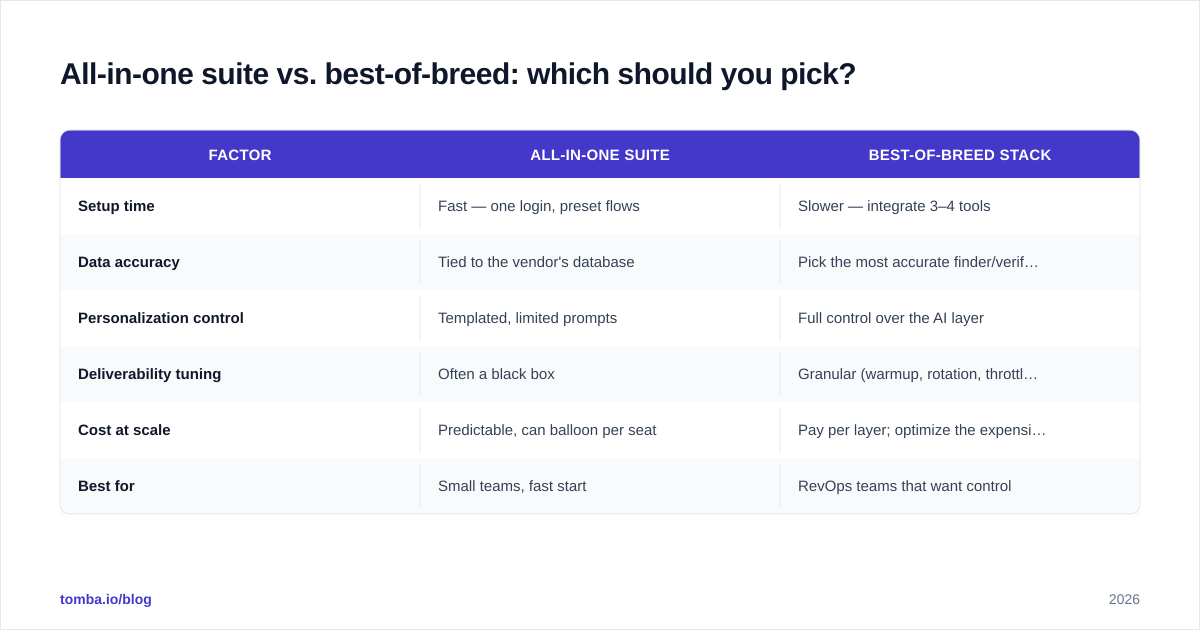
All-in-one suite vs. best-of-breed: which should you pick?#
There is no universal answer — it depends on team size, technical appetite, and how much control you need over each layer.
| Factor | All-in-one suite | Best-of-breed stack |
|---|---|---|
| Setup time | Fast — one login, preset flows | Slower — integrate 3–4 tools |
| Data accuracy | Tied to the vendor's database | Pick the most accurate finder/verifier |
| Personalization control | Templated, limited prompts | Full control over the AI layer |
| Deliverability tuning | Often a black box | Granular (warmup, rotation, throttle) |
| Cost at scale | Predictable, can balloon per seat | Pay per layer; optimize the expensive one |
| Best for | Small teams, fast start | RevOps teams that want control |
A small founder-led team usually wins with a suite: less to wire together, faster to first campaign. A scaling outbound org with a dedicated RevOps function usually wins with best-of-breed, because they can swap the weakest layer without re-platforming everything. The common middle path in 2026 is a strong sequencer plus a specialized data layer feeding it verified contacts through an API or native integration.
How do you actually build an AI outreach workflow?#
Follow the pipeline in order. Here is a concrete seven-step build you can run this week.
Step 1 — Define one narrow ICP. "Series A–B SaaS, 50–200 employees, VP Sales or RevOps lead." Narrow beats broad every time because the AI personalization has consistent context to lean on.
Step 2 — Source contacts. Use domain search and an email finder to pull decision-makers at each target account. Capture name, title, company, and a personalization hook (recent news, tech stack, hiring signal).
Step 3 — Verify and dedupe. Run the list through verification, drop invalids and duplicates, and segment catch-all domains for separate, gentler handling. A clean list of 400 outperforms a noisy list of 2,000.
Step 4 — Enrich for personalization. Attach the firmographic and role data the AI will reference. The richer the structured input, the less generic the output.
Step 5 — Generate and constrain the copy. Let the AI draft, but constrain it: one specific personalized line, a single clear value prop, one ask, under 120 words. Review a sample by hand before scaling. AI volume without a human spot-check is how brand-damaging emails ship.
Step 6 — Sequence across channels. A typical 2026 cadence: Day 1 email, Day 3 LinkedIn view + connect, Day 5 follow-up email, Day 8 second LinkedIn touch, Day 12 breakup email. Branch out anyone who replies.
Step 7 — Measure positive reply rate, not opens. Open rates are noise in a post-MPP world. Track positive replies and meetings booked per 100 contacts, and feed losers back into iteration.
This loop — source, verify, enrich, personalize, sequence, measure — is the whole game. AI accelerates steps 4 and 5 dramatically and assists step 7. The strategic steps (1 and the offer itself) stay human.
Where does AI help most — and where does it fail?#
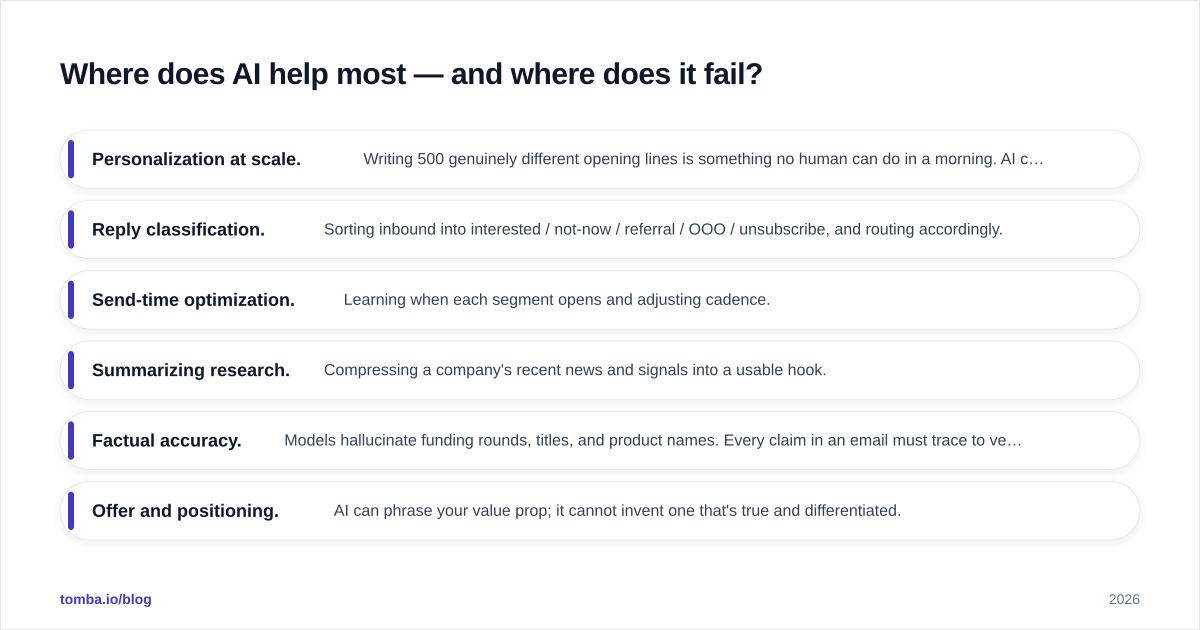
AI earns its keep on volume-with-variation tasks and falls down on judgment and truth.
Where AI clearly wins:
- Personalization at scale. Writing 500 genuinely different opening lines is something no human can do in a morning. AI can.
- Reply classification. Sorting inbound into interested / not-now / referral / OOO / unsubscribe, and routing accordingly.
- Send-time optimization. Learning when each segment opens and adjusting cadence.
- Summarizing research. Compressing a company's recent news and signals into a usable hook.
Where AI still fails — and needs a human:
- Factual accuracy. Models hallucinate funding rounds, titles, and product names. Every claim in an email must trace to verified data, not to the model's imagination.
- Offer and positioning. AI can phrase your value prop; it cannot invent one that's true and differentiated.
- Edge-case judgment. A reply that says "we're in a lawsuit, remove me" needs a human, not an auto-sequence.
- Compliance. Honoring opt-outs, GDPR/CAN-SPAM rules, and suppression lists is a liability you cannot fully delegate to a model.
The reliable mental model: AI drafts, humans decide. Anthropic, OpenAI, and every serious vendor frame their tools as assistive for exactly this reason — the model is a fast junior teammate, not an autonomous closer. (For broader context on how buyers evaluate these tools, G2's sales engagement category is a useful, vendor-neutral starting point.)
How do you keep AI outreach out of the spam folder?#
Treat deliverability as a first-class part of the system, not an afterthought — it's the layer that determines whether any of the other work is even seen.
The fundamentals haven't changed, and AI makes some of them more important because volume goes up:
- Authenticate your domain. SPF, DKIM, and DMARC must be set correctly. Google and Yahoo's 2024 bulk-sender requirements made this non-negotiable, and enforcement only tightened through 2026. HubSpot's guide to email deliverability is a solid plain-English primer.
- Warm up sending domains and inboxes. Ramp volume gradually. New domains that blast 500 cold emails on day one get flagged immediately.
- Verify before you send. This is the data-quality point again — bounces are the fastest way to wreck sender reputation. Verification is the cheapest deliverability insurance you can buy.
- Throttle and rotate. Spread volume across inboxes and cap daily sends per inbox. The sequencer's guardrail layer handles this.
- Watch the content. AI copy can drift into spammy phrasing. Run drafts through a spam-content check and keep links and images minimal in cold first-touches.
The throughline: AI lets you send more, which means the deliverability discipline that protected a 200-email campaign now has to protect a 2,000-email one. Skip it and you scale your way onto a blocklist.
Does AI outreach automation actually replace SDRs?#
No — it changes what the SDR's day looks like, and in 2026 the evidence points to augmentation, not replacement.
The repetitive work — list-building, manual research, first-draft writing, follow-up scheduling — is exactly what AI absorbs. What's left is what humans are actually good at: handling nuanced replies, running discovery calls, building multi-thread relationships inside an account, and judgment about which deals deserve extra effort.
The teams winning with sales automation in 2026 are not the ones who fired their reps and turned on a bot. They're the ones who let one rep operate at the output of three by removing the busywork. The headcount conversation is real, but the framing of "AI replaces SDRs" oversimplifies a shift that's really about leverage.
A practical sign you've automated well: your reps spend most of their time in conversations, not preparing to have them.
How do you measure whether it's working?#
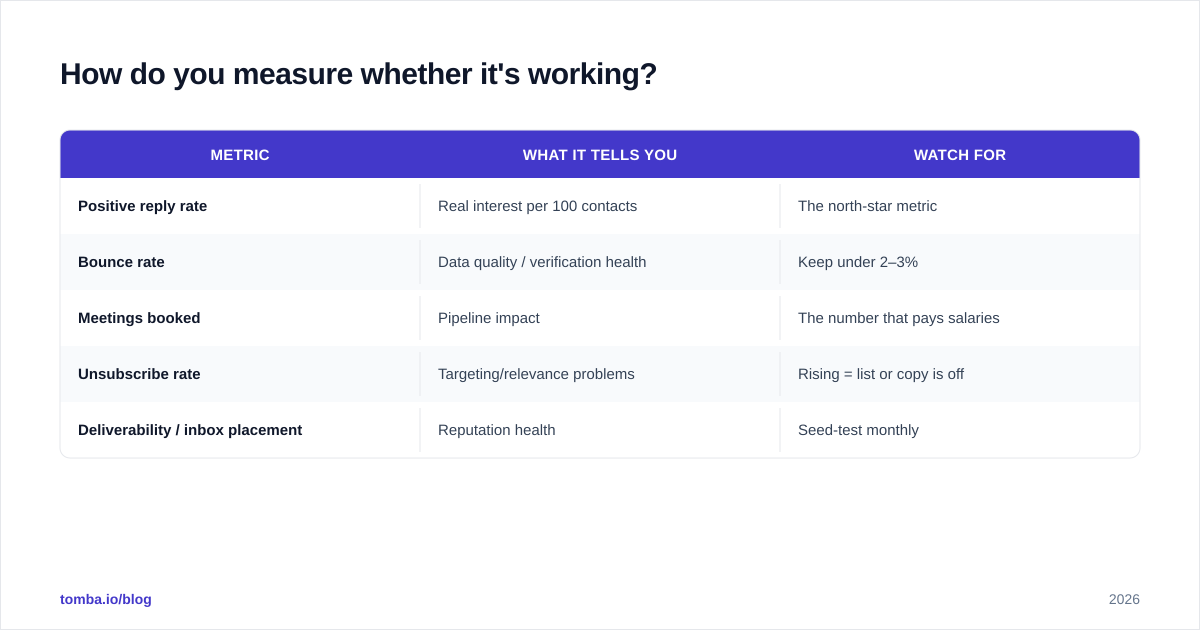
Pick metrics that survive a privacy-first inbox world, and instrument the full funnel.
| Metric | What it tells you | Watch for |
|---|---|---|
| Positive reply rate | Real interest per 100 contacts | The north-star metric |
| Bounce rate | Data quality / verification health | Keep under 2–3% |
| Meetings booked | Pipeline impact | The number that pays salaries |
| Unsubscribe rate | Targeting/relevance problems | Rising = list or copy is off |
| Deliverability / inbox placement | Reputation health | Seed-test monthly |
Open rate is intentionally not the headline here — Apple's Mail Privacy Protection and similar features inflate it to the point of uselessness for cold outreach. Anchor on positive replies and meetings.
If positive reply rate is low but bounce rate is also low, your data is fine and your copy or targeting is the problem — iterate the AI prompts and ICP. If bounce rate is high, stop everything and fix the data layer first. This diagnostic split is why measuring both matters.
A realistic 30-day rollout#
You don't need to boil the ocean. A staged rollout de-risks the whole thing:
- Week 1: Define one ICP, build and verify a 300–500 contact list, set up domain authentication and warmup.
- Week 2: Wire the AI personalization layer, generate copy, hand-review a sample of 30, refine prompts.
- Week 3: Launch a single-channel sequence to a 150-contact subset. Watch deliverability and positive replies daily.
- Week 4: Add a second channel (LinkedIn), expand to the full list, and start the measure-iterate loop.
By day 30 you have a working, measured system on one segment — which is far more valuable than a sprawling, unmeasured one across five.
Getting the data layer right#
Every layer above depends on the one underneath it, and the bottom layer is data. The fastest way to sink an AI outreach program is to feed it unverified contacts, so start there. Tomba's Email Finder gives you accurate, verified professional emails by name, company, or domain — with built-in verification so bounces never poison the campaigns you spent so long building. Pair it with domain search for whole-account coverage and you've got a clean, enriched foundation the AI layer can actually personalize against. Check the Tomba pricing plans — from the free tier through Starter at $49/mo — and build your first verified list before you automate a single send. Get the data right, and everything downstream gets easier.
Ready to find emails that actually work?
Join 150,000+ professionals who stopped guessing and started sending. Free credits on signup — no credit card required.
Get the Tomba newsletter
Practical outbound tactics and product updates — once every two weeks.
About the author