AI Pipeline Generation: How to Build Sales Pipeline in 2026
AI pipeline generation turns raw signals into qualified opportunities at scale. Here's the framework, the tooling stack, and the metrics that actually move revenue in 2026.
TL;DR
- AI pipeline generation is the practice of using machine learning, intent signals, and automation to source, qualify, and route net-new sales opportunities — replacing manual list-building and guesswork.
- It works as a sequence: capture signals → enrich contacts → score and prioritize → personalize outreach → route to the right rep. Skip a stage and the whole pipeline leaks.
- Clean, verified contact data is the foundation. AI scoring on bad emails just produces confident garbage faster.
- Expect 3–5x more qualified meetings per rep when the stack is wired correctly, but only if you measure conversion-to-opportunity, not raw volume.
- Tools split into three buckets: data/enrichment layers, scoring/intent engines, and orchestration platforms. Most teams over-buy on orchestration and under-invest in data quality.
What is AI pipeline generation?#
AI pipeline generation is the use of artificial intelligence to identify, qualify, and create sales opportunities automatically, instead of relying on reps to manually research accounts and build lists.
Think of it like the difference between fishing with a single rod and fishing with sonar. The old way, a rep casts a line where they guess fish might be. AI pipeline generation reads the water first — buying signals, hiring data, technographics, web activity — then tells you exactly where to cast and which bait to use. The rep still reels in the deal, but they stop wasting hours on empty water.
In practice, "pipeline" means qualified opportunities entering your funnel: accounts that fit your ideal customer profile (ICP), show buying intent, and have a real person you can reach. AI accelerates every part of that definition — matching firmographics to your ICP, detecting intent from behavioral data, and surfacing the right contact with a verified email and phone number.
This is distinct from sales automation, which mostly executes tasks you already defined. Pipeline generation decides who and why before automation handles the how. According to Gartner research on B2B buying, buyers now spend only about 5% of their time with any single sales rep — which means the accounts you choose to pursue matter far more than the volume of outreach you send.
How does AI pipeline generation actually work?#
It runs as a five-stage pipeline. Each stage hands clean output to the next, and a failure upstream poisons everything downstream.
1. Signal capture. The system ingests intent and trigger data: job changes, funding rounds, tech-stack adoption, content engagement, website visits, and review-site activity. These are the "someone might be in-market" flags.
2. Enrichment. Raw signals are usually just a company name or an anonymous visitor. Enrichment attaches the full picture — firmographics, headcount, revenue band, decision-maker names, and verified contact details. This is where most pipelines silently break, because a signal with no reachable human is not pipeline, it's trivia. Strong data enrichment turns a domain into an addressable buyer.
3. Scoring and prioritization. A model ranks each account and contact by fit and intent. Good scoring is explainable — you can see why an account scored 87 — and it's calibrated against closed-won history, not vibes.
4. Personalization. AI drafts the first-touch message using the signal that triggered the account ("saw you're hiring three SDRs"), the persona, and your offer. Humans review, but the blank-page tax disappears.
5. Routing. The qualified opportunity lands with the right rep, in the right sequence, with the context attached. No lead sits in a queue for three days going cold.
The thing teams miss: stages 2 and 3 depend entirely on data accuracy. An AI scoring engine fed a 40%-bounce email list will still output a tidy ranked list — it just ranks the wrong people. Verify before you score.
What does the AI pipeline generation stack look like?#
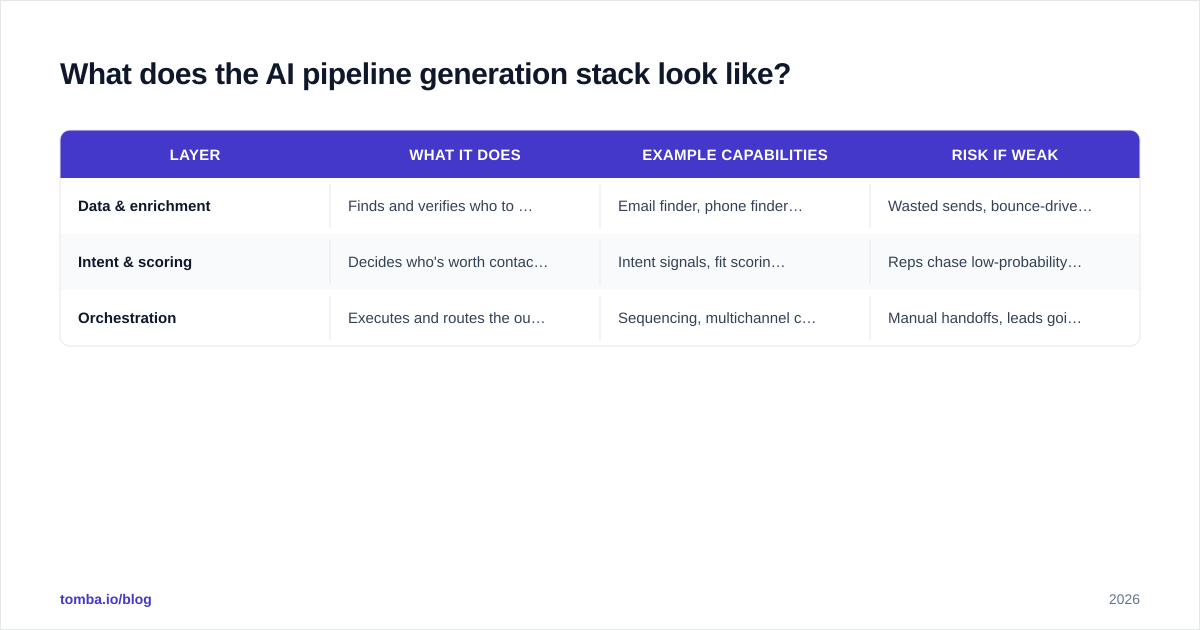
Three layers, and you need all three. Buying one and ignoring the others is the most common waste of budget I see.
| Layer | What it does | Example capabilities | Risk if weak |
|---|---|---|---|
| Data & enrichment | Finds and verifies who to contact | Email finder, phone finder, verification, firmographic enrichment | Wasted sends, bounce-driven domain damage, wrong personas |
| Intent & scoring | Decides who's worth contacting now | Intent signals, fit scoring, propensity models | Reps chase low-probability accounts, burn capacity |
| Orchestration | Executes and routes the outreach | Sequencing, multichannel cadences, CRM sync, routing | Manual handoffs, leads going cold, no attribution |
Notice the order. Data quality sits at the base because everything else multiplies it — and multiplying by a bad number gives you a bad number, faster. A B2B database with verified records is the floor, not a nice-to-have.
A practical 2026 stack might pair an enrichment and email-finding layer (to build verified contact records), an intent provider, and an orchestration platform like a sequencer or CRM-native cadence tool. You can validate vendor claims against real buyer reviews on G2 rather than trusting marketing pages — the gap between demo and daily reality is usually visible in the reviews.
Is AI pipeline generation better than manual prospecting?#
Short answer: yes for scale and consistency, no for nuance on a tiny named-account list. It depends on your motion.
If you sell to a fixed list of 50 strategic enterprise accounts, a great rep doing deep manual research will out-perform any model — the dataset is too small for AI to learn from, and the relationships are too high-touch. AI's edge appears when you're working hundreds or thousands of accounts and humans can't read every signal in time.
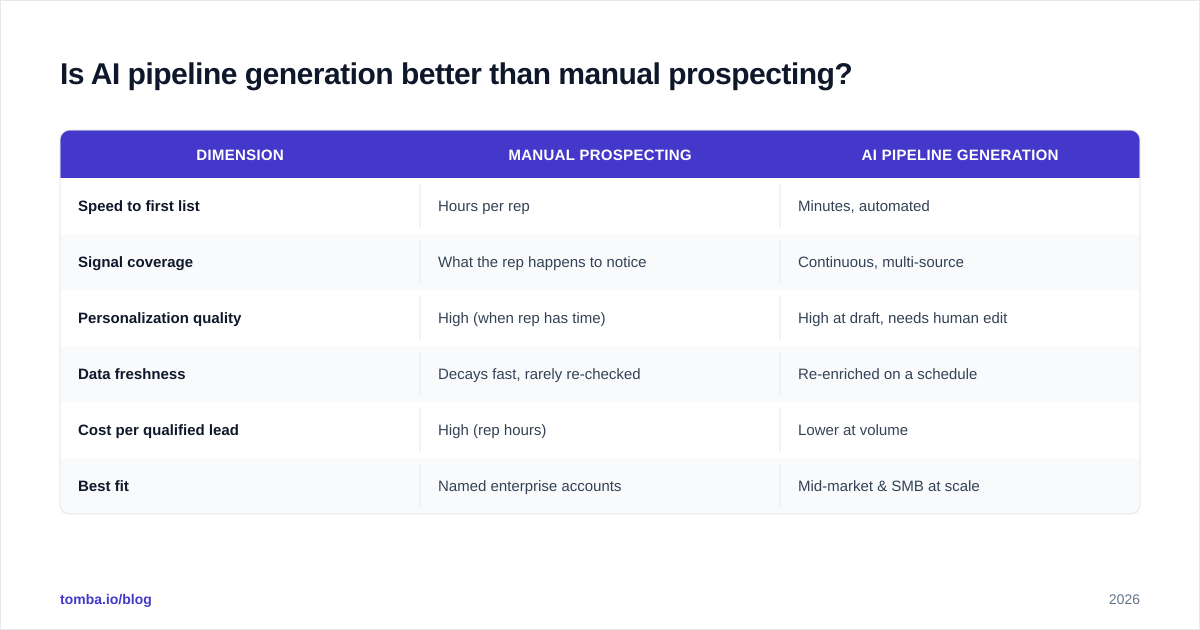
Here's the honest comparison:
| Dimension | Manual prospecting | AI pipeline generation |
|---|---|---|
| Speed to first list | Hours per rep | Minutes, automated |
| Signal coverage | What the rep happens to notice | Continuous, multi-source |
| Personalization quality | High (when rep has time) | High at draft, needs human edit |
| Data freshness | Decays fast, rarely re-checked | Re-enriched on a schedule |
| Cost per qualified lead | High (rep hours) | Lower at volume |
| Best fit | Named enterprise accounts | Mid-market & SMB at scale |
The winning teams don't pick one. They use AI to do the heavy lifting — sourcing, enriching, scoring, drafting — then point human attention at the top of the ranked list where judgment pays off. The model handles the 80% that's mechanical; the rep owns the 20% that closes.
How do you measure AI pipeline generation success?#
Measure conversion, not activity. The trap of any AI system is that it makes it cheap to produce volume, and volume feels like progress while quietly destroying your sender reputation and your reps' trust.
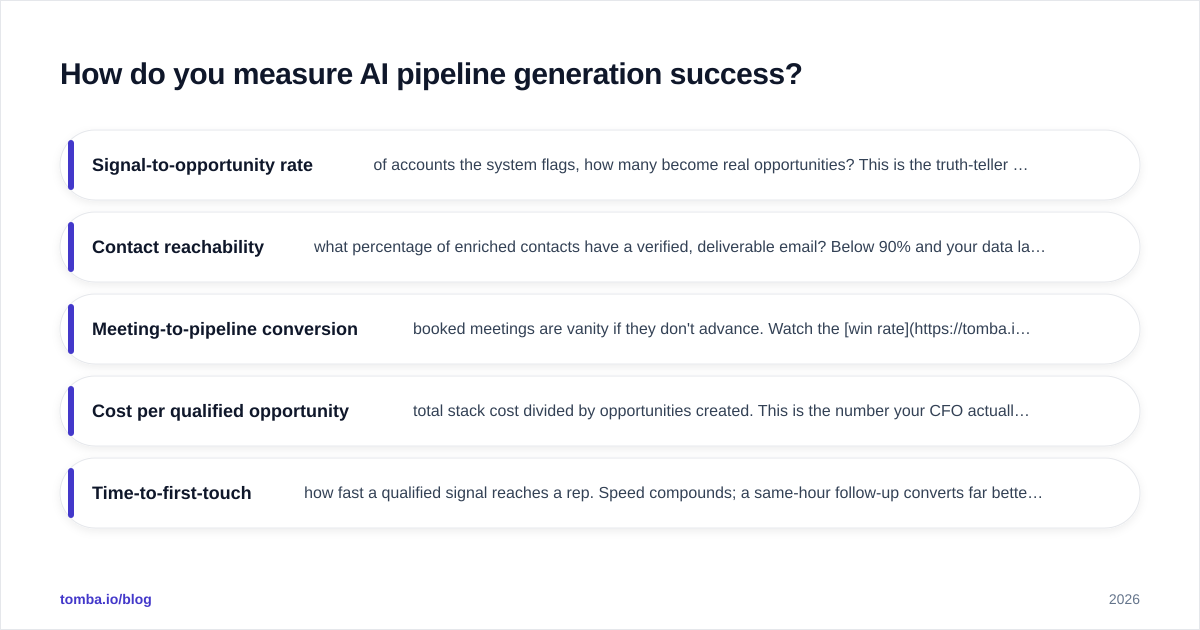
Track these:
- Signal-to-opportunity rate — of accounts the system flags, how many become real opportunities? This is the truth-teller for your scoring model.
- Contact reachability — what percentage of enriched contacts have a verified, deliverable email? Below 90% and your data layer needs work.
- Meeting-to-pipeline conversion — booked meetings are vanity if they don't advance. Watch the win rate on AI-sourced deals versus rep-sourced.
- Cost per qualified opportunity — total stack cost divided by opportunities created. This is the number your CFO actually cares about.
- Time-to-first-touch — how fast a qualified signal reaches a rep. Speed compounds; a same-hour follow-up converts far better than a same-week one.
A reasonable target: AI-sourced opportunities should convert to closed-won at no worse than 70–80% of your rep-sourced rate, while costing meaningfully less per opportunity. If AI volume converts at half the rate, your scoring or your data is broken — fix the inputs before scaling the outputs.
One warning the deliverability folks at Salesforce and most ESPs repeat: high-volume sending against unverified lists tanks your domain reputation, and once that happens even your good emails land in spam. AI lets you send more, which is exactly why verification matters more, not less.
What are the biggest mistakes in AI pipeline generation?#
Scoring before verifying. Covered above, worth repeating. Garbage in, confident garbage out.
Over-automating personalization. AI-drafted first lines that say "I noticed your company does business" fool no one. Use real signals or don't reference them. The personalization should be something a human would actually have written if they'd done the research.
Ignoring the catch-all problem. A large share of B2B domains are catch-all servers that accept any address, so standard verification returns "unknown." If your pipeline treats those as either all-valid or all-invalid, you're either sending into the void or discarding reachable buyers. A dedicated catch-all verifier resolves the ambiguity instead of guessing.
Optimizing for volume. The metric that kills more pipelines than any other is "leads generated." It rewards the system for producing noise. Tie compensation and dashboards to qualified opportunities and downstream revenue.
No human in the loop on edge cases. AI is excellent at the median case and overconfident at the edges. Strategic accounts, ambiguous personas, and unusual buying committees still need a person.
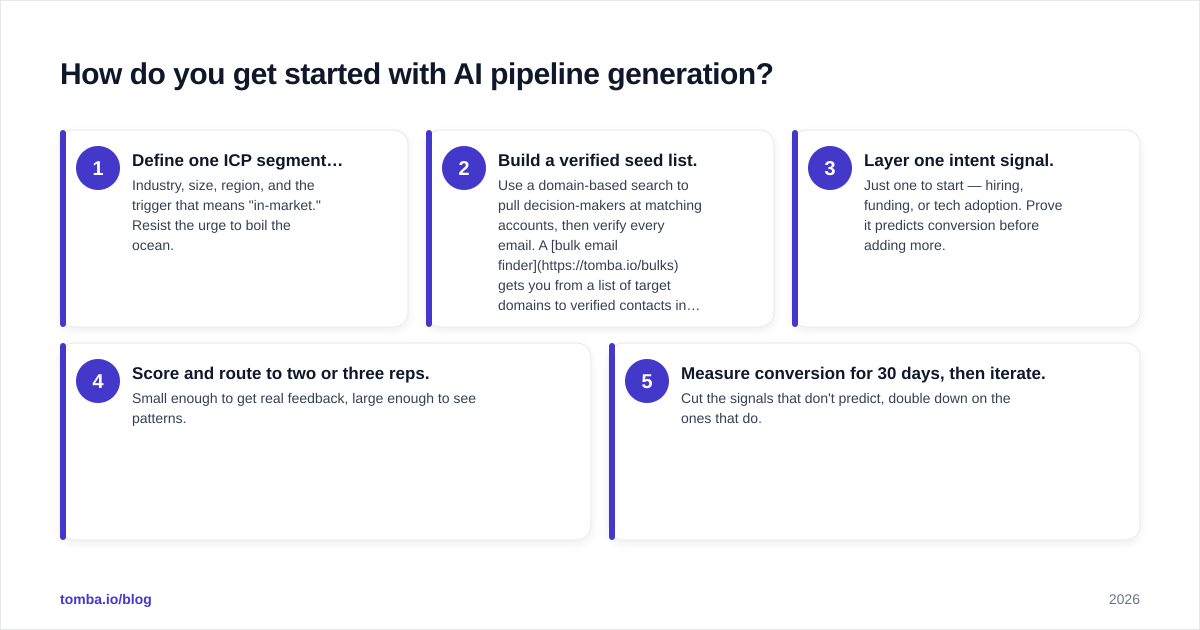
How do you get started with AI pipeline generation?#
Start narrow and prove the loop before you scale it.
- Define one ICP segment precisely. Industry, size, region, and the trigger that means "in-market." Resist the urge to boil the ocean.
- Build a verified seed list. Use a domain-based search to pull decision-makers at matching accounts, then verify every email. A bulk email finder gets you from a list of target domains to verified contacts in one pass.
- Layer one intent signal. Just one to start — hiring, funding, or tech adoption. Prove it predicts conversion before adding more.
- Score and route to two or three reps. Small enough to get real feedback, large enough to see patterns.
- Measure conversion for 30 days, then iterate. Cut the signals that don't predict, double down on the ones that do.
For teams that want to wire this into their own systems, the Tomba API handles the find-and-verify layer programmatically, so enrichment becomes a step in your pipeline code rather than a manual export. That's the difference between a one-time list and a continuously refreshed engine.
Frequently asked questions#
Does AI pipeline generation replace SDRs? No. It removes the mechanical 60–70% of an SDR's day — research, list-building, data entry — and frees them for conversations and judgment calls. Teams that cut headcount and expect the AI to close are usually disappointed; teams that redeploy reps to higher-value work see the gains.
How much data do you need before AI scoring is useful? Roughly a few hundred closed-won and closed-lost records to calibrate a fit model. Below that, use rule-based scoring (explicit ICP criteria) until you accumulate enough history.
Is it worth it for small teams? Yes, if you're working more accounts than you can manually research. A two-person team covering a thousand accounts benefits more than a ten-person team covering fifty.
Build your pipeline on data you can trust#
Every stage of AI pipeline generation — scoring, personalization, routing — multiplies the quality of your underlying contact data. Get the data layer right and the rest of the stack actually delivers; get it wrong and you've just automated the production of bad outreach.
That's where Tomba's Email Finder fits. It turns company domains and names into verified, deliverable email addresses, so the contacts entering your pipeline are real people you can reach — not bounces waiting to wreck your sender reputation. Pair it with verification and enrichment, start with the free tier (25 searches a month), and scale through the Starter plan at $49/mo when the loop is proven. Check the full Tomba pricing to match a plan to your volume. Build the foundation first, then let AI do the heavy lifting on top of it.
// get started
Find, verify and enrich your first contacts today
Start on the free plan with 25 searches a month, then scale when your team is ready.
Free plan · No credit card required · GDPR & CCPA
// about the author