AI Sales Agent in 2026: What It Is, How It Works & Tools
An AI sales agent can prospect, enrich, email, and book meetings on autopilot. Here's how they actually work in 2026, where they break, and how to deploy one without torching your pipeline.
TL;DR
- An AI sales agent is software that runs full sales workflows on its own — finding prospects, enriching them, writing outreach, replying, and booking meetings — instead of just suggesting the next step.
- The 2026 version is different from a chatbot: it chains tools (data, CRM, email, calendar) and makes decisions inside guardrails you set.
- Agents are strongest at top-of-funnel grunt work: list building, enrichment, first-touch personalization, and follow-up cadence.
- They are weakest at judgment calls — pricing pushback, multi-threaded enterprise deals, and anything needing trust.
- The deployment that works: feed the agent clean, verified contact data, keep a human on approvals, and measure replies and meetings, not "emails sent."
What is an AI sales agent?#
An AI sales agent is an autonomous system that executes sales tasks end to end, not a tool that waits for you to click. Think of the difference between a GPS that tells you to turn left and a self-driving car that takes the turn. A sales assistant suggests; a sales agent acts — it pulls a target list, enriches each contact, drafts and sends the email, watches for a reply, and schedules the call.
Technically, an agent is a large language model wrapped in a loop: it reads a goal ("book 10 demos with fintech ops leaders this week"), picks a tool, runs it, reads the result, and decides what to do next. That loop is what separates 2026 agents from the 2023 "AI email writer" generation. The model is the brain; the tools are the hands.
The tools usually include a data source for contacts, a CRM to log activity, an email or LinkedIn channel to send, and a calendar to book. Remove the tools and you have a clever writer. Add them and you have a worker.
How does an AI sales agent actually work?#
It runs a perceive-decide-act loop against your pipeline. Here is the sequence most production agents follow:
- Goal intake — You define the outcome (meetings booked), the ICP (titles, industries, company size), and the constraints (daily send caps, tone, do-not-contact lists).
- Sourcing — The agent queries a B2B data provider or your CRM to build a target list that matches the ICP.
- Enrichment — It fills gaps: verified email, role, company tech stack, recent funding. Bad data here poisons everything downstream, which is why data enrichment is the unglamorous step that decides the whole campaign.
- Personalization — It writes a first touch referencing a real signal (a job change, a product launch), not a mail-merge token.
- Send and listen — It dispatches through email or LinkedIn, then monitors for opens, replies, and bounces.
- Branch — On a reply it classifies intent (interested, not now, wrong person) and either books, nurtures, or routes to a human.
- Log and learn — Every action lands in the CRM so reps and the next run have context.
The agent only behaves well when steps 2 and 3 are solid. An agent firing perfect copy at stale, unverified addresses just automates your bounce rate. Garbage in, automated garbage out — at scale.

What can you actually automate today (and what you can't)?#
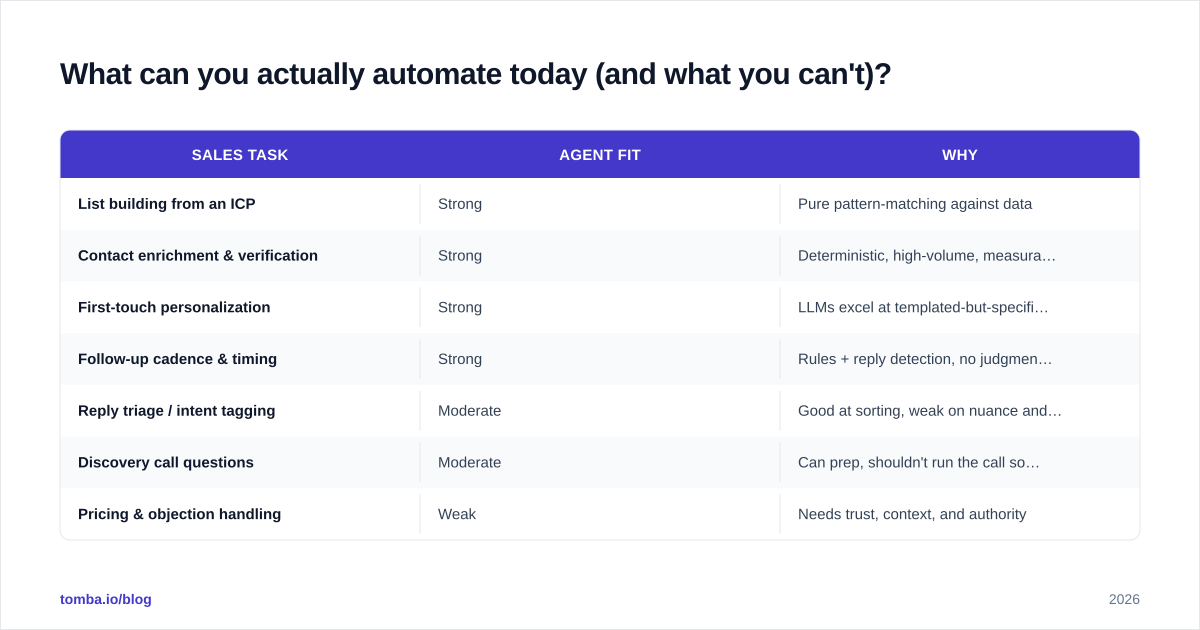
You can safely hand an agent the repetitive top-of-funnel work. You should not hand it the deal.
| Sales task | Agent fit | Why |
|---|---|---|
| List building from an ICP | Strong | Pure pattern-matching against data |
| Contact enrichment & verification | Strong | Deterministic, high-volume, measurable |
| First-touch personalization | Strong | LLMs excel at templated-but-specific copy |
| Follow-up cadence & timing | Strong | Rules + reply detection, no judgment needed |
| Reply triage / intent tagging | Moderate | Good at sorting, weak on nuance and sarcasm |
| Discovery call questions | Moderate | Can prep, shouldn't run the call solo |
| Pricing & objection handling | Weak | Needs trust, context, and authority |
| Multi-threaded enterprise deals | Weak | Human relationships, internal politics |
The honest read for 2026: agents replace the SDR's manual hours, not the AE's judgment. According to Gartner research on sales technology, the durable wins come from automating defined, repeatable tasks — exactly the top of that table — while leaving complex, relationship-driven selling to people. Treat the agent as a tireless SDR that never forgets a follow-up, not as a closer.
How is an AI sales agent different from a chatbot or copilot?#
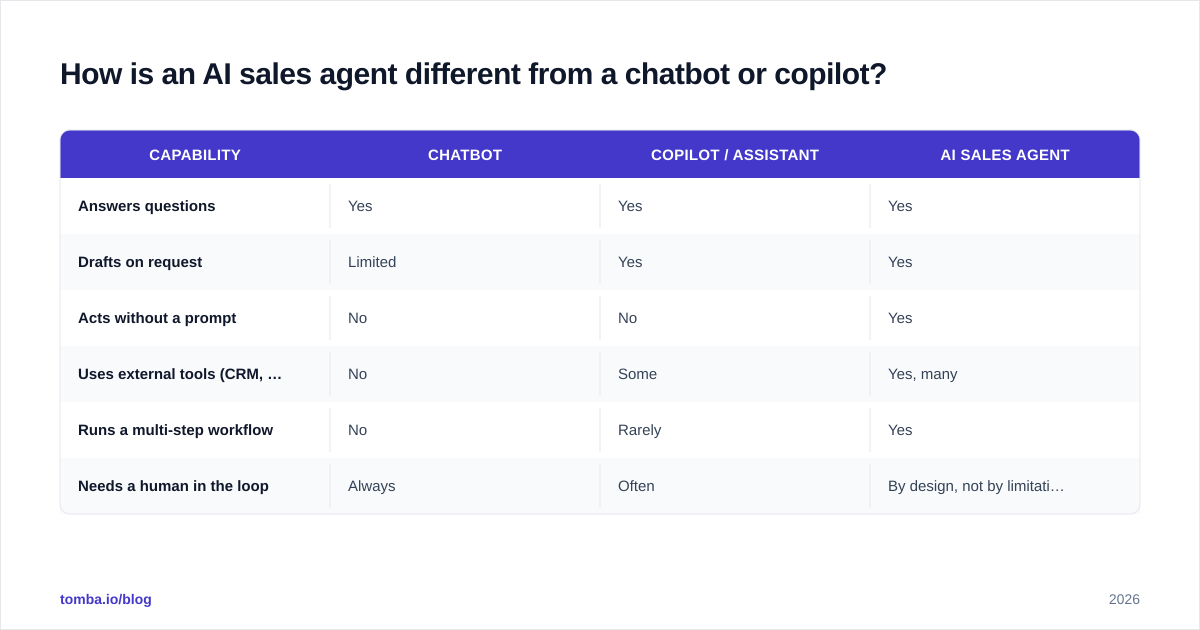
The difference is autonomy and tool access. All three use the same underlying models; what changes is how much they can do without you.
| Capability | Chatbot | Copilot / assistant | AI sales agent |
|---|---|---|---|
| Answers questions | Yes | Yes | Yes |
| Drafts on request | Limited | Yes | Yes |
| Acts without a prompt | No | No | Yes |
| Uses external tools (CRM, email, data) | No | Some | Yes, many |
| Runs a multi-step workflow | No | Rarely | Yes |
| Needs a human in the loop | Always | Often | By design, not by limitation |
A copilot sits inside your inbox and waits. An agent has a goal and a budget of actions, and it spends them. That is powerful and dangerous in equal measure — which is why guardrails matter more than raw capability. Platforms like Salesforce and HubSpot have shipped agent layers precisely because the market wants action, not just suggestions.
How do you deploy an AI sales agent without wrecking deliverability?#
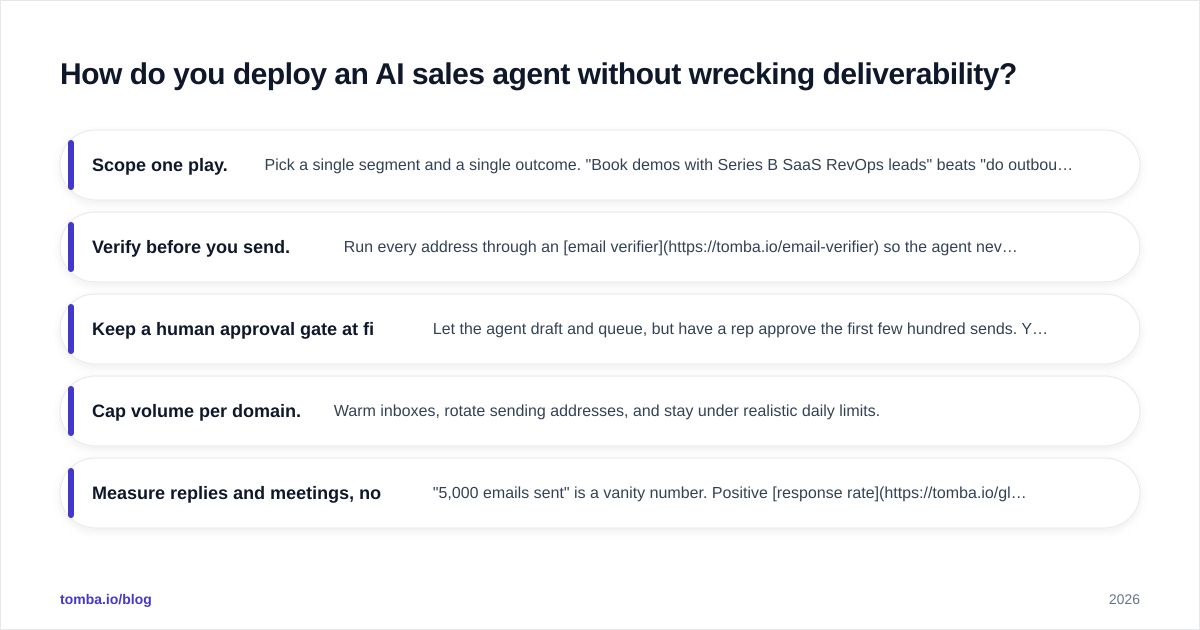
Start narrow, gate the sends, and feed it verified data. The fastest way to get an agent banned from inboxes is to point it at a giant unverified list and let it rip.
A safe rollout looks like this:
- Scope one play. Pick a single segment and a single outcome. "Book demos with Series B SaaS RevOps leads" beats "do outbound."
- Verify before you send. Run every address through an email verifier so the agent never touches a hard bounce. A 2% bounce rate quietly tanks your domain reputation; an agent sending thousands amplifies that fast.
- Keep a human approval gate at first. Let the agent draft and queue, but have a rep approve the first few hundred sends. You are calibrating tone and targeting, not babysitting forever.
- Cap volume per domain. Warm inboxes, rotate sending addresses, and stay under realistic daily limits.
- Measure replies and meetings, not activity. "5,000 emails sent" is a vanity number. Positive response rate and meetings booked are the only metrics that matter.
The agent's quality ceiling is your data quality. This is where most deployments quietly fail — not in the model, but in the list.
What does an AI sales agent cost in 2026?#
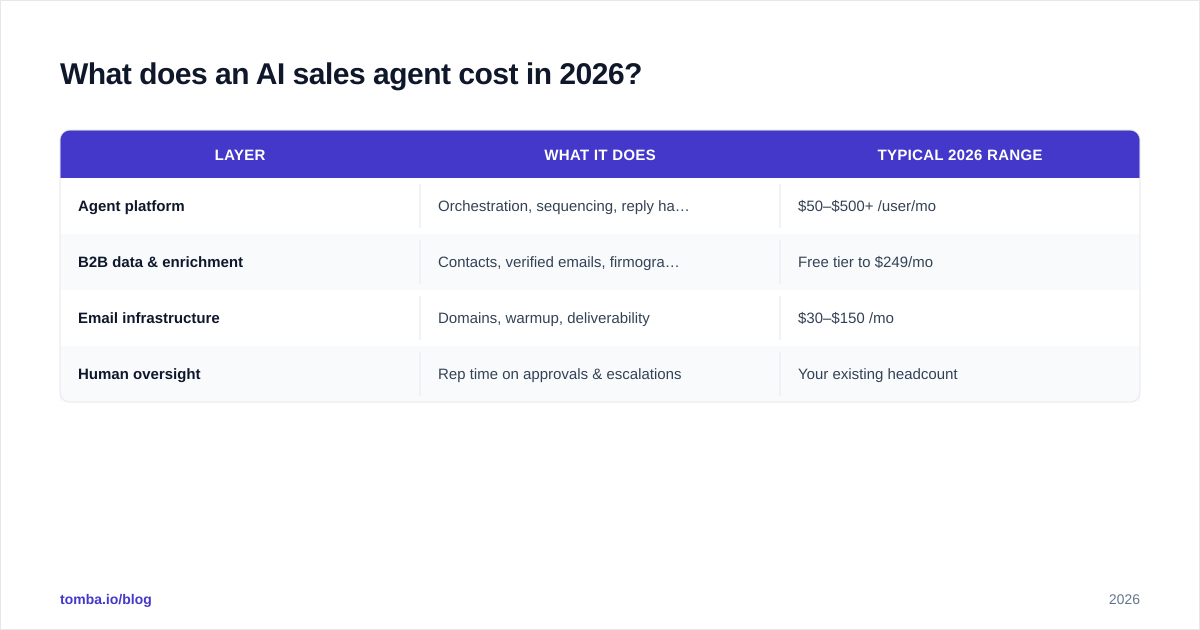
Pricing splits into the agent platform and the data that feeds it. The platform handles orchestration and sending; the data layer handles finding and verifying contacts. You need both, and teams routinely underbudget the second.
| Layer | What it does | Typical 2026 range |
|---|---|---|
| Agent platform | Orchestration, sequencing, reply handling | $50–$500+ /user/mo |
| B2B data & enrichment | Contacts, verified emails, firmographics | Free tier to $249/mo |
| Email infrastructure | Domains, warmup, deliverability | $30–$150 /mo |
| Human oversight | Rep time on approvals & escalations | Your existing headcount |
On the data layer, you do not need to overspend to get accuracy. Tomba pricing starts with a free tier at 25 searches per month, then Starter at $49/mo, Growth at $99/mo, and Pro at $249/mo — enough verified contact data to feed an agent without a five-figure data contract. The expensive mistake is buying a premium agent platform and starving it with cheap, stale data.
What should you look for when choosing an agent stack?#
Prioritize data accuracy, tool integrations, and control. The flashiest demo is rarely the one that survives contact with your real pipeline.
- Verified data access. The agent must reach an email finder and verification layer it can trust. Accuracy upstream beats cleverness downstream every time.
- Real integrations. It should write to your actual CRM — Salesforce, HubSpot, Pipedrive — not a siloed dashboard you have to reconcile later.
- Guardrails you control. Send caps, do-not-contact enforcement, approval gates, and an audit log. If you can't see what the agent did, you can't trust it with your domain.
- Reply intelligence. Detecting "not interested" versus "send me pricing" is where agents earn or lose their keep.
- Transparent sourcing. Know where the contact data comes from and how fresh it is. Opaque data is a compliance and deliverability risk.
A useful gut check, echoed across G2 reviews of AI sales assistants: buyers who rate their agent highly almost always praise data quality and CRM sync first, and copy generation second. The model is a commodity now. The pipes around it are the product.
Is an AI sales agent worth it for a small team?#
Yes — if you treat it as leverage on a working process, not a replacement for one. A two-person team with a clear ICP and clean data gets enormous lift: the agent handles the 80% of outbound that is mechanical, freeing the humans for calls and closes. A team with no ICP, no data hygiene, and no message-market fit just automates its confusion.
The sequence that works: nail your targeting and a message that gets replies manually first, then hand that proven play to an agent to scale. Agents amplify whatever you give them. Give them a winning play and verified contacts, and they multiply it. Give them chaos, and they multiply that too.
Getting started#
The first move isn't picking an agent platform — it's making sure the agent will have real, verified people to contact. An autonomous workflow built on bad data fails quietly and expensively, burning your sending domain on the way down.
Start by building one clean, verified target list. Use the Tomba Email Finder to source professional email addresses by name, company, or domain, then verify them before a single agent touches them. Feed your AI sales agent accurate, deliverable contacts and the automation finally pays off — more replies, more meetings, fewer bounces. Spin up the free tier, build your first 25-contact list, and let the agent run on data you can trust.
// get started
Find, verify and enrich your first contacts today
Start on the free plan with 25 searches a month, then scale when your team is ready.
Free plan · No credit card required · GDPR & CCPA
// about the author