AI Sales Agent Software in 2026: The Complete Buyer's Guide
AI sales agents now handle prospecting, enrichment, and follow-up around the clock. Here's how the software works, what to compare, and where it actually pays off in 2026.
AI sales agent software is no longer a 2024 demo reel. In 2026, autonomous and semi-autonomous agents are doing real pipeline work: researching accounts, drafting personalized outreach, booking meetings, and updating the CRM without a human babysitting every step. The question has shifted from "does it work?" to "which agent, for which job, at what cost?"
This guide breaks down what the category actually is, how to evaluate it, where it earns its keep, and where it still needs a human in the loop.
TL;DR#
- AI sales agent software runs multi-step sales tasks on its own — prospect research, list building, outreach drafting, follow-up, and CRM logging — using LLM reasoning plus tool access.
- The biggest value is at the top of funnel: enrichment, list building, and first-touch personalization, where volume kills human teams.
- Accuracy of the underlying contact data decides whether the agent helps or floods your domain with bounces — garbage in, garbage out.
- Expect to pay anywhere from $0 (open-source frameworks) to $1,000+/month per seat for fully managed platforms; most teams blend a data layer with an agent layer.
- An agent is only as good as its data source. Pair any agent with a verified email and enrichment provider like Tomba's email finder so it acts on real contacts, not guesses.
What is AI sales agent software?#
AI sales agent software is a program that completes sales tasks autonomously by chaining reasoning, memory, and tool calls — instead of waiting for a human to click each button.
Think of it like the difference between a power drill and a contractor. Old "sales automation" was a power drill: it executed one rule you defined ("if lead opens email twice, send template B"). An AI sales agent is closer to the contractor — you give it a goal ("book 5 demos with Series B fintech CTOs this week"), and it figures out the steps: find the accounts, enrich the contacts, draft the message, send it, read replies, and schedule the call.
Technically, these systems combine three layers:
- A reasoning model (an LLM) that plans and adapts.
- Tools and APIs it can call — email finders, CRMs, calendars, enrichment databases, send infrastructure.
- Memory and state so it remembers what it did, what worked, and where each lead sits.
This is why sales automation and AI agents are not the same thing. Automation follows a fixed branch. An agent decides the branch.
How does an AI sales agent actually work?#
Most production agents in 2026 run a loop that looks like this:
- Goal intake — you (or a workflow) hand it an objective and constraints.
- Research — it pulls firmographic and contact data on target accounts.
- Enrichment — it fills gaps: verified email, role, phone, tech stack.
- Drafting — it writes a first-touch message tied to a real trigger (funding, hiring, a recent post).
- Execution — it sends through your mailbox or sequencer.
- Reaction — it reads replies, classifies intent, and either books, nurtures, or disqualifies.
- Logging — it writes everything back to the CRM.
The fragile step is #2 and #3. If the agent invents an email address that doesn't exist, every downstream step is wasted and your sender reputation takes the hit. This is the single most common reason AI sales pilots fail — teams point a clever agent at bad data and watch bounce rates climb past 10%.
That's why serious deployments wire the agent into a verified data source through an API. The Tomba API lets an agent call for a verified email or contact enrichment mid-task, so the message it sends actually lands.
What can AI sales agents do well — and what should stay human?#
Not every task is a good fit. Here's an honest split based on what the technology reliably handles in 2026.
Agents are strong at:
- Building and enriching target lists at volume.
- Researching account triggers across many sources fast.
- Drafting personalized first touches that pass a human sniff test.
- Handling routine follow-up cadences and scheduling.
- Keeping CRM hygiene clean (no rep ever wants to do this).
Keep a human on:
- High-stakes negotiation and pricing.
- Multi-threaded enterprise deals with internal politics.
- Anything where a tone misfire burns a strategic account.
- Final judgment on whether a lead is truly qualified.
The winning pattern is agent-assisted, human-approved at the top of funnel, with humans owning the close. Treat the agent as a tireless SDR, not a closer.
What should you compare when buying AI sales agent software?#
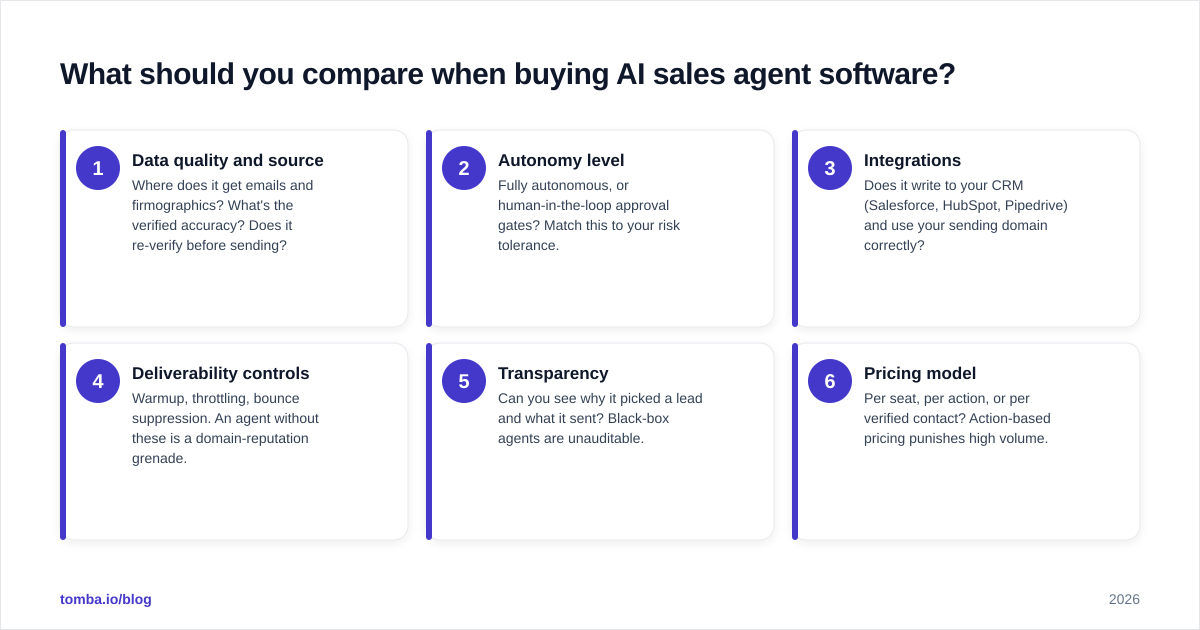
Buyers fixate on the demo and ignore the boring fundamentals that decide ROI. Use these criteria in order of impact:
- Data quality and source — Where does it get emails and firmographics? What's the verified accuracy? Does it re-verify before sending?
- Autonomy level — Fully autonomous, or human-in-the-loop approval gates? Match this to your risk tolerance.
- Integrations — Does it write to your CRM (Salesforce, HubSpot, Pipedrive) and use your sending domain correctly?
- Deliverability controls — Warmup, throttling, bounce suppression. An agent without these is a domain-reputation grenade.
- Transparency — Can you see why it picked a lead and what it sent? Black-box agents are unauditable.
- Pricing model — Per seat, per action, or per verified contact? Action-based pricing punishes high volume.
How do the main categories of AI sales agent software compare?#
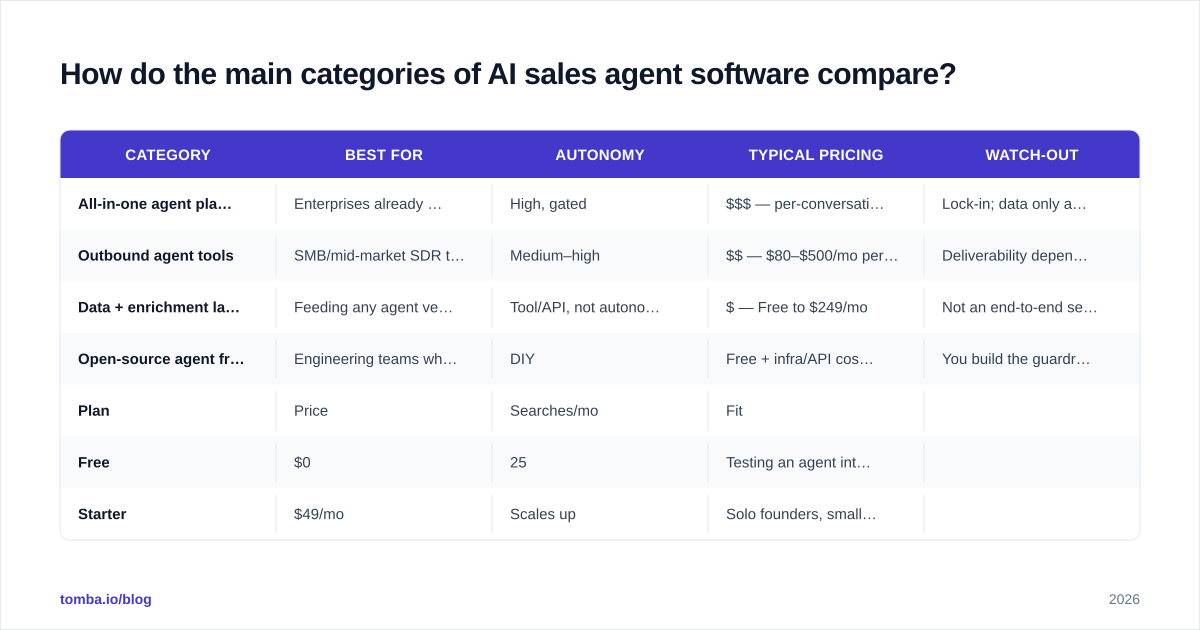
There isn't one "AI sales agent" — there are roughly four product shapes. Here's how they stack up.
| Category | Best for | Autonomy | Typical pricing | Watch-out |
|---|---|---|---|---|
| All-in-one agent platforms (e.g. Salesforce Agentforce) | Enterprises already on the CRM | High, gated | $$$ — per-conversation or per-seat, often $1,000+/mo | Lock-in; data only as good as your CRM |
| Outbound agent tools | SMB/mid-market SDR teams | Medium–high | $$ — $80–$500/mo per seat | Deliverability depends on your setup |
| Data + enrichment layer (e.g. Tomba) | Feeding any agent verified contacts | Tool/API, not autonomous | $ — Free to $249/mo | Not an end-to-end sequencer by itself |
| Open-source agent frameworks | Engineering teams who want control | DIY | Free + infra/API costs | You build the guardrails yourself |
Most real stacks combine two rows: a data layer for accurate contacts and an outbound or all-in-one layer for execution. The data layer is the cheapest line item and the one that most determines whether the rest works.
For reference on pricing tiers, here's how a dedicated data layer like Tomba is structured:
| Plan | Price | Searches/mo | Fit |
|---|---|---|---|
| Free | $0 | 25 | Testing an agent integration |
| Starter | $49/mo | Scales up | Solo founders, small lists |
| Growth | $99/mo | Higher | Active outbound teams |
| Pro | $249/mo | High volume | Agencies, heavy automation |
| Enterprise | Custom | Custom | API-driven agent fleets |
See the full breakdown on the Tomba pricing page. Note the correct Starter price is $49/mo — ignore any older $39 figures floating around.

Is AI sales agent software better than a human SDR?#
Better at different things. The honest answer is that the best 2026 teams don't choose — they layer.
An AI agent beats a human SDR on speed, volume, consistency, and tireless follow-up. It never forgets to enrich a lead, never skips the boring CRM update, and can research 500 accounts overnight.
A human SDR beats an agent on judgment, rapport, handling curveballs, and knowing when to break the script. A prospect who replies "interesting, but we just signed with a competitor" needs a human read on whether that's a dead end or a 6-month nurture.
The math that matters: an agent that handles enrichment and first-touch frees your humans to spend their hours on replies and conversations — the part where deals are actually won. According to Gartner's research on AI in sales, the durable gains come from augmenting reps, not replacing them outright.
What does a practical AI sales agent stack look like?#
Here's a grounded example you could assemble this quarter, without a six-figure platform contract.
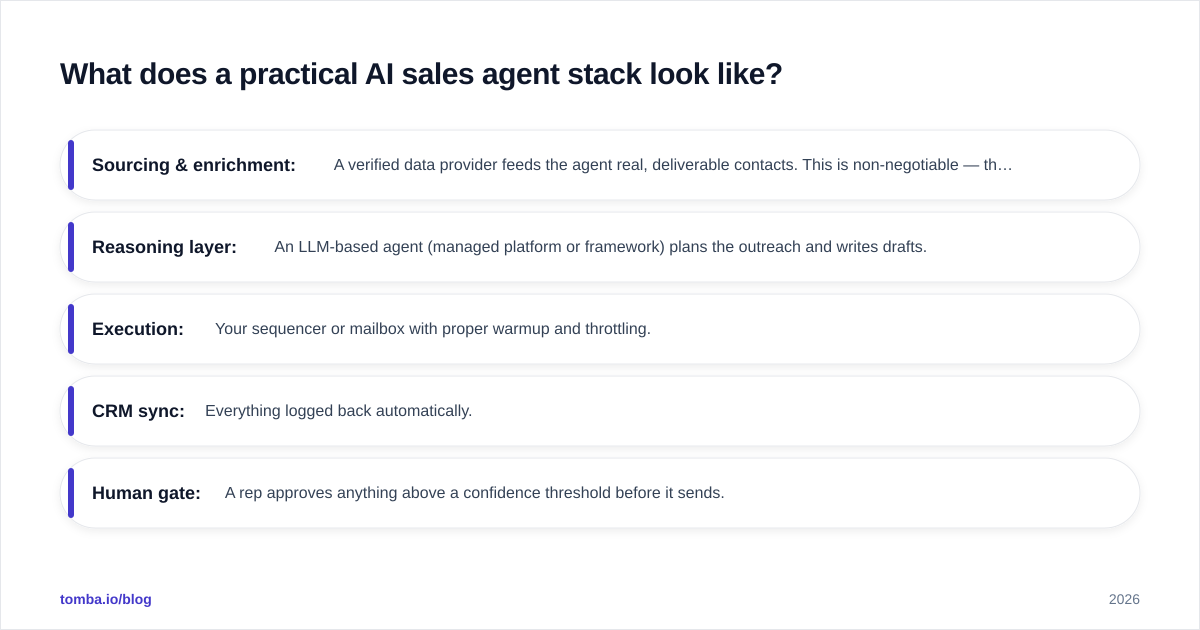
- Sourcing & enrichment: A verified data provider feeds the agent real, deliverable contacts. This is non-negotiable — the email finder and enrichment calls are what keep bounce rates low.
- Reasoning layer: An LLM-based agent (managed platform or framework) plans the outreach and writes drafts.
- Execution: Your sequencer or mailbox with proper warmup and throttling.
- CRM sync: Everything logged back automatically.
- Human gate: A rep approves anything above a confidence threshold before it sends.
The key design principle: separate the data layer from the agent layer. When your contacts come from a dedicated, re-verifiable source, you can swap or upgrade the reasoning model without rebuilding your entire pipeline — and you avoid the trap of trusting whatever stale emails a single all-in-one vendor happens to have.
How do you avoid the common failure modes?#
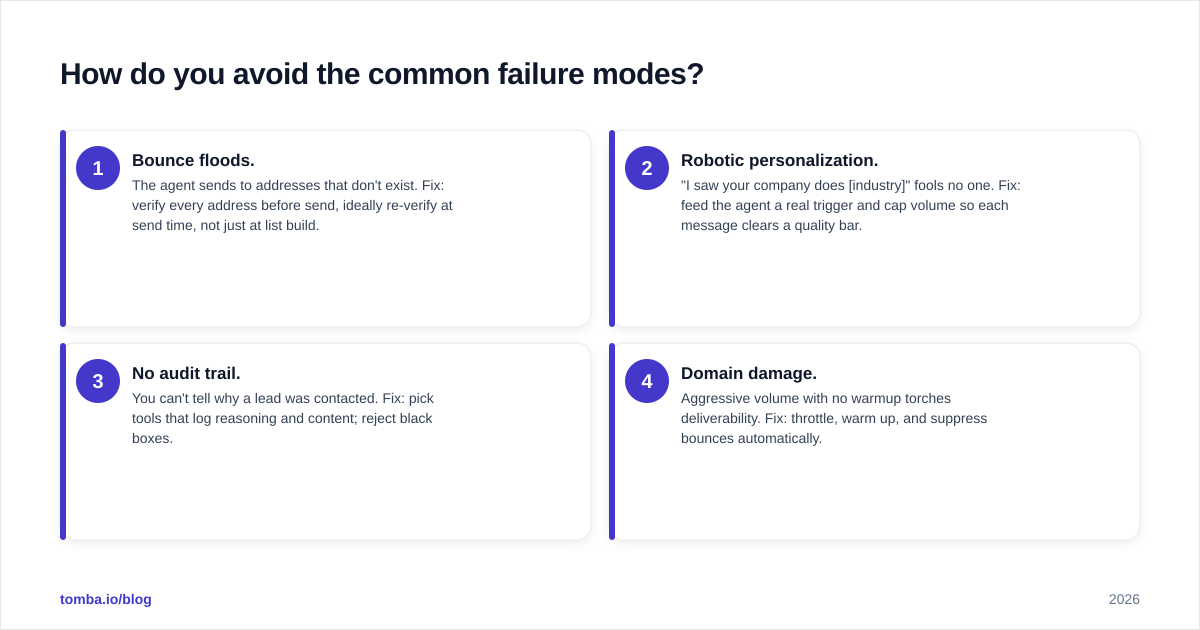
Four pitfalls sink most AI sales agent rollouts. Each has a cheap fix.
- Bounce floods. The agent sends to addresses that don't exist. Fix: verify every address before send, ideally re-verify at send time, not just at list build.
- Robotic personalization. "I saw your company does [industry]" fools no one. Fix: feed the agent a real trigger and cap volume so each message clears a quality bar.
- No audit trail. You can't tell why a lead was contacted. Fix: pick tools that log reasoning and content; reject black boxes.
- Domain damage. Aggressive volume with no warmup torches deliverability. Fix: throttle, warm up, and suppress bounces automatically.
The first and last points both trace back to data quality. An agent firing on verified contacts with proper throttling is an asset; one firing on scraped, unverified lists is a liability with a monthly invoice.
What's the realistic ROI in 2026?#
Expect efficiency gains, not magic. Teams that deploy AI sales agents well typically report reps spending materially less time on research and admin, and more on live conversations. The cost side is straightforward: a data layer runs from free to a few hundred dollars a month, and an execution layer scales with seats or volume.
The ROI lever most teams miss is data spend efficiency. Paying per-action for an all-in-one platform to do enrichment is far more expensive than calling a dedicated provider's API for the same verified contact. Decoupling these line items often cuts the data portion of the bill substantially while improving accuracy — you can validate vendor accuracy claims against third-party reviews on G2 before committing.
Frequently asked questions#
Are AI sales agents fully autonomous? Most production deployments in 2026 are semi-autonomous with human approval gates on outbound. Fully autonomous end-to-end selling exists but is reserved for low-risk, high-volume motions.
Will an AI agent hurt my email deliverability? Only if it sends to unverified addresses or ignores throttling. With verified data and proper warmup, deliverability stays healthy.
Do I need to replace my CRM? No. Good agents integrate with Salesforce, HubSpot, and Pipedrive rather than replacing them. Check vendor docs like HubSpot's AI tools overview for integration depth.
What's the cheapest way to start? Pair a free data tier with an existing sequencer and a simple agent framework, then scale the data plan as volume grows.
The bottom line#
AI sales agent software in 2026 is real, useful, and most valuable at the top of funnel — provided you feed it accurate, verified contact data. The agent is the engine; the data is the fuel. Skimp on the fuel and the best engine in the world stalls.
Before you wire up any agent, give it a reliable source of deliverable contacts. Start free with the Tomba Email Finder — find and verify professional emails by name, domain, or company, then plug those verified contacts into whatever agent you build or buy. Your bounce rate, your sender reputation, and your reps will thank you. Spin up a free account, test it against your next target list, and let your AI agent act on real people instead of guesses.
// get started
Find, verify and enrich your first contacts today
Start on the free plan with 25 searches a month, then scale when your team is ready.
Free plan · No credit card required · GDPR & CCPA
// about the author