AI Sales Analytics in 2026: The Complete Buyer's Guide
AI sales analytics turns raw CRM noise into forecasts, deal risk scores, and rep coaching. Here's how it works, what to buy, and where it breaks in 2026.
TL;DR
- AI sales analytics applies machine learning to your CRM, email, and call data to predict outcomes — which deals close, which reps need coaching, and where the forecast is wrong — instead of just reporting what already happened.
- The three pillars are predictive forecasting, deal/lead scoring, and conversation intelligence. Most "AI" dashboards only do one well; few do all three.
- Garbage in, garbage out: models trained on incomplete contact data and stale pipeline produce confident-but-wrong predictions. Clean data is the prerequisite, not an afterthought.
- Budget realistically. Conversation-intelligence suites run $1,200–$1,600 per user per year; lightweight scoring add-ons start far cheaper.
- Start with one decision you want to improve (forecast accuracy or lead prioritization), prove it, then expand.
What is AI sales analytics?#
AI sales analytics is software that uses machine learning to turn historical and live sales data into predictions and recommendations — not just charts of the past.
Think of the difference between a rear-view mirror and a GPS with live traffic. Traditional business intelligence (BI) shows you last quarter's close rate and where reps stalled. AI sales analytics looks at the same data plus thousands of signals — email reply latency, call sentiment, deal velocity, buyer engagement — and tells you "this $80k deal has a 31% chance of closing this quarter, and here's why."
Technically, these systems ingest structured data (CRM fields, pipeline stages, activity logs) and unstructured data (call transcripts, email threads, meeting notes), then run supervised models for scoring and forecasting and NLP models for conversation intelligence. The output lands back in your CRM or a dedicated dashboard as scores, risk flags, and next-best-actions.
The category overlaps with revenue operations and sales automation, but the defining trait is prediction. If a tool only aggregates and visualizes, it's BI with a new label.
Why does AI sales analytics matter in 2026?#
Because rep intuition doesn't scale and manual forecasting is wrong more often than leaders admit.
The typical sales org still forecasts by asking reps to gut-check their pipeline in a Monday call. Studies from firms like Gartner have long flagged that the majority of B2B forecasts miss by double-digit percentages. The cost isn't just a bad number on a slide — it's misallocated headcount, blown hiring plans, and board credibility.
)
AI sales analytics matters now for three concrete reasons:
- Data volume crossed the human threshold. A single rep working 40 active deals generates more signals (emails, calls, doc opens) than any manager can read. Models don't get tired at deal 12.
- Buying committees got bigger. B2B deals now involve 6–10 stakeholders. Tracking engagement across all of them by hand is impossible; software does it passively.
- Margins got tighter. With efficient-growth pressure replacing growth-at-all-costs, leaders need to know where to spend rep time. Scoring tells you which 20% of leads deserve 80% of the effort.
The catch: every prediction depends on input quality. A model fed half-empty contact records and untracked emails will hallucinate confidence. That's why teams serious about analytics first fix their data foundation — accurate emails, enriched accounts, deduped records — before turning on the models.
What are the core components of AI sales analytics?#
There are three, and most platforms specialize in one or two rather than mastering all three.
1. Predictive forecasting. Models weight every open deal by historical win patterns to produce a probability-adjusted forecast. Good systems explain the "why" (deal has been in stage 3 for 47 days vs. 21-day average) so reps can act, not just nod.
2. Lead and deal scoring. Instead of a static point system ("+10 for a demo request"), ML scoring learns which signals actually predicted past wins and re-weights continuously. This is the bridge to lead management and scoring workflows.
3. Conversation intelligence. NLP transcribes and analyzes calls and emails — talk-to-listen ratio, competitor mentions, sentiment shifts, commitments made. It surfaces coaching moments managers would never have time to find manually.
A fourth, increasingly common layer is next-best-action recommendations — the system tells a rep "send pricing now" or "loop in the CFO." Treat this as a maturity feature, not a starting requirement.
How do you compare AI sales analytics tools?#
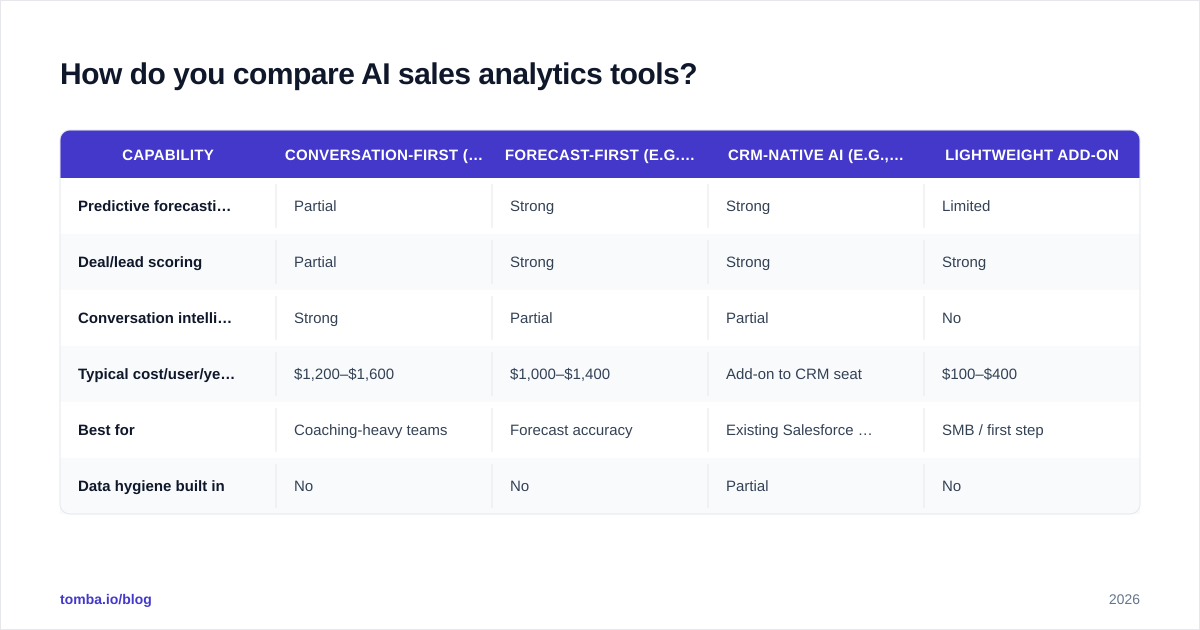
Compare on the three pillars, data hygiene support, CRM fit, and total cost per seat — not on demo flash. Here's how the major categories stack up in 2026.
| Capability | Conversation-first (e.g., Gong) | Forecast-first (e.g., Clari) | CRM-native AI (e.g., Salesforce Einstein) | Lightweight add-on |
|---|---|---|---|---|
| Predictive forecasting | Partial | Strong | Strong | Limited |
| Deal/lead scoring | Partial | Strong | Strong | Strong |
| Conversation intelligence | Strong | Partial | Partial | No |
| Typical cost/user/year | $1,200–$1,600 | $1,000–$1,400 | Add-on to CRM seat | $100–$400 |
| Best for | Coaching-heavy teams | Forecast accuracy | Existing Salesforce shops | SMB / first step |
| Data hygiene built in | No | No | Partial | No |
A few honest notes on the table. None of these tools fix bad source data for you — they assume your CRM is already clean. Conversation-first platforms are superb at coaching but weaker at portfolio-level forecasting. CRM-native AI is the path of least resistance if you already pay for the platform, but it's rarely best-in-class on any single axis.
When you evaluate, score vendors against your own historical data: ask for a backtest where the model predicts deals you already know the outcome of. Read independent reviews on G2 rather than vendor case studies. And confirm the integration depth with your stack — HubSpot, Salesforce, or Pipedrive — before signing.
)
Does AI sales analytics actually improve accuracy?#
Yes — but only as much as your data allows, and the gains come from better inputs as much as smarter models.
Here's the uncomfortable truth most vendors skip: a forecasting model is a multiplier on data quality. Feed it pipeline where 30% of contacts have no verified email, accounts are duplicated, and half the activity goes untracked, and you get predictions that are precise to two decimals and wrong by a mile. Feed it clean, enriched, deduplicated records and the same model becomes genuinely useful.
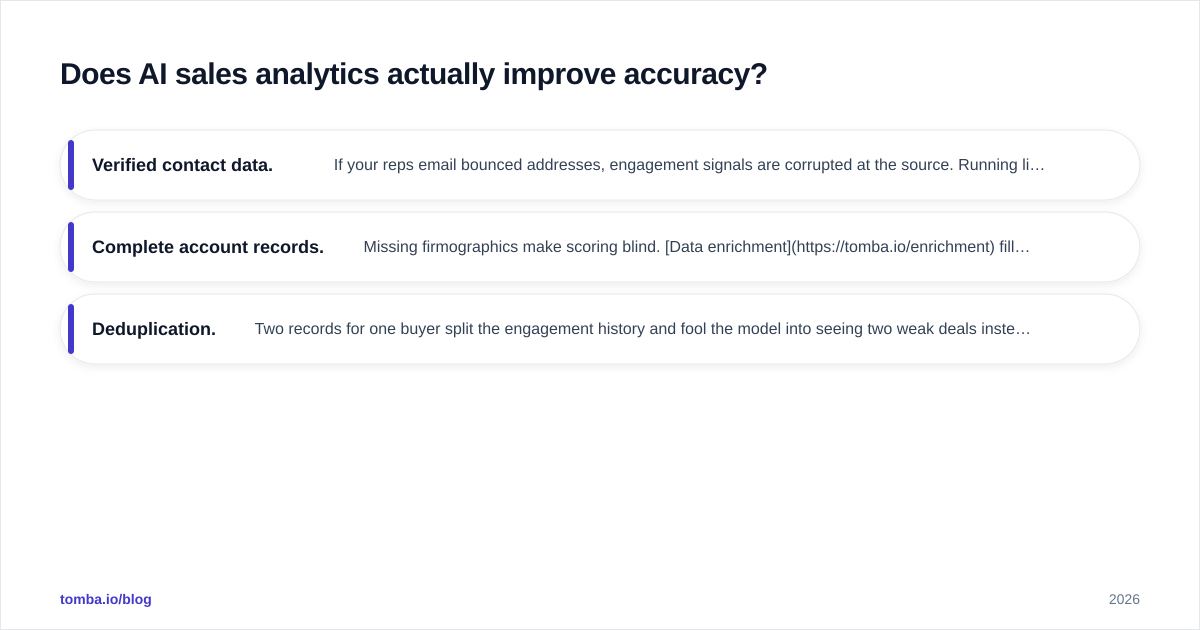
That's why the analytics journey almost always starts upstream:
- Verified contact data. If your reps email bounced addresses, engagement signals are corrupted at the source. Running lists through an email verifier before they hit the CRM keeps the signal clean.
- Complete account records. Missing firmographics make scoring blind. Data enrichment fills the gaps so the model sees the full picture.
- Deduplication. Two records for one buyer split the engagement history and fool the model into seeing two weak deals instead of one strong one.
Once the foundation is solid, the model has something real to learn from. Skip the foundation, and you've bought an expensive random-number generator with a confident UI.
How do you roll out AI sales analytics without wasting the budget?#
Pick one decision to improve, prove the lift on it, then expand — don't boil the ocean.
The failed rollouts share a pattern: the team buys a full suite, turns on every feature, overwhelms reps with scores nobody trusts, and adoption collapses within a quarter. The successful ones are narrow and sequential.
Phase 1 — Fix the foundation (weeks 1–4). Audit data quality. Verify emails, enrich accounts, dedupe. Establish a clean baseline so later predictions are trustworthy. This is also where you decide what "good data" means and who owns it.
Phase 2 — Solve one decision (weeks 4–10). Choose either forecast accuracy or lead prioritization. Implement the single capability, backtest it against known outcomes, and put the output in front of one team. Measure against a control group.
Phase 3 — Earn trust, then expand (quarter 2+). Once reps see the scores correlate with reality, add the next pillar — conversation intelligence or next-best-action. Adoption follows credibility, not features.
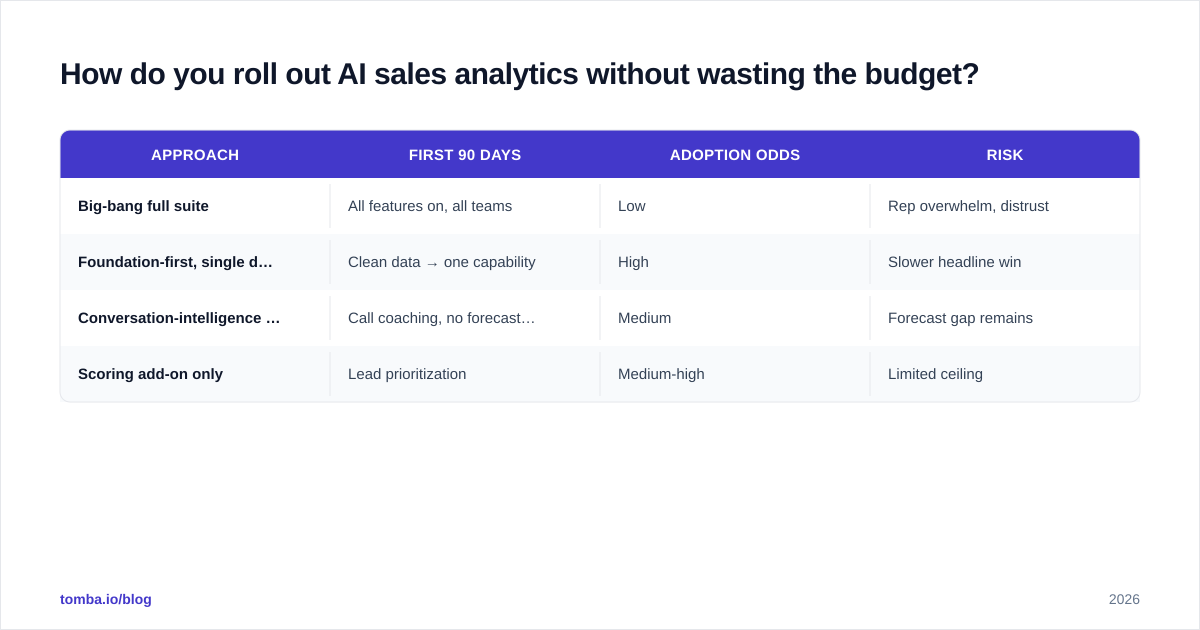
A practical sequencing comparison:
| Approach | First 90 days | Adoption odds | Risk |
|---|---|---|---|
| Big-bang full suite | All features on, all teams | Low | Rep overwhelm, distrust |
| Foundation-first, single decision | Clean data → one capability | High | Slower headline win |
| Conversation-intelligence only | Call coaching, no forecasting | Medium | Forecast gap remains |
| Scoring add-on only | Lead prioritization | Medium-high | Limited ceiling |
Throughout, keep humans in the loop. AI sales analytics is a co-pilot, not autopilot. The rep who knows the buyer's hidden blocker should be able to override a score — and the system should learn from that override. Tools that treat predictions as gospel break trust the first time they're confidently wrong on a deal the rep knew was dead.
For teams connecting analytics to outbound execution, tight integration matters more than raw model sophistication. If your scores live in one tool and your reps work in HubSpot or Salesforce, the friction of context-switching will quietly kill usage.
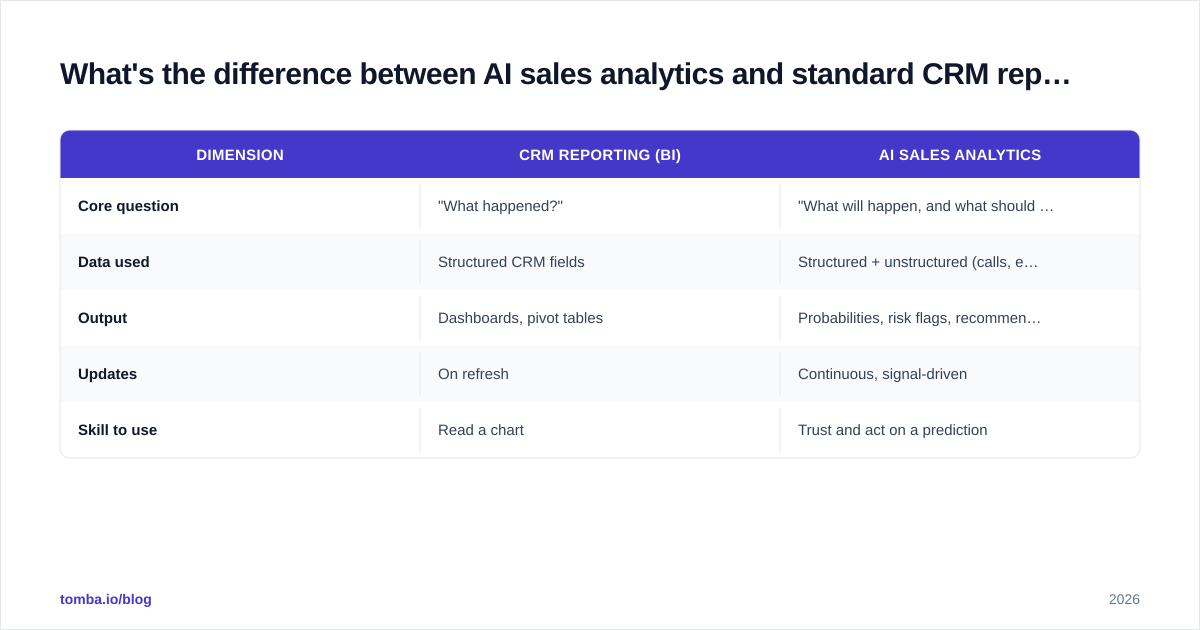
What's the difference between AI sales analytics and standard CRM reporting?#
CRM reporting describes the past; AI sales analytics predicts and prescribes the future.
| Dimension | CRM reporting (BI) | AI sales analytics |
|---|---|---|
| Core question | "What happened?" | "What will happen, and what should I do?" |
| Data used | Structured CRM fields | Structured + unstructured (calls, email) |
| Output | Dashboards, pivot tables | Probabilities, risk flags, recommendations |
| Updates | On refresh | Continuous, signal-driven |
| Skill to use | Read a chart | Trust and act on a prediction |
You need both. Reporting answers accountability questions ("did we hit quota?"); analytics answers steering questions ("which deals do I save this week?"). The mistake is paying premium prices for an AI tool and using it as a fancier dashboard.
Final take and where to start#
AI sales analytics is genuinely transformative when — and only when — it runs on clean, complete, verified data. The model is the easy part; the data foundation is where most ROI is won or lost. Start narrow, prove one decision, and expand on the back of earned trust.
Before you spend a dollar on a forecasting suite, make sure the contacts feeding it are real. Bounced emails and half-empty records poison every downstream prediction. The fastest, cheapest first step is getting verified, accurate contact data into your CRM — and that's exactly what the Tomba Email Finder is built for. Find and verify professional emails by domain or name, enrich your records, and feed your analytics stack the clean signal it needs. Check the Tomba pricing — a free tier with 25 searches/month lets you test data quality before committing, with paid plans from $49/mo when you're ready to scale. Fix the foundation first; the smart forecasts follow.
Ready to find emails that actually work?
Join 150,000+ professionals who stopped guessing and started sending. Free credits on signup — no credit card required.
Get the Tomba newsletter
Practical outbound tactics and product updates — once every two weeks.
About the author