AI Sales Assistant in 2026: How It Works and Top Tools
An AI sales assistant handles research, data entry, and follow-up so reps can sell. Here's how the tech works in 2026, what it costs, and how to pick one.
Reps spend most of their week not selling. An AI sales assistant is the software layer that takes the non-selling work — research, data entry, scheduling, follow-up drafting — and does it automatically so the human can stay in front of buyers. This guide breaks down what these tools actually do in 2026, where they help, where they overpromise, and how to choose one without lighting your budget on fire.
TL;DR#
- An AI sales assistant is software that automates research, CRM hygiene, follow-up drafting, and meeting prep — think of it as a tireless junior rep that never forgets to log a call.
- The biggest, most reliable win is time recovery: studies consistently show reps spend under a third of their day actually selling. AI assistants attack the other two-thirds.
- Categories range from CRM-native copilots (Salesforce Einstein, HubSpot Breeze) to standalone prospecting and enrichment assistants that feed clean data in.
- Garbage data breaks every AI assistant. Accurate contact data and verified emails are the foundation — automation amplifies whatever you feed it, good or bad.
- Expect to pay $30–$150 per seat per month for most assistants, with enrichment and data tools billed separately by volume.
What is an AI sales assistant?#
An AI sales assistant is a software tool that uses machine learning and large language models to perform sales support tasks that a human would otherwise do by hand. The most common jobs: researching prospects, drafting emails, summarizing calls, updating the CRM, scoring leads, and reminding reps when to follow up.
Here's a useful analogy. A great executive assistant doesn't make decisions for you — they make sure every decision you make is teed up with the right information at the right time. They book the room, pull the file, and remind you who you're meeting and why. An AI sales assistant does the same for a sales rep: it handles the prep and the paperwork so the rep can focus on the conversation.
Technically, these tools combine three layers: a data layer (contact and company information), an intelligence layer (LLMs and predictive models that interpret that data), and an action layer (the integrations that write back to your CRM, email, or calendar). Weakness in any layer degrades the whole system — most often it's the data layer.
What does an AI sales assistant actually do?#
The marketing copy for these tools is vague on purpose. Here's the concrete list of tasks a 2026-era assistant can reliably handle:
- Prospect research — pulling firmographics, recent news, funding events, and tech stack so a rep walks into a call informed.
- Data entry and CRM hygiene — logging activities, updating contact records, and flagging stale or duplicate data without manual typing.
- Email and message drafting — generating personalized first-touch and follow-up copy from a prospect's profile and your value proposition.
- Meeting prep and recap — summarizing call transcripts, extracting action items, and drafting the follow-up email before the rep even leaves the Zoom.
- Lead scoring and prioritization — ranking which accounts to work first based on fit and engagement signals.
- Scheduling and reminders — booking meetings and nudging reps when a deal goes quiet.
According to Salesforce's State of Sales research, reps spend roughly 70% of their time on tasks other than selling. That's the gap these assistants are built to close. The point isn't to replace the rep — it's to delete the busywork that keeps the rep from selling.
What are the main types of AI sales assistants?#
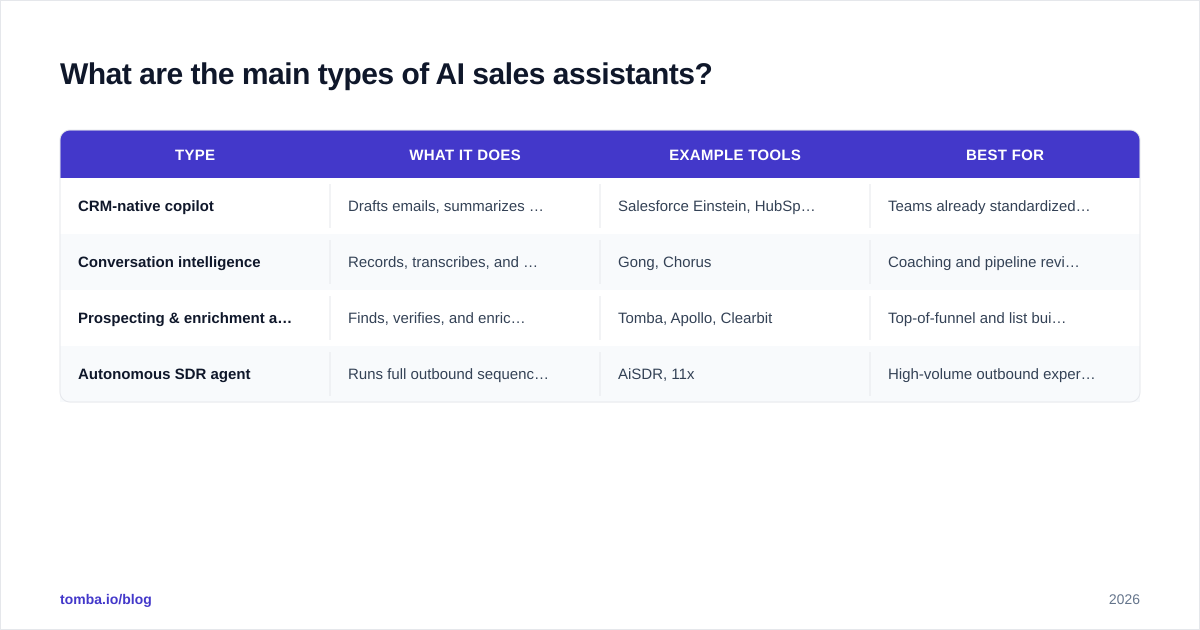
Not all assistants do the same thing. They cluster into four broad categories, and most teams end up running two or three together.
| Type | What it does | Example tools | Best for |
|---|---|---|---|
| CRM-native copilot | Drafts emails, summarizes deals, updates records inside your CRM | Salesforce Einstein, HubSpot Breeze | Teams already standardized on one CRM |
| Conversation intelligence | Records, transcribes, and analyzes calls | Gong, Chorus | Coaching and pipeline review |
| Prospecting & enrichment assistant | Finds, verifies, and enriches contact data | Tomba, Apollo, Clearbit | Top-of-funnel and list building |
| Autonomous SDR agent | Runs full outbound sequences with minimal human input | AiSDR, 11x | High-volume outbound experiments |
The categories overlap, and vendors increasingly bundle features. But the distinction matters when you buy: a conversation-intelligence tool will not build your prospect list, and a CRM copilot is only as good as the records already in your CRM. That's why a data enrichment and prospecting layer usually sits underneath everything else — it's what populates the records the other tools act on.
Is an AI sales assistant worth it?#
Short answer: yes, if your reps are drowning in admin and your data is clean enough to act on. No, if you expect it to fix a broken process or replace pipeline you don't have.
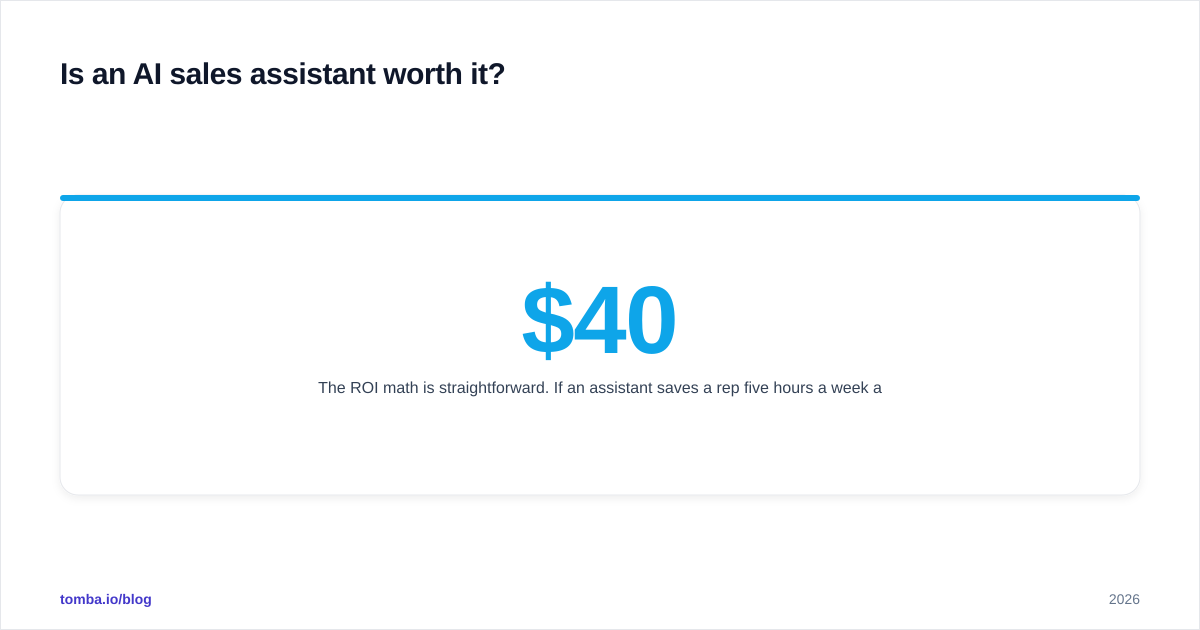
The ROI math is straightforward. If an assistant saves a rep five hours a week and that rep's fully loaded cost is $40 an hour, that's $800 a month in recovered capacity against a tool that costs $50–$150 per seat. Even at conservative time savings, the payback is fast. The risk isn't the price — it's adoption. Tools that reps don't trust get ignored, and an ignored assistant returns exactly zero.
Two failure modes are worth calling out:
- Bad data in, bad work out. An assistant that drafts a personalized email to the wrong contact, or enriches a record with a stale title, actively damages your sender reputation and your credibility. Verified, current data isn't optional — it's the precondition for everything downstream.
- Over-automation. Fully autonomous outbound at scale, with no human in the loop, is the fastest way to get your domain flagged for spam. The best results in 2026 still come from AI-assisted humans, not human-free AI.
Gartner's sales technology research has repeatedly found that adoption — not capability — is the deciding factor in whether sales tech delivers. Buy for the workflow your reps will actually use.
How do you choose the right AI sales assistant?#
Match the tool to your biggest bottleneck, not to the longest feature list. Run through these questions in order:
- Where does your team lose the most time? If it's research and list-building, start with a prospecting and enrichment assistant. If it's call follow-up, start with conversation intelligence. If it's CRM hygiene, a native copilot.
- What's your CRM, and does the tool write back to it cleanly? An assistant that can't update your system of record just creates a second place to check.
- How accurate is the underlying data? Ask vendors for their verification rate and bounce guarantees, not just their database size. A billion stale records is worse than ten million verified ones.
- What does it cost at your scale? Per-seat pricing and per-credit enrichment pricing scale very differently. Model your real volume before you sign.
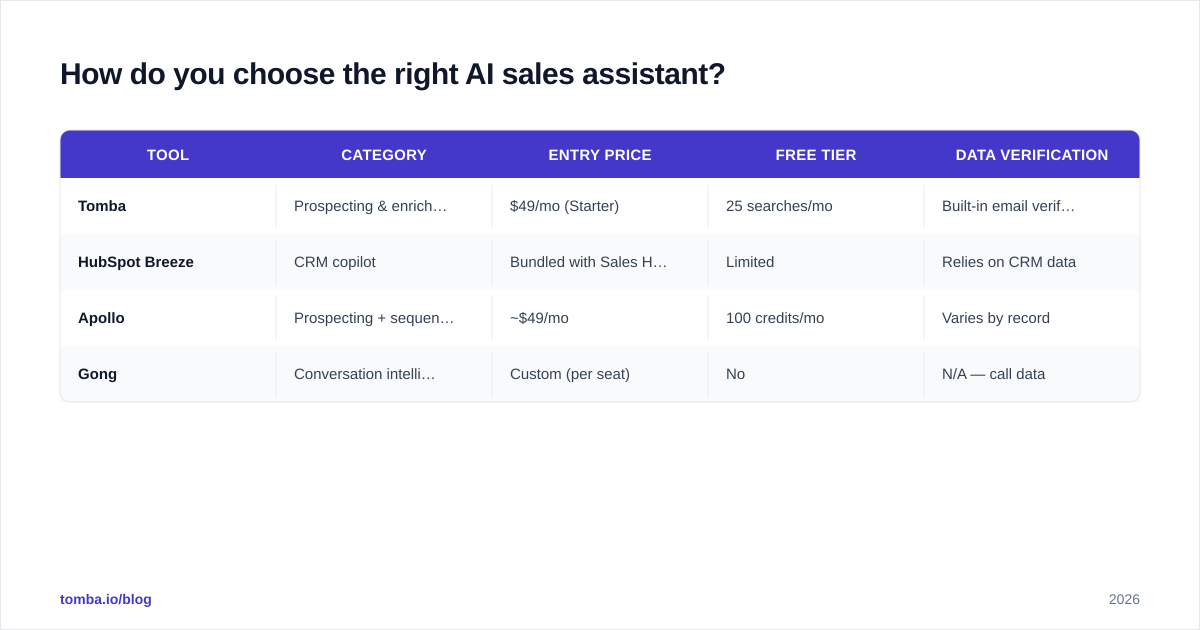
Here's a side-by-side of representative options across the spectrum, including where Tomba pricing lands for the data layer:
| Tool | Category | Entry price | Free tier | Data verification |
|---|---|---|---|---|
| Tomba | Prospecting & enrichment | $49/mo (Starter) | 25 searches/mo | Built-in email verifier + catch-all |
| HubSpot Breeze | CRM copilot | Bundled with Sales Hub | Limited | Relies on CRM data |
| Apollo | Prospecting + sequences | ~$49/mo | 100 credits/mo | Varies by record |
| Gong | Conversation intelligence | Custom (per seat) | No | N/A — call data |
Notice that the data and the workflow tools are priced and bought separately. That's by design: most teams pair a clean data source like Tomba with a CRM copilot or sequencer, rather than expecting one vendor to do both well.
How does data quality make or break an AI assistant?#
Every AI sales assistant is a multiplier, and it multiplies your data quality in both directions. Feed it verified contacts and accurate firmographics, and it drafts sharp, relevant outreach. Feed it guesses and stale records, and it confidently produces personalized messages to people who left the company two years ago.
This is the part vendors gloss over. The intelligence layer gets all the attention, but in practice the data layer determines the outcome. Three concrete safeguards:
- Verify before you act. Run new contacts through an email verifier before any assistant drafts or sends. A verified address protects your deliverability and your assistant's credibility.
- Enrich at the source. Pull complete, current records when you add a contact — not after the assistant has already acted on a thin one.
- Watch your sender reputation. Even the best copy fails if it lands in spam. Keep your bounce rate low and your sender reputation clean, because automation increases volume and volume amplifies any deliverability problem.
If you want the mechanics of how contact data feeds the rest of your stack, the broader concept of sales automation covers how these pieces connect end to end. The takeaway: invest in the data layer first, then layer intelligence and action on top. Doing it in the other order just means automating mistakes faster.
What's the difference between an AI sales assistant and an AI SDR?#
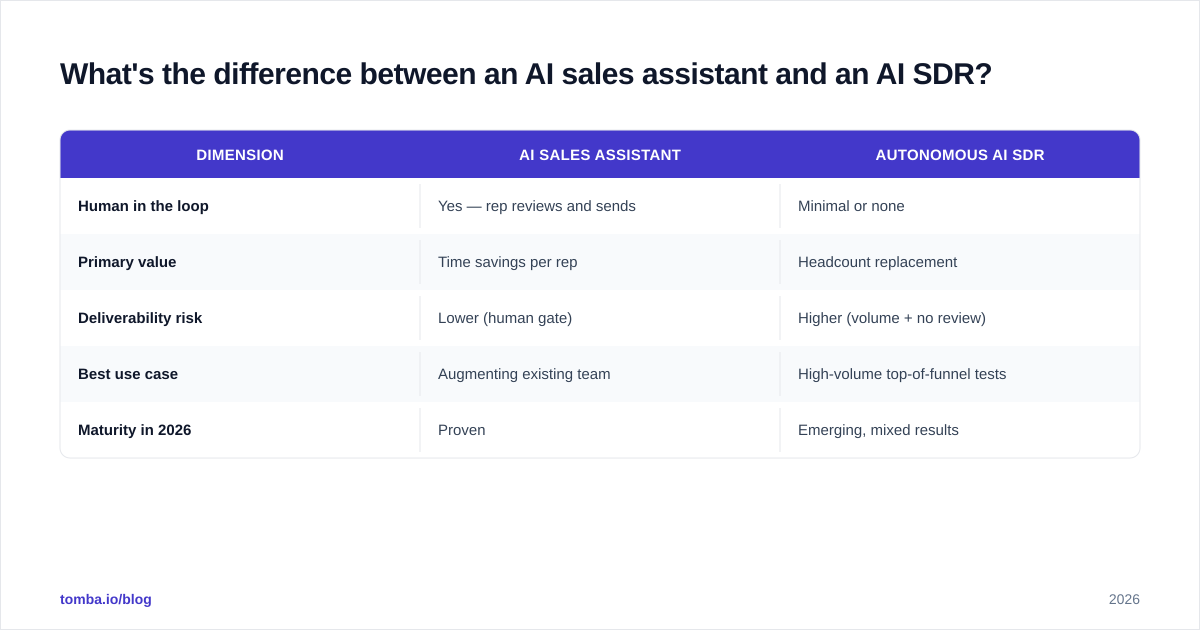
An AI sales assistant supports a human rep. An AI SDR aims to replace one. That's the cleanest way to draw the line, and it matters because the two carry very different risk profiles.
| Dimension | AI sales assistant | Autonomous AI SDR |
|---|---|---|
| Human in the loop | Yes — rep reviews and sends | Minimal or none |
| Primary value | Time savings per rep | Headcount replacement |
| Deliverability risk | Lower (human gate) | Higher (volume + no review) |
| Best use case | Augmenting existing team | High-volume top-of-funnel tests |
| Maturity in 2026 | Proven | Emerging, mixed results |
The honest assessment for 2026: assistants are a safe, proven bet. Fully autonomous SDRs are improving fast but still produce inconsistent results, and the deliverability blowback from unsupervised high-volume sending is real. Most successful teams use AI to make each rep more productive rather than to remove reps from the loop entirely. Start with augmentation, measure the lift, and only graduate to autonomy where the data and the guardrails justify it.
How do you roll one out without breaking your team?#
A phased rollout beats a big-bang launch every time. The pattern that works:
- Pick one workflow. Don't deploy six features at once. Choose the single highest-pain task — usually research or follow-up — and prove the value there.
- Clean the data feeding it. Verify and enrich the records the assistant will touch. This is the step teams skip and then blame the tool.
- Measure against a baseline. Track time-per-task or response rate before and after. If you can't measure the lift, you can't defend the spend.
- Expand by proof, not by hope. Add the next workflow only once the first one is delivering. Adoption compounds when reps see real wins.
For more on the foundations — finding and verifying the contacts that power all of this — the Tomba blog goes deeper on prospecting and deliverability tactics. And if you want third-party perspective on specific tools, G2's sales assistant category aggregates verified user reviews worth reading before you commit.
The bottom line#
An AI sales assistant earns its keep by giving reps back the hours they currently lose to admin — but only when it's built on accurate, verified contact data. The intelligence layer is impressive; the data layer is decisive.
That's where Tomba fits. Before any assistant can research, draft, or sequence, it needs real, verified contacts to work with. The Tomba Email Finder finds professional email addresses by name, domain, or company, verifies them, and feeds clean data straight into your CRM and AI workflows — so whatever assistant you layer on top is multiplying good data instead of amplifying bad. Start free with 25 searches a month, and build your automation on a foundation that won't quietly sabotage your sender reputation. Get the data right first, and every AI tool you add gets better.
Ready to find emails that actually work?
Join 150,000+ professionals who stopped guessing and started sending. Free credits on signup — no credit card required.
Get the Tomba newsletter
Practical outbound tactics and product updates — once every two weeks.
About the author