AI Sales Call Guide 2026: Tools, Scripts, and Real ROI
AI sales calls promise faster dials, live coaching, and cleaner notes. Here's what actually works in 2026, what to avoid, and how to build a stack that closes.
TL;DR
- An AI sales call is any phone conversation where software assists before, during, or after the dial — from auto-dialing and real-time coaching to fully autonomous voice agents.
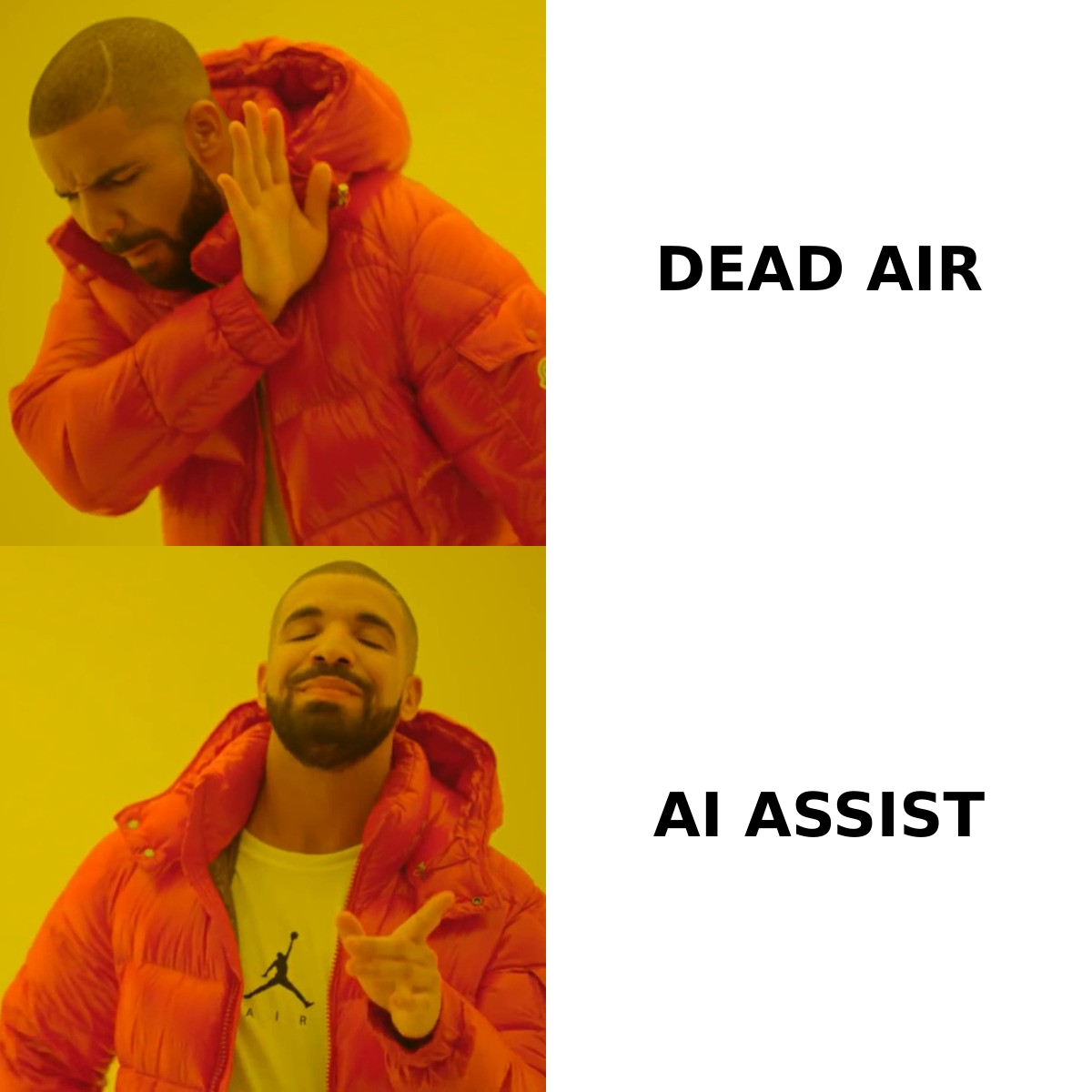
- The highest-ROI use today is assistive: AI handles dialing, transcription, note-taking, and live objection prompts while a human reps the conversation.
- Fully autonomous AI voice agents work for simple qualification and reminders, but still struggle with nuance, trust, and complex B2B discovery.
- Your data quality decides everything. Bad phone numbers and stale contacts sink even the best AI dialer — clean numbers first.
- Build the stack in layers: accurate contact data → dialer + connect rate → live assist → post-call analytics → CRM sync.
What is an AI sales call?#
An AI sales call is a phone conversation where artificial intelligence touches at least one stage of the call lifecycle: who you dial, what you say, how you say it, and what happens after you hang up.
Think of it like a flight deck. The pilot still flies the plane, but autopilot handles altitude, the instruments flag turbulence, and the black box records everything for review. AI plays the same support role on a sales call — it does not replace the rep so much as remove the busywork and surface the next best move in real time.
In practice, "AI sales call" covers three very different things, and conflating them is where most buyers waste money:
- Assistive AI — a human makes the call; AI dials, transcribes, prompts, and summarizes.
- Augmented AI — AI scores calls, predicts deal risk, and coaches reps between calls.
- Autonomous AI — a synthetic voice agent runs the entire call with no human on the line.
Most of the ROI in 2026 still sits in the first two categories. The third is improving fast but is best reserved for narrow, repeatable conversations.
How does an AI sales call actually work?#
Break the call into four phases and you can see exactly where the software earns its keep.
Before the call. AI pulls your list, enriches each record, and prioritizes who to dial based on intent signals and fit. This is where most "AI calling" failures start — not on the call, but in the list. If the phone number is wrong, no amount of conversational AI saves the dial. Feeding the system verified mobile and direct-dial numbers from a B2B phone numbers source dramatically lifts your connect rate before AI ever speaks.
During the call. Speech-to-text transcribes both sides in real time. A language model listens for keywords — pricing, competitor names, objections — and surfaces battle-card prompts on screen. Sentiment analysis flags when a prospect cools off. For autonomous agents, a text-to-speech engine generates the rep's side of the conversation directly.
Right after the call. The system writes a summary, logs the outcome, drafts the follow-up email, and updates the deal stage. This is the most reliable, least controversial win — reps hate CRM hygiene, and AI does it instantly.
Over time. Aggregated call data reveals which talk tracks convert, which objections kill deals, and which reps need coaching. This loops back into phase one.
What can AI do on a sales call vs. what still needs a human?#
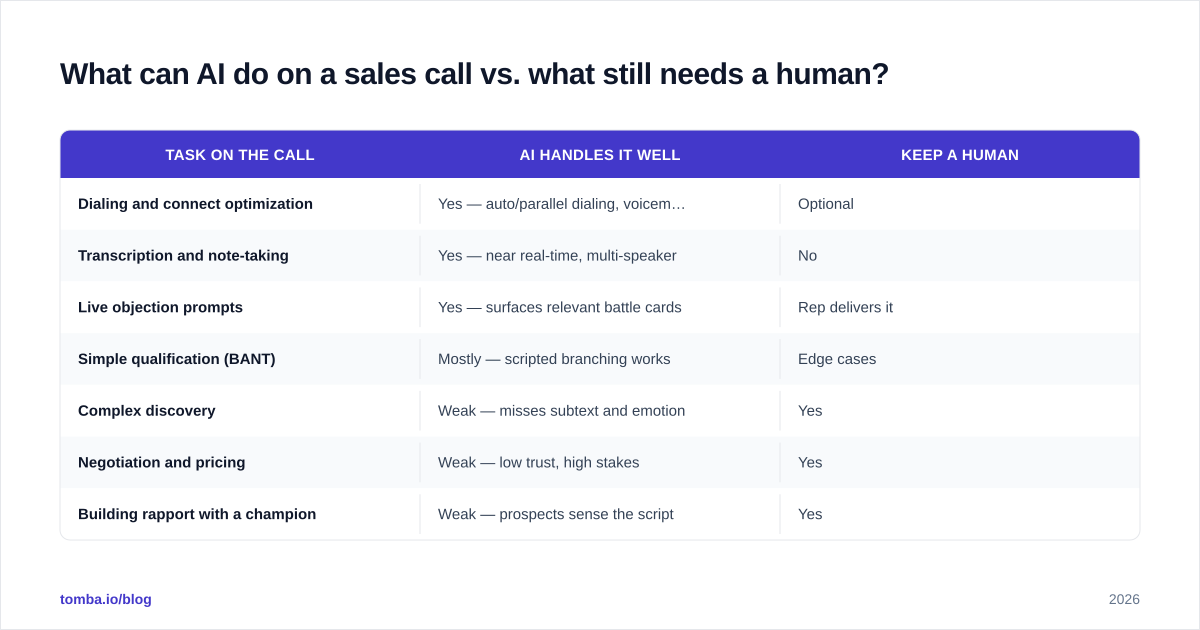
The honest answer: AI is excellent at the mechanical and the measurable, and weak at trust, nuance, and improvisation. Map your use case to the right column.
| Task on the call | AI handles it well | Keep a human |
|---|---|---|
| Dialing and connect optimization | Yes — auto/parallel dialing, voicemail drop | Optional |
| Transcription and note-taking | Yes — near real-time, multi-speaker | No |
| Live objection prompts | Yes — surfaces relevant battle cards | Rep delivers it |
| Simple qualification (BANT) | Mostly — scripted branching works | Edge cases |
| Complex discovery | Weak — misses subtext and emotion | Yes |
| Negotiation and pricing | Weak — low trust, high stakes | Yes |
| Building rapport with a champion | Weak — prospects sense the script | Yes |
| Post-call summary and CRM sync | Yes — fast and consistent | No |
The pattern is clear. Use AI to compress everything around the human moment, and protect the human moment itself. A recent Gartner analysis of sales technology adoption consistently finds that buyers still want a person for high-consideration purchases — the AI should make that person faster and better prepared, not absent.
Are autonomous AI voice agents ready for B2B?#
Short answer: for narrow jobs, yes; for full-cycle selling, not yet.
Autonomous voice agents in 2026 are genuinely good at:
- Appointment reminders and confirmations — low stakes, scripted, high volume.
- Top-of-funnel qualification — "Are you the right person? Do you have budget this quarter?"
- Reactivation calls — re-engaging cold leads with a simple offer.
- After-hours coverage — answering inbound and booking a human follow-up.
They still stumble on interruptions, accents, background noise, and any prospect who goes off-script. The "uncanny valley" of a voice that is almost-but-not-quite human can also erode trust on a first B2B touch, where credibility is the whole game. If you deploy an autonomous agent, disclose it, keep the call short, and route anything complex to a human immediately.
A safer 2026 pattern: let the autonomous agent qualify and book, then hand the actual sales conversation to a rep armed with the AI's notes. You get volume and quality.

How do you build an AI sales call stack that works?#
Build it in layers, bottom-up. Each layer fails if the one below it is weak.
Layer 1 — Accurate contact data. Everything rests here. You need current direct dials and mobile numbers, not the company switchboard. Pair a phone source with validation so you are not burning dials on dead lines — run numbers through a phone validator before they hit the dialer, and use a dedicated phone finder to source direct numbers. Many teams also enrich the record with a verified work email so the AI can fire the follow-up the moment the call ends.
Layer 2 — Dialer and connect rate. Parallel or power dialing, local presence, and voicemail drop. This is the volume engine.
Layer 3 — Live assist. Real-time transcription, objection prompts, and sentiment flags. Keep it on-screen and unobtrusive so reps glance, not stare.
Layer 4 — Post-call analytics. Call scoring, talk-ratio tracking, keyword trends, and deal-risk signals feeding your CRM.
Layer 5 — CRM and workflow sync. Outcomes, summaries, and next steps write back automatically. If your AI notes do not reach the CRM, they do not exist.
The cost mistake teams make is buying Layer 3 or 4 first — the shiny conversation AI — while Layer 1 leaks. Garbage numbers in, garbage calls out.
A simple call-prep script the AI can power#
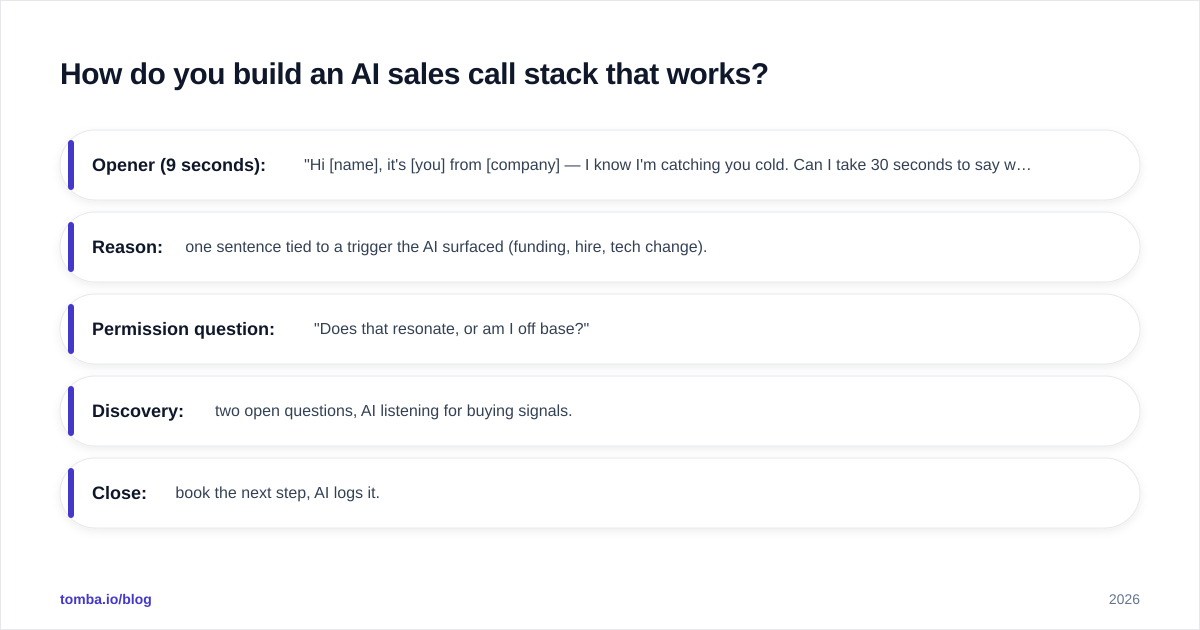
You can template the human side and let AI fill the variables per prospect:
- Opener (9 seconds): "Hi [name], it's [you] from [company] — I know I'm catching you cold. Can I take 30 seconds to say why I called, then you decide if it's worth continuing?"
- Reason: one sentence tied to a trigger the AI surfaced (funding, hire, tech change).
- Permission question: "Does that resonate, or am I off base?"
- Discovery: two open questions, AI listening for buying signals.
- Close: book the next step, AI logs it.
Keep it human and short. The AI's job is to make sure the reason is specific and the number is real.
What does an AI sales call stack cost in 2026?#
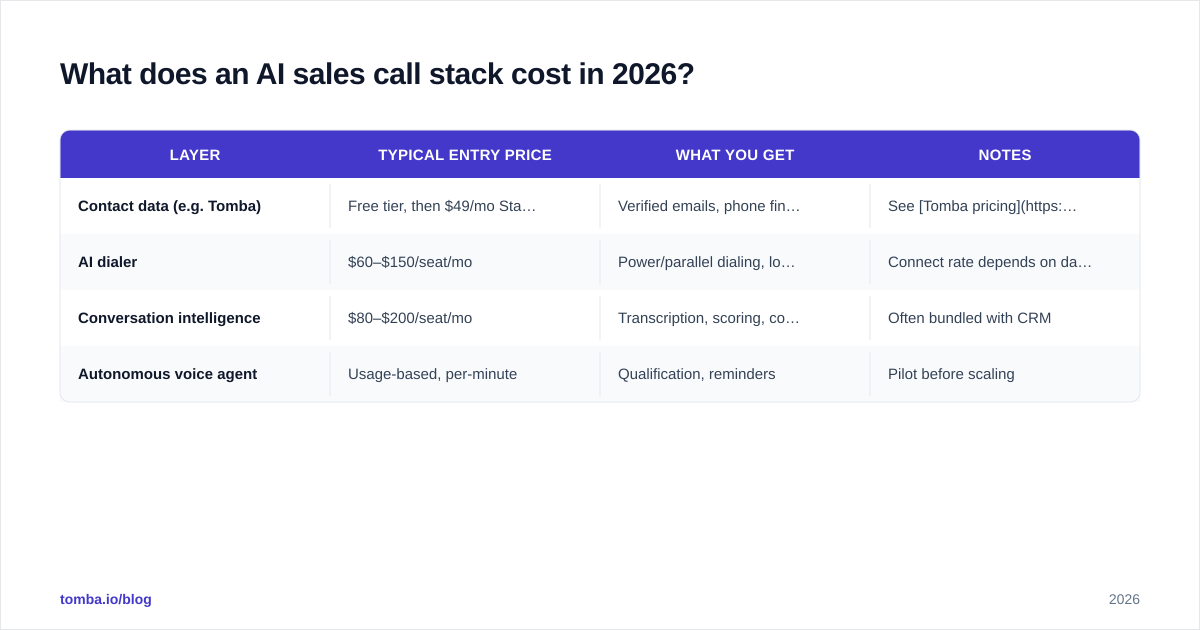
Costs vary by layer and seat count. Here is a realistic shape for a small team, combining a data provider, a dialer, and a conversation-intelligence tool.
| Layer | Typical entry price | What you get | Notes |
|---|---|---|---|
| Contact data (e.g. Tomba) | Free tier, then $49/mo Starter | Verified emails, phone finder, enrichment | See Tomba pricing for Growth/Pro tiers |
| AI dialer | $60–$150/seat/mo | Power/parallel dialing, local presence | Connect rate depends on data quality |
| Conversation intelligence | $80–$200/seat/mo | Transcription, scoring, coaching | Often bundled with CRM |
| Autonomous voice agent | Usage-based, per-minute | Qualification, reminders | Pilot before scaling |
Note Tomba's correct entry pricing: a free tier with 25 searches per month, then Starter at $49/mo, Growth at $99/mo, and Pro at $249/mo. Budget for the data layer first — it is the cheapest line item and the highest-leverage one, because it sets the ceiling on every call that follows.
How do you measure AI sales call ROI?#
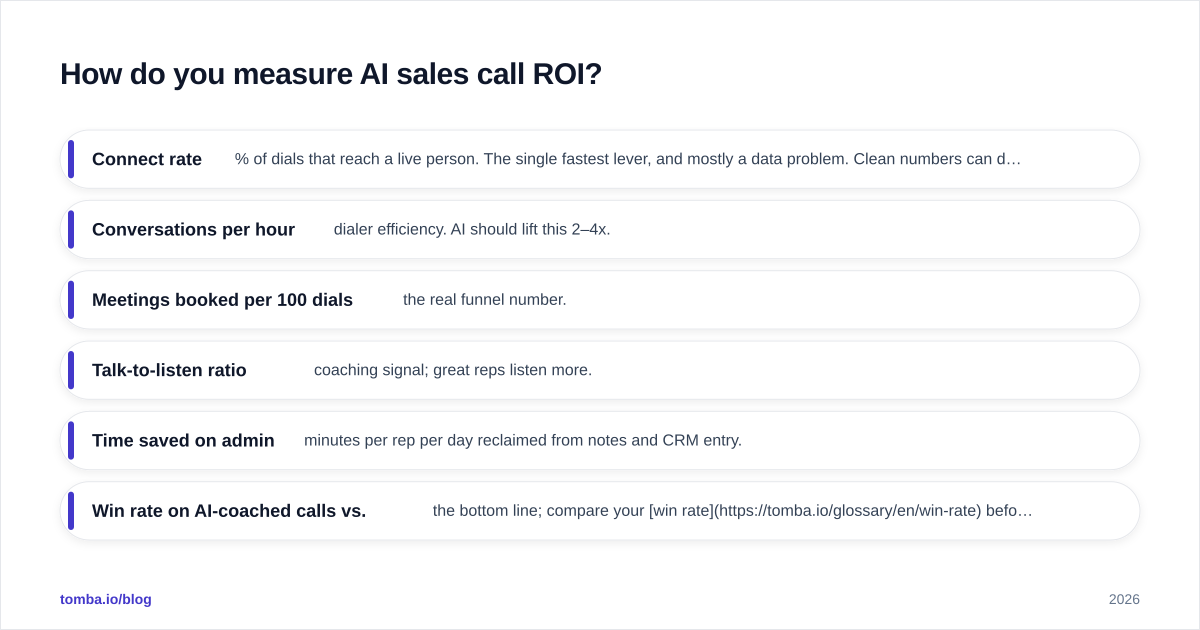
Track inputs and outputs, not vibes. The metrics that matter:
- Connect rate — % of dials that reach a live person. The single fastest lever, and mostly a data problem. Clean numbers can double it.
- Conversations per hour — dialer efficiency. AI should lift this 2–4x.
- Meetings booked per 100 dials — the real funnel number.
- Talk-to-listen ratio — coaching signal; great reps listen more.
- Time saved on admin — minutes per rep per day reclaimed from notes and CRM entry.
- Win rate on AI-coached calls vs. baseline — the bottom line; compare your win rate before and after.
Run a clean before/after. Establish two weeks of baseline, then turn on one layer at a time. If you switch on five tools at once, you will never know which one moved the number. Independent review sites like G2 are useful for vendor shortlists, but your own A/B on your own list is the only ROI proof that counts.
A note on compliance: AI calling does not exempt you from consent and recording laws. Disclose recording where required, honor do-not-call lists, and check regional rules before deploying autonomous voice — HubSpot's outreach compliance guidance is a reasonable starting point, but confirm with your legal team.
What are the most common AI sales call mistakes?#
- Leading with the data leak. Buying conversation AI while dialing stale numbers. Fix Layer 1 first.
- Over-automating the first touch. A robotic opener on a cold B2B call kills trust. Save autonomy for reminders and reactivation.
- Ignoring the human review loop. AI scoring is only valuable if a manager coaches off it weekly.
- No disclosure. Undisclosed AI voice agents create legal and reputational risk.
- Letting notes die outside the CRM. If summaries do not sync, reps stop trusting the tool.
- Skipping verification. Dialing unverified numbers wastes your most expensive resource — rep time. Validate first.
Avoid these six and you are ahead of most teams deploying AI calling in 2026.
Where should you start?#
Start with the layer that sets the ceiling: your contact data. The best AI dialer in the world cannot connect you to a wrong number, and the smartest conversation engine cannot coach a call that never happened. Get accurate direct dials and verified contacts in place, then add dialing, then assist, then analytics.
If you are sourcing the phone numbers and emails that feed your AI calling stack, start with the Tomba Email Finder to build verified, enriched contact records by domain, name, or company — then pair it with the phone finder and data enrichment so every dial your AI makes lands on a real person. Clean data in, better calls out. That is the whole game in 2026.
// get started
Find, verify and enrich your first contacts today
Start on the free plan with 25 searches a month, then scale when your team is ready.
Free plan · No credit card required · GDPR & CCPA
// about the author