AI Sales Call Analysis in 2026: The Complete Playbook
AI sales call analysis turns every recorded conversation into coaching, forecasting, and pipeline data. Here's how it works, what to buy, and how to roll it out in 2026.
TL;DR
- AI sales call analysis records, transcribes, and scores conversations so you stop guessing why deals stall and start seeing it in the data.
- The best platforms do four things well: accurate transcription, speaker separation, topic/sentiment tagging, and CRM-synced action items.
- Accuracy is real but not magic — accents, crosstalk, and jargon still trip up transcription, and "sentiment" is a directional signal, not a verdict.
- Pick a tool based on your stack (dialer, CRM, conferencing) and your goal (coaching vs. forecasting vs. compliance), not the longest feature list.
- Clean contact and phone data feeds better calls; pair call analysis with verified records from a tool like Tomba's phone finder so reps reach the right person in the first place.
What is AI sales call analysis?#
AI sales call analysis is software that listens to your sales conversations — recorded calls, video meetings, demos — and turns them into structured, searchable data: a transcript, who spoke when, which topics came up, how the prospect reacted, and what each side committed to do next.
Think of it like a flight recorder for sales. A black box doesn't fly the plane, but after every flight it tells you exactly what happened, so the next flight is safer and smoother. AI call analysis does the same for your pipeline: it captures the raw conversation, then layers on interpretation so managers and reps can review what actually moved a deal instead of relying on a rep's memory three days later.
Technically, the stack is a pipeline. Audio gets captured from your dialer or conferencing tool, passed through automatic speech recognition (ASR) to produce a transcript, run through speaker diarization to label voices, then analyzed by language models that tag topics, score sentiment, detect questions, flag competitor mentions, and extract next steps. The output lands back in your CRM as notes, fields, or tasks.
This matters because most of the value in a sales org is locked inside conversations that no one reviews. A team running 1,000 calls a month generates roughly 500+ hours of audio. No manager listens to that. AI analysis makes it queryable — "show me every call where pricing came up in the last two weeks" — in seconds.
How does AI call analysis actually work?#
There are five stages, and each one can break, so it helps to understand them individually.
1. Capture. The system joins your video calls as a bot, or pulls recordings from your phone system. Quality here sets the ceiling for everything downstream — a muffled cell connection produces a bad transcript no model can fully rescue.
2. Transcription (ASR). Speech becomes text. Modern engines hit 90%+ word accuracy on clean English audio, but drop on heavy accents, industry jargon, fast crosstalk, and bad audio. Custom vocabularies (your product names, competitor names) noticeably improve results.
3. Diarization. The system separates speakers — "Rep said X, prospect said Y." This is what enables talk-time ratios, monologue detection, and question counting.
4. Analysis. Language models tag the transcript: topics discussed, sentiment shifts, objections raised, pricing mentions, next steps, and competitor name-drops. This is where 2026-era tools have leapt ahead — they summarize a 45-minute call into five bullet points and a recommended follow-up.
5. Sync and action. Insights flow into your CRM, trigger coaching alerts, update deal scores, or fire automations. A call where the buyer says "send me the contract" should create a task, not sit in an archive.
The honest part: stages 1–3 are mature and reliable on good audio. Stage 4 is powerful but probabilistic. Treat sentiment scores and "deal health" as a smoke detector — useful for telling you where to look, not a substitute for a manager actually watching the clip.
Why does AI sales call analysis matter for revenue?#
Because it shortens the loop between a mistake and a fix. The case rests on four concrete outcomes.
Faster ramp. New reps learn by hearing what good sounds like. Searchable call libraries let a new hire study the ten best discovery calls in their first week instead of waiting months for shadowing slots to open up.
Better coaching at scale. A frontline manager with eight reps can't review every call. AI surfaces the 5% worth watching — the lost deal where the rep talked 80% of the time, the won deal that nailed objection handling — so coaching time goes where it pays off.
More accurate forecasting. When call content feeds deal scoring, "commit" stops meaning "the rep feels good." Patterns like multi-threading, next-step clarity, and buyer language become measurable inputs to your win rate math.
Compliance and knowledge capture. Regulated teams get an auditable record. Everyone else gets institutional memory that doesn't walk out the door when a top rep quits.
Independent research backs the direction of travel. Analyst coverage from Gartner and peer reviews on G2 consistently show conversation intelligence moving from "nice to have" to standard in mid-market and enterprise sales stacks.
What are the best AI sales call analysis tools in 2026?#
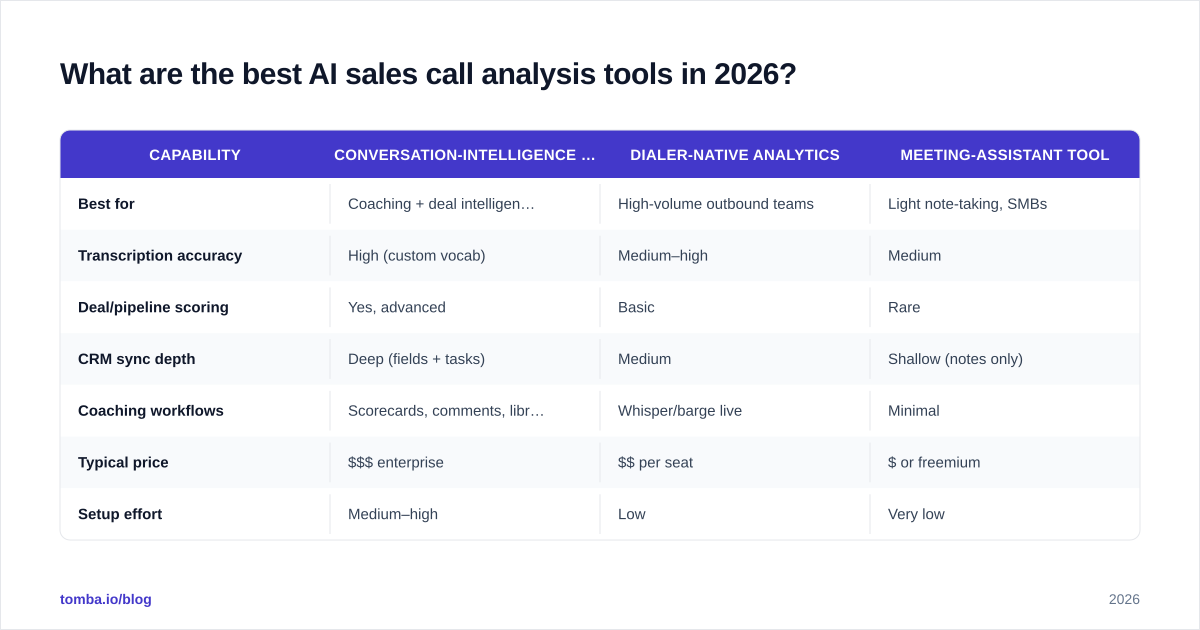
The market splits into three buckets: dedicated conversation-intelligence platforms, dialer-native analytics, and meeting-assistant tools that added sales features. Here's how the common options compare on the attributes that actually drive a buying decision.
| Capability | Conversation-intelligence platform | Dialer-native analytics | Meeting-assistant tool |
|---|---|---|---|
| Best for | Coaching + deal intelligence | High-volume outbound teams | Light note-taking, SMBs |
| Transcription accuracy | High (custom vocab) | Medium–high | Medium |
| Deal/pipeline scoring | Yes, advanced | Basic | Rare |
| CRM sync depth | Deep (fields + tasks) | Medium | Shallow (notes only) |
| Coaching workflows | Scorecards, comments, libraries | Whisper/barge live | Minimal |
| Typical price | $$$ enterprise | $$ per seat | $ or freemium |
| Setup effort | Medium–high | Low | Very low |
A few buying notes that the feature grid won't tell you:
- Match the tool to your meeting surface. If 90% of your deals close over
Zoom or Google Meet, a bot-based recorder fits. If you live in an outbound dialer, native analytics may cover you without a second vendor.
- CRM sync is the make-or-break feature. A tool that only stores transcripts in its own app creates a second silo. You want call data writing into HubSpot, Salesforce, or Pipedrive automatically.
- Check the language and accent coverage against your real team, not the demo. Ask for a trial on your own messy audio.
- Gong popularized this category; reviewing the Gong feature set is a useful benchmark even if you end up choosing something lighter.
The right answer is rarely "the most powerful platform." It's the one your reps will actually use and that writes clean data back into the systems you already run.
How accurate is AI sales call analysis — and where does it fail?#
Accuracy is high on clean audio and degrades predictably. Knowing the failure modes keeps you from over-trusting the output.
Transcription on clear English typically lands in the low-to-mid 90s for word accuracy. That number falls with strong accents, two people talking over each other, low-bandwidth phone calls, and dense technical jargon. Custom dictionaries for your product and competitor names claw back a meaningful chunk of that loss.
Sentiment analysis is the most over-sold feature. A model can tell that a buyer's language turned negative around the pricing discussion — directionally useful. It cannot reliably tell sarcasm from sincerity, or distinguish "this is expensive" said as a real objection from the same words said as a negotiating tactic. Use sentiment to prioritize which calls to review, never as the final word on deal health.
Action-item extraction is genuinely good now and getting better, but it still hallucinates occasionally — inventing a commitment that wasn't made, or missing one buried in small talk. Keep a human in the loop before an extracted "next step" auto-updates a forecast.
The data-quality point cuts deeper. Garbage contact data upstream poisons everything downstream: calls to wrong numbers, mismatched CRM records, and analysis attributed to the wrong account. Feeding your dialer verified numbers from a phone validator and enriching accounts with clean firmographics through data enrichment does more for call-analysis quality than any model upgrade.
How do you roll out call analysis without the team revolting?#
Lead with coaching, not surveillance. The single biggest predictor of failure is reps feeling spied on. Here's a rollout sequence that earns buy-in.
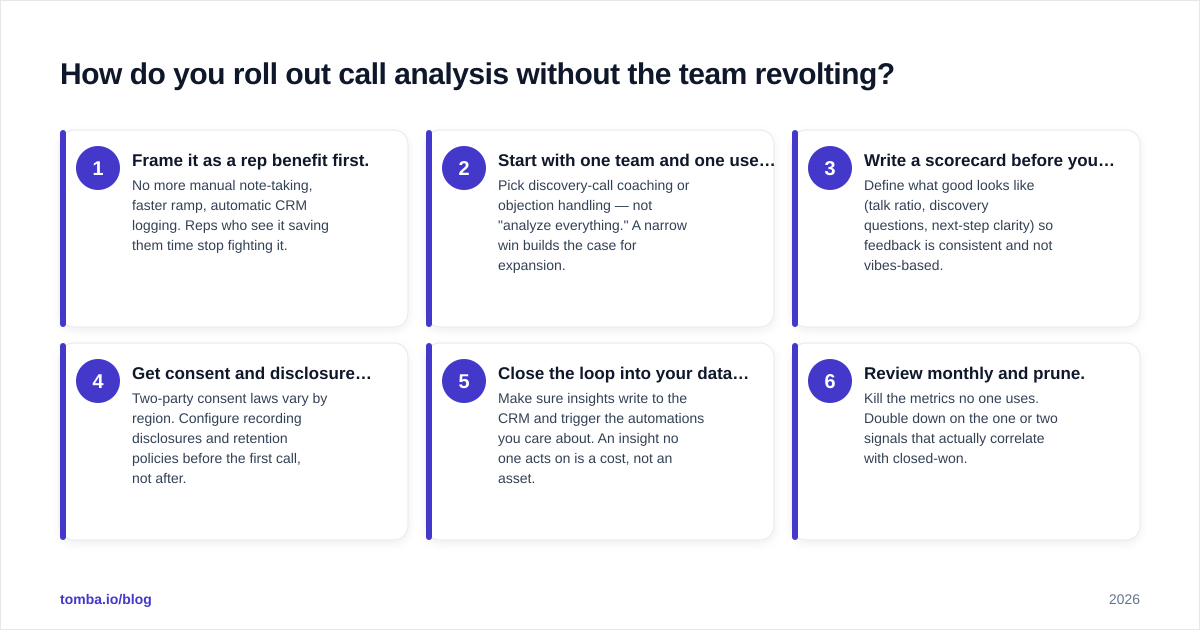
- Frame it as a rep benefit first. No more manual note-taking, faster ramp, automatic CRM logging. Reps who see it saving them time stop fighting it.
- Start with one team and one use case. Pick discovery-call coaching or objection handling — not "analyze everything." A narrow win builds the case for expansion.
- Write a scorecard before you start scoring. Define what good looks like (talk ratio, discovery questions, next-step clarity) so feedback is consistent and not vibes-based.
- Get consent and disclosure right. Two-party consent laws vary by region. Configure recording disclosures and retention policies before the first call, not after.
- Close the loop into your data stack. Make sure insights write to the CRM and trigger the automations you care about. An insight no one acts on is a cost, not an asset.
- Review monthly and prune. Kill the metrics no one uses. Double down on the one or two signals that actually correlate with closed-won.
Tie the program to a number from day one. If you can't draw a line from call analysis to ramp time, win rate, or average deal size within a quarter, you're collecting data for its own sake.
How does call analysis fit the wider sales-tech stack?#
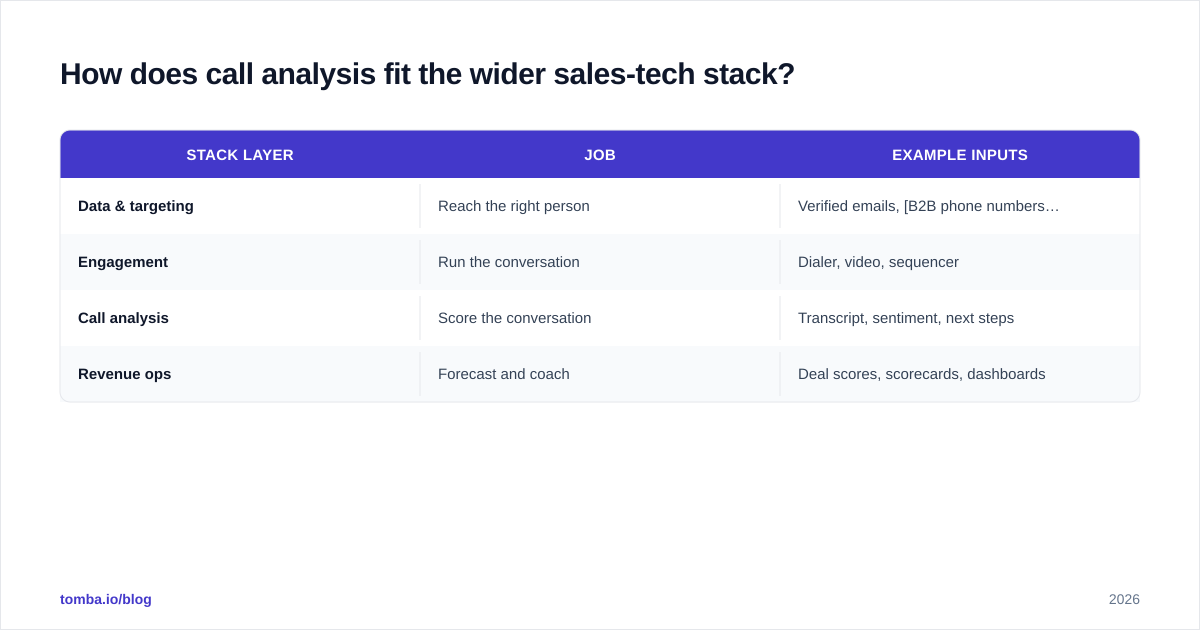
It's one layer in a pipeline, and it's only as good as the layers around it. Upstream, you need accurate targeting and contact data so reps spend call time on the right accounts. Midstream, the dialer or conferencing tool captures the conversation. Downstream, the CRM and forecasting tools consume the insights.
| Stack layer | Job | Example inputs |
|---|---|---|
| Data & targeting | Reach the right person | Verified emails, B2B phone numbers, firmographics |
| Engagement | Run the conversation | Dialer, video, sequencer |
| Call analysis | Score the conversation | Transcript, sentiment, next steps |
| Revenue ops | Forecast and coach | Deal scores, scorecards, dashboards |
The leverage point most teams miss is the first row. AI call analysis tells you what happened on the calls you made — it can't fix the fact that 30% of your calls went to stale or wrong numbers. Sales data decays fast: people change jobs, companies rebrand, direct lines get reassigned. Refreshing your contact records and validating numbers before reps dial means every minute of analyzed call time is spent on a reachable, real buyer.
What's next for AI call analysis?#
Three shifts are already underway in 2026. Real-time guidance is moving from gimmick to genuinely useful — live cue cards that surface a battlecard the moment a competitor is named. Multi-call deal intelligence is maturing, stitching together every touch on an account into a single narrative instead of isolated call summaries. And agentic follow-up is emerging, where the system doesn't just extract a next step but drafts the follow-up email and updates the deal automatically, pending rep approval.
The constant across all of it: the model is only as smart as the data and the conversation it's fed. Clean inputs, clear coaching frameworks, and disciplined CRM hygiene are what separate teams that get value from teams that just buy another dashboard.
Where Tomba fits#
Great call analysis starts before the call connects — with the right person, the right number, and a clean record. Tomba sits at that top-of-funnel layer. Use the Tomba Email Finder to find verified professional emails by name or domain, layer in B2B phone numbers so your dialer reaches live prospects, and push enriched, accurate contacts straight into your CRM through the Tomba API. Plans start free at 25 searches a month and scale to $49/mo Starter and $99/mo Growth — see full Tomba pricing. Feed your call-analysis stack clean data, and every conversation it scores is one worth scoring. Start finding better contacts at tomba.io.
// get started
Find, verify and enrich your first contacts today
Start on the free plan with 25 searches a month, then scale when your team is ready.
Free plan · No credit card required · GDPR & CCPA
// about the author