The AI Sales Coach Guide for 2026: Tools, ROI & Setup
An AI sales coach reviews every call, scores reps against your playbook, and surfaces the next best action. Here's how the tech works, what it costs, and how to roll it out without alienating your team.
TL;DR
- An AI sales coach is software that records, transcribes, and analyzes sales conversations, then scores reps against your playbook and recommends specific behavior changes — without a manager sitting in.
- It scales coaching from the 5% of calls a manager can review manually to 100% of calls, which is where most of the missed pipeline hides.
- The best tools combine conversation intelligence (call analysis), real-time guidance (live battlecards), and deal-level risk scoring.
- Expect $40–$200 per user per month depending on whether you want post-call analytics only or real-time + forecasting.
- AI coaching is only as good as the data feeding it. Clean contact data and connected CRM activity are prerequisites, not afterthoughts.
What is an AI sales coach?#
An AI sales coach is a tool that does what your best sales manager would do if they had infinite time: listen to every call, compare it to what good looks like, and tell each rep exactly what to fix next.
Think of it like a driving instructor who rides along on every single trip instead of grading you once a quarter. The human manager catches the one parallel-parking attempt they happened to witness. The AI coach sees all 400 trips, notices you brake late at the same intersection every time, and flags it before you crash a deal.
Technically, an AI sales coach sits on top of your call recordings, emails, and CRM activity. It uses speech-to-text, natural language processing, and increasingly large language models to extract signals — talk-to-listen ratio, discovery questions asked, competitor mentions, pricing objections, next-step commitments — and then maps those signals against a rubric you define or one the vendor ships by default.
The output is not a vague "be more consultative." It's "you talked 68% of the time on this call; top performers on similar deals talk 43%. Here are three moments you could have asked a question instead."
How does an AI sales coach actually work?#
There are four layers, and most products cover two or three of them. Understanding the layers helps you avoid paying for a forecasting suite when you just want call feedback.
1. Capture. The tool joins calls (Zoom, Google Meet, Teams, dialer) or ingests recordings, plus emails and CRM events. No capture, no coaching.
2. Analysis. Transcription, speaker separation, sentiment, topic detection, and keyword tracking turn raw audio into structured data. This is the "conversation intelligence" layer popularized by vendors like Gong.
3. Scoring and feedback. The system grades each interaction against a methodology — MEDDIC, SPICED, BANT, or your custom playbook — and produces a scorecard plus specific coaching notes.
4. Action. The best tools close the loop: real-time battlecards during live calls, automated follow-up suggestions, and deal-risk alerts that tell a manager which open opportunities are quietly dying.
The jump from layer 2 to layer 3 is where AI earns its keep. Plenty of tools can transcribe a call. Far fewer can tell you why the call went sideways and what to do differently, and fewer still personalize that feedback to each rep's recurring weak spots.
Why do sales teams need an AI sales coach in 2026?#
Because manual coaching doesn't scale, and the math is brutal.
A frontline manager with eight reps, each making 20 calls a week, faces 160 calls weekly. Reviewing one call properly — listening, taking notes, writing feedback — takes 30 to 45 minutes. To review even 10% of calls is four to six hours a week of pure listening, before any of the actual conversation happening. So most managers review a handful of calls, coach to gut feel, and hope.
That gap shows up in the numbers. Research consistently ties dynamic, ongoing coaching to materially higher win rates, while one-and-done quarterly reviews barely move the needle. The problem was never that managers don't care about coaching. It's that the unit economics of human attention cap it at a tiny fraction of activity.
An AI sales coach removes the cap. Every call gets reviewed. Every rep gets feedback. The manager's job shifts from "find the time to listen" to "act on the patterns the system already surfaced." That's a fundamentally better use of a manager's judgment.
There's also a ramp-time argument. New reps are expensive when they're not closing. An AI coach that flags missed discovery questions on a rep's second week compresses the learning curve that used to take months of shadowing. For teams hiring fast, that compression is the whole ballgame.
What should you look for in an AI sales coach tool?#
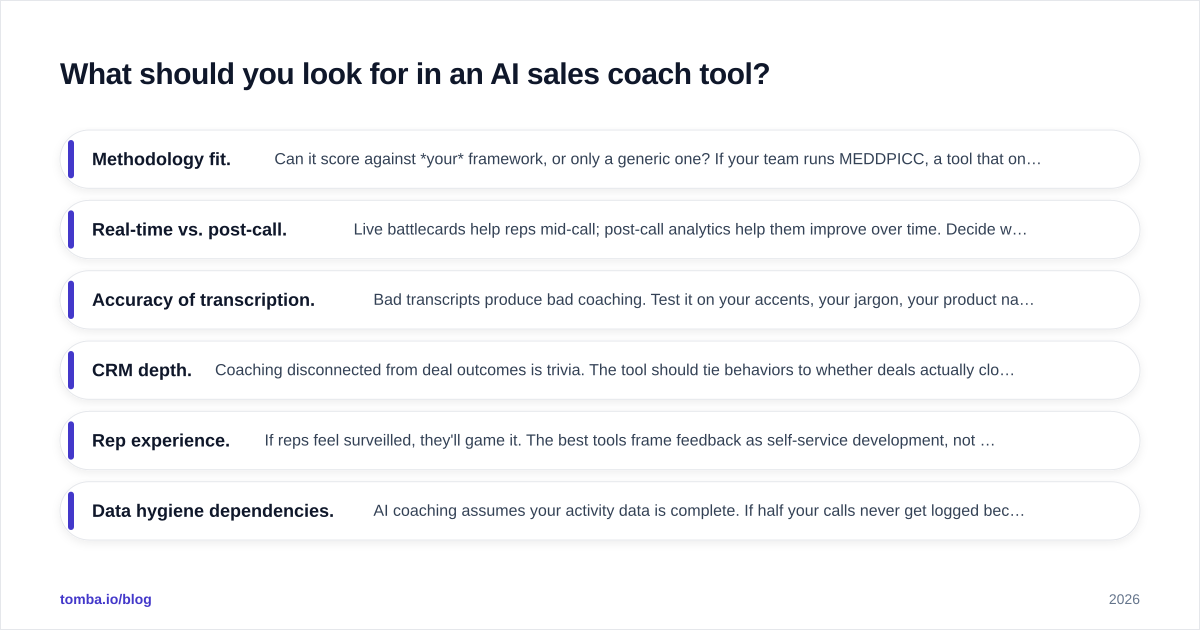
Not all "AI coaching" is equal. Use this checklist to separate real capability from marketing.
- Methodology fit. Can it score against your framework, or only a generic one? If your team runs MEDDPICC, a tool that only grades BANT is noise.
- Real-time vs. post-call. Live battlecards help reps mid-call; post-call analytics help them improve over time. Decide which you actually need before paying for both.
- Accuracy of transcription. Bad transcripts produce bad coaching. Test it on your accents, your jargon, your product names.
- CRM depth. Coaching disconnected from deal outcomes is trivia. The tool should tie behaviors to whether deals actually closed.
- Rep experience. If reps feel surveilled, they'll game it. The best tools frame feedback as self-service development, not a manager's microscope.
- Data hygiene dependencies. AI coaching assumes your activity data is complete. If half your calls never get logged because contact records are missing, the coach is blind on those deals.
That last point is where a lot of rollouts quietly fail. An AI sales coach can only analyze conversations that happen with the right people. If your reps are burning time chasing bad numbers and stale contacts, the coaching layer is optimizing a broken top of funnel. Getting accurate prospect data in place first — verified emails, direct dials, enriched company context — is what makes the downstream coaching signal trustworthy. Tools like the Tomba Email Finder and proper data enrichment sit upstream of the coaching stack for exactly this reason.
How do the top AI sales coach tools compare?#
Here's a practical comparison across the categories most teams evaluate. Prices are list rates for context and move around; treat them as ballpark, not quotes.
| Tool | Primary strength | Real-time coaching | Starting price (per user/mo) | Best for |
|---|---|---|---|---|
| Gong | Conversation intelligence + deal insights | Limited | ~$1,200/yr/user equivalent | Mid-market to enterprise revenue teams |
| Salesforce Einstein Conversation Insights | Native CRM coaching | Limited | Add-on to Sales Cloud | Salesforce-standardized orgs |
| Chorus (ZoomInfo) | Call analytics + market intelligence | No | Bundled with ZoomInfo | Teams already on ZoomInfo |
| Second Nature / role-play AI | AI role-play and rep practice | Yes (simulated) | ~$40–$90 | Onboarding and skill drills |
| Attention / newer LLM tools | Real-time live guidance + auto-CRM | Yes | ~$70–$150 | Fast-moving SDR/AE teams |
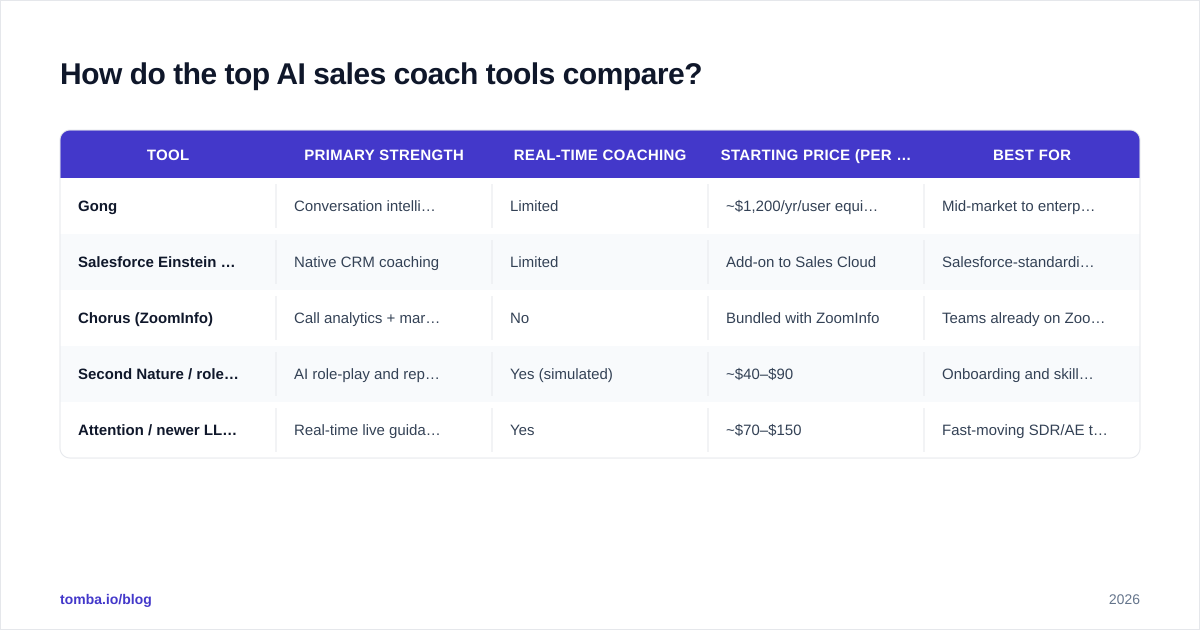
A few honest caveats. Enterprise conversation-intelligence platforms are powerful but priced for teams that can justify a real per-seat budget; a four-person startup will feel the sticker shock. The newer LLM-native tools are cheaper and faster to deploy but younger, so vet their transcription accuracy and security posture carefully. And native CRM options (Einstein, for Salesforce shops) win on data continuity but often lag standalone specialists on coaching depth.
For a deeper independent read on any specific vendor, check verified user reviews on G2 rather than trusting vendor demos alone — coaching tools demo beautifully and deploy unevenly.
Is an AI sales coach better than a human sales manager?#
No — and any vendor who says yes is selling you something. The right framing is division of labor, not replacement.
The AI handles what humans do badly: consistent, exhaustive, unbiased review of every interaction. It never gets tired on call 140, never plays favorites, never forgets to check whether a next step was set.
The human handles what AI does badly: motivation, context, career conversations, reading the personal reasons a rep is off this month, and making judgment calls on ambiguous deals. An AI coach can tell you a rep's discovery is weak. It can't tell that the rep is distracted because they're interviewing elsewhere, or coach them through a confidence slump.
The teams that win treat the AI as the always-on tier-one coach and the manager as the tier-two specialist who intervenes where it matters. The AI surfaces the pattern; the human decides what to do about it as a person. Pull the manager out entirely and you get reps optimizing for a scorecard while quietly disengaging. Keep the manager but skip the AI and you're back to coaching 5% of calls on vibes.
How do you roll out an AI sales coach without losing the team?#
Adoption is the whole game. The technology is mature enough; the failure mode is human. Here's a sequence that works.
Start with the reps, not the surveillance. Frame it as a personal practice tool first. Let reps see their own scorecards privately before any of it rolls up to managers. People accept feedback they discovered themselves and resent feedback weaponized against them.
Pick one metric that matters. Don't boil the ocean. Choose one behavior — say, setting an explicit next step on every call — and coach to it for a month. Win there, then expand.
Calibrate the rubric with your top reps. Run your best performers' calls through the tool and check that the scores match reality. If your closer scores poorly on the default rubric, the rubric is wrong, not the closer. Tune before you scale.
Connect it to real outcomes. Tie the coaching scores back to pipeline and revenue in your CRM and broader sales automation stack. Coaching that visibly correlates with closed deals earns buy-in; coaching that feels academic gets ignored.
Keep the human in the loop. Schedule the AI to surface a weekly "here's what to coach" digest for managers, and protect the 1:1 time to actually do it. The tool creates the leverage; the manager still has to pull it.
One more rollout reality: budget for the data layer. Per the published Tomba pricing, getting accurate contact and enrichment data in place starts at a fraction of what the coaching platform itself costs, and it's what keeps the coaching signal honest. An AI coach analyzing conversations with the wrong contacts is precise and useless at the same time.
What does an AI sales coach cost, and is the ROI real?#
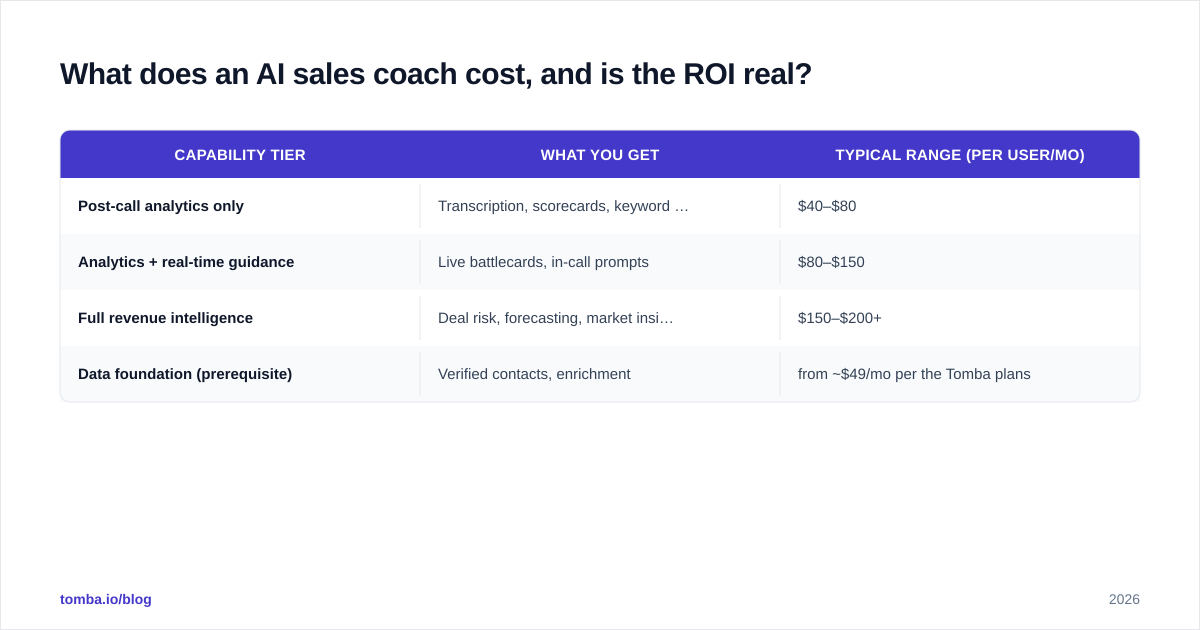
The pricing splits cleanly by capability tier.
| Capability tier | What you get | Typical range (per user/mo) |
|---|---|---|
| Post-call analytics only | Transcription, scorecards, keyword tracking | $40–$80 |
| Analytics + real-time guidance | Live battlecards, in-call prompts | $80–$150 |
| Full revenue intelligence | Deal risk, forecasting, market insights | $150–$200+ |
| Data foundation (prerequisite) | Verified contacts, enrichment | from ~$49/mo per the Tomba plans |
The ROI case rests on three levers. First, ramp time: getting new reps productive faster has an immediate, measurable payback. Second, win rate: even a few points of improvement on your average deal size compounds fast across a full team. Third, manager leverage: reclaiming the six-plus hours a week a manager spent listening to calls and redirecting it to high-judgment intervention.
The honest answer on ROI is that it's real for teams with enough volume to coach and enough deal value to matter, and marginal for very small teams where the manager can still review most calls by hand. If you have three reps and 30 deals a quarter, you don't need an AI coach yet. If you have fifteen reps and a manager drowning in call recordings, the payback is usually obvious within a quarter. Industry analysts at Gartner have tracked this shift toward AI-augmented sales enablement for several years, and the direction of travel is clear even where individual vendor claims deserve scrutiny.
Where does data quality fit into AI coaching?#
It's the foundation the whole thing stands on, and it's the part most teams skip.
An AI sales coach analyzes conversations. Conversations only happen when reps reach the right people. If your prospecting list is full of bounced emails, wrong titles, and stale phone numbers, your reps spend their best hours on dead ends — and the coach faithfully analyzes those dead-end calls, producing perfectly accurate feedback on conversations that never should have happened.
Garbage in, precise garbage out. Before you invest in coaching the conversation, invest in making sure the conversation is with someone worth coaching toward. That means verified email addresses, accurate direct dials, and enriched account context so reps walk into calls prepared. The coaching layer then has clean, high-intent activity to learn from, and its recommendations actually correlate with revenue instead of noise.
Get the data layer right first with Tomba#
An AI sales coach makes good reps better — but only when they're talking to the right prospects. Before you spend on conversation intelligence, make sure the conversations are worth analyzing. Use the Tomba Email Finder to source verified, accurate contact data by name, company, or domain, then enrich those records so every rep starts each call prepared. Start free with 25 searches a month, and scale up as your pipeline — and your coaching program — grows. Clean data in, real coaching signal out. That's the order that works.
// get started
Find, verify and enrich your first contacts today
Start on the free plan with 25 searches a month, then scale when your team is ready.
Free plan · No credit card required · GDPR & CCPA
// about the author