AI Sales Coaching Platform: A Complete 2026 Buyer's Guide
An AI sales coaching platform analyzes every call and turns scattered manager feedback into consistent, data-backed reps development. Here's how to pick one in 2026.
TL;DR
- An AI sales coaching platform records, transcribes, and scores sales conversations, then surfaces the specific moments where reps win or lose deals — so coaching is based on evidence, not memory.
- The best platforms in 2026 do three things well: accurate conversation capture, automated scorecards tied to your methodology, and workflow nudges that reach reps before the next call, not weeks later.
- Pricing usually runs $40–$150 per user per month, with the real cost hiding in implementation, CRM sync, and how much your managers actually adopt it.
- Conversation intelligence (Gong, Chorus) and AI roleplay tools (Second Nature, Hyperbound) solve different problems — many teams need both, not one.
- Coaching only works if your pipeline is full of the right conversations. Clean contact data and accurate targeting upstream decide whether coaching has anything worth analyzing.
What is an AI sales coaching platform?#
An AI sales coaching platform is software that listens to your team's sales calls and emails, evaluates them against a defined standard, and tells managers and reps exactly what to improve. Think of it as a flight recorder plus a flight instructor: the black box captures everything that happened, and the instructor replays the critical 90 seconds where the approach went wrong.
Traditional coaching depends on a manager joining a live call, scribbling notes, and giving feedback days later from memory. That model breaks at scale. A frontline manager with eight reps running 30 calls a week cannot sit in on even 5% of conversations. An AI sales coaching platform reviews 100% of them, flags the ones that need human attention, and frees the manager to coach the moments that matter instead of hunting for them.
The category overlaps with revenue operations tooling, but the focus is narrower: rep behavior and skill development, not forecasting or territory design.
How does AI sales coaching actually work?#
Most platforms run the same four-stage loop, and understanding it helps you judge where a given vendor is strong or weak.
- Capture. The platform joins calls (
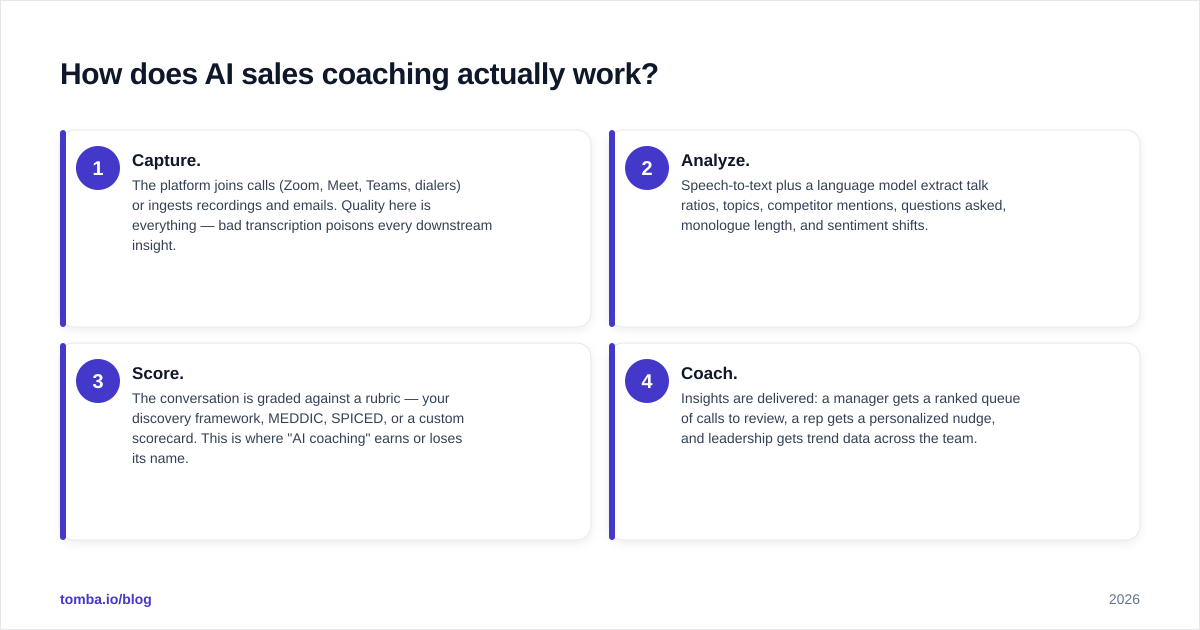
Zoom, Meet, Teams, dialers) or ingests recordings and emails. Quality here is everything — bad transcription poisons every downstream insight. 2. Analyze. Speech-to-text plus a language model extract talk ratios, topics, competitor mentions, questions asked, monologue length, and sentiment shifts. 3. Score. The conversation is graded against a rubric — your discovery framework, MEDDIC, SPICED, or a custom scorecard. This is where "AI coaching" earns or loses its name. 4. Coach. Insights are delivered: a manager gets a ranked queue of calls to review, a rep gets a personalized nudge, and leadership gets trend data across the team.
The newer wave adds a fifth element: practice. AI roleplay tools let reps rehearse a cold call or objection-handling scenario against a simulated buyer before they ever touch a live prospect. That shifts coaching from purely reactive (what went wrong) to proactive (rehearse until it goes right).
What features separate a real platform from a glorified recorder?#
A call recorder with a transcript is table stakes. The features below are what actually move win rates.
- Methodology-aware scorecards. Generic "talk less, listen more" tips are noise. You want the platform to grade against your qualification framework and flag when a rep skipped a required step.
- Deal-level rollups, not just call-level. Coaching one call is useful; seeing that a rep loses every deal at the pricing conversation is transformative.
- Automated, specific nudges. "Your average monologue was 2m40s on Tuesday — aim for under 90s" beats a vague monthly review.
- Manager enablement. The platform should make your managers better coaches, with suggested talk tracks and one-click clip sharing, not replace them.
- CRM write-back. Insights that live in a separate dashboard get ignored. They need to land in Salesforce or HubSpot where reps already work.
If a tool can't tie its analysis to a measurable outcome like win rate or response rate, treat its scores as entertainment, not coaching.
Which AI sales coaching platforms lead in 2026?#
The market splits into three buckets: conversation intelligence suites, dedicated AI roleplay/practice tools, and lightweight coaching layers bundled into sales engagement platforms. Here's how representative options compare.
| Platform | Category | Best for | Starting price (per user/mo) | Standout feature |
|---|---|---|---|---|
| Gong | Conversation intelligence | Mid-market & enterprise revenue teams | ~$100–$150 (annual, +platform fee) | Deal intelligence and trend analytics |
| Chorus (ZoomInfo) | Conversation intelligence | Teams already in the ZoomInfo stack | Bundled / custom | Native data + recording tie-in |
| Second Nature | AI roleplay | Onboarding and ramp acceleration | ~$50–$80 | Conversational AI practice partner |
| Hyperbound | AI roleplay | Cold call & discovery rehearsal | Custom | Realistic buyer simulations |
| Salesloft Conversations | Engagement + coaching | Teams wanting coaching inside cadences | Bundled with platform | Coaching in the workflow |
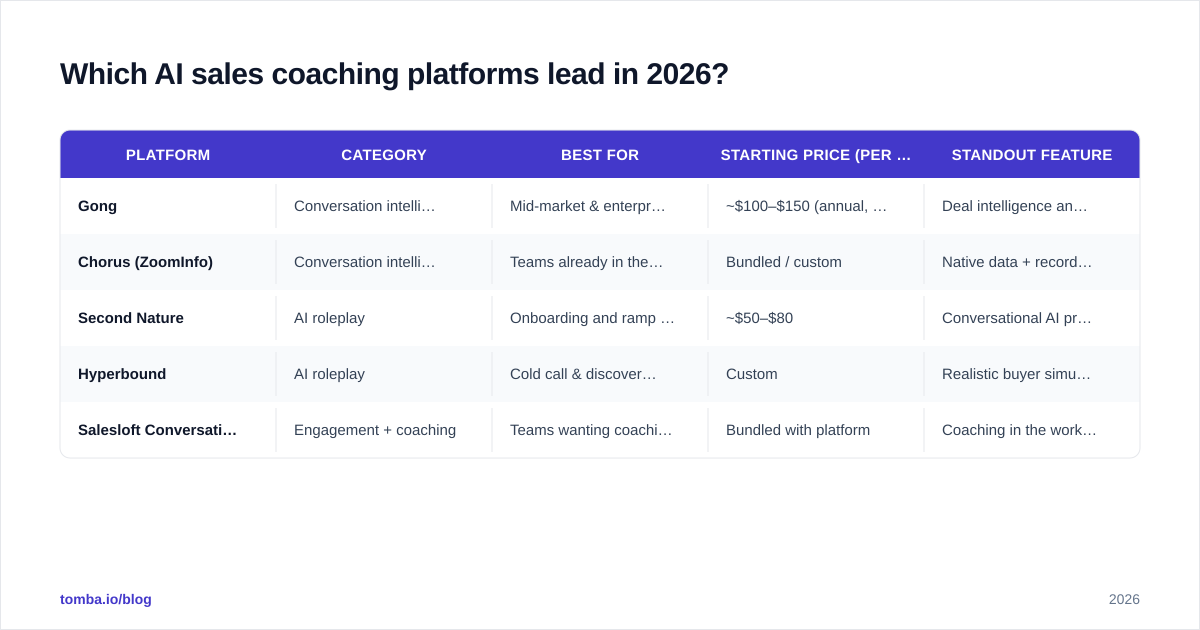
Prices shift constantly and most enterprise vendors hide them behind a sales call, so treat this as a directional guide and confirm current numbers on each vendor's own site or a review aggregator like G2. The pattern that matters: conversation intelligence tools analyze real calls after the fact, while roleplay tools build skills before the call. They are complementary, and the strongest 2026 programs run both.
For a deeper look at how vendors position themselves, HubSpot's sales hub and Salesforce both publish detailed breakdowns of their native coaching modules worth reading before you commit.
Is an AI sales coaching platform better than a human sales manager?#
No — and any vendor that implies otherwise is overselling. The right framing is that AI handles coverage and consistency, while humans handle context and motivation.
AI is unbeatable at the boring, high-volume work: reviewing every call, catching that a rep says "um" 40 times, noticing the whole team fumbles the same competitor objection. It never gets tired, never plays favorites, and never forgets to follow up.
But AI can't read that a rep is burned out, can't navigate a delicate comp conversation, and can't earn the trust that makes feedback land. A scorecard that says "discovery score: 62" means nothing until a manager sits down and explains why it matters for this rep's quota.
The teams that win treat the platform as a force multiplier for managers, not a substitute. The danger sign is a culture where reps feel surveilled by a robot. Roll it out as "here's your personal practice tool and a way to get faster feedback," not "here's how we'll catch you slacking."

What does an AI sales coaching platform actually cost?#
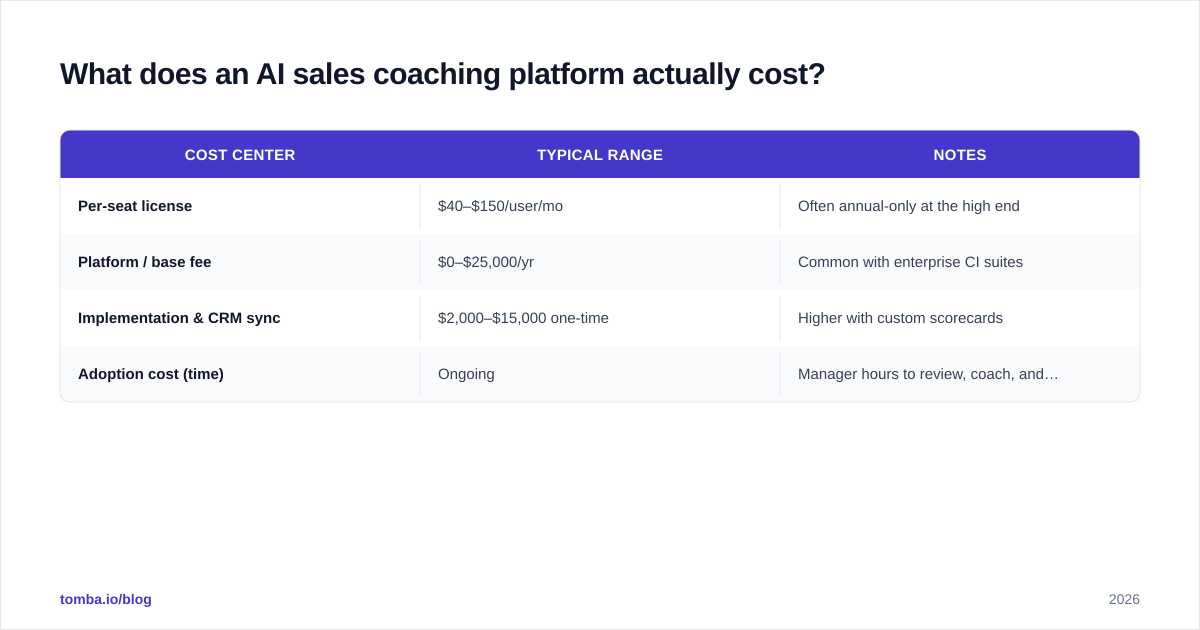
The sticker price is the smallest part of the bill. Budget for four cost centers.
| Cost center | Typical range | Notes |
|---|---|---|
| Per-seat license | $40–$150/user/mo | Often annual-only at the high end |
| Platform / base fee | $0–$25,000/yr | Common with enterprise CI suites |
| Implementation & CRM sync | $2,000–$15,000 one-time | Higher with custom scorecards |
| Adoption cost (time) | Ongoing | Manager hours to review, coach, and maintain rubrics |
A 20-rep team can easily land between $30,000 and $60,000 per year all-in. The brutal truth: the platform only pays back if managers use it weekly. Shelfware here is expensive shelfware. Before signing, ask the vendor for adoption benchmarks from accounts your size and tie a chunk of the contract to a successful pilot.
How do you roll out AI sales coaching without reps revolting?#
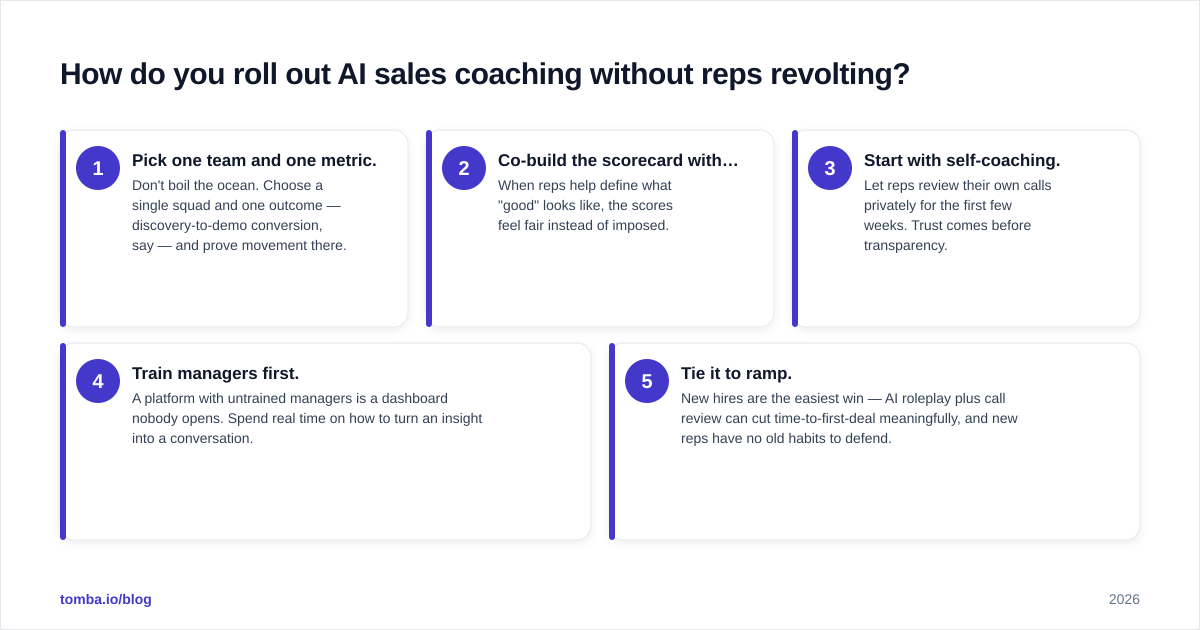
Adoption, not features, is where these projects live or die. Run the rollout as a process, not a switch you flip.
- Pick one team and one metric. Don't boil the ocean. Choose a single squad and one outcome — discovery-to-demo conversion, say — and prove movement there.
- Co-build the scorecard with reps. When reps help define what "good" looks like, the scores feel fair instead of imposed.
- Start with self-coaching. Let reps review their own calls privately for the first few weeks. Trust comes before transparency.
- Train managers first. A platform with untrained managers is a dashboard nobody opens. Spend real time on how to turn an insight into a conversation.
- Tie it to ramp. New hires are the easiest win — AI roleplay plus call review can cut time-to-first-deal meaningfully, and new reps have no old habits to defend.
Pair the rollout with healthy pipeline hygiene. Coaching is only as good as the conversations feeding it, which depends on reps reaching real decision-makers in the first place. If half your team's dials hit wrong numbers or dead inboxes, no coaching platform can fix that — the fix lives upstream in your sales prospecting and data quality.
What are the biggest mistakes buyers make?#
- Buying for features they'll never configure. A 200-signal AI engine is useless if you only ever look at talk ratio. Buy for the three things you'll actually act on.
- Ignoring data privacy and consent. Recording calls triggers legal obligations that vary by region. Confirm consent workflows before, not after, you deploy.
- Treating scores as gospel. AI transcription still mishears, especially with accents, jargon, and crosstalk. Spot-check before you put a number in someone's review.
- Forgetting the top of the funnel. A coaching platform optimizes how reps handle the meetings they get. It does nothing to fill the calendar. That's a separate, upstream problem.
That last point is the one teams underrate most. The cleanest coaching insights in the world are wasted if your reps are spending half their day chasing bad contacts. Accurate targeting and verified contact data decide whether there are enough quality conversations to coach in the first place.
Where does data quality fit into all this?#
Coaching sits at the bottom of a funnel, and the funnel starts with finding the right people to talk to. Even the best AI sales coaching platform can only analyze the meetings that happen — it can't manufacture pipeline.
That's where your prospecting stack matters. Before a rep ever needs coaching on their discovery call, someone has to find a verified, reachable contact at a company that fits your profile. If you're building or cleaning that top-of-funnel layer, Tomba's Email Finder locates accurate professional email addresses by name, company, or domain search, with a built-in email verifier so your reps spend their time in real conversations instead of bouncing off dead inboxes. Start free with 25 searches a month, then scale on Tomba pricing from $49/mo as your outbound grows. Fill the funnel with the right contacts, and your coaching platform finally has something worth coaching.
Pick the coaching platform that fits how your managers actually work, prove it on one team, and feed it a pipeline built on clean data. Do those three things and AI coaching stops being a dashboard nobody opens and becomes the reason your reps ramp twice as fast.
Ready to find emails that actually work?
Join 150,000+ professionals who stopped guessing and started sending. Free credits on signup — no credit card required.
Get the Tomba newsletter
Practical outbound tactics and product updates — once every two weeks.
About the author