AI Sales Forecast: How to Predict Revenue Accurately in 2026
An AI sales forecast turns messy pipeline data into a number you can defend. Here is how the models work, where they beat spreadsheets, and how to roll one out.
An AI sales forecast uses machine learning to predict how much revenue your pipeline will actually close, based on patterns in your historical deals instead of a rep's gut feeling. Done right, it turns the quarterly "what's your number?" ritual from a negotiation into a measurement. This guide explains how the models work, how accurate they really are, what tools to evaluate, and how to roll one out without breaking the trust of your sales team.
TL;DR#
- An AI sales forecast scores every open deal on its probability to close and rolls those probabilities into a revenue projection, refreshed continuously instead of once a quarter.
- The biggest accuracy gains come not from the algorithm but from clean inputs: enriched contact data, accurate activity logging, and consistent stage definitions.
- Most teams see forecast accuracy improve from the industry-typical 45–55% range toward 80%+ once they replace manual roll-ups with a model.
- Tools range from CRM-native (Salesforce Einstein, HubSpot) to specialist platforms (Clari, Gong, Aviso) — pick based on data volume and how much process discipline you already have.
- AI does not replace the forecast call. It gives managers a defensible baseline to coach against, so reviews focus on the deals where human judgment actually matters.
What is an AI sales forecast?#
An AI sales forecast is a revenue prediction produced by a model that has learned from your closed-won and closed-lost history. Instead of asking each rep "how confident are you?", it looks at the measurable signals around a deal — stage, age, deal size, engagement volume, buyer seniority, time since last touch — and estimates the probability that it closes within a given period.
Think of it like a weather forecast. A meteorologist does not guess tomorrow's rain by looking out the window. They feed atmospheric readings into a model trained on decades of similar conditions and get a percentage. An AI sales forecast does the same thing with your pipeline: it converts a pile of weak signals into one calibrated number.
The technical core is usually a classification or regression model. A gradient-boosted tree or logistic regression assigns each open opportunity a close probability; those probabilities are summed (weighted by deal value) into an expected-revenue figure. More advanced platforms layer in time-series models that account for seasonality and your typical sales-cycle length.
The output is not a single static number. A good system re-scores the pipeline every night, so the forecast shifts as deals progress, stall, or die — which is exactly what manual roll-ups can never do.
Why are manual sales forecasts so inaccurate?#
Manual forecasts fail because they depend on optimism and memory, two things humans are bad at calibrating. Industry research from Gartner and others repeatedly finds that fewer than half of B2B sales forecasts land within an acceptable margin of the actual result.
Three structural problems drive the inaccuracy:
- Happy ears. Reps weight recent conversations heavily. One good call moves a deal from "maybe" to "commit" regardless of the underlying signals.
- Sandbagging. When the number affects quota and comp, reps have an incentive to lowball so they can over-deliver. Managers then pad on top, and the distortion compounds up the chain.
- Stale data. A spreadsheet forecast is a snapshot. By the time it reaches the VP, several deals have already changed state.
An AI sales forecast removes the incentive problem by scoring deals on observable behavior, not stated confidence. It does not get tired, it does not sandbag, and it updates the moment new activity lands in the CRM. That is also why the quality of your underlying data matters more than the sophistication of the model — which we will come back to.
How accurate is an AI sales forecast?#
Accurate enough to change how you run the business, but only when fed clean data. In practice, teams that move from manual roll-ups to a model-driven forecast typically push accuracy from the 45–55% band into the 80–90% band within two to three quarters. The exact lift depends heavily on data hygiene and deal volume — a team with 30 deals a quarter will see noisier predictions than one with 3,000.
A few honest caveats:
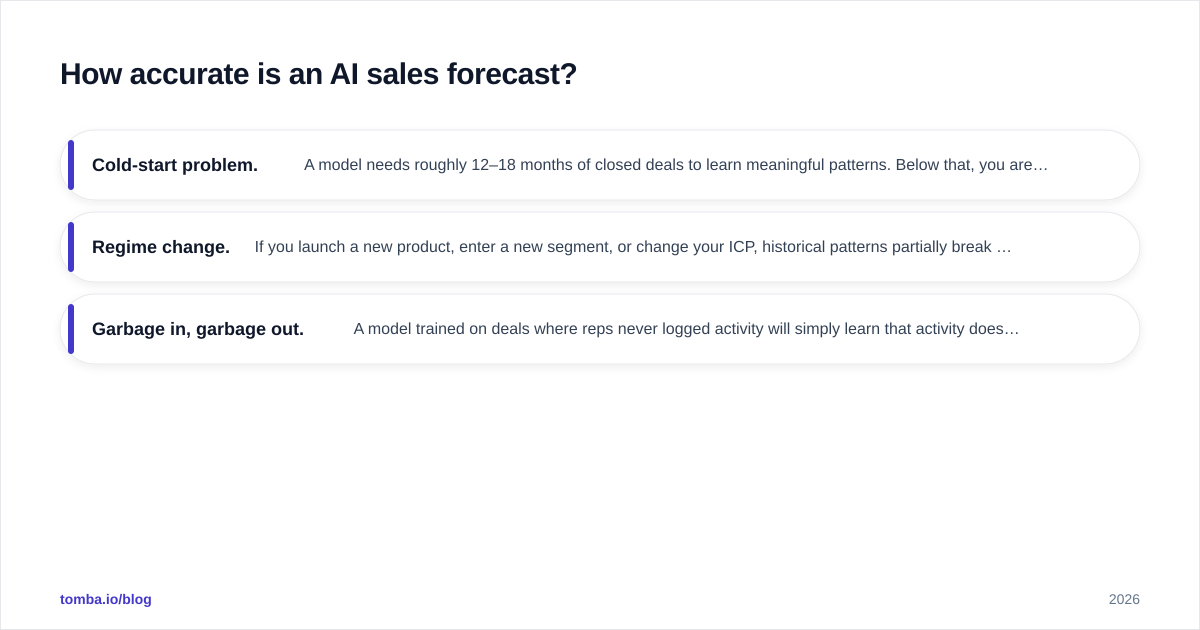
- Cold-start problem. A model needs roughly 12–18 months of closed deals to learn meaningful patterns. Below that, you are better off with a weighted-stage forecast.
- Regime change. If you launch a new product, enter a new segment, or change your ICP, historical patterns partially break and accuracy dips until the model re-learns.
- Garbage in, garbage out. A model trained on deals where reps never logged activity will simply learn that activity does not matter — which is wrong, and dangerous.
This is where contact and account data quality becomes a forecasting issue, not just a prospecting one. If half your opportunity records have missing decision-maker contacts or unverified emails, the engagement signals the model relies on are incomplete. Enriching records with accurate data enrichment and verified contacts gives the model cleaner features to learn from.
What signals does an AI forecasting model use?#
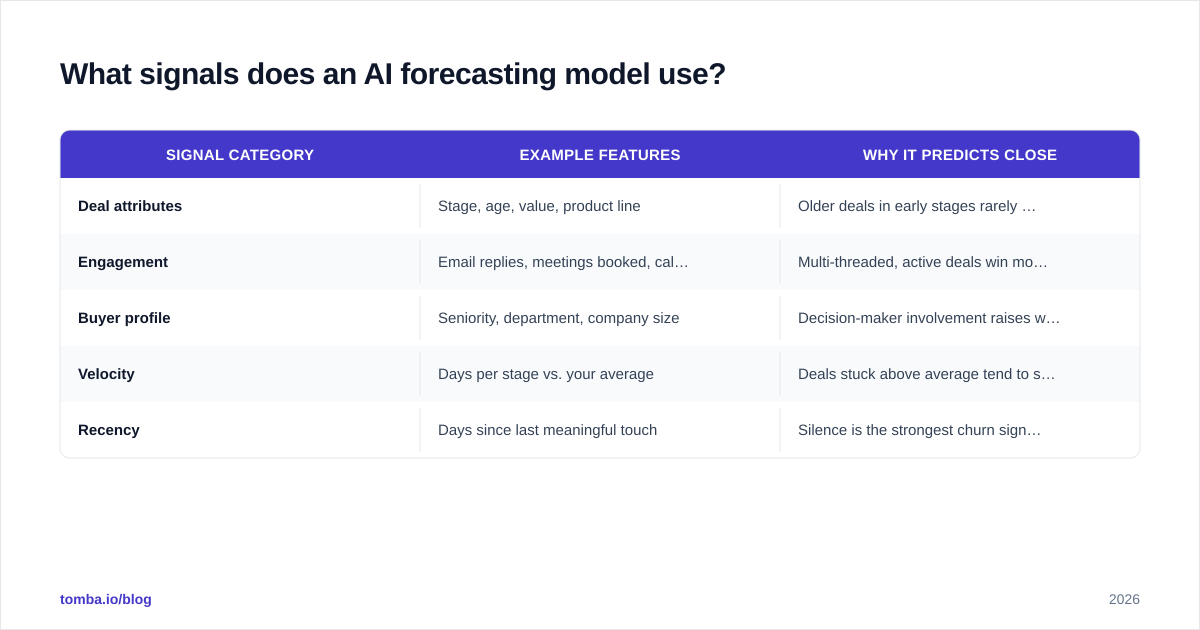
The model converts raw CRM and activity data into features. The most predictive ones across most B2B motions are below.
| Signal category | Example features | Why it predicts close |
|---|---|---|
| Deal attributes | Stage, age, value, product line | Older deals in early stages rarely close |
| Engagement | Email replies, meetings booked, calls logged | Multi-threaded, active deals win more |
| Buyer profile | Seniority, department, company size | Decision-maker involvement raises win rate |
| Velocity | Days per stage vs. your average | Deals stuck above average tend to slip |
| Recency | Days since last meaningful touch | Silence is the strongest churn signal |
Notice that several of these depend on knowing who is on the deal and being able to reach them. A deal with one junior contact looks very different from one with a verified VP and two influencers attached. Building complete buying-group records — using an email finder to identify and contact the full committee, plus an email verifier to keep those records valid — directly improves the buyer-profile and engagement features the model leans on.
Which AI sales forecasting tools should you consider in 2026?#
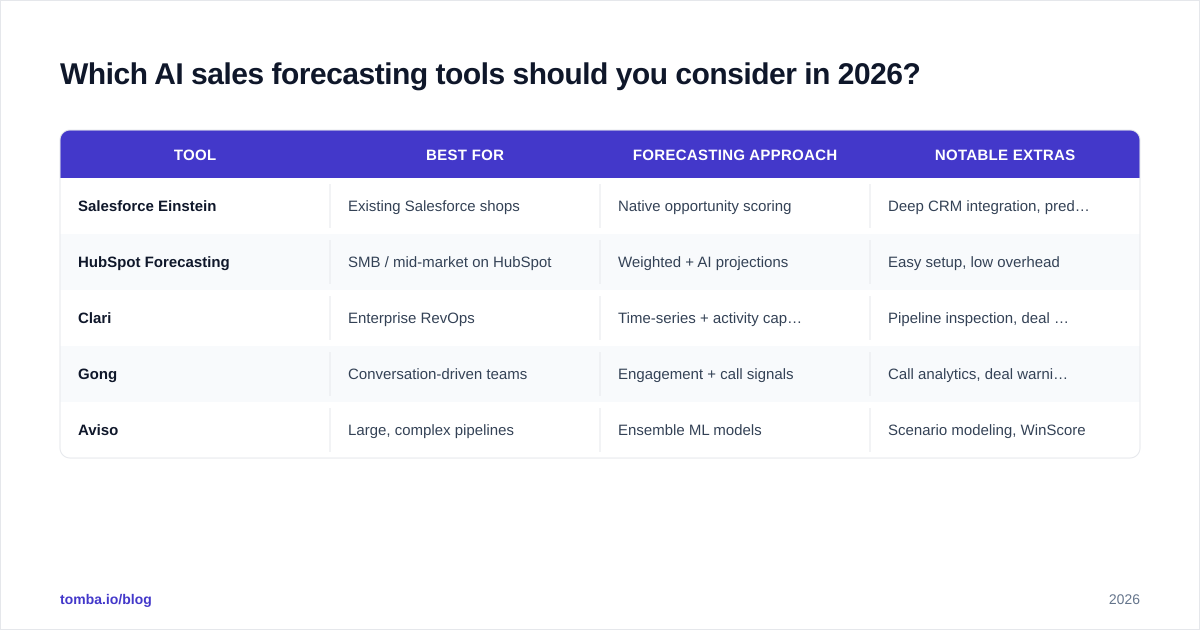
The market splits into CRM-native forecasting and specialist revenue-intelligence platforms. CRM-native options are cheaper and good enough for clean, mid-volume pipelines. Specialists add conversation intelligence, deal-risk alerts, and more sophisticated models, at a meaningfully higher price.
| Tool | Best for | Forecasting approach | Notable extras |
|---|---|---|---|
| Salesforce Einstein | Existing Salesforce shops | Native opportunity scoring | Deep CRM integration, predictive AI |
| HubSpot Forecasting | SMB / mid-market on HubSpot | Weighted + AI projections | Easy setup, low overhead |
| Clari | Enterprise RevOps | Time-series + activity capture | Pipeline inspection, deal rooms |
| Gong | Conversation-driven teams | Engagement + call signals | Call analytics, deal warnings |
| Aviso | Large, complex pipelines | Ensemble ML models | Scenario modeling, WinScore |
A practical rule: if your CRM data is already disciplined and your deal count is moderate, start with the native tool you already pay for. If forecasting pain is acute, your cycles are long, and you have RevOps headcount to run the system, a specialist like Clari or Gong earns its cost. Compare independent reviews on G2 before committing — vendor demos always look perfect.
How do you roll out an AI sales forecast without losing the team?#
The technical setup is the easy part. The hard part is adoption, because reps distrust any system that grades their deals. Run the rollout in four phases.
Phase 1 — Fix the data. Before any model touches your pipeline, audit it. Standardize stage definitions, enforce activity logging, and fill the gaps in your contact records. A model trained on incomplete records will produce confident nonsense. This is the highest-leverage step and the one teams most often skip. Use bulk tooling like a bulk email finder to backfill missing decision-maker contacts across open opportunities so engagement data is complete.
Phase 2 — Run shadow mode. For one full quarter, let the AI forecast run alongside your manual one without acting on it. Compare both against actuals at quarter end. This builds trust with evidence instead of asking the team to take a leap of faith.
Phase 3 — Use it to coach, not to police. Surface the deals where the model and the rep disagree most. Those are the highest-value coaching conversations: either the rep knows something the model does not (log it), or the model caught a risk the rep missed. Frame the AI as a second opinion, never as a verdict.
Phase 4 — Close the loop. Feed every closed deal back in, retrain on a schedule, and track forecast accuracy as a managed metric. Watch your win rate and forecast error together — improving one without the other usually means the model is miscalibrated.
A common mistake is treating the AI number as the final forecast. It is not. It is the baseline the human forecast must justify departing from. The judgment call still belongs to the manager; the model just makes that call defensible.
What are the limits of AI sales forecasting?#
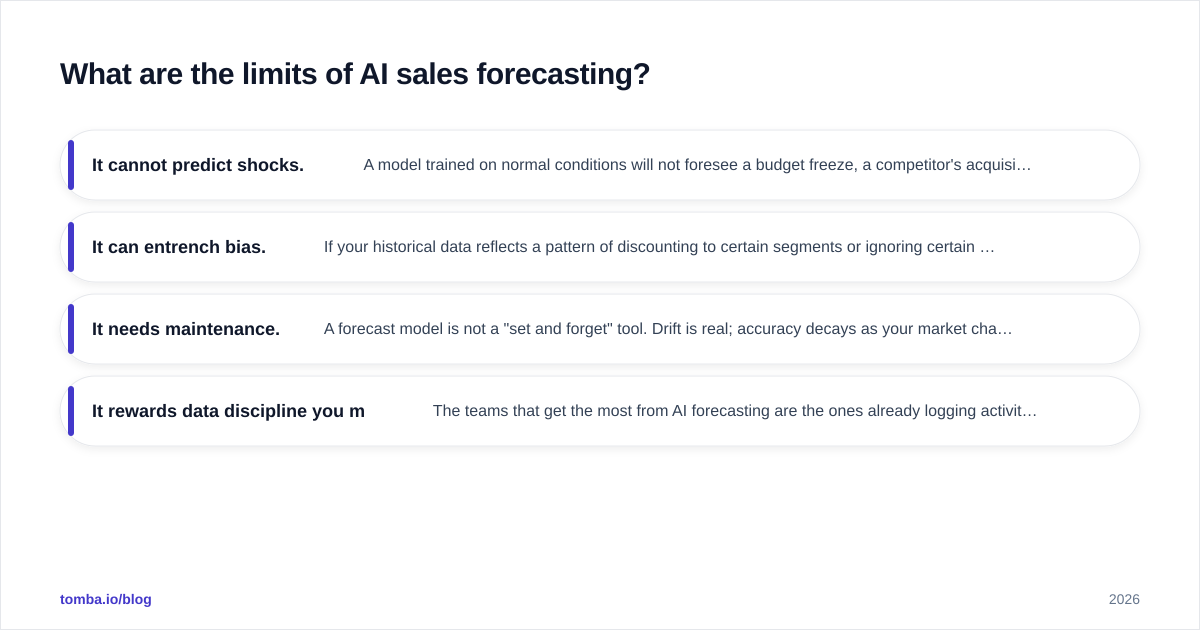
AI forecasting is not magic, and overselling it erodes the trust you need for adoption. Keep these limits in view:
- It cannot predict shocks. A model trained on normal conditions will not foresee a budget freeze, a competitor's acquisition, or a champion leaving. Those still need human intelligence.
- It can entrench bias. If your historical data reflects a pattern of discounting to certain segments or ignoring certain buyer types, the model learns and repeats it. Audit features for unintended bias.
- It needs maintenance. A forecast model is not a "set and forget" tool. Drift is real; accuracy decays as your market changes if you do not retrain.
- It rewards data discipline you may not have. The teams that get the most from AI forecasting are the ones already logging activity well. If your CRM is a graveyard, fix that first.
Used with those limits in mind, an AI sales forecast becomes the most reliable planning input you have — a continuously updated, bias-resistant baseline that frees managers to spend review time on the deals where their experience genuinely moves the number.
Get the data layer right first#
Every accurate AI sales forecast rests on complete, verified pipeline data — and that starts with knowing who is actually on each deal. Before you invest in a forecasting platform, make sure your opportunity records contain the full buying group with reachable, validated contacts. Tomba's Email Finder lets you identify and verify decision-makers across your open pipeline so your engagement signals are complete and your model has clean features to learn from. Start on the free tier (25 searches a month), and when you are ready to enrich at scale, the Starter plan runs $49/mo — see full Tomba pricing for Growth, Pro, and Enterprise options. Feed your model good data, and the forecast will finally be a number you can defend.
// get started
Find, verify and enrich your first contacts today
Start on the free plan with 25 searches a month, then scale when your team is ready.
Free plan · No credit card required · GDPR & CCPA
Get the Tomba newsletter
Product and data updates
// about the author