AI Sales Forecasting Accuracy: How to Hit 95% in 2026
Most sales forecasts miss by 20% or more. Here's how AI forecasting models actually improve accuracy in 2026 — and the data hygiene work that decides whether they do.
TL;DR
- AI sales forecasting accuracy depends far more on your input data than on the algorithm — a great model fed stale CRM records still misses badly.
- Mature teams using AI-assisted forecasting routinely land inside a 5–10% error band; most spreadsheet-driven teams sit at 20%+ variance.
- The biggest accuracy killers are missing contacts, duplicate accounts, and pipeline that hasn't been touched in 30+ days — not the math.
- Treat AI forecasting as a system: clean data in, weighted-pipeline plus historical patterns through the model, human judgment on top.
- Start measuring forecast error every quarter. You cannot improve accuracy you don't track.
What is AI sales forecasting accuracy?#
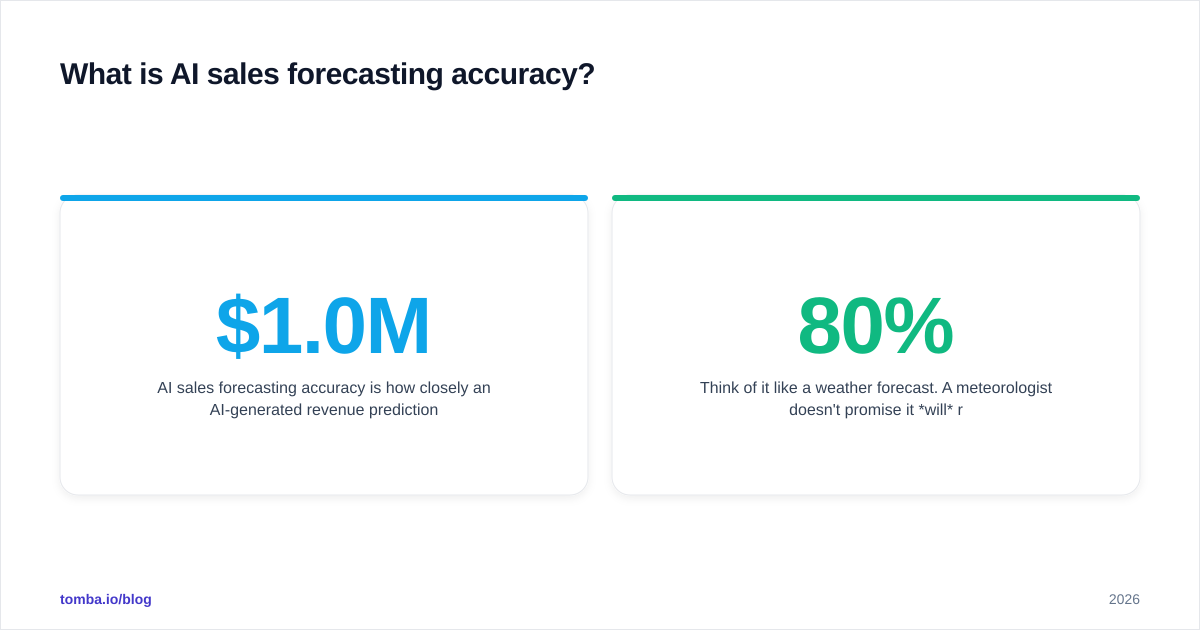
AI sales forecasting accuracy is how closely an AI-generated revenue prediction matches what actually closes. If your model predicts $1.0M for the quarter and you book $940K, you ran a 6% error — and in forecasting, error is the only number that matters.
Think of it like a weather forecast. A meteorologist doesn't promise it will rain; they say there's an 80% chance. Over hundreds of forecasts, you find out whether their 80% really means 80%. AI sales forecasting works the same way: it assigns probabilities to deals and a confidence band to the total, and accuracy is measured over many cycles, not one lucky quarter.
The shift from traditional forecasting is the shift from a rep's opinion ("I feel good about this one") to a model that scores every open opportunity against thousands of historical deals with similar attributes — deal size, stage velocity, buyer engagement, industry, number of contacts involved. According to Gartner, organizations that adopt AI in their sales processes report meaningful gains in forecast reliability, but the gains are uneven — and the difference almost always traces back to data quality.
Why are most sales forecasts so inaccurate?#
Most forecasts are wrong because they're built on optimism and bad data, then passed through a model that faithfully amplifies both.
Here are the usual culprits:
- Stale pipeline. A deal hasn't moved in 45 days but still sits in "Negotiation." Reps don't update it because closing it as lost feels like admitting defeat. The model treats it as live.
- Happy ears. Reps inflate close probability and pull-in dates. Aggregate enough optimism and your forecast is structurally too high every quarter.
- Missing or wrong contact data. If half your accounts have one contact and no buying committee mapped, the model can't see engagement breadth — a top predictor of whether a deal actually closes.
- Duplicate and merged accounts. The same logo counted twice, or split across two reps, distorts both the total and the per-account probability.
- No historical baseline. You can't predict the future without a clean record of the past. Teams that don't log lost reasons or actual close dates starve the model.
An AI model is not magic. Feed it the same messy CRM that produced your 25%-off forecast and it will produce a confidently wrong number — sometimes worse, because leadership now trusts it. The accuracy work happens upstream, in the data layer, long before the algorithm runs.
What accuracy can you realistically expect in 2026?#
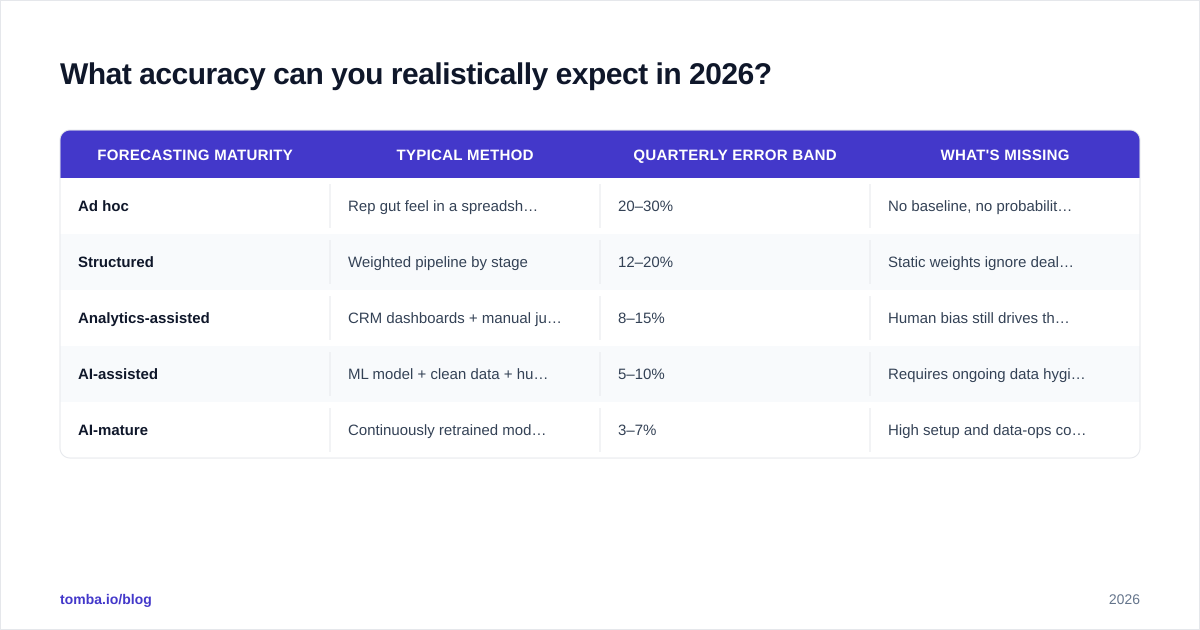
Conclusion first: a well-run AI forecasting setup should keep you inside a 5–10% error band on quarterly commit, versus the 15–25% that's typical for manual, spreadsheet-led teams. "95% accurate" is achievable on the commit number for mature teams, but treat any vendor promising it out of the box with skepticism — accuracy is earned through data discipline, not bought.
Here's how the tiers break down in practice:
| Forecasting maturity | Typical method | Quarterly error band | What's missing |
|---|---|---|---|
| Ad hoc | Rep gut feel in a spreadsheet | 20–30% | No baseline, no probability scoring |
| Structured | Weighted pipeline by stage | 12–20% | Static weights ignore deal-level signals |
| Analytics-assisted | CRM dashboards + manual judgment | 8–15% | Human bias still drives the number |
| AI-assisted | ML model + clean data + human review | 5–10% | Requires ongoing data hygiene |
| AI-mature | Continuously retrained model, enriched data | 3–7% | High setup and data-ops cost |
Two caveats. First, error band widens with deal size and sales cycle length — enterprise forecasts with six-month cycles are inherently noisier than transactional SaaS. Second, accuracy is a trailing metric. You only know last quarter's error after the quarter closes, so you're always improving the process that generates future forecasts.
How does AI actually improve forecast accuracy?#
AI improves accuracy by replacing static, one-size-fits-all assumptions with deal-specific probability scoring grounded in your own history.
A traditional weighted-pipeline forecast says "Proposal stage = 60% likely to close." Every proposal-stage deal gets 60%, whether it's a hot inbound deal with five engaged stakeholders or a cold one with a single unresponsive contact. AI scoring looks at the attributes of each deal and compares them to thousands of past deals that shared those attributes, then assigns a probability that reflects reality for that deal.
The signals a good model weighs include:
- Stage velocity — how fast the deal is moving relative to deals that won.
- Engagement breadth — number of contacts involved and their seniority. A single-threaded deal is fragile.
- Recency of activity — last meaningful touch. Silence is a strong negative signal.
- Deal size relative to your norm — outlier-sized deals close differently.
- Source and segment — inbound vs. outbound, industry, company size.
- Historical rep calibration — does this rep usually over- or under-call?
Notice that nearly every one of those signals is a data requirement. Engagement breadth needs every stakeholder in the CRM with a valid email. Segment scoring needs firmographic fields populated. This is exactly why teams invest in data enrichment before they invest in fancier models — the model is only as smart as the fields it can read.
What data do you need for accurate AI forecasting?#
You need three things: complete contact and account records, clean historical outcomes, and continuously refreshed signals. Miss any one and accuracy degrades.
Complete records. Every open opportunity should map the full buying committee, not just one champion. If your reps only log a single contact per account, the model is blind to engagement breadth — one of the strongest close predictors. Filling those gaps is where an email finder and a maintained B2B database earn their keep: you can enrich accounts with the decision-makers reps never bothered to add.
Clean history. The model trains on what happened before. That means accurate close dates, real won/lost flags, and logged loss reasons. Garbage history produces garbage probabilities. Run a quarterly de-duplication pass and verify that "closed" deals actually closed when the record says they did.
Fresh signals. Engagement, last-touch, and email validity decay fast. A contact who changed jobs is now a dead signal masquerading as a live one. Periodic email verification keeps your engagement data honest — a bounced address is not an engaged stakeholder, and the model should know that.

A simple data-readiness checklist before you trust any AI forecast:
- Every open deal has 2+ mapped contacts with verified emails
- Firmographic fields (industry, size, region) are >90% populated
- No duplicate accounts in the pipeline
- Loss reasons logged on every closed-lost deal for the last 4 quarters
- Last-activity timestamp is accurate, not auto-touched by integrations
Which AI forecasting approaches work best?#
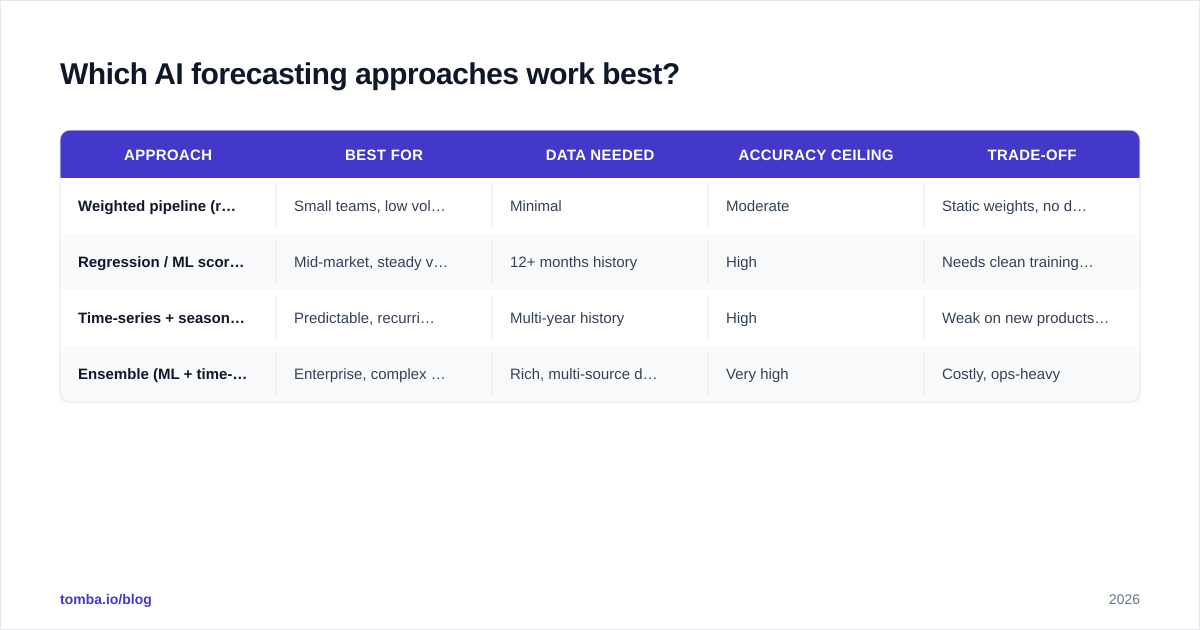
There's no single best model — the right approach depends on your deal volume and how much historical data you have. Here's how the main approaches compare.
| Approach | Best for | Data needed | Accuracy ceiling | Trade-off |
|---|---|---|---|---|
| Weighted pipeline (rule-based) | Small teams, low volume | Minimal | Moderate | Static weights, no deal-level nuance |
| Regression / ML scoring | Mid-market, steady volume | 12+ months history | High | Needs clean training data |
| Time-series + seasonality | Predictable, recurring revenue | Multi-year history | High | Weak on new products/segments |
| Ensemble (ML + time-series + judgment) | Enterprise, complex cycles | Rich, multi-source data | Very high | Costly, ops-heavy |
For most B2B teams, ML-based deal scoring layered on top of a weighted pipeline hits the sweet spot: meaningfully more accurate than static weights, without the data-engineering burden of a full ensemble. Many CRMs and revenue platforms now ship this natively — Salesforce Einstein and HubSpot forecasting tools both score deals automatically, provided you feed them clean records.
Whatever the approach, keep a human in the loop. The model produces a number; your sales leaders apply judgment about deals the model can't see — a verbal commit not yet in the system, a known budget freeze, a champion who just resigned. The most accurate forecasts in 2026 are AI-generated and human-adjusted, never one or the other alone. This is the core of mature revenue operations: the system proposes, experienced humans dispose.
How do you measure and improve forecast accuracy over time?#
You improve what you measure, so the first move is to log forecast-vs-actual every single quarter and compute the error. No measurement, no improvement — you're just guessing whether you got better.
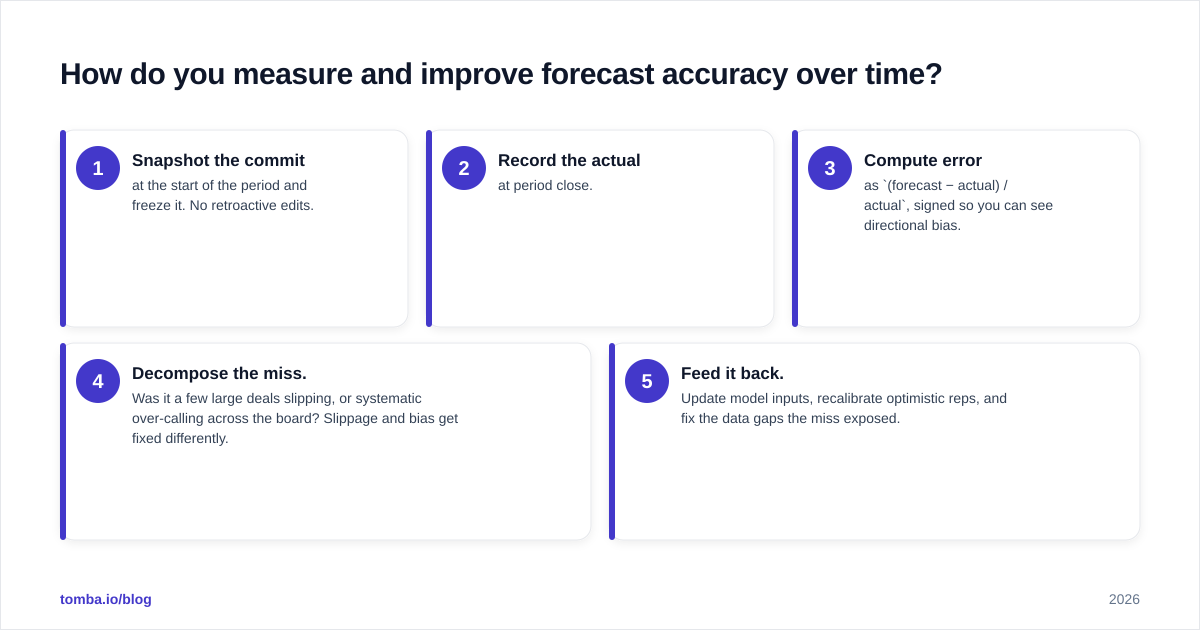
A practical measurement loop:
- Snapshot the commit at the start of the period and freeze it. No retroactive edits.
- Record the actual at period close.
- Compute error as
(forecast − actual) / actual, signed so you can see directional bias. - Decompose the miss. Was it a few large deals slipping, or systematic over-calling across the board? Slippage and bias get fixed differently.
- Feed it back. Update model inputs, recalibrate optimistic reps, and fix the data gaps the miss exposed.
Watch for directional bias, not just magnitude. A team that's consistently 12% high has a calibration problem you can correct with a simple adjustment factor. A team that's randomly ±15% has a data or process problem that needs deeper work. Track your win rate alongside forecast error — when both stabilize, your forecasting system is genuinely maturing.
Common improvement levers, in order of usual impact:
- Fix data completeness first. It's the cheapest, highest-leverage fix. Enrich missing contacts, verify emails, kill duplicates.
- Recalibrate per-rep optimism using each rep's historical call accuracy.
- Tighten stage definitions so "Proposal" means the same thing for everyone.
- Retrain the model on the most recent four quarters so it reflects current market conditions, not 2024's.
- Shorten the feedback cycle — review forecast accuracy monthly, not just at quarter-end.
The pattern across all of these: accuracy is an operating discipline, not a software purchase. The teams that win don't have a secret algorithm; they have clean data and a relentless feedback loop.
How does data quality connect to your tooling?#
The shortest path to better AI sales forecasting accuracy in 2026 runs through your contact data, because every meaningful signal the model uses is built on top of accurate, complete records. You can't score engagement breadth on accounts with one contact, and you can't trust last-touch on emails that silently bounce.
That's the practical reason data-enrichment tooling sits at the foundation of any forecasting effort. Use the Tomba Email Finder to fill in the missing decision-makers on your open opportunities so the model can finally see the full buying committee — then keep those records honest with verification and enrichment as deals progress. Clean inputs are the unglamorous, decisive 80% of forecast accuracy. Start there, and the model will reward you. You can compare plans on the Tomba pricing page; the free tier is enough to enrich a quarter of pipeline and see the difference in your next forecast.
Ready to find emails that actually work?
Join 150,000+ professionals who stopped guessing and started sending. Free credits on signup — no credit card required.
Get the Tomba newsletter
Practical outbound tactics and product updates — once every two weeks.
About the author