The AI Sales Funnel in 2026: Build, Automate, and Convert
An AI sales funnel uses machine learning to score, route, and personalize every stage from awareness to close. Here's how to build one in 2026 without breaking your stack.
TL;DR
- An AI sales funnel is your standard awareness-to-close pipeline with machine learning bolted onto the parts humans do badly at scale: scoring, routing, timing, and personalization.
- The biggest wins are not "AI writes my emails." They are better lead prioritization, faster routing, and predictive forecasting that tells you which deals are actually real.
- You need three things before any AI helps: clean contact data, a defined stage model, and outcome labels (won/lost) to train on.
- Tooling splits into four layers — data, scoring, engagement, and analytics. Most teams overbuy engagement and underbuy data.
- Start narrow: automate one stage (usually MQL-to-SQL handoff), measure the lift, then expand. Funnels rebuilt all at once tend to break trust with the sales team.
What is an AI sales funnel?#
An AI sales funnel is a conventional sales funnel where machine learning models handle the decisions that don't scale with headcount: which lead to call first, when to send the next touch, which message fits which buyer, and which deals deserve forecast confidence.
Think of it like a smart thermostat versus a manual dial. The old funnel is the dial — a rep manually decides who's hot, who's cold, and what to do next, based on gut and a spreadsheet. The AI funnel is the thermostat: it reads signals continuously, adjusts on its own, and only pings a human when something needs a real decision. The stages don't change. The decisions inside the stages get automated.
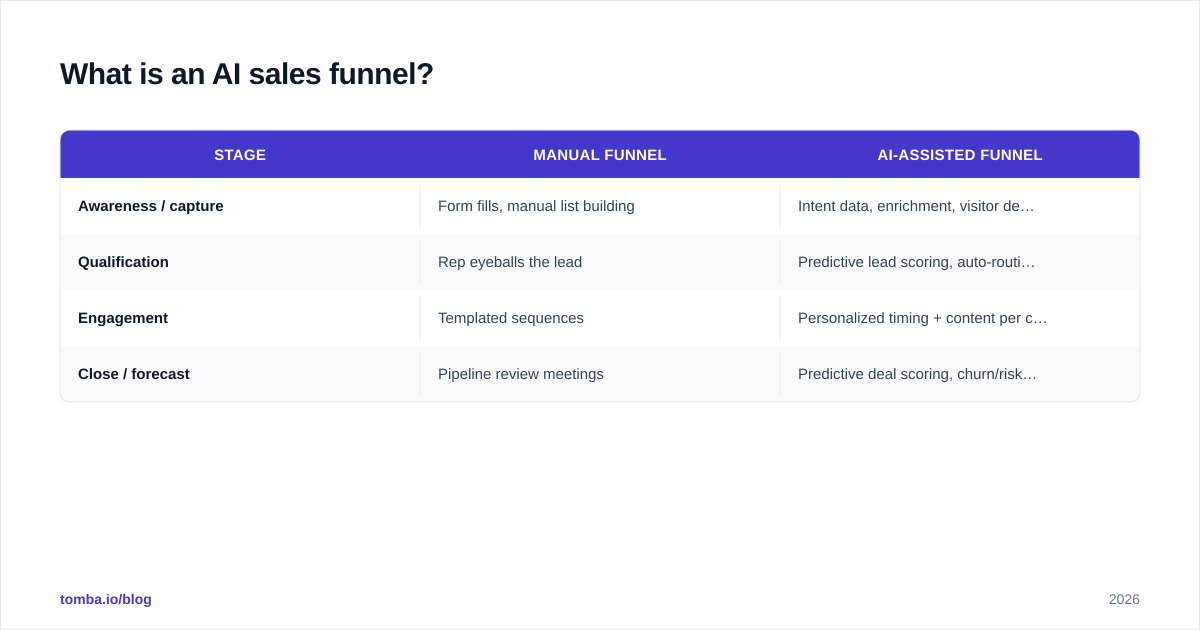
Concretely, a modern funnel has four stages and AI touches each one:
| Stage | Manual funnel | AI-assisted funnel |
|---|---|---|
| Awareness / capture | Form fills, manual list building | Intent data, enrichment, visitor de-anonymization |
| Qualification | Rep eyeballs the lead | Predictive lead scoring, auto-routing |
| Engagement | Templated sequences | Personalized timing + content per contact |
| Close / forecast | Pipeline review meetings | Predictive deal scoring, churn/risk flags |
The mistake most teams make is treating "AI funnel" as a content-generation feature. Writing emails faster is the smallest lever. The real returns come from prioritization and timing, because that's where reps waste most of their hours.
How is it different from a traditional sales funnel?#
The difference is who decides, and how fast. In a traditional funnel, a human reads every signal and makes every call between stages. That works at 50 leads a month and collapses at 5,000.
Three practical differences stand out:
Prioritization is continuous, not periodic. A rep re-ranks their list maybe once a day. A scoring model re-ranks every time a new signal lands — a page visit, an email open, a job change. The hottest lead at 9 a.m. may not be the hottest at 2 p.m., and the AI funnel notices.
Routing is instant. Research from HubSpot and others has long shown that responding to a lead within the first five minutes dramatically increases the odds of qualifying it. Manual routing — where a lead sits in a queue until someone assigns it — kills that window. AI routing closes it.
Forecasting is evidence-based. Instead of a sales manager asking "is this deal real?" in a Friday pipeline review, a model trained on your historical won/lost data scores each open deal. According to Gartner, sales organizations increasingly treat AI-driven forecasting as a baseline expectation rather than a differentiator going into 2026.
What does an AI sales funnel actually need to work?#
Before you buy a single tool, you need three foundations. Skip these and the AI produces confident garbage.
1. Clean, complete contact data. Models are only as good as the records they score. If half your leads are missing job title, company size, or a verified email, your scoring model is guessing. This is why the data layer matters more than the flashy engagement layer. Enriching and verifying contacts up front — using an email verifier and data enrichment before records ever hit the funnel — is unglamorous and high-leverage.
2. A defined stage model. AI can't automate a handoff you haven't defined. You need explicit, agreed-upon definitions: what makes a lead an MQL, what makes it an SQL, what triggers a stage change. If your team argues about what "qualified" means, no model will fix that — it'll just automate the confusion.
3. Outcome labels. Supervised models learn from history. You need a meaningful volume of closed-won and closed-lost deals, tagged accurately, so the model can learn what a good lead looks like. A funnel with 30 historical deals isn't enough to train anything trustworthy — lean on rules-based scoring until you have a few hundred labeled outcomes.
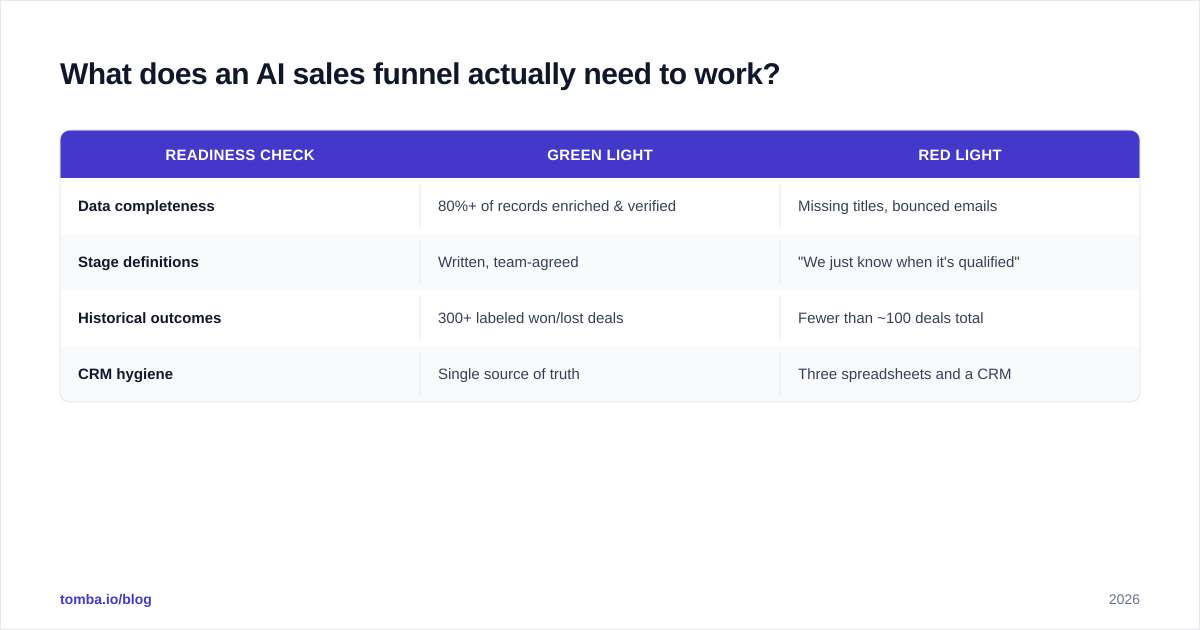
A quick gut-check before you start:
| Readiness check | Green light | Red light |
|---|---|---|
| Data completeness | 80%+ of records enriched & verified | Missing titles, bounced emails |
| Stage definitions | Written, team-agreed | "We just know when it's qualified" |
| Historical outcomes | 300+ labeled won/lost deals | Fewer than ~100 deals total |
| CRM hygiene | Single source of truth | Three spreadsheets and a CRM |
How do you build an AI sales funnel step by step?#
Here's the sequence that works in practice. Resist the urge to do all of it at once.
Step 1 — Fix the data layer first. Get your inbound and prospected contacts enriched and verified before they enter the funnel. Bad emails inflate your "engagement" metrics with bounces and poison your scoring. Use an email finder to fill gaps for prospected accounts, and run lists through verification so your model trains on reachable people.
Step 2 — Define and instrument stages. Map your funnel stages in your CRM and make sure every transition fires a tracked event. You can't model what you don't measure.
Step 3 — Start with rules-based scoring, then graduate to ML. Begin with a simple weighted score (title fit + company size + engagement). Once you have enough labeled outcomes, swap in a predictive model. Going straight to ML with thin data is how teams end up distrusting "the algorithm."
Step 4 — Automate one handoff. The MQL-to-SQL routing handoff is usually the highest-ROI place to start. Auto-assign, auto-notify, and set an SLA timer. Measure speed-to-lead before and after.
Step 5 — Layer in personalized engagement. Now add AI-assisted timing and content — but keep a human approving anything that goes out at volume. See our take on sales automation for where to draw the human-in-the-loop line.
Step 6 — Add predictive forecasting last. Once stages and data are solid, deal scoring becomes genuinely useful. Build it on top, not first.
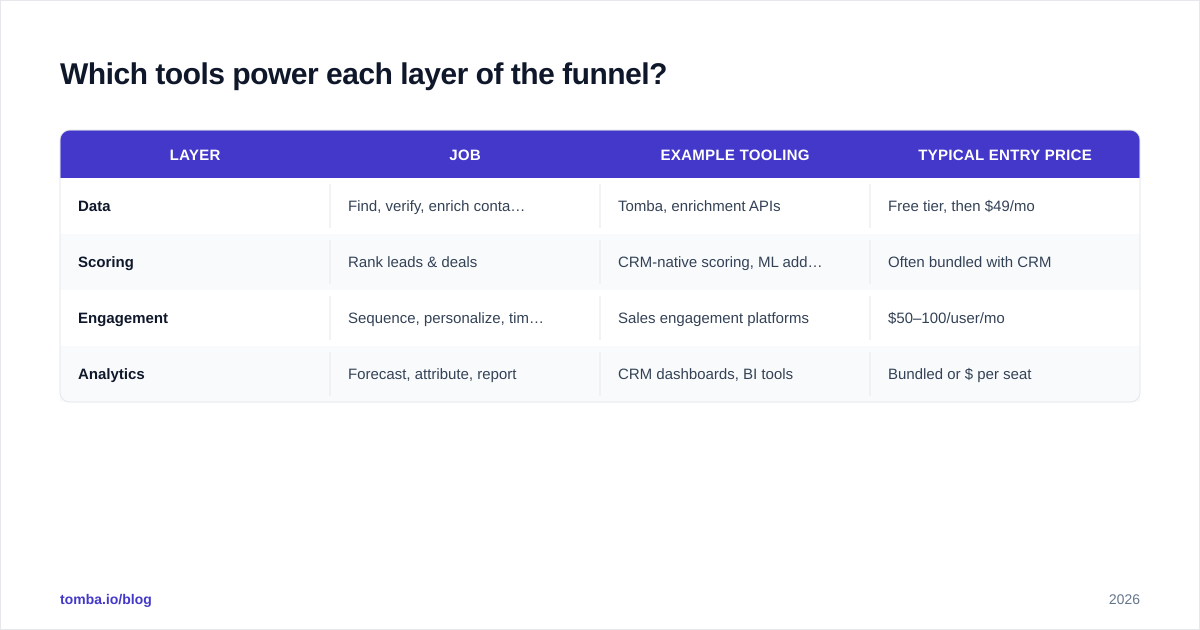
Which tools power each layer of the funnel?#
There's no single "AI funnel" product — you assemble layers. Here's how the categories break down and roughly what they cost.
| Layer | Job | Example tooling | Typical entry price |
|---|---|---|---|
| Data | Find, verify, enrich contacts | Tomba, enrichment APIs | Free tier, then $49/mo |
| Scoring | Rank leads & deals | CRM-native scoring, ML add-ons | Often bundled with CRM |
| Engagement | Sequence, personalize, time outreach | Sales engagement platforms | $50–100/user/mo |
| Analytics | Forecast, attribute, report | CRM dashboards, BI tools | Bundled or $ per seat |
For the data layer specifically, Tomba pricing starts with a free tier of 25 searches per month, then Starter at $49/mo, Growth at $99/mo, and Pro at $249/mo — which covers the find-and-verify foundation most funnels are missing. Compare options on a neutral marketplace like G2 before committing; the engagement layer in particular has dozens of near-identical players.
The common overspend: teams buy a $90/user/month engagement platform and feed it unverified data. That's a fast car with no fuel. Spend on the data layer first; it makes every layer above it work better.
What are the biggest mistakes teams make?#
Automating a broken process. AI accelerates whatever you point it at. If your qualification logic is wrong, you'll now disqualify good leads faster. Fix the process on paper before you automate it.
Trusting scores you can't explain. If a rep asks "why is this lead a 92?" and the answer is "the model said so," adoption dies. Use models that surface the top contributing factors. Explainability is what gets sales to actually follow the score.
Ignoring data decay. B2B data goes stale fast — people change jobs constantly. A contact you verified six months ago may be gone. Re-verification and ongoing lead management and scoring hygiene aren't one-time tasks.
Removing humans entirely. The funnels that work keep humans in the loop for judgment calls and final approval on high-volume sends. Per Salesforce research on AI adoption in sales, the strongest results come from augmentation — AI handling the repetitive scoring and routing while reps own the relationship — not full automation.
Measuring activity instead of outcomes. "We sent 10,000 personalized emails" is not a result. Tie every automation to a funnel metric: speed-to-lead, MQL-to-SQL conversion, win rate. If a fancy AI step doesn't move one of those, cut it.
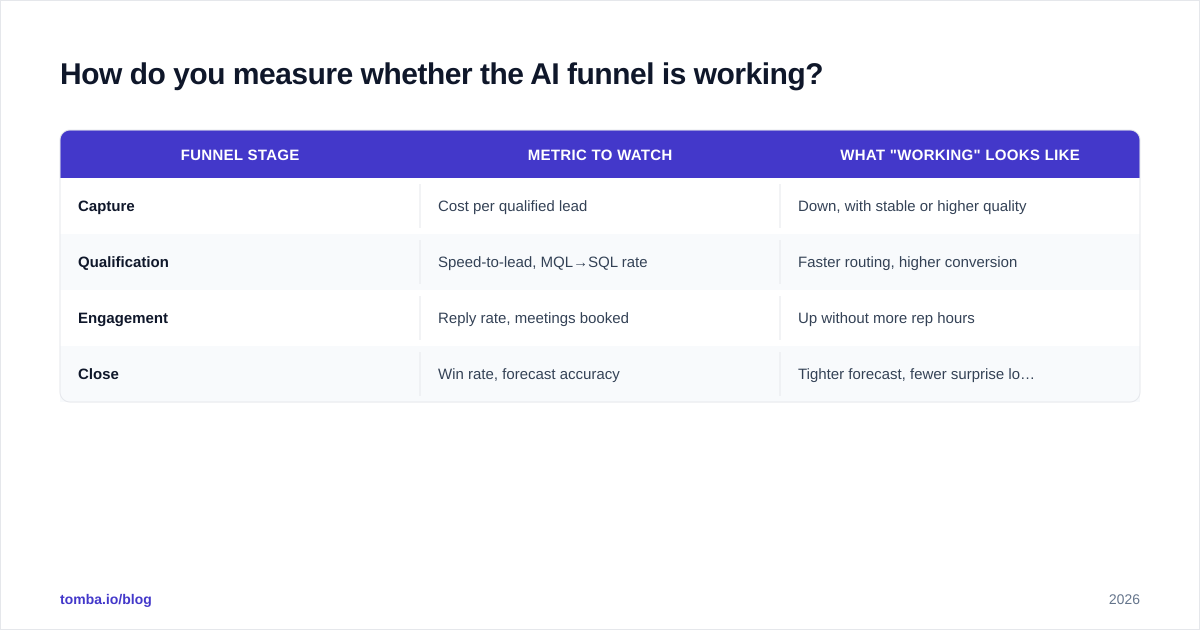
How do you measure whether the AI funnel is working?#
Pick metrics that map to each stage, baseline them before you automate, and re-measure after. If a number doesn't move, the AI layer isn't earning its cost.
| Funnel stage | Metric to watch | What "working" looks like |
|---|---|---|
| Capture | Cost per qualified lead | Down, with stable or higher quality |
| Qualification | Speed-to-lead, MQL→SQL rate | Faster routing, higher conversion |
| Engagement | Reply rate, meetings booked | Up without more rep hours |
| Close | Win rate, forecast accuracy | Tighter forecast, fewer surprise losses |
The cleanest test is a holdout: route a slice of leads through the old manual process and the rest through the AI funnel, then compare conversion and speed. If you can't run a true holdout, at least compare month-over-month against your pre-AI baseline. Anecdotes ("reps love it") are nice; conversion lift is the proof.
Is an AI sales funnel worth it for a small team?#
Yes, but with a narrower scope. A two-person sales team doesn't need predictive deal scoring — it needs the data layer and one automated handoff. The math is simple: if AI saves each rep an hour a day of list-building and manual research, that's roughly 20 hours a month back into selling. At small scale, the data and routing layers pay for themselves; the heavy ML forecasting layer is overkill until you have volume.
For larger teams, the calculus flips. At high lead volume, manual prioritization leaks revenue every day, and predictive scoring plus instant routing becomes the difference between hitting and missing quota. The bigger your funnel, the more the AI layer is worth.
Either way, the entry point is the same: clean data and one well-instrumented handoff. Everything else is expansion.
Where should you start this week?#
Start with the layer that makes every other layer work — your data. A scoring model trained on bounced emails and missing titles will steer your reps wrong no matter how sophisticated it is. Before you evaluate a single engagement platform, get your contact records found, verified, and enriched so the funnel has something real to act on.
The fastest way to do that is with Tomba Email Finder: find professional email addresses by domain, name, or company, verify them, and feed clean, reachable contacts into the top of your funnel. Start on the free tier, prove the data-quality lift on one campaign, and expand from there. Build the foundation right, and the AI layers you add on top will actually convert.
Ready to find emails that actually work?
Join 150,000+ professionals who stopped guessing and started sending. Free credits on signup — no credit card required.
Get the Tomba newsletter
Practical outbound tactics and product updates — once every two weeks.
About the author