AI Sales Outreach Automation: The 2026 Playbook for Reps
AI can write, send, and follow up on outreach faster than any SDR team. Here's how to automate sales outreach in 2026 without torching your domain or sounding like a robot.
TL;DR
- AI sales outreach automation means using software to research prospects, draft personalized messages, send sequences, and trigger follow-ups with minimal manual work — not blasting the same template to 10,000 people.
- The winning stack in 2026 is layered: clean data → AI personalization → multichannel sequencing → deliverability guardrails → a human closing the loop on warm replies.
- Personalization at scale only works when the underlying data is accurate. Garbage contact data poisons every downstream AI step.
- Automate the research and the first-draft, keep a human on strategy and on hot conversations. Full autopilot still tanks reply rates.
- Track reply rate and positive-reply rate, not send volume. Volume is the vanity metric that gets your domain blacklisted.
What is AI sales outreach automation?#
AI sales outreach automation is the practice of letting software handle the repetitive parts of prospecting — finding contacts, researching them, writing the first draft, sending it, and chasing non-responders — so reps spend their time on conversations that actually move deals.
Think of it like a self-driving car with a driver still behind the wheel. The system handles the highway miles (data entry, sequencing, follow-up timing) while a human takes over for the tricky merges (a CFO who replies with a hard question, a champion who goes quiet). Technically, it's a pipeline of connected tools: a data source feeds an enrichment layer, which feeds an AI writer, which feeds a sending engine, which reports back into your CRM.
The shift from 2023 to 2026 is real. Old "automation" was mail-merge with {{first_name}}. Modern AI outreach reads a prospect's recent LinkedIn post, their company's latest funding round, and the job they're hiring for — then writes an opener that references all three in a sentence that sounds like you wrote it at 7am with coffee.
Why automate sales outreach at all?#
The short answer: math. A human SDR can research and personalize maybe 20–30 quality emails a day. An AI-assisted rep can do 150+ at the same quality bar, because the research and drafting collapse from eight minutes per prospect to under one.
But speed is only half of it. The other half is consistency. Humans get tired, skip the research step on Friday afternoon, and forget to follow up on day 4. Automation never forgets the follow-up — and follow-ups are where most replies actually come from. Studies from outreach platforms consistently show the majority of positive replies land on the second through fifth touch, not the first.
Here's the part teams get wrong: automation amplifies whatever you feed it. Good targeting and clean data, amplified, means more meetings. Bad targeting and dirty data, amplified, means more spam complaints and a burned domain. The tool is a megaphone, not a strategy.
What does an AI outreach pipeline actually look like?#
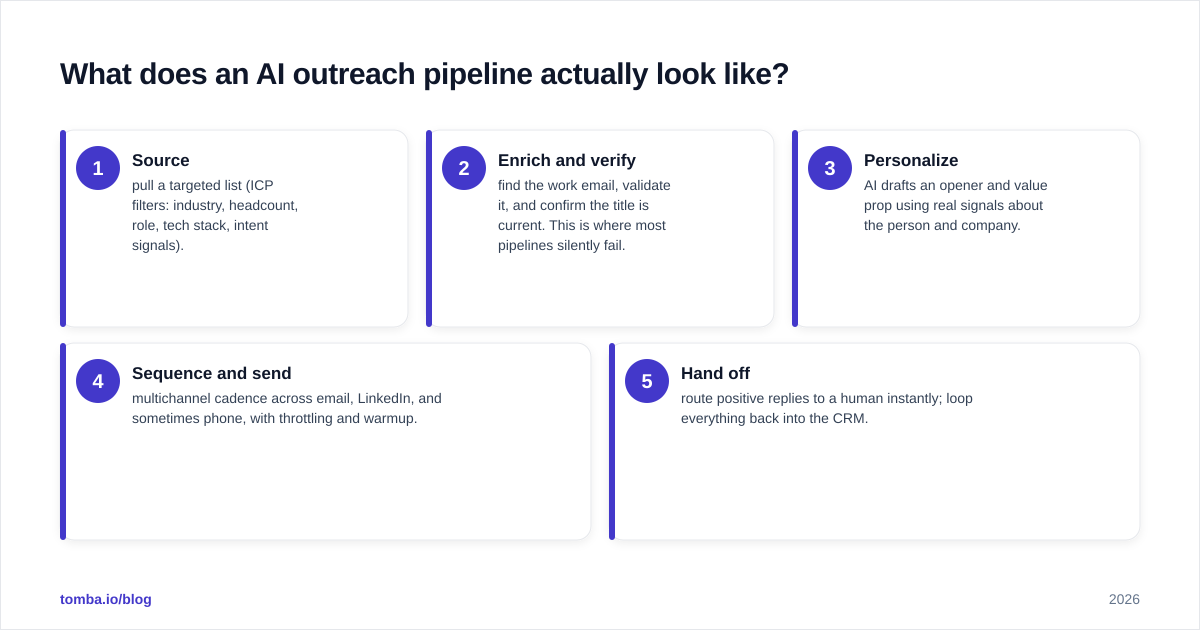
A reliable pipeline has five stages, and each one hands off to the next. Skip a stage and the whole thing leaks.
- Source — pull a targeted list (ICP filters: industry, headcount, role, tech stack, intent signals).
- Enrich and verify — find the work email, validate it, and confirm the title is current. This is where most pipelines silently fail.
- Personalize — AI drafts an opener and value prop using real signals about the person and company.
- Sequence and send — multichannel cadence across email, LinkedIn, and sometimes phone, with throttling and warmup.
- Hand off — route positive replies to a human instantly; loop everything back into the CRM.
The most important arrow in that diagram is the one from stage 2 to stage 3. If the email is wrong or the person changed jobs, your perfectly written AI opener lands in a dead inbox — or worse, in a spam trap. That's why accurate contact data is the foundation, not an afterthought. A solid email verifier sits between sourcing and sending for exactly this reason.
Which parts should AI handle, and which should stay human?#
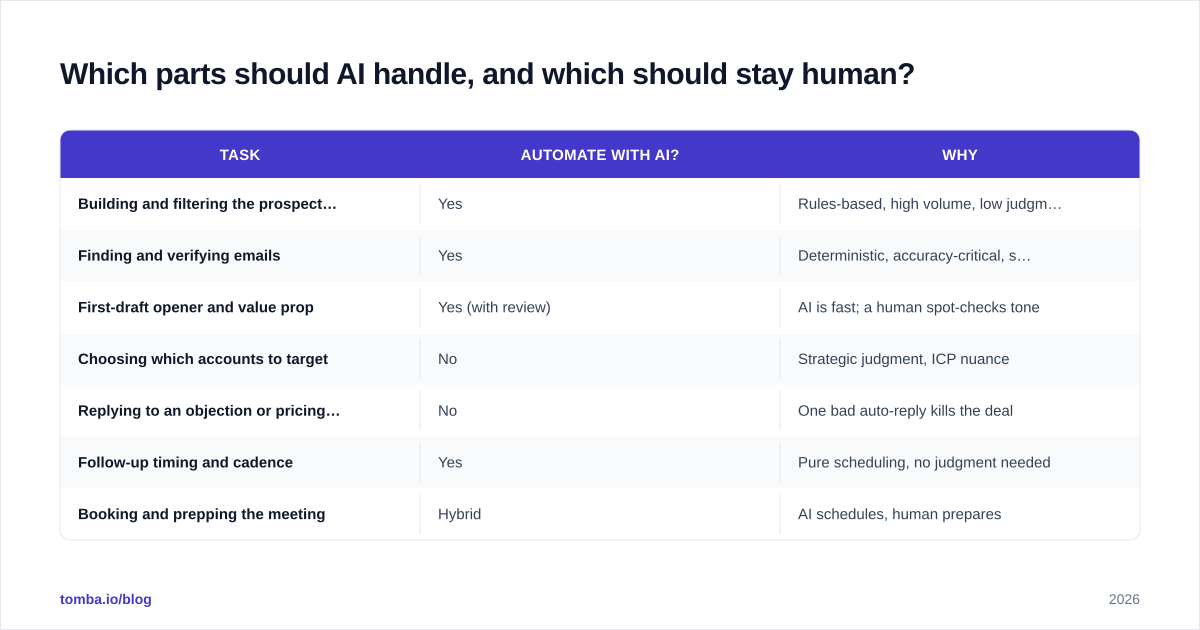
This is the question that separates teams who book meetings from teams who get flagged as spam. The rule of thumb: automate the inputs, keep humans on the judgment.
| Task | Automate with AI? | Why |
|---|---|---|
| Building and filtering the prospect list | Yes | Rules-based, high volume, low judgment |
| Finding and verifying emails | Yes | Deterministic, accuracy-critical, scalable |
| First-draft opener and value prop | Yes (with review) | AI is fast; a human spot-checks tone |
| Choosing which accounts to target | No | Strategic judgment, ICP nuance |
| Replying to an objection or pricing question | No | One bad auto-reply kills the deal |
| Follow-up timing and cadence | Yes | Pure scheduling, no judgment needed |
| Booking and prepping the meeting | Hybrid | AI schedules, human prepares |
The trap in 2026 is the "fully autonomous AI SDR" pitch. Agents that research, write, send, and reply with zero human review look great in a demo and quietly destroy reply rates in production, because prospects can smell a bot the moment the conversation goes off-script. Keep a human on the warm replies. That's where revenue is won or lost.
How do you personalize at scale without sounding like a robot?#
Personalization at scale is a contradiction only if you treat every contact identically. The fix is tiered personalization: spend more AI effort on higher-value accounts.
- Tier 1 (top accounts): AI drafts using three or more live signals — recent post, funding, hiring, product launch — and a human edits every message before it sends.
- Tier 2 (mid): AI personalizes the opener from one or two signals; humans review a sample.
- Tier 3 (volume): AI personalizes only the first line; the rest is a strong, tested template.
The signal quality matters more than the word count. "I saw you're hiring three backend engineers in Berlin" beats a 200-word essay about how much you admire their mission. Specificity reads as effort; flattery reads as filler.
A practical tip most teams miss: feed the AI structured data, not raw scrapes. If your data enrichment layer returns clean fields — current title, department, company headcount, tech stack — the AI writes tighter, more accurate openers than if you dump a messy LinkedIn export into the prompt. Clean inputs, clean outputs. For background on the broader category, HubSpot's sales automation overview is a reasonable neutral primer.
What tools make up a 2026 AI outreach stack?#
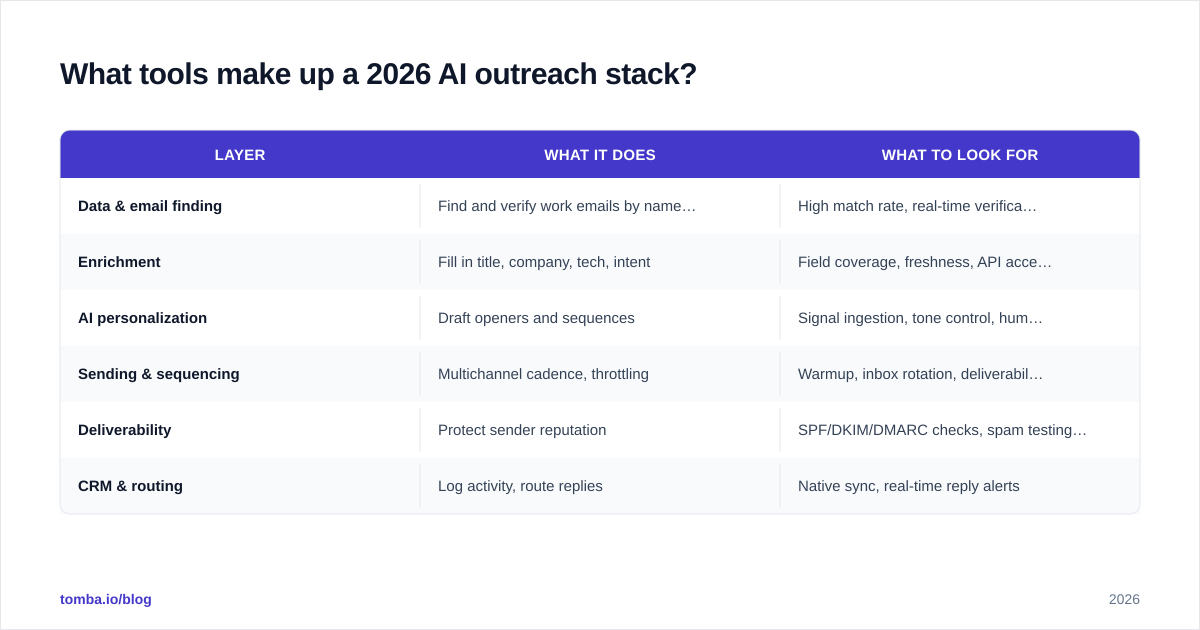
There's no single tool that does everything well. The teams that win pick a best-in-class layer for each job and connect them. Here's how the categories break down.
| Layer | What it does | What to look for |
|---|---|---|
| Data & email finding | Find and verify work emails by name/domain | High match rate, real-time verification, low bounce |
| Enrichment | Fill in title, company, tech, intent | Field coverage, freshness, API access |
| AI personalization | Draft openers and sequences | Signal ingestion, tone control, human-in-loop editing |
| Sending & sequencing | Multichannel cadence, throttling | Warmup, inbox rotation, deliverability controls |
| Deliverability | Protect sender reputation | SPF/DKIM/DMARC checks, spam testing, blacklist monitoring |
| CRM & routing | Log activity, route replies | Native sync, real-time reply alerts |
For the data layer, you want a provider with a strong email finder and built-in verification so bad addresses never reach the sending stage. For the sequencing layer, tools like Instantly or Smartlead handle inbox rotation; you can compare options on a marketplace like G2. The key is that these layers integrate — most connect through native apps or [
Zapier-style automation](https://tomba.io/integrations/zapier) so the list flows from source to send without manual CSV juggling.
A word of caution on consolidation: all-in-one platforms (Apollo, Outreach, Salesloft) are convenient, but their data layer is often weaker than a dedicated finder. If your match rate is 55% and your bounce rate is 8%, no amount of AI copywriting saves the campaign. Many teams keep an all-in-one for sequencing and bolt on a specialist data tool for accuracy.
How do you keep AI outreach out of the spam folder?#
You can have the best AI copy in the world and still land in spam if your technical setup is sloppy. Deliverability is the silent killer of automated outreach, and AI volume makes it worse because you're sending more.
The non-negotiables:
- Authenticate your domain. SPF, DKIM, and DMARC records, all valid. A quick SPF check catches the most common misconfiguration in seconds.
- Warm up new sending domains and inboxes. Never send 200 cold emails from a brand-new mailbox on day one. Ramp over weeks.
- Verify every address before sending. Bounces above 2–3% signal mailbox providers that you're a spammer. Verification keeps you under that line.
- Throttle and rotate. Spread sends across the day and across multiple inboxes rather than blasting all at once.
- Watch your reputation. Google Postmaster Tools and a periodic blacklist check tell you if your domain is degrading before reply rates crater.
The throughline: AI lets you send more, which means deliverability discipline matters more, not less. The teams that scale automated outreach successfully treat sender reputation like a credit score — slow to build, fast to ruin, and worth protecting obsessively. Google's own sender guidelines spell out the bulk-sender rules that now apply to most outreach senders.
What metrics actually tell you it's working?#
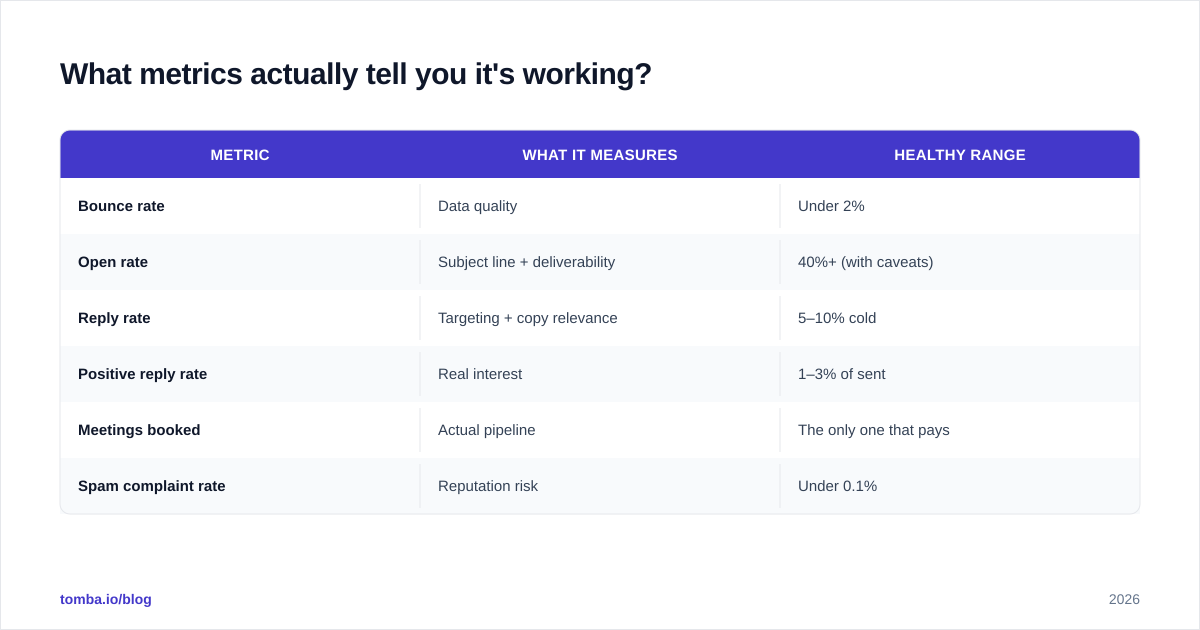
Send volume is a vanity metric. It feels like progress and tells you almost nothing about pipeline. Track these instead.
| Metric | What it measures | Healthy range |
|---|---|---|
| Bounce rate | Data quality | Under 2% |
| Open rate | Subject line + deliverability | 40%+ (with caveats) |
| Reply rate | Targeting + copy relevance | 5–10% cold |
| Positive reply rate | Real interest | 1–3% of sent |
| Meetings booked | Actual pipeline | The only one that pays |
| Spam complaint rate | Reputation risk | Under 0.1% |
Open rate has gotten noisy since Apple and others started pre-fetching images, so weight reply and positive-reply rates higher. A campaign with a 60% open rate and a 0.5% reply rate is a campaign with a great subject line and terrible targeting.
The diagnostic flow is simple. High bounce? Fix your data. Good opens but no replies? Fix your targeting and offer. Good replies but no meetings? Fix your call-to-action and your handoff speed. Each metric points at a specific stage in the pipeline, which is exactly why the staged framework above matters — you can isolate the leak.
How do you start without overbuilding?#
Don't buy six tools and a RevOps consultant on day one. Start narrow and prove it works.
- Pick one tight ICP segment — say, Series A SaaS companies hiring sales leaders.
- Build a clean list of 100 verified contacts. Accuracy first; this is your foundation.
- Write one strong sequence — three to four touches, AI-drafted openers, human-edited.
- Send from one warmed inbox with full authentication.
- Measure reply and positive-reply rates. Iterate the opener and offer before you scale.
Once that segment converts, then you add volume, more inboxes, and more automation. Scaling a broken sequence just breaks it faster. The point of automation is to multiply something that already works — not to manufacture results from a process you haven't validated.
This crawl-walk-run approach also protects your domain. You learn your deliverability limits on 100 contacts, not 10,000, and you find the copy that resonates before you've committed your reputation to it.
The bottom line#
AI sales outreach automation in 2026 is not about removing humans — it's about pointing humans at the 20% of work that needs judgment and letting software handle the other 80%. The teams that win automate research, drafting, sequencing, and follow-up, while keeping a person on targeting strategy and every warm reply. And all of it rests on one foundation: accurate, verified contact data, because automation amplifies whatever you feed it.
Start there. Before you automate a single send, make sure the emails you're sending to actually exist and reach the right person. Tomba's email finder finds professional addresses by name, domain, or company and verifies them in real time — so your AI-personalized outreach lands in a real inbox instead of a spam trap. Try it on the free tier (25 searches a month), and check the full Tomba pricing when you're ready to scale from a clean foundation rather than a leaky one.
// get started
Find, verify and enrich your first contacts today
Start on the free plan with 25 searches a month, then scale when your team is ready.
Free plan · No credit card required · GDPR & CCPA
// about the author