The AI Sales Process in 2026: A Step-by-Step Playbook
AI now touches every stage of the sales cycle. Here is a practical, stage-by-stage playbook for building an AI sales process that actually closes deals in 2026.
TL;DR
- An AI sales process layers automation and machine learning onto the classic funnel — prospecting, enrichment, outreach, qualification, forecasting — so reps spend more time selling and less time on admin.
- The biggest wins are early: data sourcing, lead scoring, and personalized outreach. That is where AI returns hours per rep per week.
- AI does not replace your sales process. It compresses it. You still need clean data, a defined funnel, and human judgment at the close.
- Tool stacks matter less than data quality. A model trained on stale contacts will confidently send emails to people who left the company in 2023.
- Start with one stage, measure the lift, then expand. Teams that "AI-everything" at once usually end up with a slower, noisier pipeline.
What is an AI sales process?#
An AI sales process is your existing sales cycle with machine learning and automation embedded at each stage — instead of a rep doing every task by hand, software handles the repetitive, data-heavy work and surfaces recommendations.
Think of it like a modern kitchen. The chef (your rep) still decides the menu and plates the dish, but the prep cooks, timers, and temperature sensors (AI) handle the grunt work and warn you before something burns. The judgment stays human. The toil gets automated.
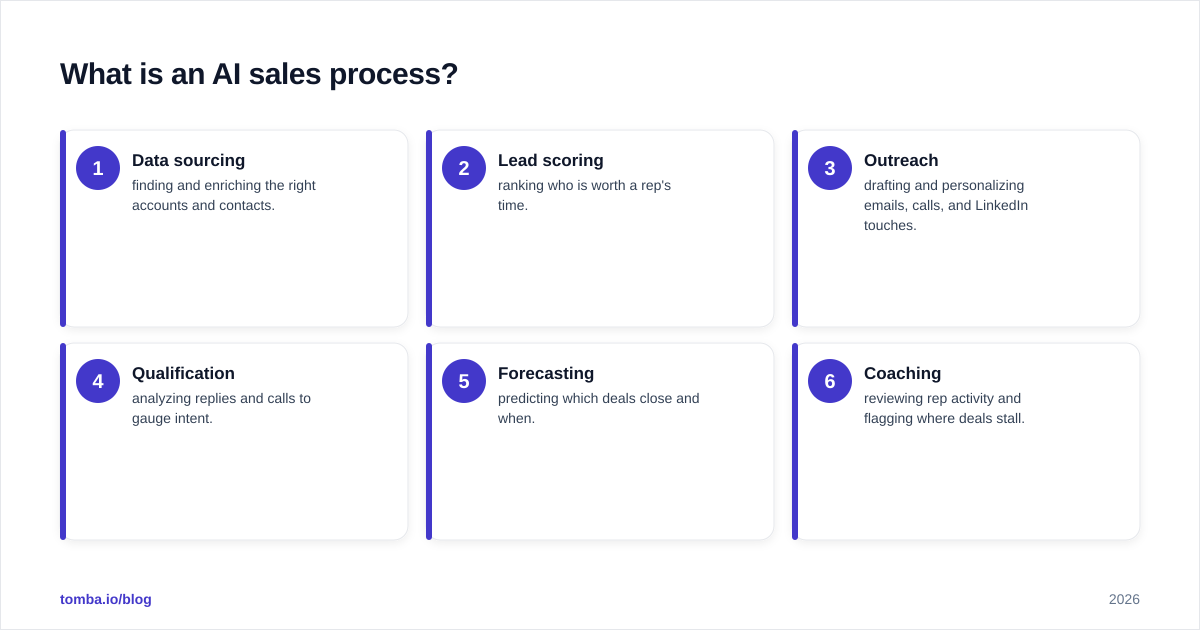
Concretely, a 2026 AI sales process touches six stages:
- Data sourcing — finding and enriching the right accounts and contacts.
- Lead scoring — ranking who is worth a rep's time.
- Outreach — drafting and personalizing emails, calls, and LinkedIn touches.
- Qualification — analyzing replies and calls to gauge intent.
- Forecasting — predicting which deals close and when.
- Coaching — reviewing rep activity and flagging where deals stall.
The mistake teams make is treating "AI sales" as a single product you buy. It is not. It is a sequence of decisions about where automation adds leverage and where a human still needs to own the call.
Why is AI changing the sales process in 2026?#
Because the cost of the first 80% of every sales task dropped to near zero, and that 80% used to eat half a rep's week.
Three shifts converged. First, contact data became programmatically accessible at scale through APIs, so enrichment no longer means a VA copy-pasting from LinkedIn. Second, large language models got good enough to draft outreach that does not read like a mail merge. Third, CRMs opened up enough that AI can read pipeline history and predict outcomes instead of just storing them.
The result: according to industry research compiled by Gartner, a growing majority of B2B sales organizations now use AI in at least one core workflow, and the leaders are pushing it into forecasting and deal coaching — the stages that were "human-only" two years ago.
The honest caveat: AI amplifies whatever process you already have. If your funnel is undefined and your data is dirty, AI makes you fail faster and at higher volume. Fix the fundamentals first.
How do you build an AI sales process stage by stage?#
Map one AI capability to each funnel stage, ship it, measure the lift, then move to the next. Here is the stage-by-stage breakdown.
Stage 1 — Data sourcing and enrichment#
Everything downstream depends on this. A perfectly written, perfectly timed email sent to a bad address is a 0% reply rate.
Use an email finder to source verified professional addresses by name and domain, then run data enrichment to fill in title, company size, tech stack, and social profiles. For account-based plays, domain search pulls every reachable contact at a target company so you can map the buying committee instead of guessing one champion.
The AI angle here is matching and validation: models score the likelihood an email is deliverable and flag catch-all domains before you waste a send.
Stage 2 — Lead scoring#
Once you have data, AI ranks it. A scoring model weighs firmographics, behavior, and intent signals to tell a rep who to call first. This is where AI beats human intuition reliably — a model evaluating 40 variables across 5,000 leads will out-prioritize a rep eyeballing a list every time.
Tie scores to a clear threshold. If your team treats a marketing qualified lead and a raw list import the same way, the score is decorative.
Stage 3 — AI-assisted outreach#
Generative AI drafts the first version of every email, call script, and LinkedIn message. The rep edits, the rep approves, the rep is accountable. Never let a model send unsupervised at scale — that is how you torch your sending domain.
Stage 4 — Qualification and reply analysis#
AI reads inbound replies and call transcripts, classifies intent ("interested," "not now," "wrong person"), and routes accordingly. This kills the lag between a prospect raising a hand and a rep noticing.
Stage 5 — Forecasting#
Models analyze deal stage, activity, and historical close rates to predict the quarter. This is where you reduce the "hockey stick" surprise at quarter-end.
Stage 6 — Coaching#
AI flags deals that have gone quiet, calls where the rep talked 80% of the time, and stages where pipeline consistently leaks. Managers coach the pattern, not the anecdote.
Which tools fit each stage of the AI sales process?#
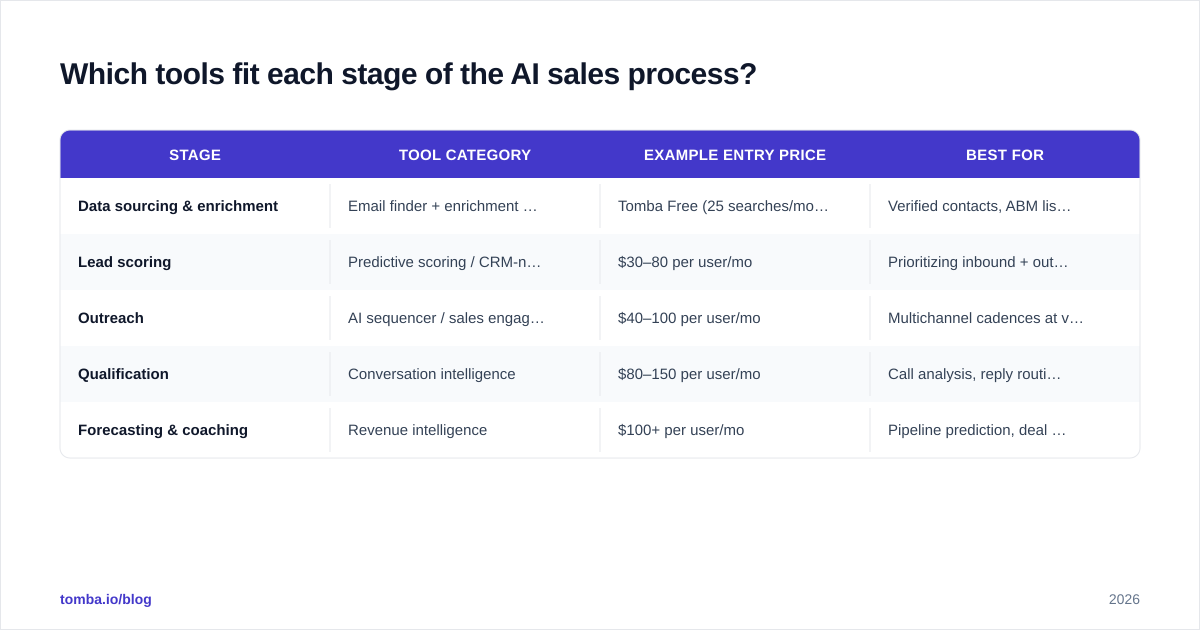
No single platform does all six stages well. Most teams assemble a stack. Here is how common categories map to the funnel, with rough entry pricing so you can budget realistically.
| Stage | Tool category | Example entry price | Best for |
|---|---|---|---|
| Data sourcing & enrichment | Email finder + enrichment API | Tomba Free (25 searches/mo), Starter $49/mo | Verified contacts, ABM list building |
| Lead scoring | Predictive scoring / CRM-native AI | $30–80 per user/mo | Prioritizing inbound + outbound queues |
| Outreach | AI sequencer / sales engagement | $40–100 per user/mo | Multichannel cadences at volume |
| Qualification | Conversation intelligence | $80–150 per user/mo | Call analysis, reply routing |
| Forecasting & coaching | Revenue intelligence | $100+ per user/mo | Pipeline prediction, deal risk |
A few pricing notes worth checking against the vendors directly. Tomba's data layer starts free at 25 searches per month, with Starter at $49/mo, Growth at $99/mo, and Pro at $249/mo — full Tomba pricing is published. Engagement and revenue-intelligence platforms are almost always priced per seat, so a 10-rep team scales linearly. Validate every quote on a review site like G2 before you commit, because list prices and real contract prices diverge fast in this category.
The stack-builder's rule: spend the most on the stage where your funnel actually leaks. If you have great conversations but a thin top of funnel, invest in sourcing — not another conversation-intelligence seat.
Is an AI sales process better than a traditional one?#
Yes for volume, speed, and consistency — no for relationship-heavy, high-ACV deals where the process was never the bottleneck.
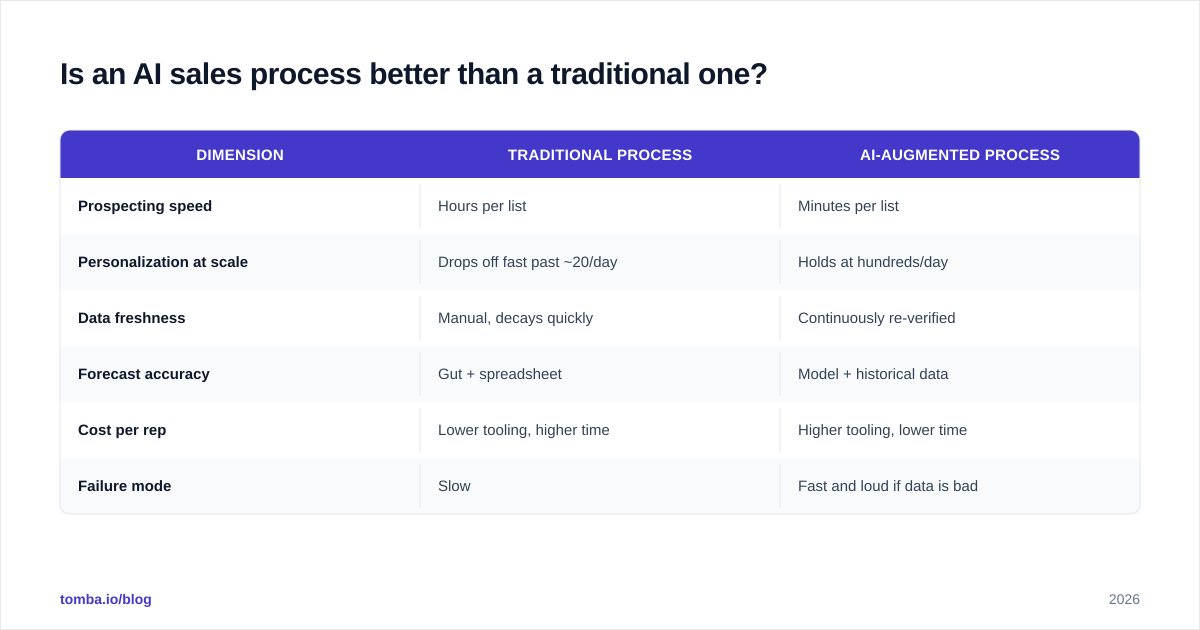
Here is the honest comparison.
| Dimension | Traditional process | AI-augmented process |
|---|---|---|
| Prospecting speed | Hours per list | Minutes per list |
| Personalization at scale | Drops off fast past ~20/day | Holds at hundreds/day |
| Data freshness | Manual, decays quickly | Continuously re-verified |
| Forecast accuracy | Gut + spreadsheet | Model + historical data |
| Cost per rep | Lower tooling, higher time | Higher tooling, lower time |
| Failure mode | Slow | Fast and loud if data is bad |
The pattern across teams that adopt AI well: they do not chase a higher reply rate first. They chase reclaimed time. A rep who gets back six hours a week from automated sourcing and drafting spends those hours on live conversations — and that is what moves the number.
For a deeper look at how automation reshapes the broader motion, the concept of sales automation covers the workflow layer that sits underneath these AI features.
What does an AI sales process workflow look like end to end?#
Here is a concrete daily loop a single SDR might run in 2026. The diagram below shows the same flow visually.
- Morning, 15 minutes. Pull a fresh account list. Run domain search to get every contact at 50 target accounts. Enrich and verify in bulk.
- Scoring, automatic. The model ranks the new contacts overnight; the rep opens a pre-prioritized queue.
- Drafting, 30 minutes. AI generates first-pass personalized emails referencing each prospect's role and company. The rep edits the top 25, deletes the three that misfired, approves the rest.
- Sending, automatic. The sequencer spaces sends to protect sender reputation and pauses anyone who replies.
- Replies, AI-triaged. Interested replies jump to the top of the inbox with a suggested response; "not now" replies auto-schedule a follow-up in 90 days.
- Calls, recorded and analyzed. Conversation intelligence transcribes and scores each call, feeding the coaching loop.
- Forecast, updated live. Each booked meeting and advanced stage updates the quarter prediction without a manual CRM hygiene session.
Notice what the human still owns: the edit, the approval, the call, and the close. AI removed the prep, not the judgment.
What are the risks and how do you avoid them?#
The three failure modes are predictable, so plan around them.
Bad data at scale. AI sends faster, so dirty data burns your domain faster. Mitigate by verifying every address before send with an email verifier and monitoring bounce rates weekly. A bounce rate creeping past 3% is a fire, not a metric.
Generic "AI smell" in outreach. Prospects can spot a model-written email now. The fix is not banning AI — it is giving the model real inputs (a recent trigger, a specific role pain) so the draft has something true to say. Edit ruthlessly.
Over-automation of the close. Forecasting and coaching AI inform decisions; they should not make them. A model flagging a deal as low-probability is a prompt to call the champion, not to ghost the account.
Compliance and consent. Outbound rules differ by region. AI volume does not exempt you from CAN-SPAM, GDPR, or local equivalents. HubSpot maintains a solid practical primer on email compliance requirements if you need a refresher before scaling sends.
How do you measure AI sales process ROI?#
Measure reclaimed time first, pipeline second, revenue third — in that order, because the early signal shows up in hours saved long before it shows up in closed-won.
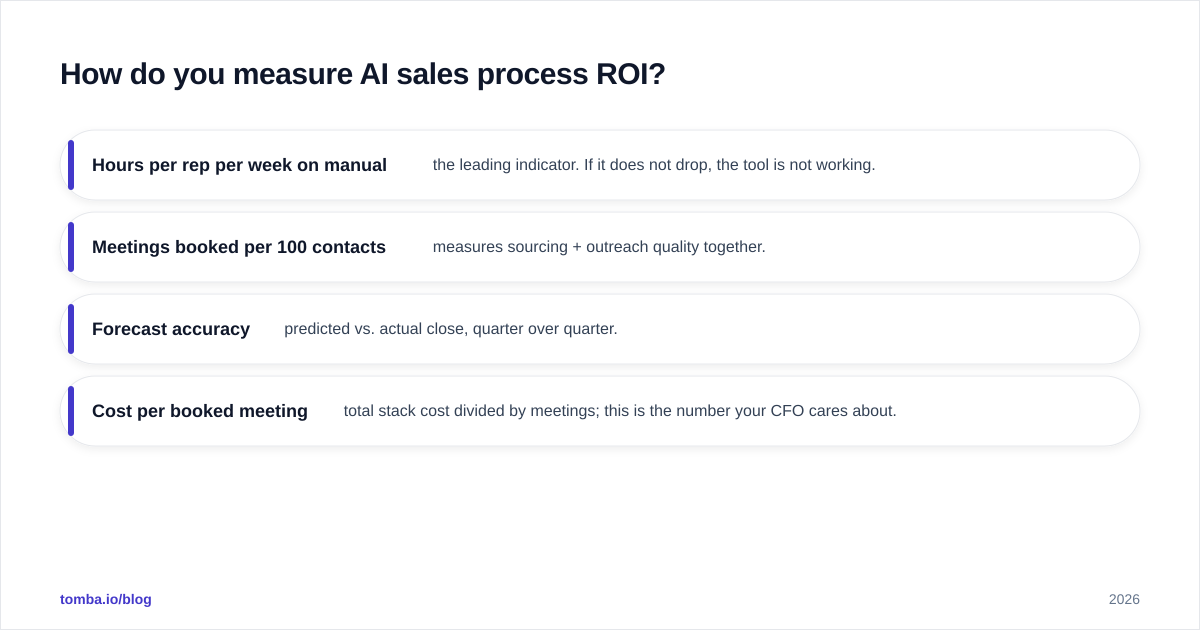
Track these four metrics before and after each AI rollout:
- Hours per rep per week on manual tasks — the leading indicator. If it does not drop, the tool is not working.
- Meetings booked per 100 contacts — measures sourcing + outreach quality together.
- Forecast accuracy — predicted vs. actual close, quarter over quarter.
- Cost per booked meeting — total stack cost divided by meetings; this is the number your CFO cares about.
Run each new tool as a two-week A/B against your current process on a real segment. If the lift is not visible at small scale, it will not magically appear at large scale.
Frequently asked questions#
Does AI replace sales reps? No. It replaces the repetitive parts of their job — list building, data entry, first-draft writing. The conversation, the negotiation, and the relationship stay human. Teams that cut reps and kept only tools generally saw pipeline shrink.
What is the cheapest way to start? Begin at the data layer, where the ROI is clearest. A free or low-cost email finder plus verification gives you clean inputs that make every other tool work better. You can validate the entire concept on Tomba's free tier before spending on per-seat platforms.
How long until I see results? Sourcing and outreach lifts show up in two to four weeks. Forecasting accuracy needs at least one full quarter of data to be trustworthy. Coaching impact is the slowest — budget a quarter or two.
Do I need to rebuild my CRM? Usually not. Most AI sales tools integrate with existing CRMs through native connectors or integrations like Zapier, HubSpot, and Salesforce. Start with what you have.
Build your AI sales process on clean data#
Every stage above — scoring, outreach, qualification, forecasting — degrades the moment your contact data goes stale. The cheapest, highest-leverage place to start an AI sales process is the data layer, and that is exactly what the Tomba Email Finder is built for: verified professional emails by name, domain, or company, with enrichment and bulk lookup baked in. Start free with 25 searches a month, wire it into your CRM, and feed the rest of your AI stack inputs it can actually trust. Get the data right first, and every model downstream gets smarter.
Ready to find emails that actually work?
Join 150,000+ professionals who stopped guessing and started sending. Free credits on signup — no credit card required.
Get the Tomba newsletter
Practical outbound tactics and product updates — once every two weeks.
About the author