AI Sales Prospecting in 2026: A Practical Playbook
AI sales prospecting promises more meetings with less grunt work — but only if you build the workflow right. Here's the 2026 playbook, tools, and pitfalls.
TL;DR
- AI sales prospecting uses machine learning to find, score, and prioritize accounts and contacts — so reps spend time selling, not list-building.
- The biggest wins come from three layers working together: targeting (who), enrichment (their data), and personalization (the message).
- AI is only as good as the contact data underneath it. Garbage emails sink even the smartest sequencer.
- A repeatable workflow beats any single tool. Build the pipeline first, then plug tools into each stage.
- You still need a human in the loop. AI drafts and prioritizes; people decide and build relationships.
Sales teams now have more prospecting software than they can name, and most of it claims "AI." The question is no longer whether to use AI sales prospecting — it's how to wire it into a workflow that actually books meetings instead of burning your sender reputation. This guide breaks down what AI prospecting really does, the workflow that works in 2026, a tool comparison, and the mistakes that quietly kill pipelines.
What is AI sales prospecting?#
AI sales prospecting is the use of machine learning and large language models to automate the early, repetitive parts of outbound: identifying which companies to target, finding the right contacts, enriching their data, scoring intent, and drafting personalized first-touch messages.
Think of it like a kitchen prep team. The chef (your rep) still cooks the meal — the close, the discovery, the relationship. But AI handles the chopping, measuring, and plating prep: pulling lists, cleaning addresses, ranking who's hungriest. Technically, that means models trained on firmographic, technographic, and behavioral signals predict which accounts are most likely to convert, then automation handles the data-gathering busywork around them.
The shift in 2026 isn't that AI writes emails — that's old news. It's that AI now chains tasks together: it can detect a trigger event (a funding round, a new hire, a tech-stack change), find the relevant decision-maker, pull a verified email, and queue a tailored message, all before a rep opens their laptop.
How does AI prospecting actually work?#
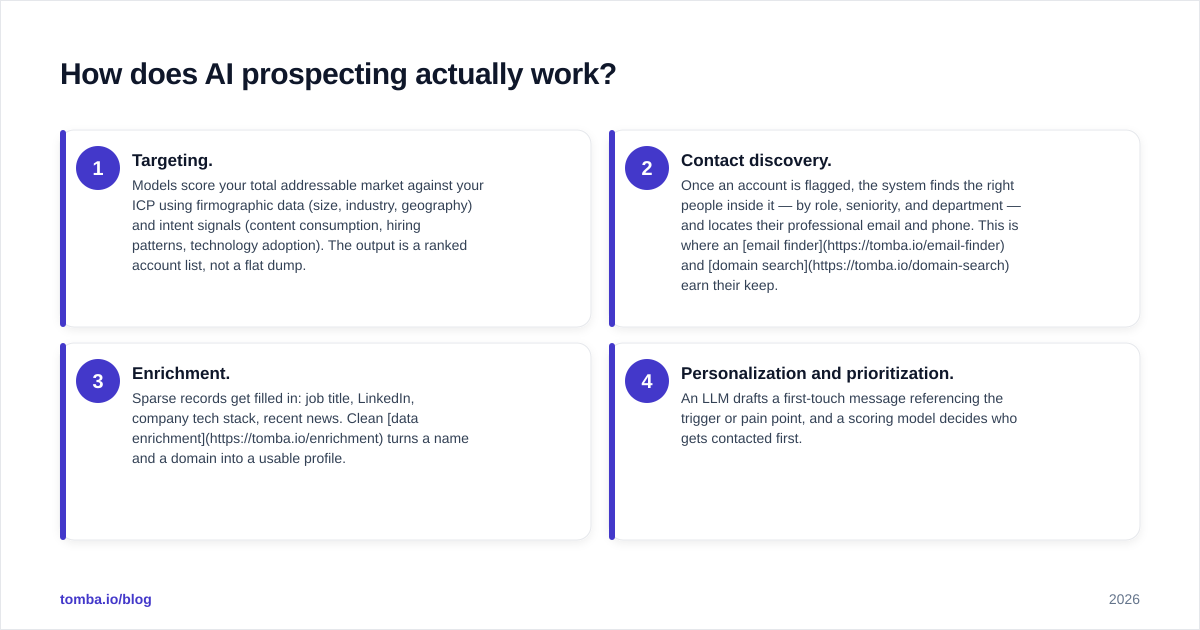
Under the hood, most AI prospecting stacks run four jobs in sequence:
- Targeting. Models score your total addressable market against your ICP using firmographic data (size, industry, geography) and intent signals (content consumption, hiring patterns, technology adoption). The output is a ranked account list, not a flat dump.
- Contact discovery. Once an account is flagged, the system finds the right people inside it — by role, seniority, and department — and locates their professional email and phone. This is where an email finder and domain search earn their keep.
- Enrichment. Sparse records get filled in: job title, LinkedIn, company tech stack, recent news. Clean data enrichment turns a name and a domain into a usable profile.
- Personalization and prioritization. An LLM drafts a first-touch message referencing the trigger or pain point, and a scoring model decides who gets contacted first.
The critical dependency runs left to right. If targeting is sloppy, you enrich the wrong people. If contact data is wrong, your beautifully personalized email bounces and your domain reputation takes the hit. That's why data quality — not AI cleverness — is the foundation.
Is AI prospecting better than manual prospecting?#
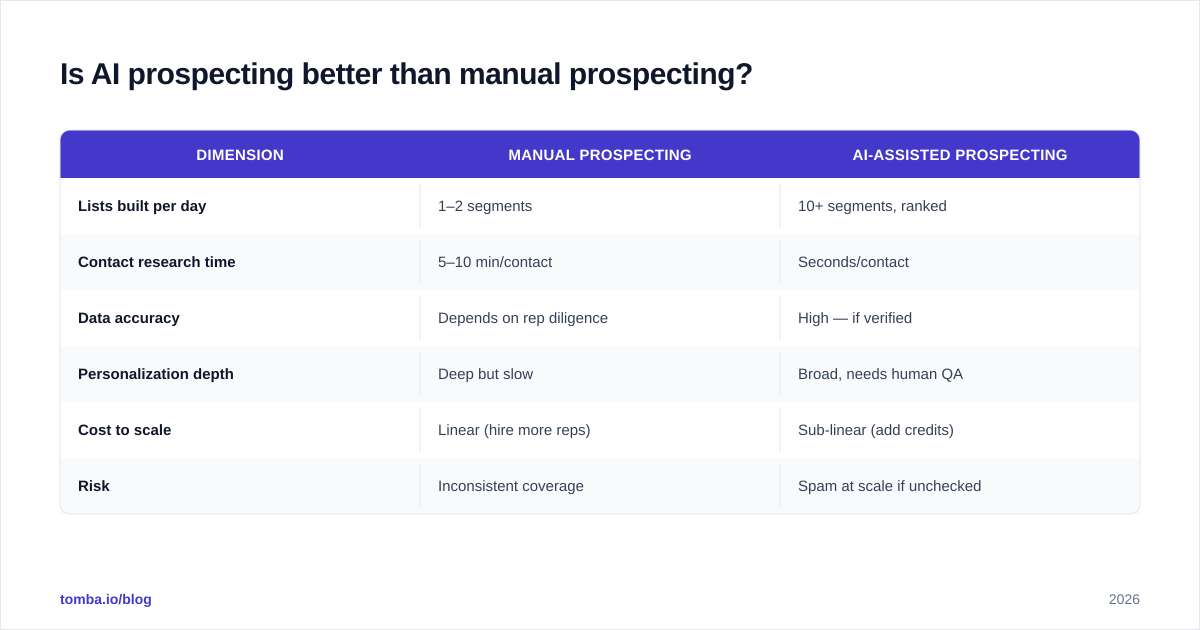
Yes, for volume and consistency — but not as a full replacement. The honest answer is that AI wins on speed and scale, while humans still win on judgment and relationships.
Manual prospecting forces a rep to spend hours per day researching accounts, hunting for emails, and copy-pasting into a CRM. AI compresses that to minutes and never gets bored or skips a step. But AI also confidently produces wrong answers — a plausible-looking email that's actually a guess, a "trigger event" that's irrelevant noise, a personalization line that's subtly off. Unsupervised, it scales mistakes as fast as it scales output.
The teams getting real lift treat AI as a force multiplier on a human strategy, not a substitute for one. The rep defines the ICP and the offer; AI executes the legwork; the rep reviews before anything ships at volume.
| Dimension | Manual prospecting | AI-assisted prospecting |
|---|---|---|
| Lists built per day | 1–2 segments | 10+ segments, ranked |
| Contact research time | 5–10 min/contact | Seconds/contact |
| Data accuracy | Depends on rep diligence | High — if verified |
| Personalization depth | Deep but slow | Broad, needs human QA |
| Cost to scale | Linear (hire more reps) | Sub-linear (add credits) |
| Risk | Inconsistent coverage | Spam at scale if unchecked |
What does a 2026 AI prospecting workflow look like?#
The best-performing workflow is boringly repeatable. Tools change; the stages don't. Here's the pipeline most efficient teams run:
Stage 1 — Define the trigger. Pick a buying signal worth acting on: a new VP of Sales, a competitor's tool in their stack, recent funding, a job posting that implies a pain point. Triggers beat static lists because timing is most of cold outreach.
Stage 2 — Pull the account list. Use intent and firmographic filters to rank accounts. Don't chase everyone — chase the ranked top of the list.
Stage 3 — Find and verify contacts. For each account, find the decision-maker's email, then verify it. This is the make-or-break step. A verified list keeps your bounce rate low and your sender reputation intact. Run new contacts through an email verifier before they ever enter a sequence.
Stage 4 — Enrich. Add the context the message needs: role, recent activity, company news.
Stage 5 — Personalize at the first line. Let the LLM draft, but anchor every message to a real, specific detail. Generic "I saw your company is growing" lines are worse than no personalization.
Stage 6 — Sequence and monitor. Send through a warmed-up domain, watch reply and bounce rates, and feed results back into your targeting model.

Which AI prospecting tools should you actually compare?#
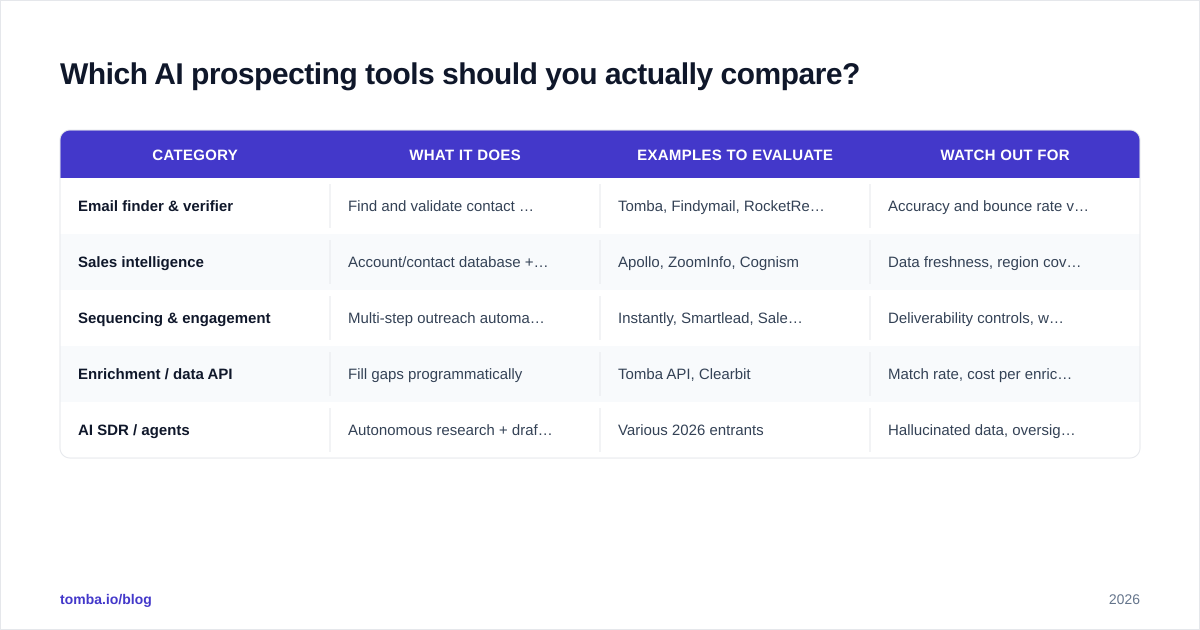
There's no single "best" tool — there are best tools per stage. A common mistake is buying one all-in-one platform and assuming it's elite at everything. In practice, all-in-ones are convenient but average; specialists win on the stage they're built for. Most strong stacks mix a data/finder layer, an enrichment layer, and a sequencing layer.
| Category | What it does | Examples to evaluate | Watch out for |
|---|---|---|---|
| Email finder & verifier | Find and validate contact emails | Tomba, Findymail, RocketReach | Accuracy and bounce rate vary widely |
| Sales intelligence | Account/contact database + intent | Apollo,ZoomInfo, Cognism | Data freshness, region coverage |
| Sequencing & engagement | Multi-step outreach automation | Instantly, Smartlead, Salesloft | Deliverability controls, warmup |
| Enrichment / data API | Fill gaps programmatically | Tomba API, Clearbit | Match rate, cost per enrichment |
| AI SDR / agents | Autonomous research + drafting | Various 2026 entrants | Hallucinated data, oversight needs |
When you evaluate any of these, ignore the marketing and check three numbers: match rate, verified-email accuracy, and bounce rate in your own test of 100 real contacts. Independent review sites like G2 and Capterra are useful for filtering, but your own bounce test is the only benchmark that matters for deliverability.
If you're replacing a heavyweight platform, it's worth scoping cost too — compare a tool like an Apollo alternative or a RocketReach alternative on a per-verified-contact basis, not on sticker price. Transparent Tomba pricing starts with a free tier of 25 searches per month and a Starter plan at $49/mo, which makes a head-to-head test cheap to run.
How do you keep AI prospecting data accurate?#
Accuracy is a process, not a purchase. Even the best provider's data decays — people change jobs constantly, and B2B records go stale at roughly 2–3% per month. Three habits keep your data trustworthy:
Verify before you send, every time. Never trust a found email without verification. A real-time check against the mail server catches typos, dead mailboxes, and risky catch-all domains before they bounce.
Re-verify on a schedule. Lists you built three months ago are not the lists you have today. Re-run aging segments through bulk verification before reusing them.
Watch your deliverability signals. A rising bounce rate or dropping reply rate is your data warning you. Tie those metrics back to the source so you can cut underperforming data providers fast. For the mechanics behind this, the email deliverability fundamentals — SPF, DKIM, sender reputation — still govern whether your AI-personalized message even reaches an inbox. Vendor documentation from providers like HubSpot covers the inbox-placement side well.
The pattern to internalize: AI multiplies whatever you feed it. Feed it verified, enriched, well-targeted data and it multiplies meetings. Feed it scraped junk and it multiplies spam complaints.
What mistakes kill AI prospecting campaigns?#
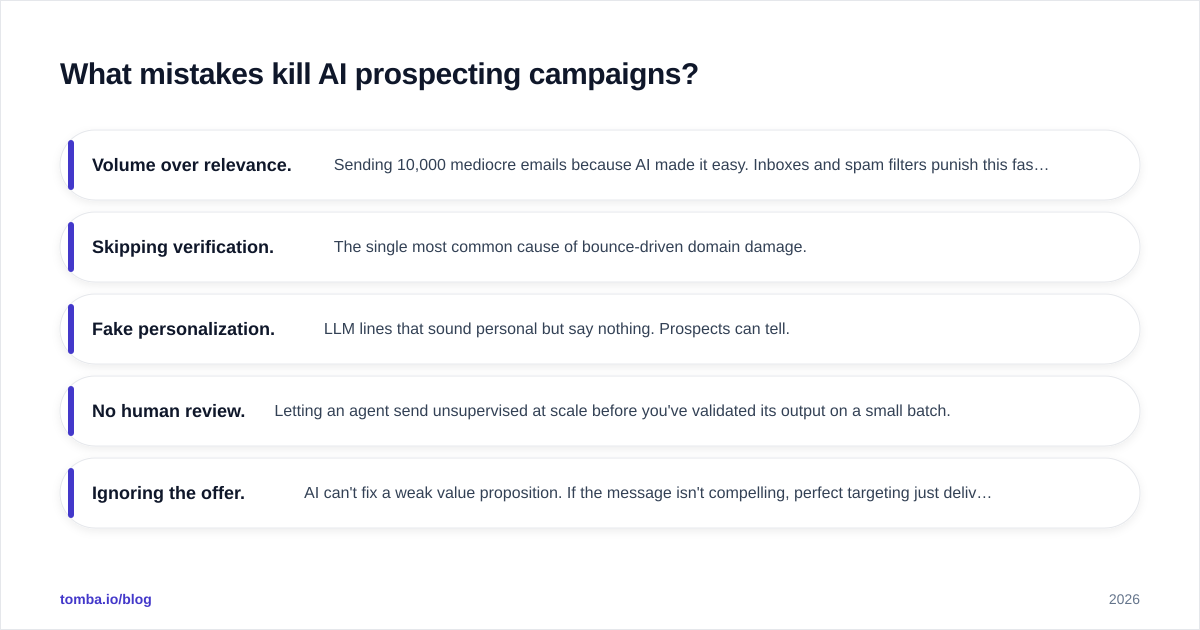
The failures are predictable, which means they're avoidable:
- Volume over relevance. Sending 10,000 mediocre emails because AI made it easy. Inboxes and spam filters punish this fast.
- Skipping verification. The single most common cause of bounce-driven domain damage.
- Fake personalization. LLM lines that sound personal but say nothing. Prospects can tell.
- No human review. Letting an agent send unsupervised at scale before you've validated its output on a small batch.
- Ignoring the offer. AI can't fix a weak value proposition. If the message isn't compelling, perfect targeting just delivers your rejection faster.
Treat your first AI-driven campaign like a science experiment: small batch, measure bounce and reply rates, fix the weak stage, then scale. The teams that win iterate on the workflow, not just the tooling.
Putting it together#
AI sales prospecting in 2026 is less about a magic tool and more about a disciplined pipeline: sharp targeting, verified contact data, genuine personalization, and a human checking the work before it scales. Nail the data layer first — everything downstream depends on it.
That's exactly where a precise, verification-first data source pays off. The Tomba Email Finder finds professional emails by name, domain, or company and pairs with built-in verification, so the contacts entering your AI sequences are real before they ever cost you a bounce. Start on the free tier, test it against your current list, and keep only the data that actually lands in inboxes. Build the pipeline right, and AI does the rest.
// get started
Find, verify and enrich your first contacts today
Start on the free plan with 25 searches a month, then scale when your team is ready.
Free plan · No credit card required · GDPR & CCPA
// about the author