AI Sales Software in 2026: Tools, Workflows & ROI Guide
AI sales software now writes outreach, scores leads, and forecasts deals. Here's how the 2026 stack actually works, what it costs, and where it pays off.
TL;DR
- AI sales software is any tool that uses machine learning or LLMs to automate or augment a selling task: prospecting, writing, scoring, forecasting, or coaching.
- The 2026 stack splits into five layers — data/enrichment, prospecting, engagement, conversation intelligence, and forecasting/RevOps. Most teams over-buy on engagement and under-invest in clean data.
- The biggest ROI is rarely "AI writes my emails." It's AI removing manual research, deduping bad records, and surfacing the 5% of accounts worth a human's time.
- Budget realistically: a working AI sales stack runs $80–$250 per seat per month once you add a data provider, a sequencer, and a conversation tool.
- Garbage in, garbage out still rules. AI that acts on stale contact data just sends wrong messages faster — start with accurate data before you automate anything.
What is AI sales software?#
AI sales software is any application that uses machine learning, natural language processing, or large language models to do — or assist with — a task a salesperson would otherwise do by hand. That covers a wide range: finding a prospect's email, drafting a cold opener, transcribing a discovery call, predicting which deal will close, or telling a rep which account to phone next.
Think of it like power tools on a construction site. A hammer still works, but a crew with nail guns and laser levels frames a house in a fraction of the time. AI sales software is the nail gun — it doesn't replace the carpenter's judgment about where the wall goes, it just removes the slow, repetitive swinging.
The category exploded after 2023 because LLMs made two things cheap that used to be expensive: generating natural-sounding text at scale, and reading unstructured data (call transcripts, emails, web pages) to extract structure. By 2026, "AI" is a feature checkbox on nearly every sales tool, which makes the label almost useless on its own. What matters is which task the AI does and whether it does it well enough to trust.
What are the main categories of AI sales software?#
Most buyers get confused because vendors describe themselves with overlapping buzzwords. It helps to map tools to the layer of the funnel they touch. There are five practical layers.
1. Data and enrichment. The foundation. These tools find and verify contact information — emails, phone numbers, job titles, company firmographics — and keep your CRM records fresh. AI here is used for pattern detection (guessing and validating email formats), entity resolution (matching duplicate records), and confidence scoring. If this layer is weak, everything above it is automating mistakes. Tools like Tomba's email finder and data enrichment live here.
2. Prospecting and lead generation. Software that builds target lists, identifies buying signals (job changes, funding rounds, tech-stack changes), and surfaces accounts that look like your best customers. AI scores fit and intent so reps spend time on the right names.
3. Engagement and sequencing. The outbound layer: multi-step email and LinkedIn cadences, AI-written first drafts, send-time optimization, and reply detection. This is the most crowded category and where most teams overspend.
4. Conversation intelligence. Records and transcribes calls, then analyzes them — talk-ratio, competitor mentions, next-step commitments, sentiment. It turns a manager's "listen to 3 calls a week" into "search every call for objections about pricing."
5. Forecasting and RevOps. Pulls signals from across the stack to predict pipeline, flag at-risk deals, and recommend next actions. This is the revenue operations brain that ties everything together.
Which AI sales software should you actually buy?#
The honest answer: it depends on where your pipeline leaks. Below is a category-level comparison to help you decide where a dollar goes furthest, with representative tools and pricing patterns observed across vendor sites and review platforms like G2 in 2026.
| Layer | What it fixes | Representative tools | Typical price/seat/mo | Buy first if… |
|---|---|---|---|---|
| Data & enrichment | Bad/missing contact data | Tomba, Clearbit,ZoomInfo | $0–$99 (Tomba), $$$ (ZoomInfo) | Bounce rates are high, CRM is stale |
| Prospecting & signals | Wrong accounts targeted | Apollo, 6sense, Demandbase | $49–$150 | Reps waste time on bad-fit leads |
| Engagement & sequencing | Low outbound volume | Instantly, Salesloft, Outreach | $30–$130 | Follow-up is inconsistent |
| Conversation intelligence | No call visibility | Gong, Chorus, Fireflies | $80–$160 | Coaching is guesswork |
| Forecasting & RevOps | Unreliable pipeline calls | Clari, Gong Forecast, HubSpot | $$$ (often custom) | Forecasts miss by >15% |
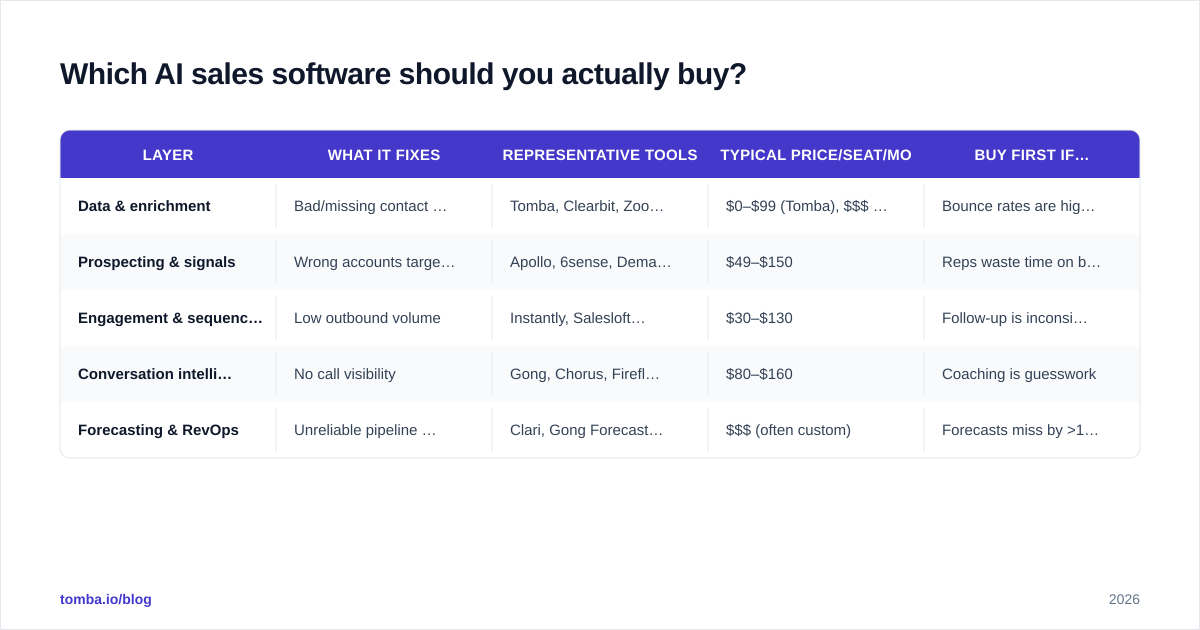
Notice the pattern: the cheapest layer to fix (data) is the one with the highest downstream leverage, because every other tool consumes that data. A $130 sequencer firing emails at addresses with a 30% bounce rate is a worse investment than a $49 data tool that gets you to a 2% bounce rate first.
How much does AI sales software cost in 2026?#
Budget for a stack, not a single tool. A realistic small-team setup looks like this:
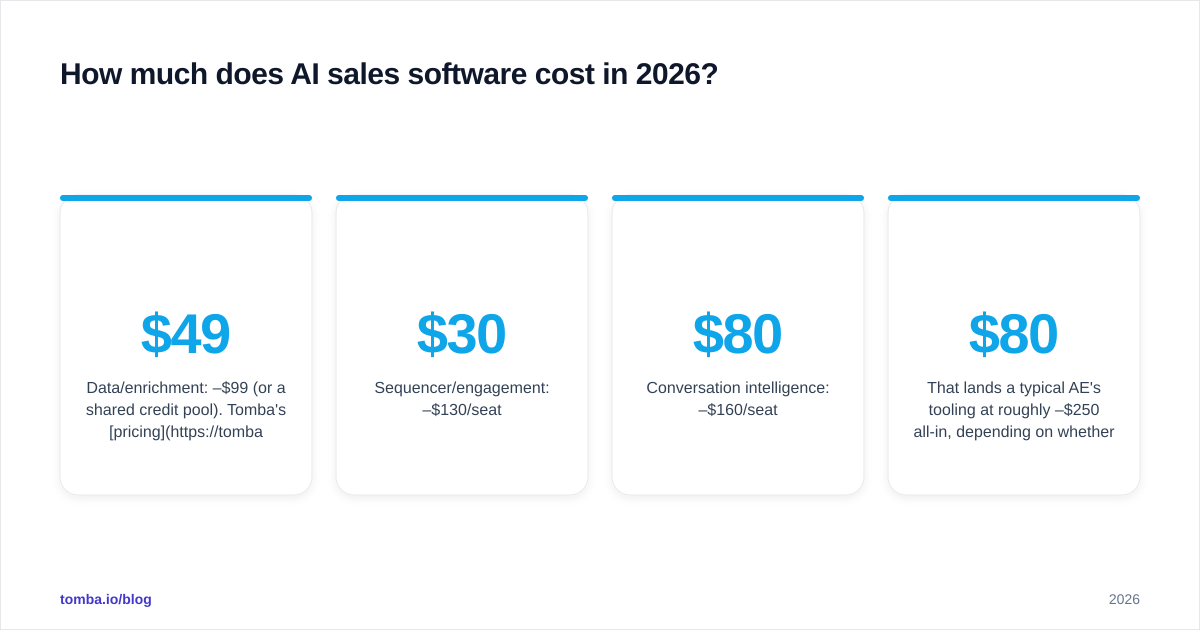
- Data/enrichment: $49–$99/mo per seat (or a shared credit pool). Tomba's pricing, for example, runs a free tier at 25 searches/mo, Starter at $49/mo, Growth at $99/mo, and Pro at $249/mo, with Enterprise custom.
- Sequencer/engagement: $30–$130/seat/mo.
- Conversation intelligence: $80–$160/seat/mo.
- Forecasting/RevOps: often custom, frequently bundled into your CRM (HubSpot, Salesforce) or a dedicated platform.
That lands a typical AE's tooling at roughly $80–$250 per month all-in, depending on whether you add conversation intelligence. The mistake teams make is buying the flashy $150 engagement platform first and skimping on the $49 data layer — then wondering why deliverability tanks.
A useful rule: spend on AI sales software in proportion to how much human time it returns. A tool that saves each rep 5 hours a week of manual research pays for itself almost regardless of sticker price. A tool that saves 20 minutes does not, no matter how clever the demo looks.
Does AI sales software actually improve results?#
Yes — but only for specific tasks, and only when the inputs are clean. Here's where the evidence (and operator experience) is strongest versus weakest.
Where AI reliably wins:
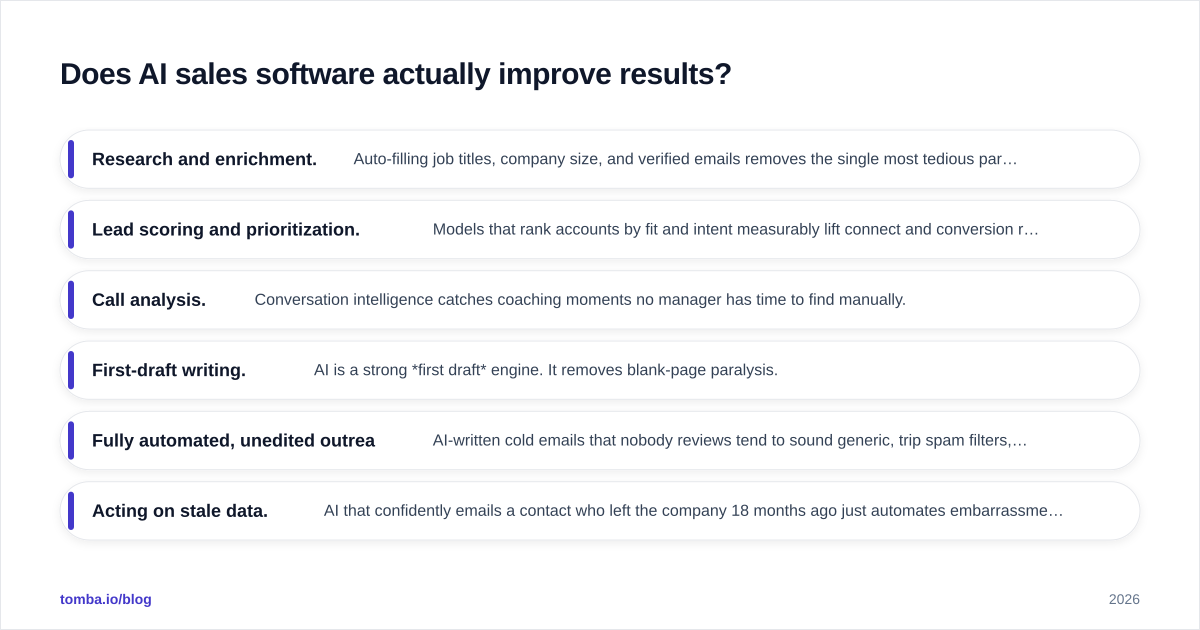
- Research and enrichment. Auto-filling job titles, company size, and verified emails removes the single most tedious part of prospecting. This is near-universally positive.
- Lead scoring and prioritization. Models that rank accounts by fit and intent measurably lift connect and conversion rates, because reps stop spraying.
- Call analysis. Conversation intelligence catches coaching moments no manager has time to find manually.
- First-draft writing. AI is a strong first draft engine. It removes blank-page paralysis.
Where AI underdelivers:
- Fully automated, unedited outreach. AI-written cold emails that nobody reviews tend to sound generic, trip spam filters, and damage sender reputation. The reply rate gain from personalization evaporates when every prospect gets the same "I noticed you're the {{title}} at {{company}}" template.
- Acting on stale data. AI that confidently emails a contact who left the company 18 months ago just automates embarrassment.
The throughline: AI sales software amplifies whatever you feed it. Feed it accurate, verified data and a human's editorial judgment, and it's a force multiplier. Feed it a dirty list and a "set it and forget it" mindset, and it scales your mistakes.
How do you build an AI sales stack that works?#
Build from the bottom of the funnel up, and validate each layer before adding the next.
Step 1 — Fix your data first. Before any automation, get your contact data verified. Run your list through an email verifier to strip dead addresses, and use domain search to fill gaps. This single step protects deliverability for everything downstream. A 2% bounce rate is the goal; above 5% and mailbox providers start throttling you.
Step 2 — Prioritize, don't just collect. Add a scoring layer so reps work the best-fit accounts first. The point of AI prospecting isn't more leads — it's fewer, better leads.
Step 3 — Automate engagement with a human in the loop. Use AI to draft and sequence, but require a rep to edit the first touch on any account that matters. Reserve full automation for the long tail where a generic-but-relevant message is acceptable.
Step 4 — Add visibility. Layer in conversation intelligence once you have consistent volume. You can't coach what you can't see.
Step 5 — Close the loop with forecasting. Once data flows cleanly through the stack, forecasting models have something trustworthy to predict on.
For teams that prefer to wire this together programmatically, the Tomba API lets you push verified data straight into a CRM or enrichment workflow, so the foundation layer feeds everything above it automatically. If you're currently evaluating broader platforms, it's worth comparing point solutions against all-in-one suites — see how a focused data tool stacks up as an Apollo alternative before committing to a single vendor for every layer.
What should you watch out for?#
A few traps catch buyers every year:
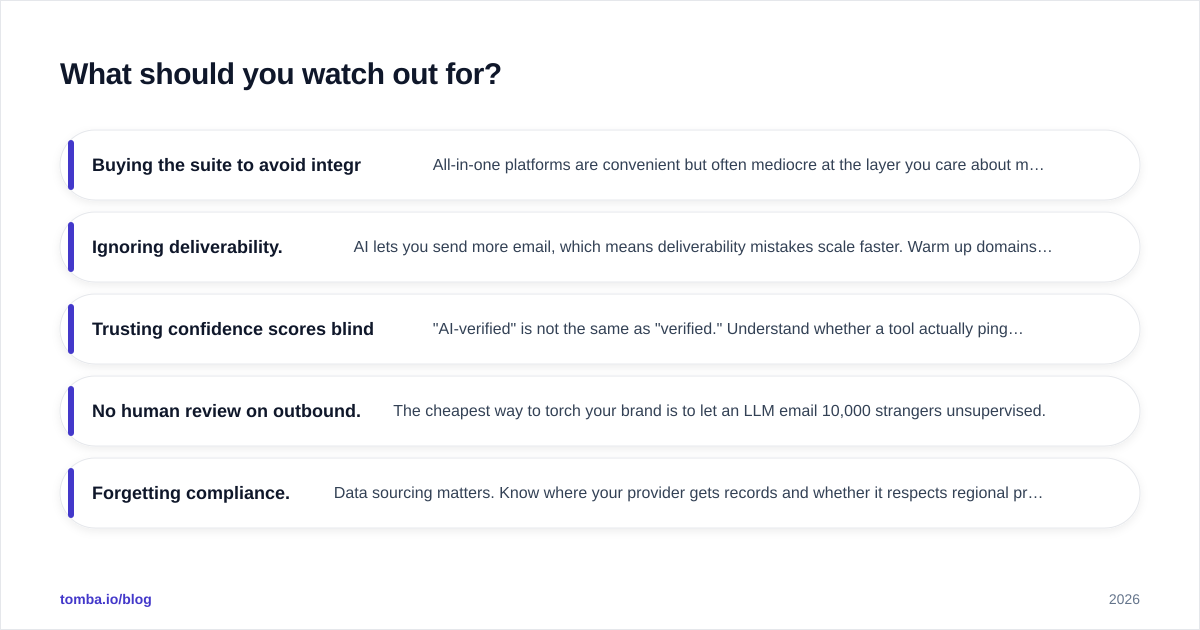
- Buying the suite to avoid integration work. All-in-one platforms are convenient but often mediocre at the layer you care about most. Best-of-breed plus good integrations usually wins. Check vendor integration directories — Salesforce's AppExchange and similar marketplaces tell you whether tools actually talk to each other.
- Ignoring deliverability. AI lets you send more email, which means deliverability mistakes scale faster. Warm up domains, authenticate properly, and keep volume sane.
- Trusting confidence scores blindly. "AI-verified" is not the same as "verified." Understand whether a tool actually pinged the mail server or just guessed from a pattern. For catch-all domains especially, you need a real catch-all verifier, not a probability score.
- No human review on outbound. The cheapest way to torch your brand is to let an LLM email 10,000 strangers unsupervised.
- Forgetting compliance. Data sourcing matters. Know where your provider gets records and whether it respects regional privacy law. Analyst firms like Gartner publish buyer guidance on this if you need a neutral reference.
Is AI going to replace salespeople?#
No — and that framing misses the point. AI sales software replaces tasks, not roles. The tasks it eats are the ones reps already hate: manual data entry, list building, copying notes into the CRM, formatting follow-ups. What's left is what humans are actually good at: building trust, navigating a complex buying committee, reading a room, and knowing when to push or wait.
The realistic 2026 picture is a smaller, more leveraged sales team where each rep is supported by a layer of AI that handles the grunt work. The teams that win aren't the ones who automate the most — they're the ones who automate the right things and keep humans on the high-judgment moments. A rep with great data and a good AI copilot will outproduce three reps drowning in spreadsheets, every time.
The bottom line#
AI sales software is no longer optional, but the winners aren't the teams with the longest tool list. They're the teams that fix their data foundation first, automate selectively, and keep a human on every message that matters. Start at the bottom of the stack, prove ROI at each layer, and resist the urge to buy the shiniest engagement platform before your contact data is clean.
That foundation is exactly where to begin. Tomba's Email Finder gives you verified, accurate contact data — the input every other AI sales tool depends on — with a free tier to test it and plans that scale as your stack grows. Get the data right first, and the rest of your AI sales software actually starts to pay off.
// get started
Find, verify and enrich your first contacts today
Start on the free plan with 25 searches a month, then scale when your team is ready.
Free plan · No credit card required · GDPR & CCPA
// about the author