AI Sales Systems in 2026: How to Build a Stack That Closes
AI sales systems now run prospecting, enrichment, and outreach on autopilot. Here's how to architect a stack in 2026 that books more meetings without bloating headcount or cost.
TL;DR
- An AI sales system is not one tool — it's a layered stack where data, signals, AI reasoning, and execution connect into a single revenue workflow.
- The four layers that matter in 2026: a clean data foundation, intent/signal capture, an AI orchestration brain, and execution channels (email, phone, LinkedIn).
- Garbage data breaks everything downstream. AI can't fix a wrong email address — accurate contact data is the non-negotiable base layer.
- Most teams overspend on flashy "AI SDR" agents and underspend on the data and verification that make those agents work.
- Start small: automate one high-friction step (enrichment or first-touch personalization), measure reply lift, then expand.
Sales teams have spent two years bolting "AI" onto every part of the funnel. Some of it works. A lot of it is a chatbot wearing a trench coat. The difference between a real AI sales system and a pile of disconnected tools comes down to architecture — how the pieces feed each other.
This post breaks down what an AI sales system actually is in 2026, the layers you need, how the main platforms compare, and a practical build order so you don't waste budget on the wrong layer first.
What is an AI sales system?#
An AI sales system is a connected set of tools that uses machine learning to find, qualify, personalize, and reach buyers with minimal manual input — and improves as it ingests more outcome data.
Think of it like a modern car assembly line versus a single robot arm. One robot arm welding doors is automation. An assembly line where each station hands off to the next, sensors catch defects, and the whole thing reroutes when a part is missing — that's a system. Most teams buy robot arms and wonder why the car never gets built.
Technically, an AI sales system combines four things: a data layer (who exists and how to reach them), a signal layer (who's worth reaching now), a reasoning layer (what to say and to whom), and an execution layer (actually sending and tracking it). When those four talk to each other, you get compounding leverage. When they don't, you get four subscriptions and a spreadsheet.
The mistake almost every team makes is starting at the reasoning layer — buying a shiny "AI SDR" — while the data layer underneath is full of bounced emails and stale titles. AI reasoning on bad data produces confident, well-written messages sent to the wrong person. Speed at being wrong is not an upgrade.
What are the four layers of an AI sales system?#
Here's the stack from the ground up. Each layer depends on the one below it.
1. Data foundation. Contact and company records: names, verified emails, phone numbers, firmographics, tech stack. This is the bedrock. If the email bounces, nothing above it matters. A reliable email finder and email verifier live here, alongside data enrichment that fills gaps in your CRM records.
2. Signal layer. Intent and trigger data: job changes, funding rounds, hiring spikes, website visits, tech adoption. This tells the system who to act on and when. A perfect message at the wrong moment still loses.
3. Reasoning layer. The AI brain — LLMs that segment accounts, draft personalized copy, score leads, and decide next steps. This is where "AI SDR" agents and copilots operate. It's powerful, but only as good as layers 1 and 2.
4. Execution layer. The channels and sequencing: cold email platforms, dialers, LinkedIn automation, and the CRM that records what happened. Outcomes from this layer should feed back into the reasoning layer so the system learns.
The feedback loop in the diagram above is what separates a 2026 system from a 2023 one. Replies, bounces, and booked meetings flow back into scoring and copy generation, so the system gets sharper every week instead of decaying.
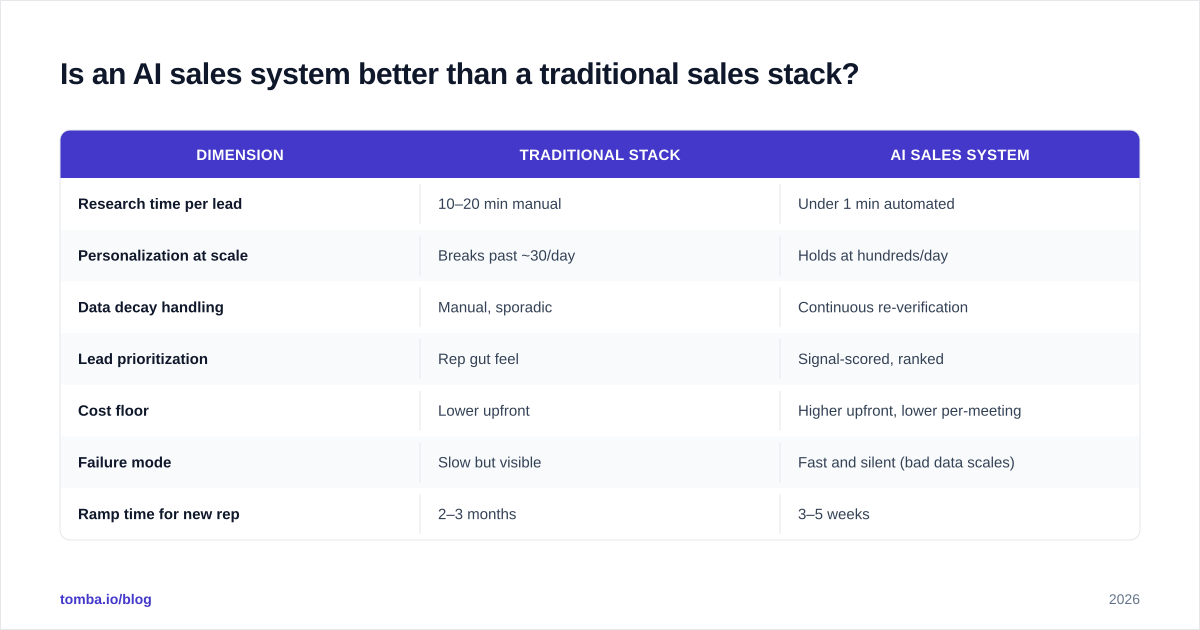
Is an AI sales system better than a traditional sales stack?#
Yes — but only when your data and process are solid first. Bolt AI onto a broken pipeline and you automate the brokenness.
A traditional stack is a CRM plus a sequencer plus a rep doing manual research. An AI sales system compresses the research, writing, and prioritization that used to eat 60% of an SDR's day. The reps who keep their jobs in 2026 aren't the ones who send the most emails — they're the ones who manage the system and handle the human conversations the AI books.
According to Gartner research on sales technology, the gap between high and low performers increasingly comes down to data quality and tool integration, not the number of tools owned. More software does not equal more pipeline.
Here's the honest tradeoff:
| Dimension | Traditional stack | AI sales system |
|---|---|---|
| Research time per lead | 10–20 min manual | Under 1 min automated |
| Personalization at scale | Breaks past ~30/day | Holds at hundreds/day |
| Data decay handling | Manual, sporadic | Continuous re-verification |
| Lead prioritization | Rep gut feel | Signal-scored, ranked |
| Cost floor | Lower upfront | Higher upfront, lower per-meeting |
| Failure mode | Slow but visible | Fast and silent (bad data scales) |
| Ramp time for new rep | 2–3 months | 3–5 weeks |
The "fast and silent" failure mode is the one to respect. A human notices when 40% of their emails bounce. An automated system will happily send 10,000 emails to dead addresses and report high "activity." That's why verification isn't optional housekeeping — it's load-bearing.
Which AI sales tools fit each layer?#
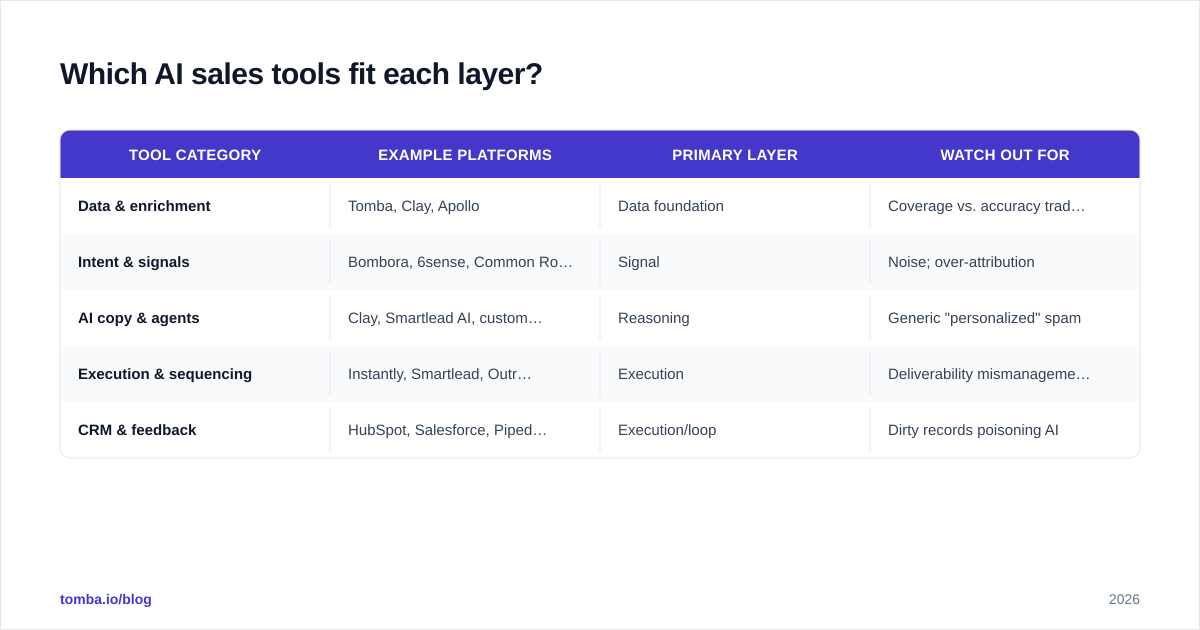
No single vendor owns the whole stack well, despite what every homepage claims. Most teams assemble best-of-layer tools and connect them. Here's a realistic map of common platforms by their strongest layer:
| Tool category | Example platforms | Primary layer | Watch out for |
|---|---|---|---|
| Data & enrichment | Tomba, Clay, Apollo | Data foundation | Coverage vs. accuracy tradeoffs |
| Intent & signals | Bombora, 6sense, Common Room | Signal | Noise; over-attribution |
| AI copy & agents | Clay, Smartlead AI, custom GPT | Reasoning | Generic "personalized" spam |
| Execution & sequencing | Instantly, Smartlead, Outreach | Execution | Deliverability mismanagement |
| CRM & feedback | HubSpot, Salesforce, Pipedrive | Execution/loop | Dirty records poisoning AI |
A few things this table makes obvious. First, platforms like Apollo and Clay show up in multiple layers because they're trying to be the whole stack — convenient, but you trade depth for breadth. Second, your CRM is part of the AI system now, not a passive database. If your HubSpot integration is fed clean, enriched records, the AI layer above it reasons well. If it's fed duplicates and stale titles, every downstream decision inherits that rot.
You can validate any vendor's real-world performance on a peer-review site like G2 before committing — homepage claims and verified review patterns often disagree.
How do you build an AI sales system without wasting budget?#
Build bottom-up, one layer at a time, and prove ROI at each step before adding the next. The teams that fail buy the reasoning layer first because it demos well.
Step 1 — Fix the data foundation. Before anything else, audit your contact data. Run your existing list through verification and measure the bounce rate. If it's above 5%, stop and fix this. Use an email finder API to enrich and re-verify records programmatically rather than by hand. This single step often lifts reply rates more than any AI copy tool, because deliverability improves and you stop burning your sending domain on dead addresses.
Step 2 — Add one signal source. Pick the highest-intent trigger for your business — job changes for recruiters, funding rounds for infra vendors, hiring spikes for sales tools. One good signal beats five noisy ones. Route those signals into a prioritized queue.
Step 3 — Insert AI at the highest-friction step. Usually that's first-touch personalization. Let the reasoning layer draft openers grounded in real, enriched data — the prospect's role, company, and a verified trigger. Keep a human in the loop for review until reply rates justify loosening it.
Step 4 — Connect execution and close the loop. Wire your sequencer and CRM so outcomes (replies, bounces, meetings) flow back into scoring. Without this loop you have automation, not a system — it never learns.
Step 5 — Expand only after measuring. Add the next layer only when the current one shows a clear lift in reply rate or meetings booked. Resist the urge to buy the "all-in-one AI platform" until you know which layer is actually your bottleneck.
A practical sequencing rule: spend your first dollar on data accuracy, your second on signal, and your third on AI copy — never the reverse. Most teams invert this and wonder why their beautifully written, AI-generated emails get a 1% reply rate. The copy was fine. The list was dead.
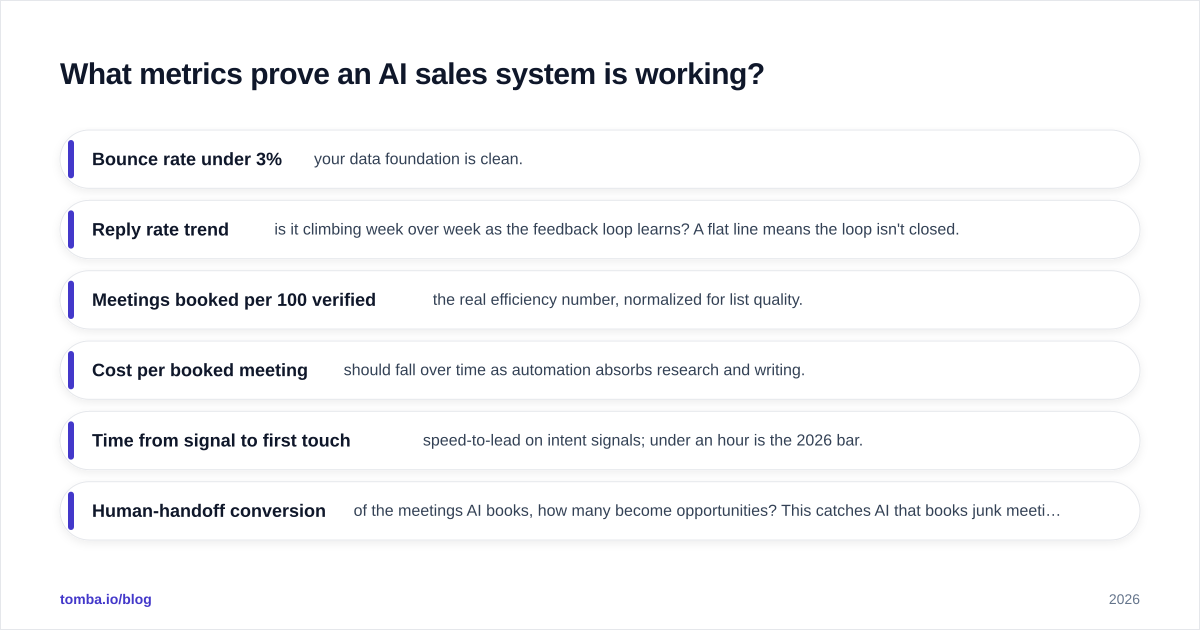
What metrics prove an AI sales system is working?#
Track outcome metrics, not activity metrics. "Emails sent" went up the day you bought automation — that proves nothing.
The metrics that actually indicate a healthy AI sales system:
- Bounce rate under 3% — your data foundation is clean.
- Reply rate trend — is it climbing week over week as the feedback loop learns? A flat line means the loop isn't closed.
- Meetings booked per 100 verified contacts — the real efficiency number, normalized for list quality.
- Cost per booked meeting — should fall over time as automation absorbs research and writing.
- Time from signal to first touch — speed-to-lead on intent signals; under an hour is the 2026 bar.
- Human-handoff conversion — of the meetings AI books, how many become opportunities? This catches AI that books junk meetings to look busy.
If reply rate is flat and cost per meeting isn't dropping after a quarter, your system is automating motion without intelligence. Usually the culprit is a broken feedback loop or a data layer you skipped fixing. Go back to step one.
One more honest caveat: an AI sales system amplifies whatever process you give it. Strong ICP definition and a real value proposition get amplified into pipeline. A vague ICP and a generic pitch get amplified into spam at scale — and a damaged sending reputation that takes months to repair. The technology is a multiplier, not a strategy. Fix the strategy first, then let the system scale it.
Where should you start today?#
Start at the bottom of the stack, because every layer above it inherits the data layer's quality. The fastest, lowest-risk win is verifying and enriching the contact data you already have — before you spend a cent on an AI agent.
Tomba's Email Finder is built for exactly this foundation layer: find and verify professional email addresses by name, company, or domain, then push clean records into the rest of your stack through the Tomba API or native integrations. The Free tier gives you 25 searches a month to test accuracy on your own list; paid plans start at $49/mo (Starter), with Growth at $99/mo and Pro at $249/mo as you scale. See full Tomba pricing for credit volumes.
Build the foundation first. Verify your data, add one signal, insert AI where the friction is highest, and close the loop so the system learns. Do that, and the AI layer everyone obsesses over finally has something true to reason about — which is the whole point.
Ready to find emails that actually work?
Join 150,000+ professionals who stopped guessing and started sending. Free credits on signup — no credit card required.
Get the Tomba newsletter
Practical outbound tactics and product updates — once every two weeks.
About the author