AI Sales Training in 2026: Tools, Frameworks & ROI
AI sales training replaces slow ride-alongs with on-demand roleplay, call scoring, and personalized coaching. Here's how it works, what it costs, and how to roll it out without wrecking team trust.
TL;DR
- AI sales training uses roleplay simulators, conversation analysis, and automated coaching to ramp reps in weeks instead of quarters — without booking a manager's calendar for every practice rep.
- The biggest wins are speed-to-quota for new hires and consistent coaching across a whole team, not flashy demos.
- Tools split into three buckets: roleplay/simulation (Second Nature, Hyperbound), call intelligence (Gong, Chorus), and content/enablement (Mindtickle, Highspot).
- Budget roughly $30–$200 per rep per month depending on the layer; expect a 3–6 month payback if onboarding time is your bottleneck.
- AI augments human coaching — it does not replace your best frontline manager. Treat it as reps-on-tap, not a verdict machine.
What is AI sales training?#
AI sales training is the practice of using machine-learning tools to coach reps through realistic practice, automated feedback, and personalized learning paths — instead of relying only on manager shadowing, static slide decks, and quarterly workshops.
Think of it like a flight simulator for sellers. A pilot does not learn emergency landings by crashing real planes; they rack up hundreds of hours in a simulator that throws curveballs at them safely. AI sales training does the same thing for a discovery call or a pricing objection: the rep practices against a realistic AI buyer as many times as they want, gets scored, and tries again — all before they touch a live prospect.
Technically, these platforms combine three capabilities: large language models that play a buyer persona, speech and sentiment analysis that scores talk ratio, filler words, and objection handling, and a recommendation engine that surfaces the next lesson based on where a rep is weak.
The shift matters because traditional sales training has a brutal retention problem. Sales reps forget the majority of what they learn within a week of a training event, according to widely cited research summarized by enablement vendors and analysts like Gartner. Spaced, on-demand practice fixes the forgetting curve far better than a one-off bootcamp.
Why are sales teams adopting AI training now?#
The short answer: ramp time is the most expensive number in your sales org, and AI attacks it directly.
When a new account executive takes six to nine months to hit full quota, every month shaved off that ramp is real pipeline. Managers have always known the fastest way to shorten ramp is more reps-at-bats and more coaching — but both are constrained by manager time. A frontline manager with eight reports physically cannot run twenty roleplays a week and review every call.
AI removes that constraint. A rep can run a cold-call simulation at 9pm, fail three times, and nail it on the fourth without burning a single manager hour. The manager then reviews the AI-scored summary and spends their limited time on the judgment calls a model still gets wrong.
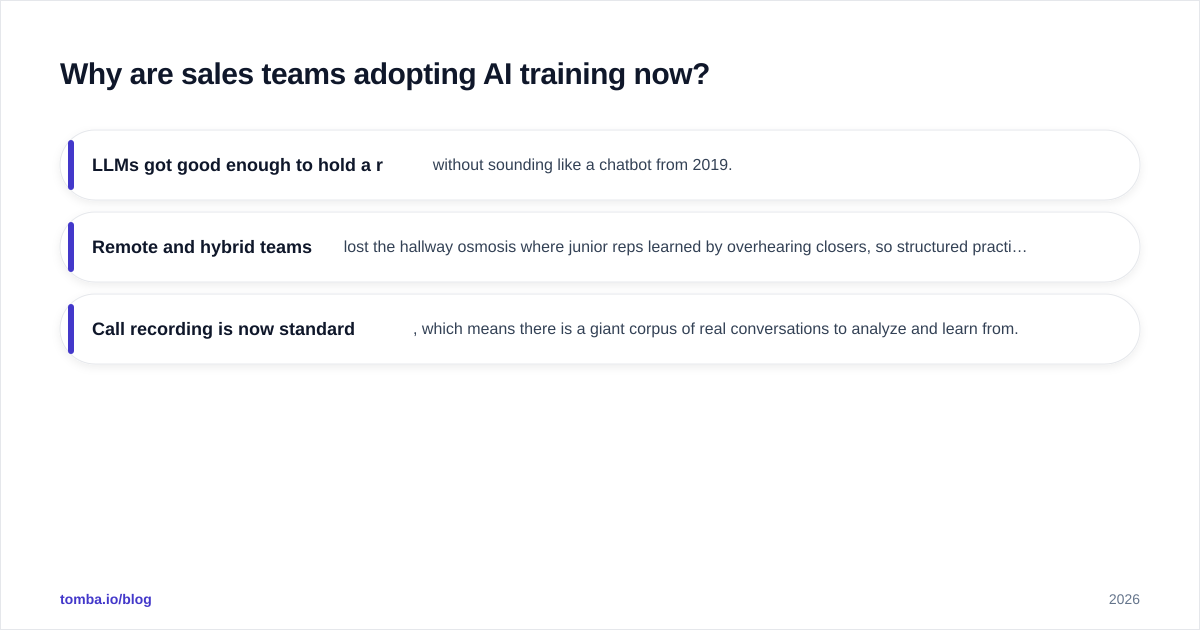
A few converging trends pushed this from "nice demo" to "line item":
- LLMs got good enough to hold a realistic objection-heavy conversation without sounding like a chatbot from 2019.
- Remote and hybrid teams lost the hallway osmosis where junior reps learned by overhearing closers, so structured practice had to fill the gap.
- Call recording is now standard, which means there is a giant corpus of real conversations to analyze and learn from.
How does AI sales training actually work?#
Most programs stack three layers. You do not need all three on day one, but understanding the split helps you avoid paying for overlap.
1. Roleplay and simulation. The rep talks to an AI buyer that holds a persona — a skeptical CFO, a friendly champion, a price-sensitive SMB owner. The tool scores the conversation on talk ratio, discovery questions asked, objections handled, and whether the rep advanced the deal. Hyperbound and Second Nature lead here.
2. Conversation intelligence. Tools like Gong and Chorus record and transcribe real customer calls, then flag coachable moments: monologues longer than two minutes, missed buying signals, competitor mentions, weak next-step language. This is training grounded in actual deals, not hypotheticals.
3. Enablement and content. Platforms like Mindtickle and Highspot manage the curriculum — certifications, learning paths, and just-in-time content surfaced inside the CRM. The AI personalizes which module a rep sees next based on their gaps.
The most effective programs create a loop: real calls (layer 2) reveal a weakness, the rep drills it in simulation (layer 1), and the enablement layer (layer 3) tracks mastery and unlocks the next skill.
Which AI sales training tools should you compare in 2026?#
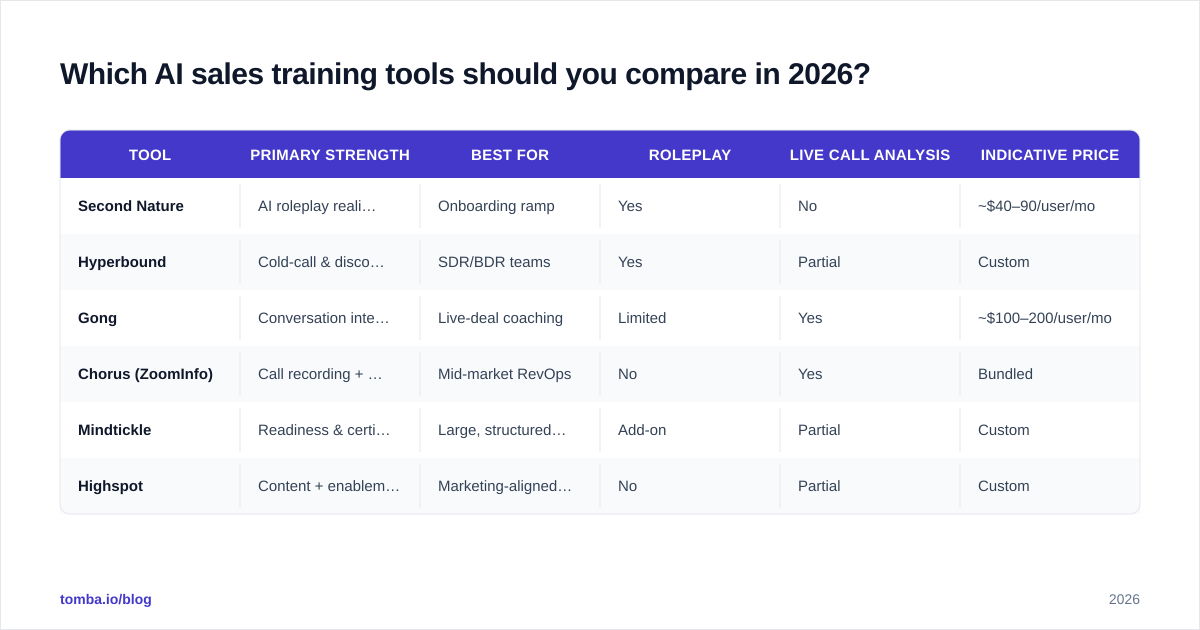
There is no single winner — the right pick depends on whether your pain is onboarding, live-deal coaching, or content sprawl. Here is how the main categories stack up.
| Tool | Primary strength | Best for | Roleplay | Live call analysis | Indicative price |
|---|---|---|---|---|---|
| Second Nature | AI roleplay realism | Onboarding ramp | Yes | No | ~$40–90/user/mo |
| Hyperbound | Cold-call & discovery sims | SDR/BDR teams | Yes | Partial | Custom |
| Gong | Conversation intelligence | Live-deal coaching | Limited | Yes | ~$100–200/user/mo |
| Chorus (ZoomInfo) | Call recording + insights | Mid-market RevOps | No | Yes | Bundled |
| Mindtickle | Readiness & certification | Large, structured orgs | Add-on | Partial | Custom |
| Highspot | Content + enablement | Marketing-aligned teams | No | Partial | Custom |
A few honest caveats on that table:
- Prices are indicative. Most of these vendors quote per-seat and negotiate hard at volume. Always get a live quote.
- "Roleplay" varies wildly in quality. A scripted branching tree is not the same as a free-form LLM buyer. Demo with your own objections.
- Bundling muddies comparison. Chorus comes with ZoomInfo; Gong is standalone. Factor in what you already pay for.
For an outside read on user sentiment before you commit, cross-check current reviews on G2 — vendor demos are polished, but the gripes in review threads tell you where the rough edges are.
Is AI sales training better than traditional coaching?#
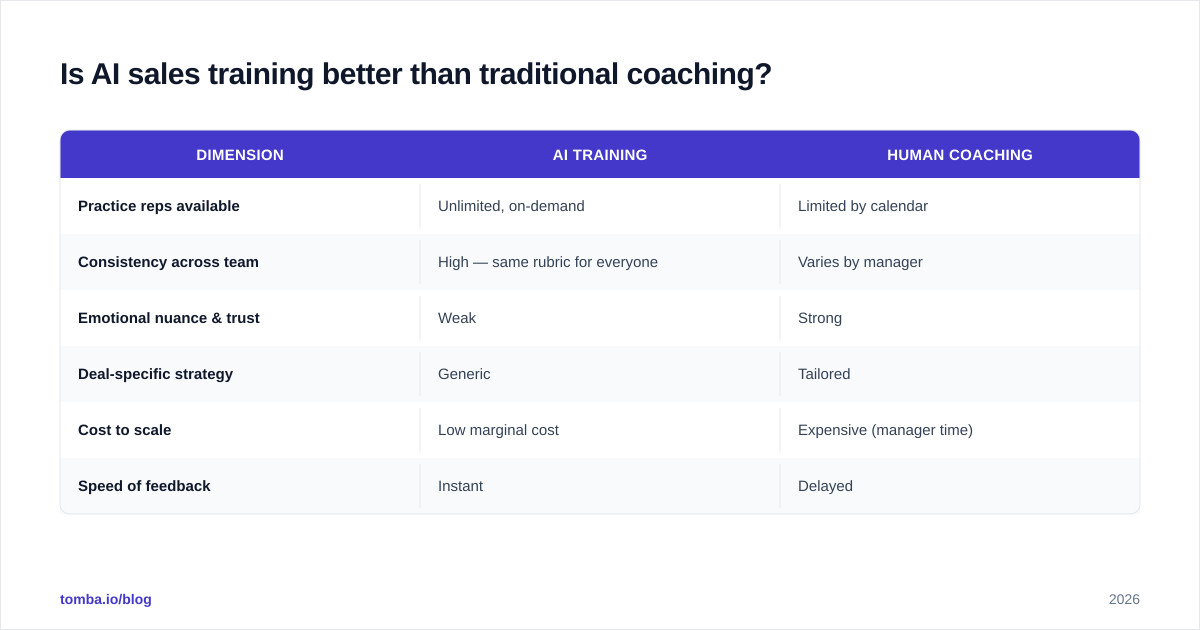
No — and any vendor who tells you it fully replaces human coaching is overselling. AI is better at volume and consistency; humans are better at judgment and trust.
Here is the split that holds up in practice:
| Dimension | AI training | Human coaching |
|---|---|---|
| Practice reps available | Unlimited, on-demand | Limited by calendar |
| Consistency across team | High — same rubric for everyone | Varies by manager |
| Emotional nuance & trust | Weak | Strong |
| Deal-specific strategy | Generic | Tailored |
| Cost to scale | Low marginal cost | Expensive (manager time) |
| Speed of feedback | Instant | Delayed |
The winning move is a hybrid. Use AI for the high-volume, low-judgment work: drilling the elevator pitch, practicing objection handling, certifying product knowledge. Reserve scarce manager time for the things a model still botches — reading a stalled deal, navigating an internal champion's politics, or deciding when to walk away.
One real risk: over-indexing on AI scores. A model that penalizes "talk ratio over 45%" will mark down a rep who correctly spent ten minutes walking a technical buyer through an integration. Scores are signals, not verdicts. Train your managers to overrule the AI when context demands it, or you will optimize reps into robotic, box-checking behavior.
How do you measure ROI on AI sales training?#
Tie it to one number you already track: time-to-first-deal, or ramp-to-quota. Everything else is secondary.
Build the business case like this:
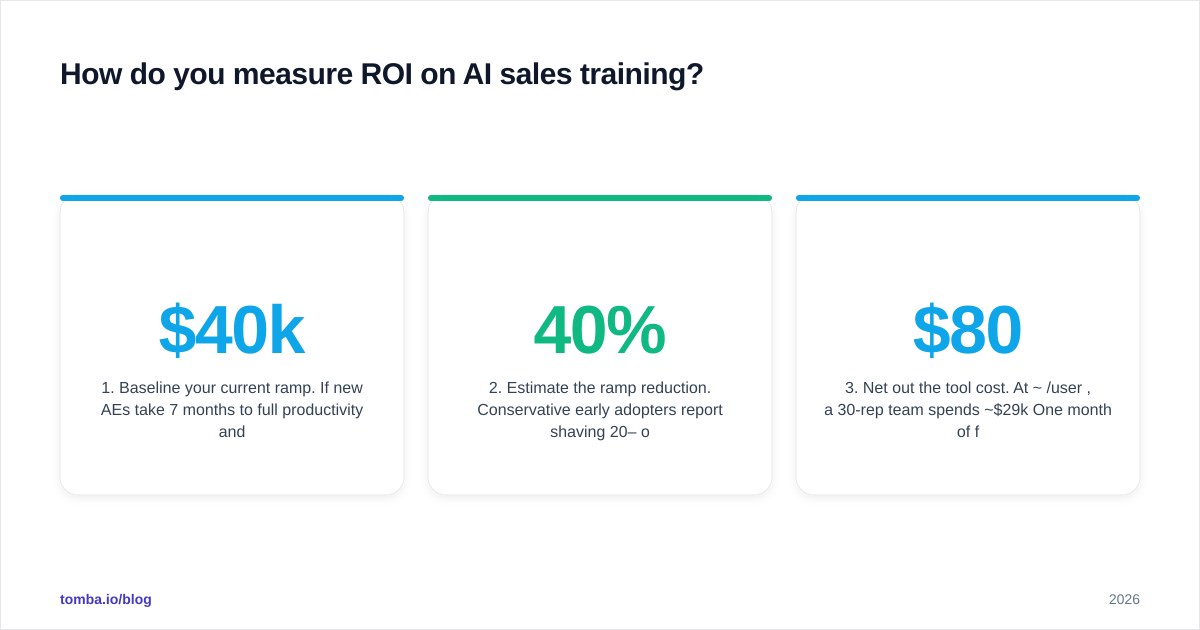
- Baseline your current ramp. If new AEs take 7 months to full productivity and full productivity is $40k/month in quota, every month cut is worth $40k in pulled-forward attainment per rep.
- Estimate the ramp reduction. Conservative early adopters report shaving 20–40% off onboarding when practice volume goes up. Model the low end.
- Net out the tool cost. At ~$80/user/month, a 30-rep team spends ~$29k/year. One month of faster ramp on a handful of new hires often covers it.
- Track leading indicators weekly. Roleplay completion rate, objection-handling score trend, and talk-ratio on real calls move long before quota does.
Secondary metrics worth watching: win rate on competitive deals (does objection drilling show up?), discovery-call-to-opportunity conversion, and rep confidence survey scores. For a structured view of how coaching connects to revenue outcomes, HubSpot's sales research and your own win rate and response rate data are the honest scoreboard.
The mistake to avoid: measuring activity instead of outcomes. "Reps completed 400 roleplays" is a vanity metric. "New-hire ramp dropped from 7 to 5 months" is ROI.
What does a 90-day rollout look like?#
Start narrow, prove the loop, then expand. A failed AI training rollout almost always comes from boiling the ocean on day one.
Days 1–30 — pilot. Pick one motion (say, SDR cold calls) and one cohort (your next new-hire class). Configure two or three buyer personas that match real ICPs. Set a simple baseline: current connect-to-meeting rate.
Days 31–60 — embed. Make a weekly roleplay quota part of the cadence. Managers review AI summaries in 1:1s instead of running every practice themselves. Start pulling real-call insights into the practice topics so drills match live failures.
Days 61–90 — expand and prove. Roll a second motion (discovery, demo, or negotiation). Compare the pilot cohort's ramp against your historical baseline and report it to leadership in one slide. If the number moved, you have your renewal case.
The reps who feed your AI training also need a steady stream of real prospects to practice on — and clean contact data is what turns practice into pipeline. If your team is burning ramp time chasing bad emails, fix the top of the funnel first: an accurate email finder and email verifier mean your freshly trained reps spend their new skills on contactable buyers, not bounced sends. Pair that with data enrichment so every roleplay maps to a persona your reps will actually meet in the wild. Compare options on Tomba pricing — the Starter plan is $49/mo.
Common mistakes that kill AI training programs#
- Treating the AI score as gospel. Context beats rubrics. Let managers overrule.
- No tie to live calls. Simulation divorced from real deals trains reps for a fantasy buyer.
- Mandating volume without feedback. Reps will game completion metrics if no human ever reviews the output.
- Skipping persona work. A generic AI buyer teaches generic selling. Invest in personas that mirror your ICP, objections and all.
- Buying three overlapping tools. Map the three layers first; you probably don't need all of them in year one.
The bottom line#
AI sales training is the most reliable way to compress ramp time and make coaching consistent across a team — provided you use it as reps-on-tap and keep humans in charge of judgment. Pilot one motion, measure ramp-to-quota, and expand only once the number moves.
And remember that even the best-trained rep is only as effective as the list they're working. Before you scale outreach, make sure your team is reaching real, verified inboxes: start with the Tomba Email Finder to turn names and domains into deliverable contacts, so every minute of AI training converts into actual conversations. Your reps did the practice — give them a list worth calling.
// get started
Find, verify and enrich your first contacts today
Start on the free plan with 25 searches a month, then scale when your team is ready.
Free plan · No credit card required · GDPR & CCPA
// about the author