AI SDR in 2026: What It Is, Best Tools, and How to Deploy
An AI SDR can book meetings while your reps sleep — but only if the data feeding it is clean. Here is how AI SDRs work, what they cost, and where they break in 2026.
TL;DR
- An AI SDR (Sales Development Representative) is software that automates the top-of-funnel work a human SDR does: building lists, enriching contacts, writing first-touch messages, and following up — without a person clicking send each time.
- It does not replace closers. It replaces the repetitive research-and-type loop that eats 60-70% of a rep's day.
- AI SDRs only perform as well as their data layer. Feed one bad emails and you automate bounces at scale.
- Expect $0.50-$2 per booked-meeting cost at scale, versus $30-$80 for human-driven prospecting — but only after a 4-8 week ramp.
- The winning 2026 stack is usually a thin AI SDR layer on top of a verified contact source like Tomba Email Finder, not a single monolithic tool.
What is an AI SDR?#
An AI SDR is a sales development rep made of software instead of a person. Think of it like a self-driving car for the top of your funnel: you still set the destination (ICP, offer, goals), but the system handles the lane-changes — finding accounts, pulling contacts, drafting the opener, sending the follow-up, and flagging replies for a human to take over.
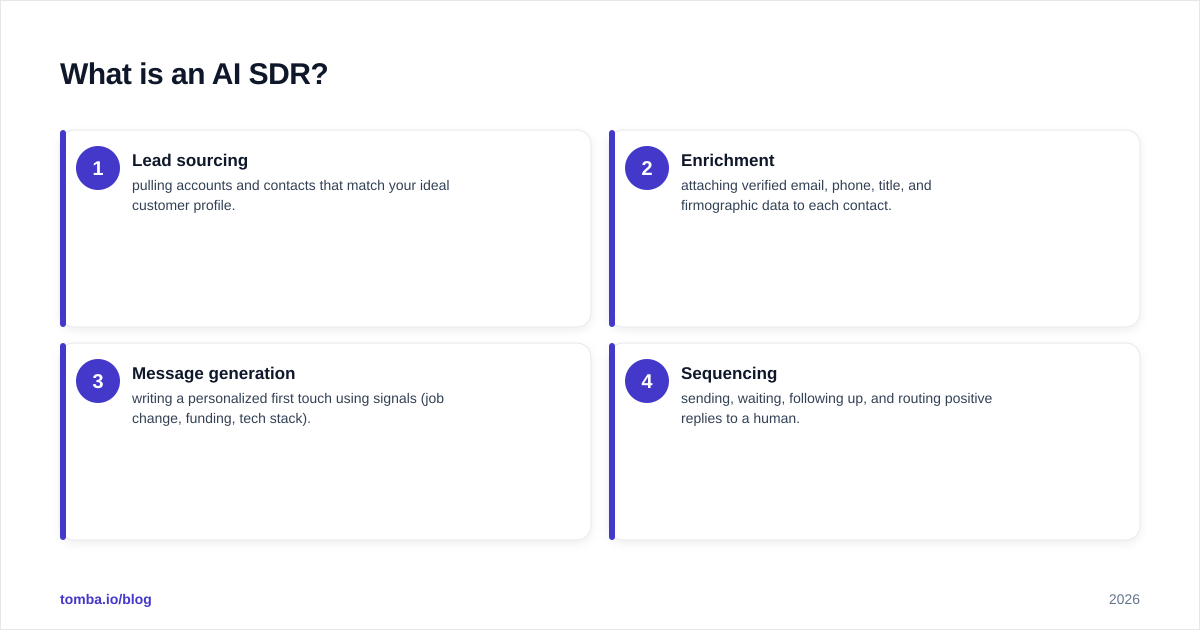
Technically, an AI SDR chains together four capabilities that used to live in four separate tools:
- Lead sourcing — pulling accounts and contacts that match your ideal customer profile.
- Enrichment — attaching verified email, phone, title, and firmographic data to each contact.
- Message generation — writing a personalized first touch using signals (job change, funding, tech stack).
- Sequencing — sending, waiting, following up, and routing positive replies to a human.
The phrase covers a spectrum. On one end, a "co-pilot" that drafts emails a rep approves. On the other, an "autopilot" agent that runs entire sequences unattended. Most teams in 2026 land in the middle: AI does the research and drafting, a human approves the send and owns the conversation once someone replies.
How does an AI SDR actually work?#
The loop is mechanical once you see it. An AI SDR ingests a trigger — a new account list, a website visitor, a funding announcement — and then runs the same pipeline a good human rep runs, just faster and without coffee breaks.
Here is the typical sequence:
- Trigger: A signal fires. Could be an uploaded target list, an inbound form, or an intent signal from a data provider.
- Resolve the contact: The agent identifies the right person at the account and finds their work email and phone. This is where data enrichment and an email finder do the heavy lifting.
- Verify: Before anything sends, the address is checked so the agent does not torch your domain reputation on dead inboxes. A built-in email verifier step is non-negotiable here.
- Personalize: The model writes an opener referencing a real, specific detail — not "I loved your recent post" filler.
- Send and wait: The sequence runs across email (and sometimes LinkedIn), spacing touches to look human.
- Hand off: A positive reply pauses automation and pings a human. This is the single most important guardrail.
The quality of every downstream step depends on step two and three. A beautiful, perfectly personalized email sent to john@compny.com (typo, doesn't exist) is worse than useless — it's a hard bounce that drags your sender score down. According to Gartner, most failed sales-tech rollouts trace back to data quality, not the tooling on top of it.
Is an AI SDR better than a human SDR?#
Short answer: for the top of the funnel, increasingly yes — for the conversation, no, and probably not for a while.
An AI SDR wins on volume, consistency, and cost-per-touch. It never skips follow-ups, never has a bad Monday, and runs 1,000 personalized first-touches for roughly what one human runs in a day. Where it loses is judgment: reading a lukewarm "maybe later," knowing when to call instead of email, and handling the human texture of a real buying conversation.
The honest framing is augmentation, not replacement. A two-person SDR team plus an AI SDR layer routinely outperforms a five-person team with no automation — because the humans spend their hours on live conversations instead of list-building.
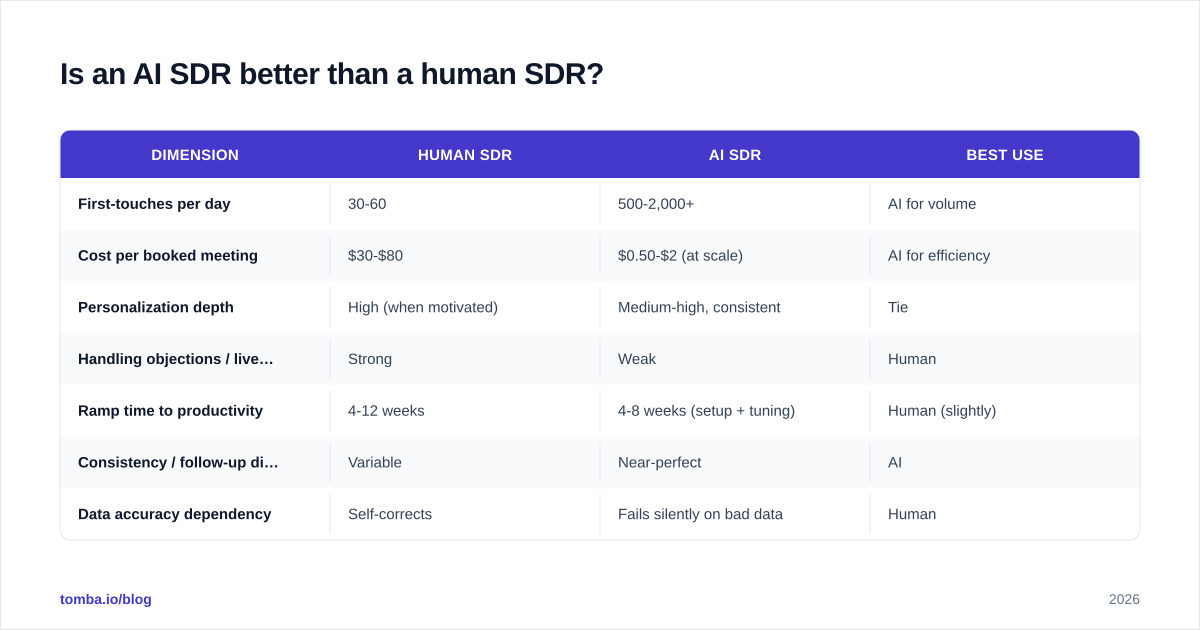
| Dimension | Human SDR | AI SDR | Best use |
|---|---|---|---|
| First-touches per day | 30-60 | 500-2,000+ | AI for volume |
| Cost per booked meeting | $30-$80 | $0.50-$2 (at scale) | AI for efficiency |
| Personalization depth | High (when motivated) | Medium-high, consistent | Tie |
| Handling objections / live replies | Strong | Weak | Human |
| Ramp time to productivity | 4-12 weeks | 4-8 weeks (setup + tuning) | Human (slightly) |
| Consistency / follow-up discipline | Variable | Near-perfect | AI |
| Data accuracy dependency | Self-corrects | Fails silently on bad data | Human |
The last row is the trap. A human notices when a list is garbage. An AI SDR will cheerfully email all 2,000 garbage records unless your data layer is clean going in.
What does an AI SDR cost in 2026?#
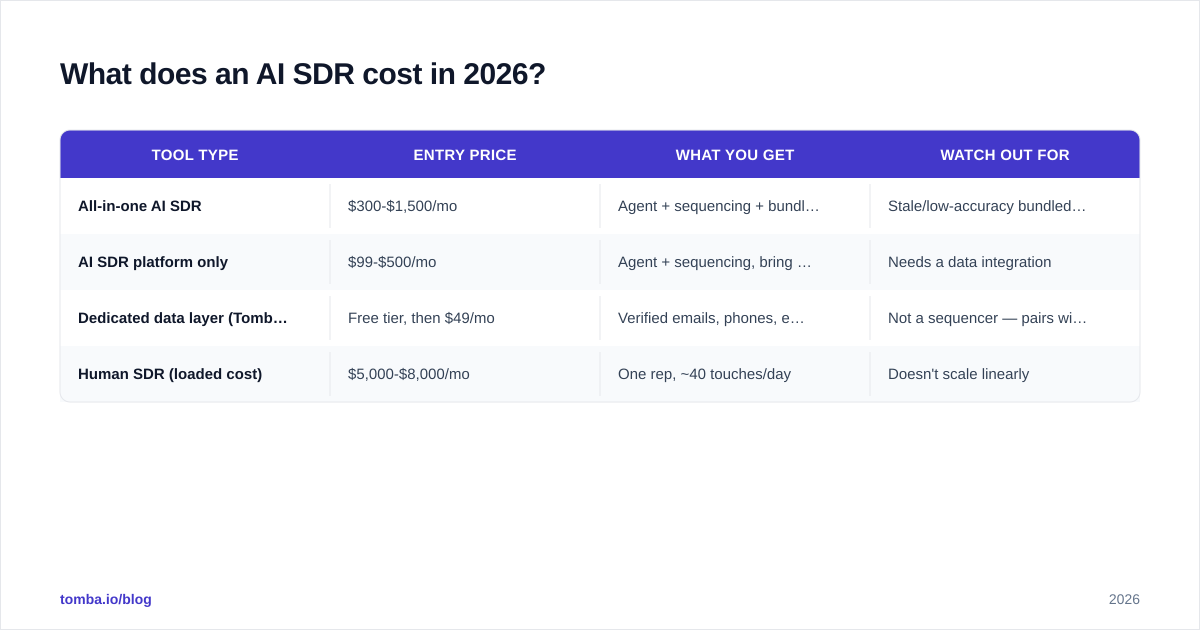
Pricing splits into two buckets: the AI SDR platform (the agent, sequencing, and message generation) and the data layer (verified contacts feeding it). Many vendors bundle thin data and charge a premium for it; you almost always get better accuracy and price by pairing a focused AI SDR tool with a dedicated contact source.
| Tool type | Entry price | What you get | Watch out for |
|---|---|---|---|
| All-in-one AI SDR | $300-$1,500/mo | Agent + sequencing + bundled data | Stale/low-accuracy bundled emails |
| AI SDR platform only | $99-$500/mo | Agent + sequencing, bring your own data | Needs a data integration |
| Dedicated data layer (Tomba) | Free tier, then $49/mo | Verified emails, phones, enrichment, API | Not a sequencer — pairs with one |
| Human SDR (loaded cost) | $5,000-$8,000/mo | One rep, ~40 touches/day | Doesn't scale linearly |
For reference, Tomba pricing runs a Free tier (25 searches/month), Starter at $49/mo, Growth at $99/mo, and Pro at $249/mo — so the verified-data layer under an AI SDR can cost less than a tenth of the agent platform. The math that matters is cost per booked meeting, not sticker price. A cheap agent feeding on inaccurate data produces expensive bounces; a verified source feeding a mid-tier agent produces meetings.
What should you look for in an AI SDR tool?#
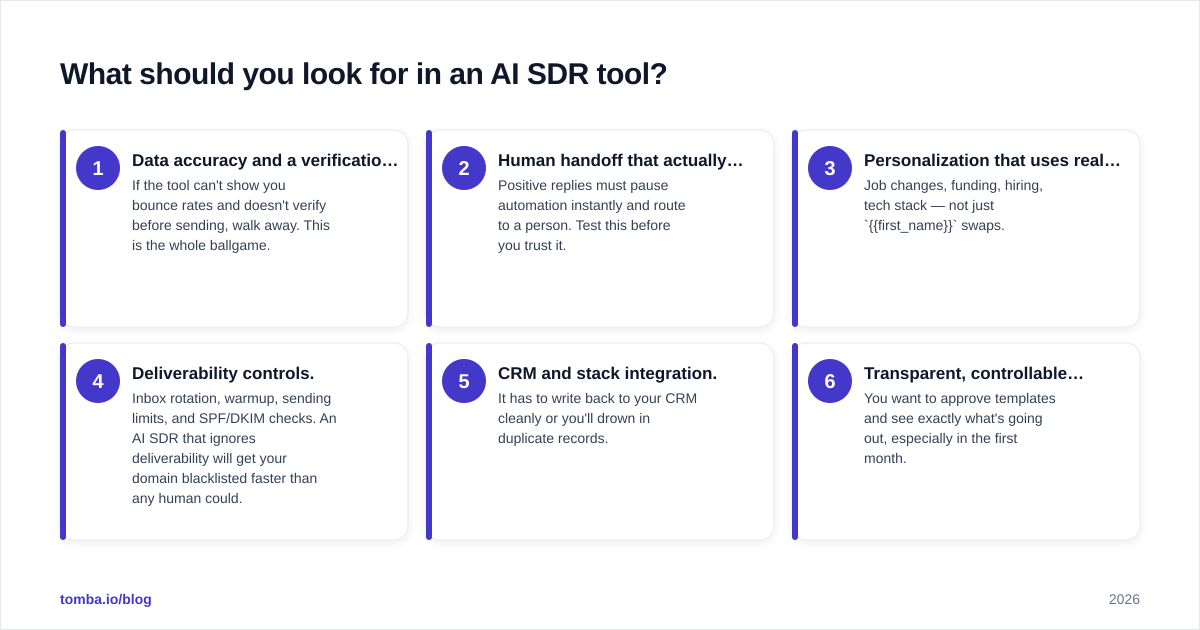
Evaluate on these six criteria, roughly in order of how often they get ignored:
- Data accuracy and a verification step. If the tool can't show you bounce rates and doesn't verify before sending, walk away. This is the whole ballgame.
- Human handoff that actually works. Positive replies must pause automation instantly and route to a person. Test this before you trust it.
- Personalization that uses real signals. Job changes, funding, hiring, tech stack — not just
{{first_name}}swaps. - Deliverability controls. Inbox rotation, warmup, sending limits, and SPF/DKIM checks. An AI SDR that ignores deliverability will get your domain blacklisted faster than any human could.
- CRM and stack integration. It has to write back to your CRM cleanly or you'll drown in duplicate records.
- Transparent, controllable sending. You want to approve templates and see exactly what's going out, especially in the first month.
If you're assembling your own stack, the data layer is the piece to get right first. A dedicated domain search and verification source, exposed via a clean email finder API, lets any AI SDR platform plug into accurate, fresh contacts instead of a vendor's aging database.
How do you deploy an AI SDR without torching your domain?#
Treat the rollout like onboarding a new hire who works terrifyingly fast — give it a small, supervised territory before handing over the keys.
A safe 6-step rollout:
- Week 1 — Define and feed. Nail your ICP and connect a verified data source. Garbage in, garbage out applies brutally here. Use bulk enrichment to clean your existing list first.
- Week 1-2 — Warm up. New sending domains and inboxes need warmup. Don't blast 2,000 emails on day one from a cold domain; you'll land in spam permanently.
- Week 2-3 — Pilot small. Run 100-200 contacts through the full loop with a human approving every send. Measure bounce rate, reply rate, and meeting rate.
- Week 3-4 — Tune the messaging. Use the pilot data to fix openers, signals, and follow-up timing. This is where most of the lift comes from.
- Week 4-6 — Scale gradually. Increase volume only as deliverability holds. Watch your sender reputation like a hawk.
- Ongoing — Audit weekly. Spot-check sent messages, review handoffs, and re-verify your list monthly. Contact data decays ~30% a year.
The single highest-leverage habit: verify before every send and re-verify your database monthly. Platforms like HubSpot and reviews on G2 repeatedly show that the teams who win with AI SDRs are the ones obsessed with list hygiene, not the ones with the fanciest model.
Where do AI SDRs still fail in 2026?#
Three failure modes show up again and again, and none of them are about the AI being "not smart enough."
Bad data, automated. The most common failure. An AI SDR with a stale or unverified list doesn't fail loudly — it sends thousands of emails to dead addresses, spikes your bounce rate, and quietly kills your deliverability. By the time you notice, your domain is cooked. The fix is upstream: a verified contact source and a hard verification gate before send.
Over-automation past the reply. When agents try to handle live, nuanced replies, they generate stilted, robotic conversations that buyers smell instantly. The fix is a strict handoff rule: the moment a human replies with intent, a human takes over.
Generic personalization at scale. "Personalized" mail-merge that references nothing real reads worse than an obvious blast, because it pretends to be tailored. If your AI SDR can't pull a genuine, specific signal per contact, dial personalization down to honest and brief rather than fake-bespoke.
Every one of these traces back to either data quality or knowing where to stop the automation. Solve those two and the AI SDR earns its keep. Ignore them and you've built a very efficient reputation-destruction machine.
The bottom line#
An AI SDR is leverage, not magic. It compresses the research-enrich-write-follow-up loop into something that runs at machine speed and machine cost — which is genuinely transformative for top-of-funnel volume. But it inherits every weakness of the data you feed it, and it has no judgment about when to stop automating. The teams winning with AI SDRs in 2026 pair a focused agent with a clean, verified data layer and keep a human on every live conversation.
Start with the foundation most AI SDR rollouts skip: accurate, verified contacts. Tomba Email Finder gives your AI SDR the one thing it can't generate on its own — real, deliverable email addresses, backed by verification, domain search, and enrichment through a single API. Spin up the free tier (25 searches/month), confirm the accuracy on your own list, and plug it into whatever agent you run on top. Get the data layer right and the rest of the stack finally works.
Ready to find emails that actually work?
Join 150,000+ professionals who stopped guessing and started sending. Free credits on signup — no credit card required.
Get the Tomba newsletter
Practical outbound tactics and product updates — once every two weeks.
About the author