AI SDR Agents in 2026: How They Work and Which to Use
AI SDR agents promise to automate prospecting, research, and outreach end to end. Here's how they actually work in 2026, where they break, and how to deploy one without torching your domain.
TL;DR
- AI SDR agents are software workers that research accounts, write personalized outreach, send sequences, and book meetings with little human input — they are not just smarter templates.
- The category split is real: full-autonomy platforms (Artisan, 11x, Qualified Piper) versus agent layers bolted onto existing tools (Apollo, Outreach, Salesloft AI).
- Output quality is capped by data quality. A great agent on stale or unverified contact data still sends mail to bounced inboxes and kills your domain.
- Expect strong wins on volume and research, weaker results on nuanced multi-threaded deals. Most teams in 2026 run agents for top-of-funnel and keep humans on qualified opportunities.
- Budget realistically: seat-based AI SDR platforms run $1,000–$5,000+/month. The hidden cost is verified data and deliverability infrastructure underneath the agent.
What is an AI SDR agent?#
An AI SDR agent is an autonomous system that performs the core work of a sales development rep — building target lists, researching each prospect, writing tailored messages, sending multi-step sequences, and handling replies — and adapts its next action based on what happened. Think of it as the difference between a vending machine and a barista. A sequencing tool is a vending machine: you load the same can for everyone and pull the lever. An AI SDR agent is a barista who reads the order, remembers your last visit, and changes the drink on the fly.
That "adapts its next action" part is what separates a real agent from a glorified mail merge. A 2024-era tool fired a fixed five-email cadence at every contact. A 2026 agent decides whether to email this person, what angle to use based on their company's recent funding round, when to switch to LinkedIn, and how to respond when they reply "not now, ask me in Q3."
The agent boom is downstream of two things maturing at once: cheaper, more reliable LLM reasoning, and the data enrichment APIs that feed those models real-time signals. Without both, you get confident-sounding emails addressed to people who left the company eight months ago.
How do AI SDR agents actually work?#
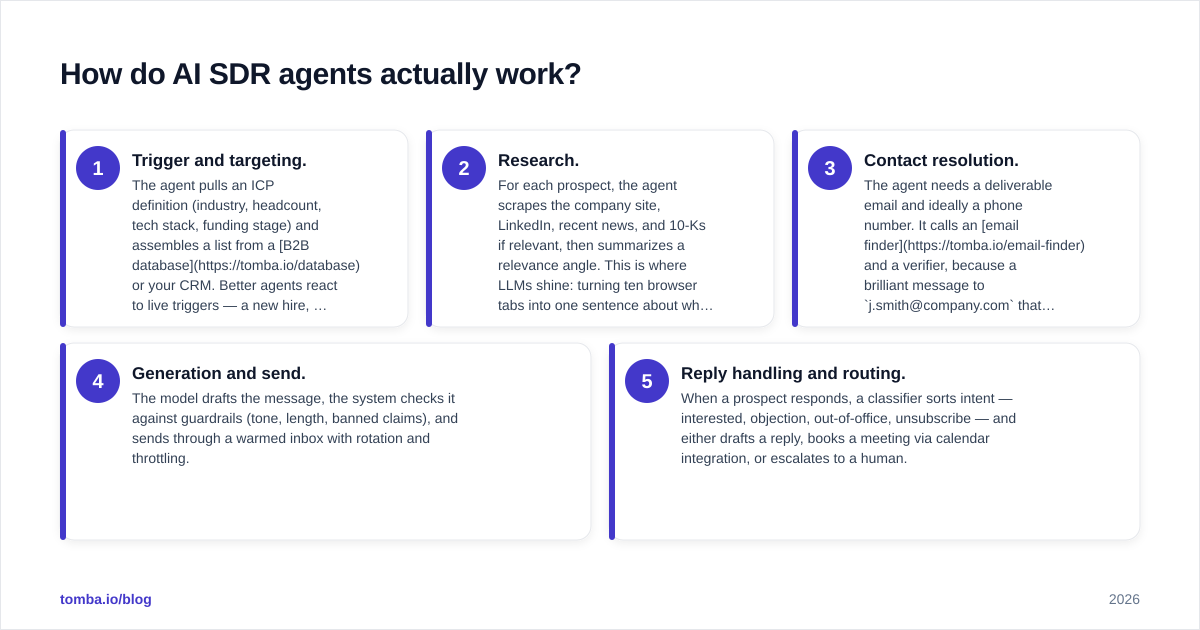
Under the hood, almost every AI SDR agent runs the same five-stage loop, regardless of marketing language:
- Trigger and targeting. The agent pulls an ICP definition (industry, headcount, tech stack, funding stage) and assembles a list from a B2B database or your CRM. Better agents react to live triggers — a new hire, a funding event, a job posting — instead of static lists.
- Research. For each prospect, the agent scrapes the company site, LinkedIn, recent news, and 10-Ks if relevant, then summarizes a relevance angle. This is where LLMs shine: turning ten browser tabs into one sentence about why this account matters now.
- Contact resolution. The agent needs a deliverable email and ideally a phone number. It calls an email finder and a verifier, because a brilliant message to
j.smith@company.comthat bounces is worse than no message at all. - Generation and send. The model drafts the message, the system checks it against guardrails (tone, length, banned claims), and sends through a warmed inbox with rotation and throttling.
- Reply handling and routing. When a prospect responds, a classifier sorts intent — interested, objection, out-of-office, unsubscribe — and either drafts a reply, books a meeting via calendar integration, or escalates to a human.
The magic isn't any single step. It's that the loop runs unattended across thousands of contacts and remembers state per prospect. The fragility is also in the loop: every stage compounds. A 5% error in targeting, times a 10% bounce rate, times a generic angle, produces an agent that looks busy and books nothing.
)
Are AI SDR agents better than human SDRs?#
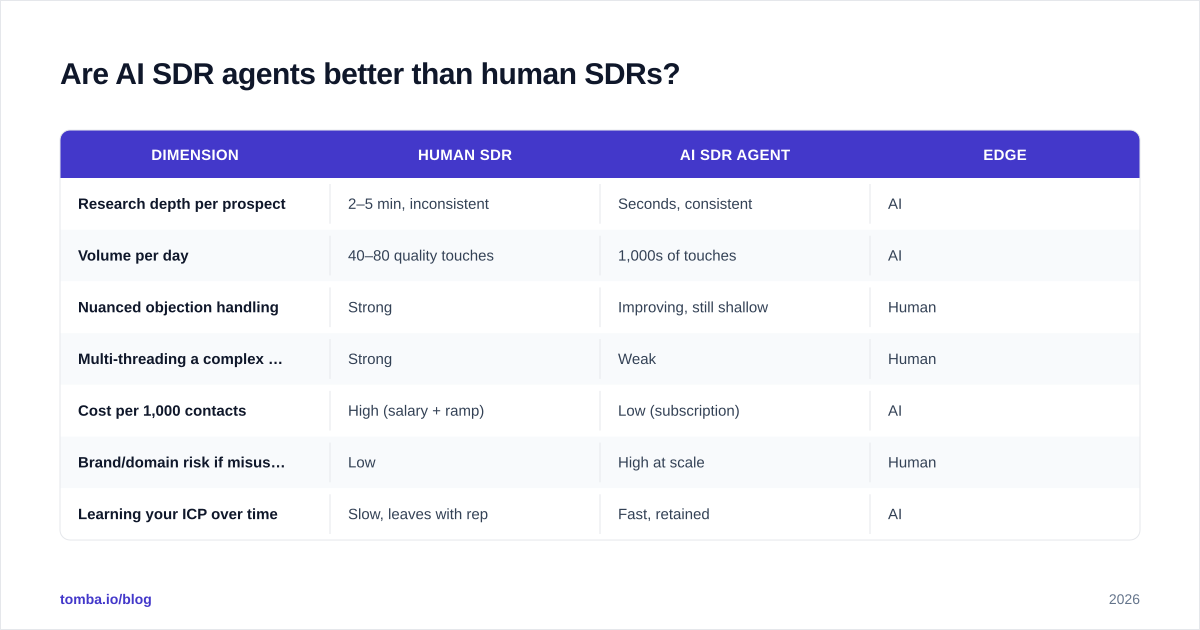
Short answer: better at some things, worse at others, and best as a layer rather than a replacement. The honest framing is task-by-task, not "AI vs. human."
| Dimension | Human SDR | AI SDR agent | Edge |
|---|---|---|---|
| Research depth per prospect | 2–5 min, inconsistent | Seconds, consistent | AI |
| Volume per day | 40–80 quality touches | 1,000s of touches | AI |
| Nuanced objection handling | Strong | Improving, still shallow | Human |
| Multi-threading a complex deal | Strong | Weak | Human |
| Cost per 1,000 contacts | High (salary + ramp) | Low (subscription) | AI |
| Brand/domain risk if misused | Low | High at scale | Human |
| Learning your ICP over time | Slow, leaves with rep | Fast, retained | AI |
| Handling a warm inbound reply fast | Variable | Instant | AI |
The pattern most teams settle on in 2026: agents own top-of-funnel grunt work — list building, research, first-touch personalization, follow-up persistence — while humans take over the moment a deal shows real buying intent. The agent is your tireless first-year SDR; your AE is still the closer.
Where teams get burned is treating the agent as a headcount replacement and pointing it at a bad list. The agent doesn't get tired, which means it will cheerfully send 5,000 emails to an unverified list and bury your sending domain in spam folders by Thursday. Volume without email deliverability discipline is not a strategy — it's a liability with a dashboard.
According to Gartner's research on sales technology, buyers increasingly resent low-effort automated outreach, which means the bar for "personalized enough to be worth sending" keeps rising. An agent that mass-produces obviously-templated mail can actively damage pipeline.
What should you look for when choosing an AI SDR agent?#
Use these criteria as a buying checklist. The flashy demo always works; the questions below separate tools that survive contact with your real data.
- Data source transparency. Where does contact data come from, and how fresh is it? Ask for verified-email rates, not total record counts. A tool with 200M contacts at 70% deliverability is worse than 50M at 96%.
- Built-in verification. Does the agent verify every address before sending, including catch-all domains? If not, you'll need a separate email verifier in the loop.
- Deliverability infrastructure. Inbox rotation, warmup, throttling, SPF/DKIM/DMARC handling. Without this, scale kills you.
- Personalization that uses real signals. "Hi {{first_name}}, I saw {{company}} is growing" is not personalization. Look for agents that cite a specific, verifiable fact.
- Human-in-the-loop controls. Can you require approval before send? Set guardrails? Pause instantly? Autonomy you can't govern is a risk, not a feature.
- Reply intelligence. How well does it classify and route responses? This is where weak agents leak qualified leads.
- Integrations. Native sync with your CRM and tools — check for a real HubSpot integration or Salesforce integration, not a brittle Zapier hack.
- Pricing model. Per-seat, per-meeting, or per-credit — and what happens to cost as you scale volume.
)
How much do AI SDR agents cost in 2026?#
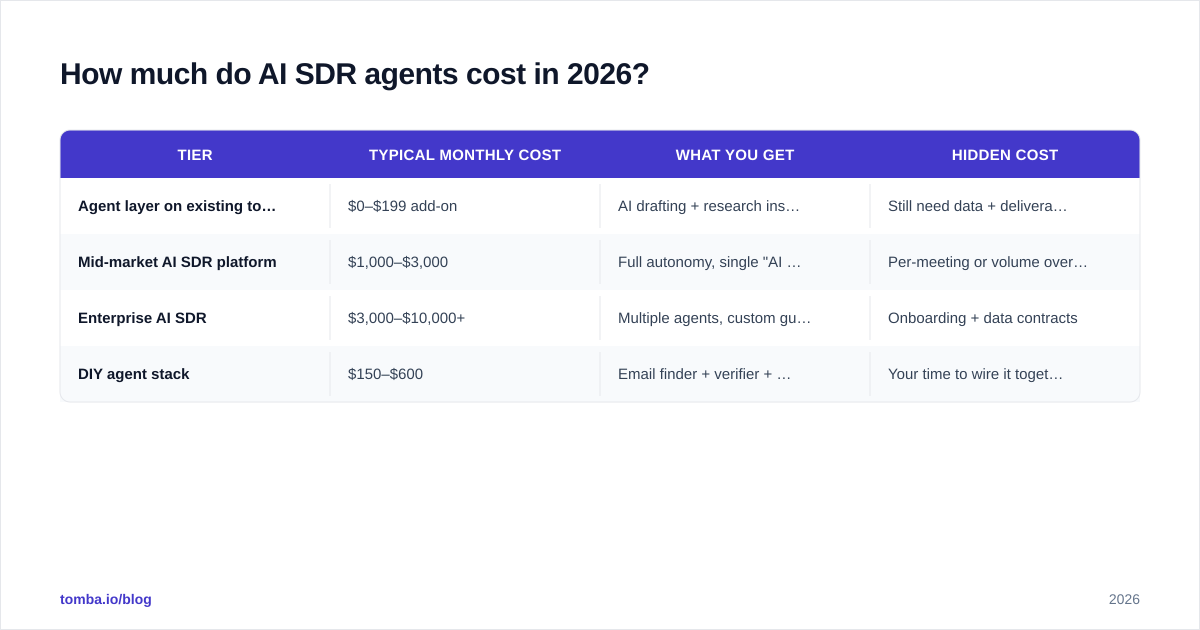
Pricing falls into two camps, and the sticker price is rarely the real cost.
| Tier | Typical monthly cost | What you get | Hidden cost |
|---|---|---|---|
| Agent layer on existing tool | $0–$199 add-on | AI drafting + research inside Apollo/Outreach | Still need data + deliverability |
| Mid-market AI SDR platform | $1,000–$3,000 | Full autonomy, single "AI rep" | Per-meeting or volume overages |
| Enterprise AI SDR | $3,000–$10,000+ | Multiple agents, custom guardrails | Onboarding + data contracts |
| DIY agent stack | $150–$600 | Email finder + verifier + sequencer + LLM | Your time to wire it together |
The DIY column is underrated. Many teams in 2026 assemble their own "agent" from a contact-data API, a verifier, a sequencer, and an LLM — paying a fraction of the all-in-one price while keeping full control of data quality. That route leans on something like the Tomba API for the find-and-verify layer plus your own logic for generation and routing.
Whichever camp you pick, budget for the layer beneath the agent. The agent is the visible 20%; verified data and deliverability are the invisible 80% that actually determines whether meetings get booked. You can compare what the data layer costs on the Tomba pricing page — the Starter plan is $49/mo and the Growth plan $99/mo, which is typically a rounding error next to the agent subscription itself.
Which AI SDR platforms lead the market?#
The landscape sorts into autonomous platforms and agent-augmented incumbents. A quick orientation — verify current capabilities yourself on G2, since this category ships features weekly:
- Artisan (Ava). One of the original "AI SDR" brands; full-loop autonomy with built-in data.
- 11x (Alice). Autonomous outbound positioned as a digital worker.
- Qualified (Piper). Focused on inbound — converting website visitors into pipeline, pairs naturally with website visitor reveal.
- Apollo AI. Agent features layered onto a large existing prospecting database.
- Outreach / Salesloft AI. Reply classification and message assist inside established sequencers; good for teams already standardized on those platforms — though plenty evaluate an Outreach alternative before committing.
None of these escape the data-quality ceiling. Whatever brand you choose, run the same test: feed it 100 of your real target accounts and measure how many emails it finds, verifies, and lands in the inbox. That number predicts pipeline better than any feature list.
What are the biggest risks, and how do you avoid them?#
Three failure modes account for most AI SDR disasters.
1. Domain reputation collapse. An agent sending high volume on unverified data triggers spam filters fast. Once your domain is flagged, even your hand-written email to a warm lead lands in spam. Fix: verify every address (including catch-all domains with a dedicated catch-all verifier), warm inboxes properly, throttle sends, and monitor your sender reputation continuously.
2. Generic personalization at scale. The agent feels productive while producing mail prospects instantly recognize as automated. Fix: require a specific, verifiable fact in every first touch, and cap daily volume so each message clears a quality bar. Quality of signal beats quantity of sends.
3. Ungoverned autonomy. An agent making decisions you can't see or override will eventually email the wrong segment, make a claim you can't back, or reply to a customer as if they were a prospect. Fix: insist on approval gates, audit logs, and an instant kill switch before you scale past a pilot.
The throughline: an AI SDR agent amplifies whatever you point it at. Point it at clean, verified, well-targeted data with guardrails, and it amplifies pipeline. Point it at a scraped list with no oversight, and it amplifies damage just as efficiently.
How do you get started without breaking things?#
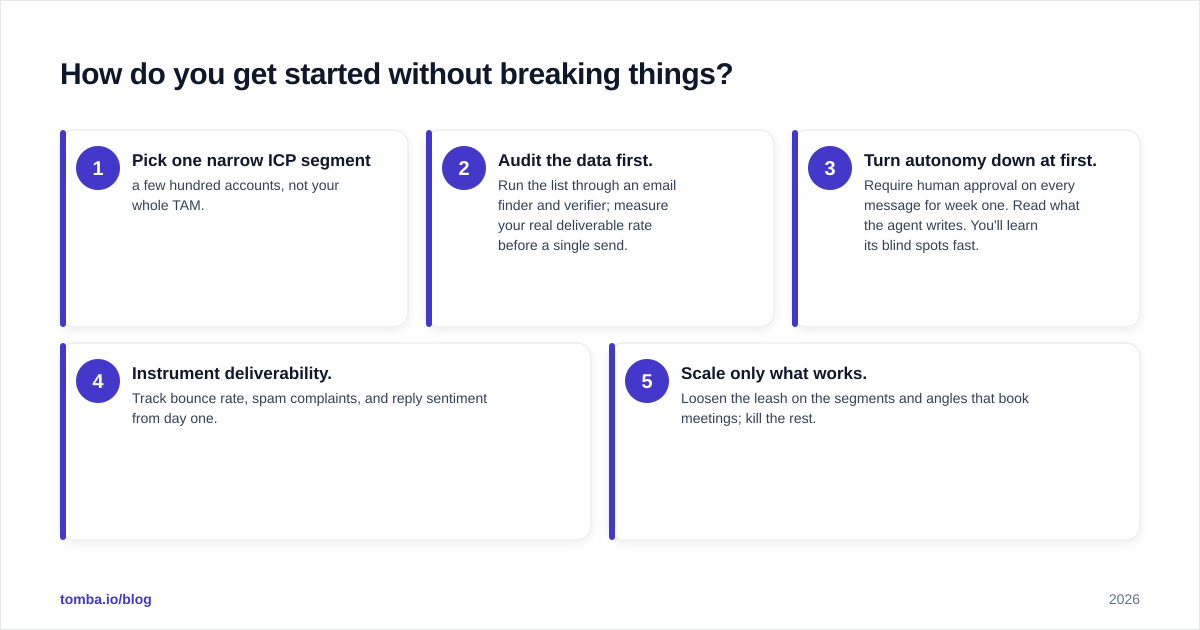
Run a contained pilot before you hand an agent the keys:
- Pick one narrow ICP segment — a few hundred accounts, not your whole TAM.
- Audit the data first. Run the list through an email finder and verifier; measure your real deliverable rate before a single send.
- Turn autonomy down at first. Require human approval on every message for week one. Read what the agent writes. You'll learn its blind spots fast.
- Instrument deliverability. Track bounce rate, spam complaints, and reply sentiment from day one.
- Scale only what works. Loosen the leash on the segments and angles that book meetings; kill the rest.
This is the boring path, and it's the one that keeps your domain alive. The teams winning with AI SDR agents in 2026 aren't the ones who automated the most — they're the ones who automated the right things on top of data they could trust.
The bottom line#
AI SDR agents are genuinely useful and genuinely overhyped, both at once. They compress research, scale persistence, and free your humans for the conversations that actually close. They also fail loudly when the data underneath them is bad — and most of them are happy to fail at 5,000 emails a day.
Before you spend four figures a month on an agent, get the foundation right: find real contacts, verify they're deliverable, and protect your sending reputation. That's the part the agent can't fix for you. Start with the Tomba Email Finder to build and verify a clean target list — domain search, email verification, and catch-all detection included — then point whatever agent you choose at data it can actually convert. The free tier gives you 25 searches a month to test it against your own accounts before you commit a dollar to autonomy.
// get started
Find, verify and enrich your first contacts today
Start on the free plan with 25 searches a month, then scale when your team is ready.
Free plan · No credit card required · GDPR & CCPA
// about the author