AI SDR Co-Pilot Mode in 2026: The Human-in-the-Loop Playbook
Autopilot AI SDRs burn your domain and your brand. Co-pilot mode keeps a human on the trigger while AI does the grunt work. Here is how to run it in 2026.
TL;DR
- "AI SDR co-pilot mode" means the AI handles research, list-building, drafting, and prioritization. A human rep approves every send and owns the relationship. It is the opposite of fully autonomous "autopilot" agents.
- Autopilot AI SDRs scale volume fast. But they quietly burn your domain reputation, brand trust, and reply rates. Co-pilot mode trades raw output for precision and deliverability.
- The winning stack is boring: clean data in, AI drafting in the middle, a human approval gate at the end. Garbage contacts make even the best AI useless, so verification comes first.
- Co-pilot reps run 3-5x more accounts than manual reps. They avoid the deliverability cliff that kills autopilot programs by month two.
- Start narrow: one segment, one play, and a human reviewing 100% of sends. Then loosen the leash only where the data earns it.
What is AI SDR co-pilot mode?#
AI SDR co-pilot mode is a human-in-the-loop way to run an AI sales development rep. The AI drafts, researches, and prioritizes. A person then reviews and approves before anything reaches a prospect. Think of it like a modern airliner. The autopilot flies the boring straight-line cruise. But a trained pilot sets the route, handles takeoff and landing, and can grab the yoke the instant something looks wrong. Nobody wants an empty cockpit at 35,000 feet. Nobody should want one on their pipeline either.
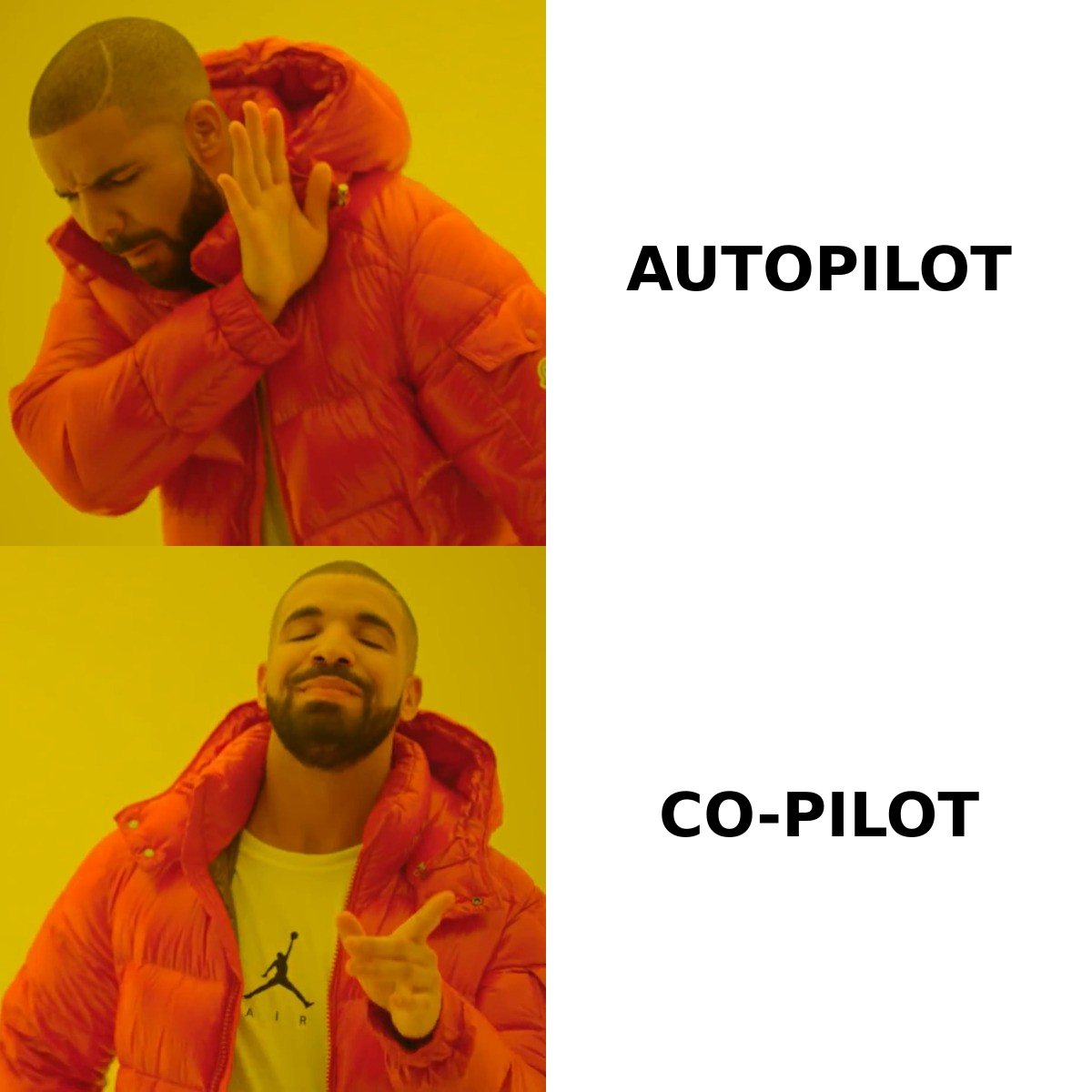
The contrast that matters is co-pilot vs autopilot. An autopilot AI SDR finds contacts, writes emails, sends them, and books meetings with zero human review. It sounds like the dream — a rep that never sleeps. In practice, autopilot programs tend to produce huge send volume, weak personalization, and a domain reputation that collapses within weeks. Co-pilot mode keeps the human as the editor-in-chief. The AI stays the tireless junior researcher.
This distinction has become the defining design choice in AI sales technology for 2026. The first wave of "AI SDR" products promised full automation. The second wave won customers by repositioning around augmentation, because buyers got wise to robotic outreach fast.
Why does co-pilot mode beat full autopilot?#
Because the bottleneck in outbound was never how many emails you could send. It was how many good emails you could send to real people without getting flagged. Autopilot solves the wrong problem.
Here is what breaks when you take the human out:
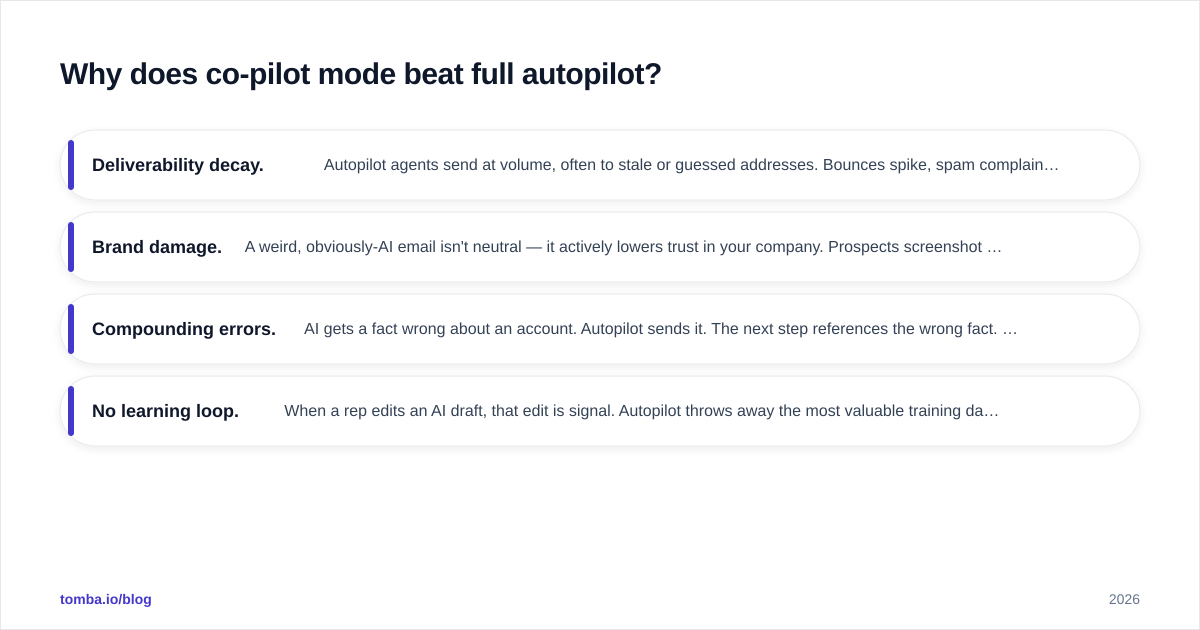
- Deliverability decay. Autopilot agents send at volume, often to stale or guessed addresses. Bounces spike, spam complaints climb, and your sender reputation drops. Once mailbox providers distrust your domain, even your good emails land in spam.
- Brand damage. A weird, obviously-AI email isn't neutral. It actively lowers trust in your company. Prospects screenshot the bad ones and post them. You cannot un-send a cringe sequence to 4,000 of your ICP.
- Compounding errors. AI gets a fact wrong about an account. Autopilot sends it. The next step references the wrong fact. Now you have a confidently incorrect thread with a buyer. A human catches this in two seconds.
- No learning loop. When a rep edits an AI draft, that edit is signal. Autopilot throws away the most valuable training data you have — human judgment about what's actually good.
Co-pilot mode keeps the throughput gains, since the AI does 80% of the keystrokes. It also keeps a human accountable for the 20% that decides whether a deal happens. According to HubSpot's research on sales AI adoption, reps mostly want AI for research and drafting, not for hands-off sending. The augmentation use cases are where trust and results both live.
How does the co-pilot workflow actually run?#
The workflow is a relay, not a black box. Each stage hands off to the next. The human sits at the approval gate before anything external happens.
- Trigger. A signal fires — a website visit, a funding round, a job change, or a target account list from the AE. This decides who gets worked.
- Enrich and verify. The AI pulls firmographic and contact data. Then it verifies that the email is real and deliverable. This step is non-negotiable. Skip it and everything downstream is built on sand. Use a real email verifier and run data enrichment before drafting, not after.
- Research. The AI summarizes the account: recent news, tech stack, and the prospect's role and likely pains. It assembles the "why now" and "why you" angles a rep would otherwise spend 15 minutes digging for.
- Draft. The AI writes the first-touch email and follow-ups, grounded in the research, in your team's voice.
- Human approval gate. The rep reviews. Edit, approve, or kill. This is the entire point — the human owns the send.
- Send and sequence. Approved messages go out through your sending infrastructure at human-paced volume.
- Feedback. Edits, replies, and booked meetings feed back to tune prioritization and drafting.
The magic isn't any single step. It's that the human only spends time where judgment matters. Research and first drafts eat a rep's day, and here they get compressed to seconds. The rep becomes an editor and a closer instead of a copy-paste robot.
Co-pilot vs autopilot vs manual SDR: which one wins?#
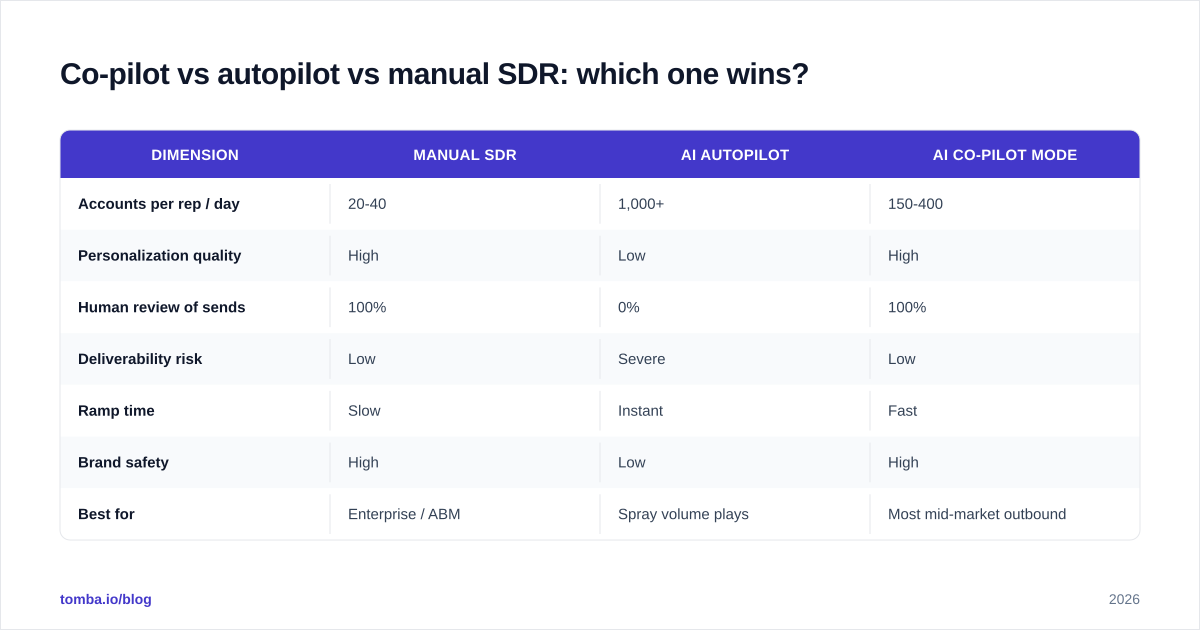
There's no universally correct answer, but there is a correct answer per situation. Manual is high-quality and hard to scale. Autopilot is scalable and low-quality. Co-pilot is the deliberate middle that most B2B teams should default to in 2026.
| Dimension | Manual SDR | AI Autopilot | AI Co-Pilot Mode |
|---|---|---|---|
| Accounts per rep / day | 20-40 | 1,000+ | 150-400 |
| Personalization quality | High | Low | High |
| Human review of sends | 100% | 0% | 100% |
| Deliverability risk | Low | Severe | Low |
| Ramp time | Slow | Instant | Fast |
| Brand safety | High | Low | High |
| Best for | Enterprise / ABM | Spray volume plays | Most mid-market outbound |
| Typical reply rate trend | Stable | Decays in weeks | Stable / improving |
The pattern is clear: co-pilot mode gives you most of autopilot's throughput and most of manual's quality. You give up the fantasy of zero headcount. But headcount was never the real constraint — pipeline quality was. Analyst coverage from Gartner on sales AI lands in the same place: augmentation drives durable productivity gains, while full automation drives short-term volume and long-term trust erosion.
What does the co-pilot tech stack look like?#
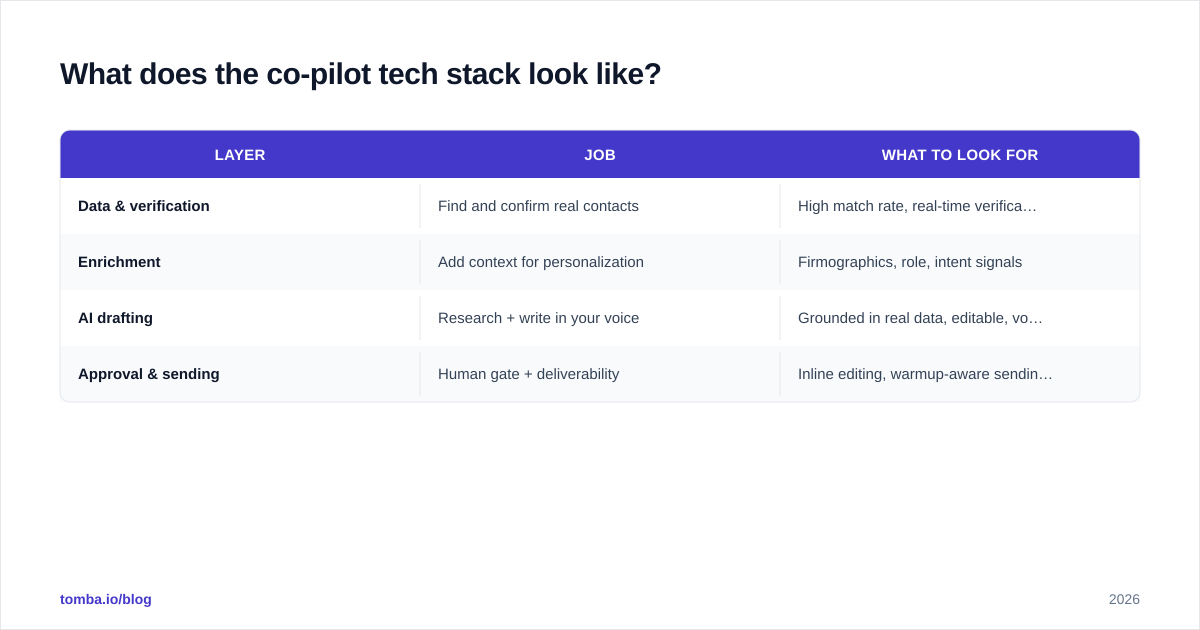
You need four layers, and they need to be loosely coupled so you can swap any one of them. Buying a single "does everything" autopilot box is how teams get locked into bad data and bad sending.
| Layer | Job | What to look for |
|---|---|---|
| Data & verification | Find and confirm real contacts | High match rate, real-time verification, catch-all handling |
| Enrichment | Add context for personalization | Firmographics, role, intent signals |
| AI drafting | Research + write in your voice | Grounded in real data, editable, voice control |
| Approval & sending | Human gate + deliverability | Inline editing, warmup-aware sending caps |
The data layer is where most co-pilot programs live or die. An AI co-pilot that drafts a beautiful email to a bounced address is worse than useless. It wastes a rep's review time and damages your domain.
That's why the verify-first sequence matters. Confirm the address exists, find emails by domain when you only have a company, and only then let the AI write. You can wire this through the Tomba API so verification and enrichment run automatically before a draft is generated. Or pull contacts straight into a sheet with the bulk email finder for batch plays.
On the sending side, respect your warmup limits and sender reputation. Co-pilot volume is human-paced by design, which is exactly why it stays deliverable. Tools like G2's deliverability category list the warmup and monitoring options worth pairing with your co-pilot.

How do you keep AI personalization from sounding like AI?#
Ground every claim in a real, verifiable fact, and cut anything the AI couldn't actually know. The tell of bad AI outreach isn't bad grammar — it's confident vagueness. "I loved your company's commitment to innovation" is what a machine writes when it has no data. "Saw you're hiring three backend engineers in Berlin — usually means the platform team is under load" is what a co-pilot writes when it's been fed real enrichment.
Practical guardrails for the human at the gate:
- One specific, true detail per email. If the AI can't produce one, the account isn't ready — kill the draft.
- Ban the filler. No "in today's fast-paced world," no "I hope this email finds you well," no three-adjective stacks. Keep a blocklist your reps enforce on review.
- Match the relationship temperature. A cold first touch is short and curious, not a pitch deck in paragraph form.
- Read it aloud. If a rep wouldn't say it to the prospect's face, it doesn't send.
The human gate is also your quality flywheel. Every edit a rep makes is a labeled example of "worse → better." Capture those edits and your drafting quality climbs week over week. A closed autopilot can never do this, because it never sees a correction. For more on the writing side, our cold email templates give reps a grounded starting frame the AI can personalize against instead of inventing from scratch.
When should you actually loosen the leash?#
Only where the data has earned it, and never on the first touch to a net-new account. Co-pilot mode isn't a permanent training-wheels phase — it's a control system. As confidence rises in a specific play, you can let the AI auto-send the low-risk steps while keeping humans on the high-stakes ones.
A sensible graduation path:
- Phase 1 — full review. A human approves 100% of sends. You're calibrating voice, data quality, and prioritization. Stay here longer than feels comfortable.
- Phase 2 — selective auto-send. Let the AI auto-send purely operational, low-risk messages, like a meeting reminder or a "still interested?" bump. Humans still own every first touch and every reply to a warm prospect.
- Phase 3 — exception-based review. The AI sends within tight guardrails. It only escalates edge cases — a VIP account, an ambiguous reply, or a low-confidence draft — to a human.
Notice what never gets fully automated: the first impression and the human-to-human reply. Those are where deals are won and brands are protected. Even mature co-pilot programs keep a person on those two moments. This is the same principle Salesforce bakes into its agent tooling. Humans stay in the loop on high-judgment, high-trust interactions, while routine steps automate.
What metrics tell you co-pilot mode is working?#
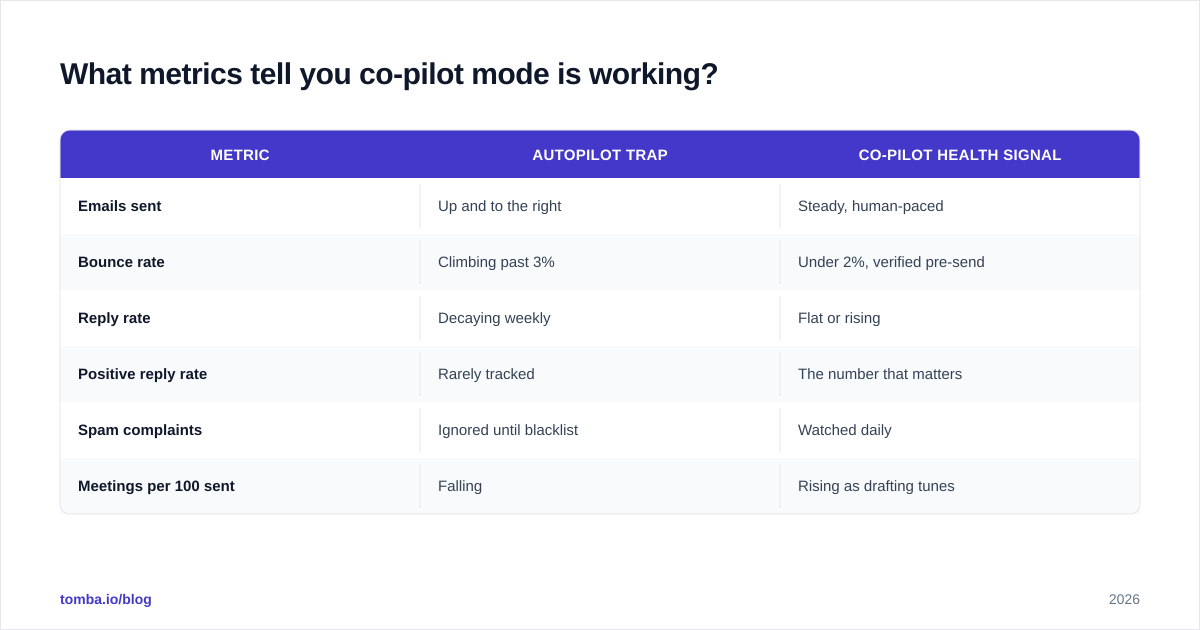
Watch quality and deliverability, not just volume. Volume is the metric autopilot games while everything important quietly degrades.
| Metric | Autopilot trap | Co-pilot health signal |
|---|---|---|
| Emails sent | Up and to the right | Steady, human-paced |
| Bounce rate | Climbing past 3% | Under 2%, verified pre-send |
| Reply rate | Decaying weekly | Flat or rising |
| Positive reply rate | Rarely tracked | The number that matters |
| Spam complaints | Ignored until blacklist | Watched daily |
| Meetings per 100 sent | Falling | Rising as drafting tunes |
If your sent count is flat but your positive replies and meetings-per-hundred are rising, co-pilot mode is doing its job. The AI removes busywork, and the human turns attention into pipeline. If sent count is exploding while reply rate slides, you've drifted back toward autopilot. Your domain will send you the bill.
The bottom line#
AI SDR co-pilot mode wins in 2026 because it automates the work nobody should do by hand — research, list-building, first drafts, and prioritization. At the same time, it keeps a human accountable for the two things that move revenue: the first impression and the real conversation. Start narrow, verify before you draft, review every send, and loosen the leash only where the numbers earn it.
The whole system rests on clean, real contact data. An AI co-pilot is only as good as the addresses you feed it. Tomba's Email Finder gives your co-pilot verified, deliverable contacts to build on, so your reps spend their review time on judgment instead of cleaning up bounces. Start on the free tier with 25 searches a month, then scale into the Starter plan at $49/mo once your first co-pilot play is converting. Put a human in the cockpit, let the AI fly the boring parts, and keep your domain — and your brand — intact.
Ready to find emails that actually work?
Join 150,000+ professionals who stopped guessing and started sending. Free credits on signup — no credit card required.
Get the Tomba newsletter
Practical outbound tactics and product updates — once every two weeks.
About the author