AI SDR Objection Handling: A 2026 Framework That Converts
AI SDRs can now field real-time objections—if you build them right. Here's the 2026 framework, prompts, and guardrails that turn pushback into booked meetings.
TL;DR
- AI SDR objection handling works when you treat objections as a classification problem first, response problem second—detect intent, then route to a vetted rebuttal, never a freestyled one.
- The four objection families (no budget, no time, no need, no trust) cover ~80% of replies. Pre-write rebuttals for each and let the AI match, not invent.
- Guardrails matter more than cleverness: confidence thresholds, human-in-the-loop escalation, and a "do not claim" list keep your AI SDR from hallucinating pricing or promises.
- Accurate contact data is the unglamorous prerequisite—an AI rebuttal sent to the wrong inbox or a catch-all that bounces never gets the chance to convert.
- A well-tuned AI SDR lifts positive reply rates by handling the second email, where most human reps quietly give up.
What is AI SDR objection handling?#
AI SDR objection handling is the process of letting an AI sales development rep detect, classify, and respond to prospect pushback—"too expensive," "we already use X," "email me in Q3"—using vetted responses instead of static drip sequences.
Think of it like a flight simulator versus a paper checklist. A traditional sequence is the checklist: it fires email 2 on day 3 no matter what the prospect said in their reply to email 1. An AI SDR is the simulator: it reads the reply, recognizes "we're locked into a contract until December" as a timing objection, and adapts the next touch to acknowledge that timeline instead of barreling ahead.
The technical reality in 2026 is that large language models are good at two things relevant here: classifying short text and generating fluent responses. The trap is letting them do too much of the second. The best-performing AI SDR systems lean hard on classification and keep generation on a tight leash.
Why do most AI SDRs fail at objections?#
Most AI SDRs fail because they freestyle. Given a vague objection, an unconstrained model will happily invent a discount, promise a feature you don't ship, or contradict your pricing page. That's not an objection handled—it's a liability created.
Three failure patterns show up again and again:
- Hallucinated commitments. The model offers "a 30% discount for annual plans" because that phrasing is statistically common in sales emails. You never authorized it.
- Tone mismatch. A curt "Not interested" gets a 200-word essay. A detailed technical question gets a one-line brush-off. The model can't read the room without explicit instruction.
- Wrong-target sends. The rebuttal is perfect, but it went to
info@or a catch-all domain that swallowed it. Garbage data in, no reply out.
That third one is worth dwelling on. According to HubSpot's research on sales benchmarks, follow-up persistence is one of the strongest predictors of booked meetings—yet none of that matters if the contact record is wrong. Your objection-handling engine is only as good as the inbox it reaches, which is why a clean email verifier step sits upstream of any AI reply logic.

What are the four objection families?#
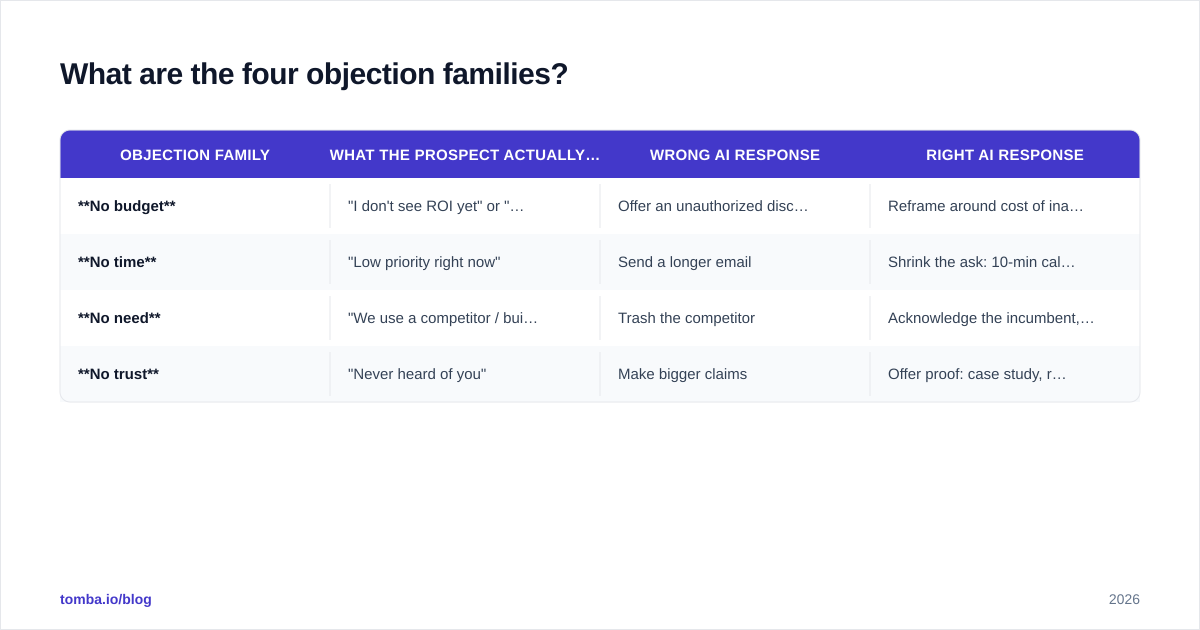
Nearly every B2B objection collapses into one of four families. Naming them is the whole game—once you can classify, you can route.
| Objection family | What the prospect actually means | Wrong AI response | Right AI response |
|---|---|---|---|
| No budget | "I don't see ROI yet" or "wrong quarter" | Offer an unauthorized discount | Reframe around cost of inaction, ask about budget timing |
| No time | "Low priority right now" | Send a longer email | Shrink the ask: 10-min call, async Loom, or a defer-and-nurture |
| No need | "We use a competitor / built in-house" | Trash the competitor | Acknowledge the incumbent, surface a specific gap |
| No trust | "Never heard of you" | Make bigger claims | Offer proof: case study, referral, free audit |
The power of this table is that each family maps to a finite set of pre-approved rebuttals. The AI's job shrinks to: read reply → pick family → select rebuttal variant → personalize the first sentence. No invention required.
This is also where a response rate lens helps you prioritize. Track which family you see most. Most outbound teams discover "no time" and "no need" dominate, which tells you exactly which two rebuttal libraries to perfect first.
How do you build the rebuttal logic?#
You build it as a decision tree the model fills in, not a blank page it writes on. Here's the structure that works in production.
Step 1 — Detect. Run the inbound reply through a classifier prompt that returns one of: interested, objection_budget, objection_time, objection_need, objection_trust, not_a_fit, unsubscribe, or out_of_office. Force a single-label output. If confidence is low, route to a human.
Step 2 — Select. Map the label to a rebuttal template from your library. Each template has 2–3 variants so your sequence doesn't read like a robot to anyone who got a similar email last month.
Step 3 — Personalize. Let the model rewrite only the opening line to reference the prospect's actual words. Everything else—the proof point, the ask, the CTA—stays fixed and pre-approved.
Step 4 — Guardrail. Pass the drafted reply through a validation layer: does it contain a price not on the pricing page? A promised feature not on your roadmap? A competitor's name in a negative sentence? If yes, block and escalate.
This four-step loop is deliberately boring. Boring is reliable. The teams getting burned by AI SDRs in 2026 are the ones who skipped steps 2 and 4 and let a clever model run the whole show. If you want the model to draft rebuttals from scratch for inspiration, do it offline with a tool like cold email AI, review the output, then promote the winners into your fixed library—don't let it improvise live.
Is an AI SDR better than a human at objections?#
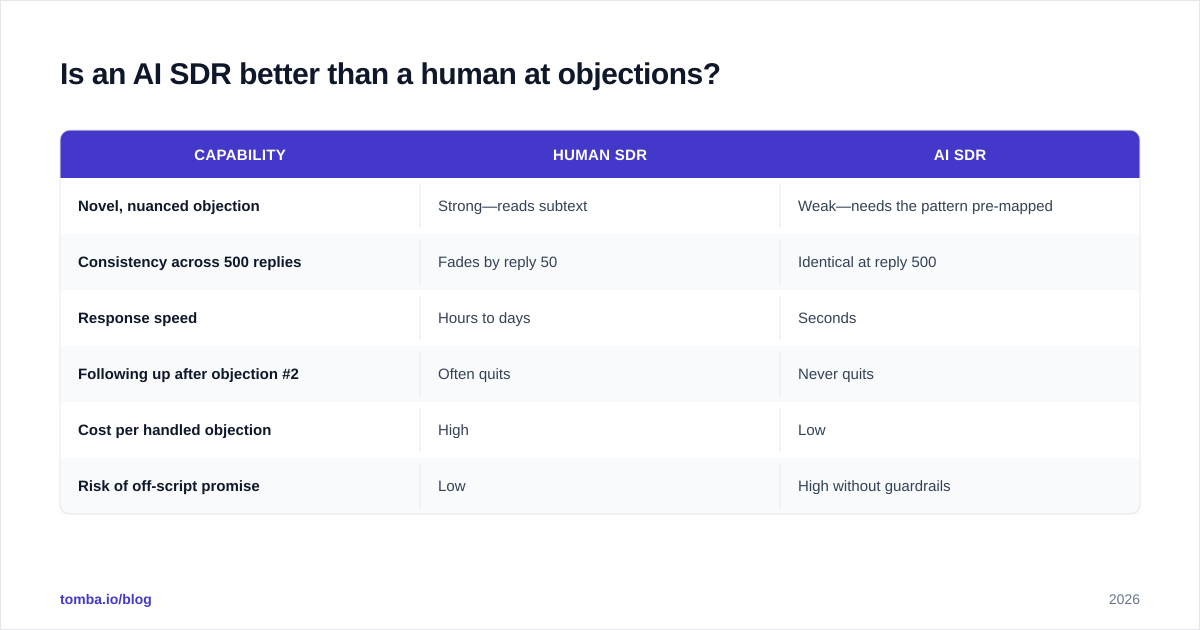
No—and yes. An AI SDR is worse at genuinely novel objections and better at the boring, high-volume ones humans skip. The honest answer is that they're complementary, not competitive.
Here's where each wins:
| Capability | Human SDR | AI SDR |
|---|---|---|
| Novel, nuanced objection | Strong—reads subtext | Weak—needs the pattern pre-mapped |
| Consistency across 500 replies | Fades by reply 50 | Identical at reply 500 |
| Response speed | Hours to days | Seconds |
| Following up after objection #2 | Often quits | Never quits |
| Cost per handled objection | High | Low |
| Risk of off-script promise | Low | High without guardrails |
Gartner's outlook on AI in sales points to augmentation, not replacement, as the durable pattern—AI clears the repetitive volume so humans spend their judgment where it actually moves deals. The model handles the "we're slammed this quarter" replies at scale; the human steps in when a prospect raises something the library never anticipated.
A practical split: let the AI SDR own objection families 1–3 (budget, time, need) end-to-end with guardrails, and auto-escalate every "trust" objection to a human, since trust is built by people, not templates.
What does a good AI objection rebuttal actually look like?#
A good rebuttal is short, acknowledges the objection literally, and reduces the ask. Here are three vetted examples by family.
Budget objection — prospect: "No budget for this right now."
"Totally fair, [Name]—Q3 is tight for a lot of teams. Quick question so I'm not wasting your time: is it a 'not this quarter' or a 'not this year'? If it's timing, I'll just check back when budget frees up. If it's ROI, I've got a 2-line breakdown of what [similar company] saved."
Time objection — prospect: "Slammed, email me later."
"Done—I'll get out of your inbox. One option if it's useful: I recorded a 90-second Loom showing the exact workflow, so you can skim it whenever instead of booking a call. Want the link?"
Need objection — prospect: "We already use [Competitor]."
"Makes sense—[Competitor] is solid for [thing they're good at]. The teams that switch usually hit a wall on [specific gap]. If that's not a pain for you, no worries at all. If it is, happy to show you the 5-minute version."
Notice what none of these do: they don't argue, they don't oversell, and they hand the prospect an easy "no." That last part is counterintuitive but it's what keeps you out of the spam folder and protects your sender reputation. An AI SDR that pushes too hard generates spam complaints, and complaints torch deliverability for your entire domain—objection-handling that wins the battle and loses the war.
What guardrails keep an AI SDR safe?#
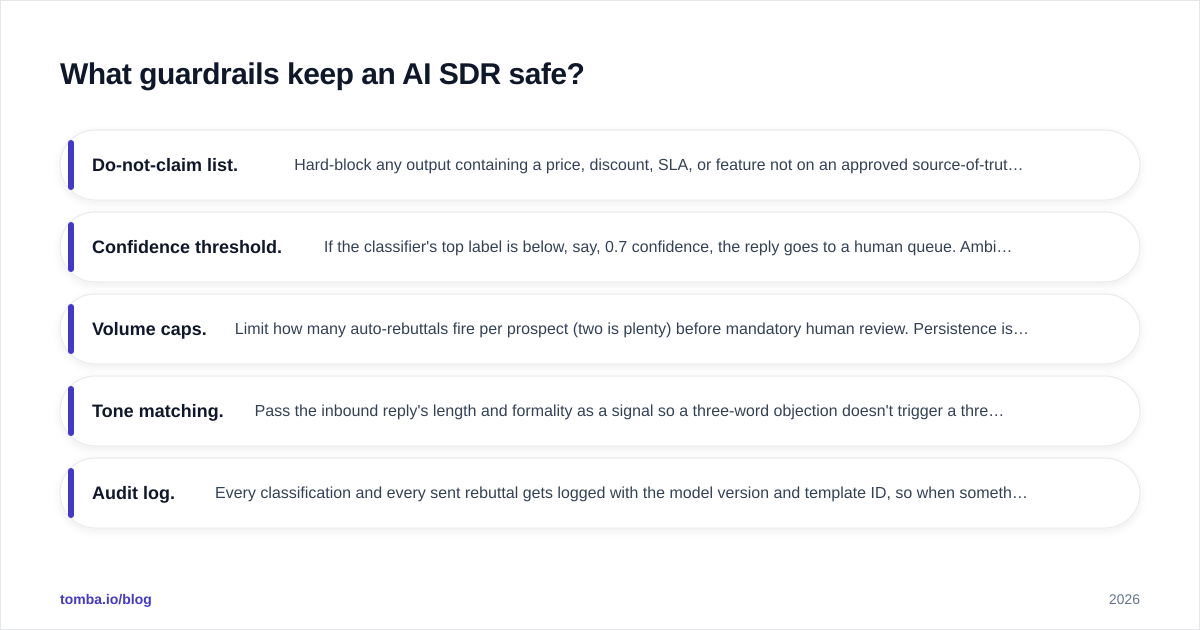
Guardrails are the difference between a tool and a time bomb. Implement these before you turn the system loose on a real list.
- Do-not-claim list. Hard-block any output containing a price, discount, SLA, or feature not on an approved source-of-truth document. Validate against your live pricing page, not the model's memory.
- Confidence threshold. If the classifier's top label is below, say, 0.7 confidence, the reply goes to a human queue. Ambiguity is not the model's friend.
- Volume caps. Limit how many auto-rebuttals fire per prospect (two is plenty) before mandatory human review. Persistence is good; harassment is a lawsuit.
- Tone matching. Pass the inbound reply's length and formality as a signal so a three-word objection doesn't trigger a three-paragraph response.
- Audit log. Every classification and every sent rebuttal gets logged with the model version and template ID, so when something goes wrong you can trace it.
You can wire most of this into your sales automation stack with conditional steps and webhook validation. The point is that the guardrails are code, not vibes. G2's category data on sales AI tools shows the vendors winning on retention are the ones marketing safety and control, not just generation horsepower—the market has already learned this lesson the hard way.
How does data quality affect AI objection handling?#
Data quality is the silent multiplier. The smartest rebuttal engine in the world produces zero pipeline if it's firing into dead inboxes, and worse, bouncing emails drag down the deliverability that lets your good sends land.
Three data failure modes sabotage AI SDRs specifically:
- Bounces from stale lists spike your bounce rate, which mailbox providers read as a spammer signal—now even your well-handled objections land in spam.
- Catch-all domains accept everything and deliver nothing, so the AI thinks the rebuttal sent successfully while the prospect never sees it. A catch-all verifier flags these before you waste a touch.
- Wrong-contact sends route a CFO-targeted budget rebuttal to a junior coordinator who can't act on it—the right message, the wrong human.
This is why the front of the funnel matters as much as the rebuttal logic at the back. Verified contacts mean your objection-handling engine actually gets the at-bats it needs. Pull clean, role-accurate emails with an email finder and verify them before the first send, and your AI SDR's hit rate climbs without touching a single line of the rebuttal code. For phone-based follow-up on high-value objections, layering in a phone finder gives your human reps a second channel when a trust objection escalates out of email.
What's the right tool stack for 2026?#
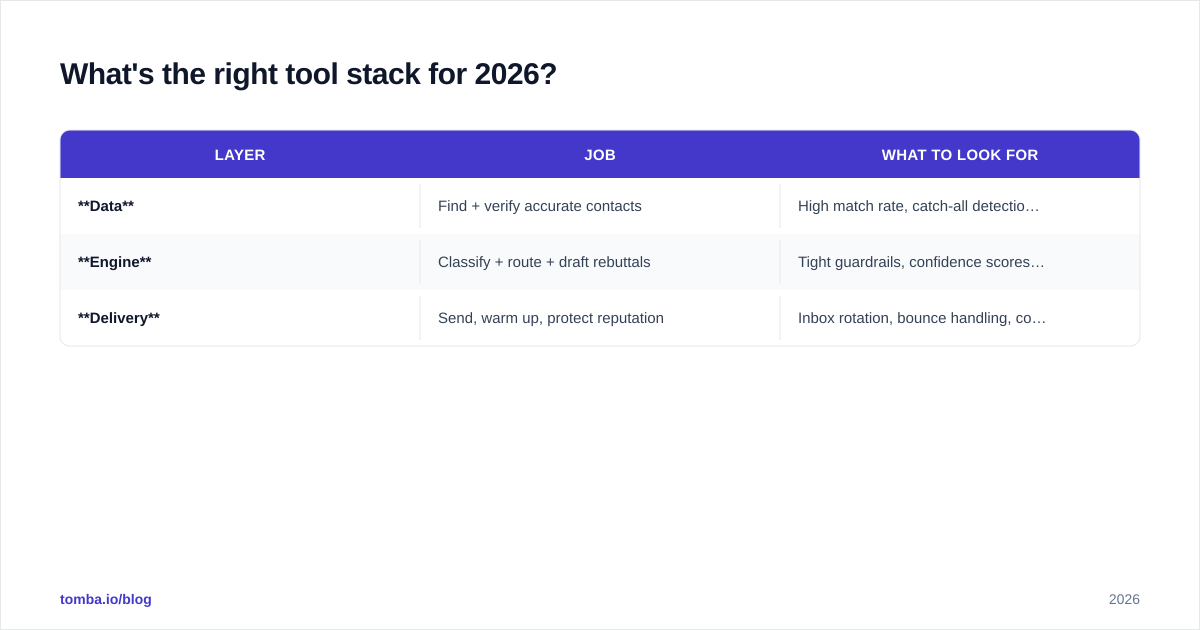
The stack splits into three layers, and most teams over-invest in the middle and under-invest in the first.
| Layer | Job | What to look for |
|---|---|---|
| Data | Find + verify accurate contacts | High match rate, catch-all detection, fresh sources |
| Engine | Classify + route + draft rebuttals | Tight guardrails, confidence scores, human handoff |
| Delivery | Send, warm up, protect reputation | Inbox rotation, bounce handling, complaint monitoring |
The mistake is buying a flashy "AI SDR" engine and skipping the data and delivery layers. A clean foundation—verified contacts feeding a guardrailed rebuttal library sending from a warmed, reputation-safe domain—beats a brilliant model sitting on a swamp of bad data every single time. Check Tomba pricing if you're scoping the data layer; the Free tier (25 searches/mo) is enough to test your match rates before committing, with Starter at $49/mo when you scale.
Closing: start with the inbox that converts#
AI SDR objection handling lives or dies on two things: a finite, vetted rebuttal library wrapped in real guardrails, and accurate data that gets those rebuttals to the right inbox. Get the second one wrong and the first one never matters.
Before you obsess over prompts, fix your foundation. Use the Tomba Email Finder to source role-accurate, verified contacts so every objection your AI SDR handles is one it actually had a chance to win. Start free with 25 searches, confirm your match and bounce rates, then point your rebuttal engine at a list you can trust. The smartest objection handling in the world is wasted on the wrong address—so start with the one that converts.
// get started
Find, verify and enrich your first contacts today
Start on the free plan with 25 searches a month, then scale when your team is ready.
Free plan · No credit card required · GDPR & CCPA
// about the author