AI SDR vs Agency: Which Outbound Engine Wins in 2026?
AI SDRs promise pipeline at software prices; outbound agencies sell experience and done-for-you ops. Here's the honest cost, speed, and quality breakdown for 2026.
You have budget for pipeline and two ways to spend it: license an AI SDR platform that runs outreach on autopilot, or sign a retainer with an outbound agency that does it for you. Both promise booked meetings. They get there very differently, and picking wrong costs you a quarter.
This guide breaks down AI SDR vs agency on the dimensions that actually move revenue: cost, ramp time, lead quality, control, and where each one quietly fails.
TL;DR#
- AI SDRs win on cost-per-touch and speed-to-launch. You own the data, the messaging, and the iteration loop — but you also own the work when it breaks.
- Outbound agencies win on hands-off execution and borrowed expertise. You get a team that's run hundreds of campaigns, but you rent the playbook and pay for headcount.
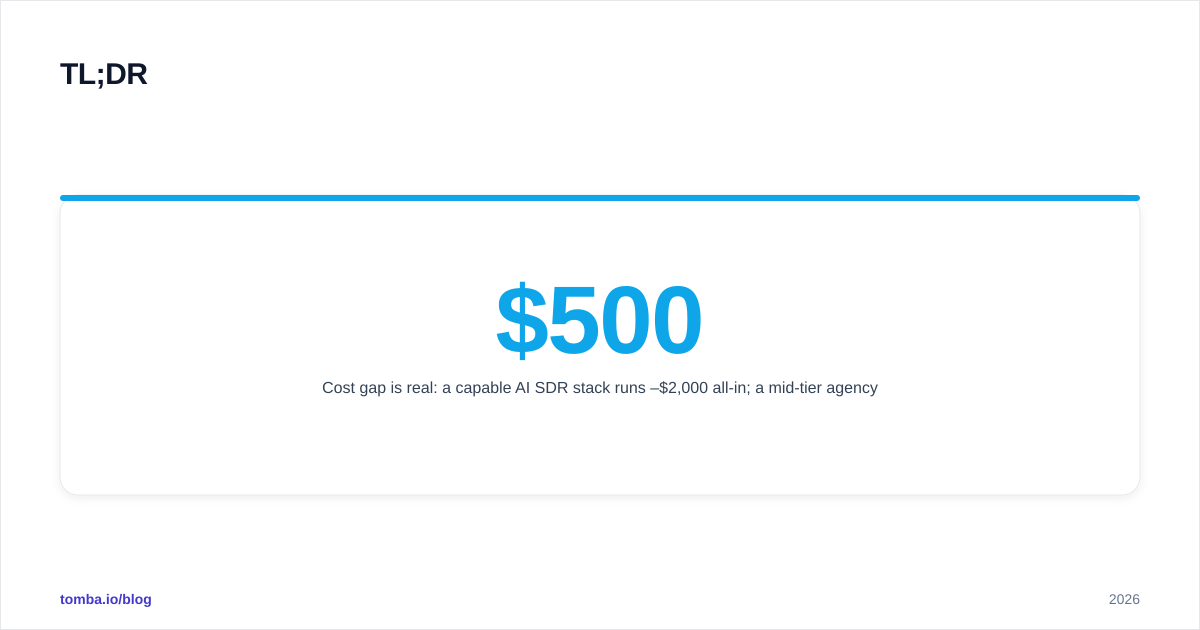
- Cost gap is real: a capable AI SDR stack runs $500–$2,000/mo all-in; a mid-tier agency retainer runs $5,000–$12,000/mo plus a ramp period.
- Quality is a wash on paper — both live or die on your data and offer. Garbage in, garbage out, regardless of who pushes send.
- Best answer for most teams in 2026: a hybrid — AI SDR tooling for volume and data, a human (in-house or fractional) for strategy and reply handling.
What is an AI SDR?#
An AI SDR is software that automates the top-of-funnel sales development rep workflow: building lists, finding contact data, writing and personalizing emails, sequencing follow-ups, and sometimes drafting replies. Think of it as a tireless junior rep who never sleeps, never asks for PTO, and costs less than a single SaaS seat — but who only does exactly what you've configured.
The modern AI SDR category bundles a few jobs that used to need separate tools:
- Lead sourcing — pulling target accounts and contacts from a database
- Email discovery — finding and validating work emails, often via an email finder and email verifier
- Copy generation — drafting first-touch and follow-up messages
- Sequencing & sending — multi-step cadences across inboxes
- Reply triage — classifying responses, sometimes auto-drafting
The catch: an AI SDR executes your strategy. It doesn't invent one. If your ICP is fuzzy or your offer is weak, the AI just sends bad emails faster.
What is an outbound agency?#
An outbound agency is a service business that runs your outbound for you. You hand over your ICP and offer; they staff the campaign with strategists, copywriters, and human or AI-assisted SDRs, then deliver booked meetings or qualified replies against an agreed target.
You're buying three things:
- Execution capacity — people who do the work so your team doesn't
- Borrowed pattern recognition — they've run outbound across many clients and industries
- Accountability — a single throat to choke when meetings don't show up
Agencies range from boutique shops (2–3 people, founder-led, deeply hands-on) to scaled lead-gen factories (templated playbooks, junior staff, high client counts). Quality variance is enormous, which is the single biggest risk in the agency path.
AI SDR vs agency: the head-to-head comparison#
Here's the honest side-by-side. Numbers are 2026 market ranges, not vendor marketing.
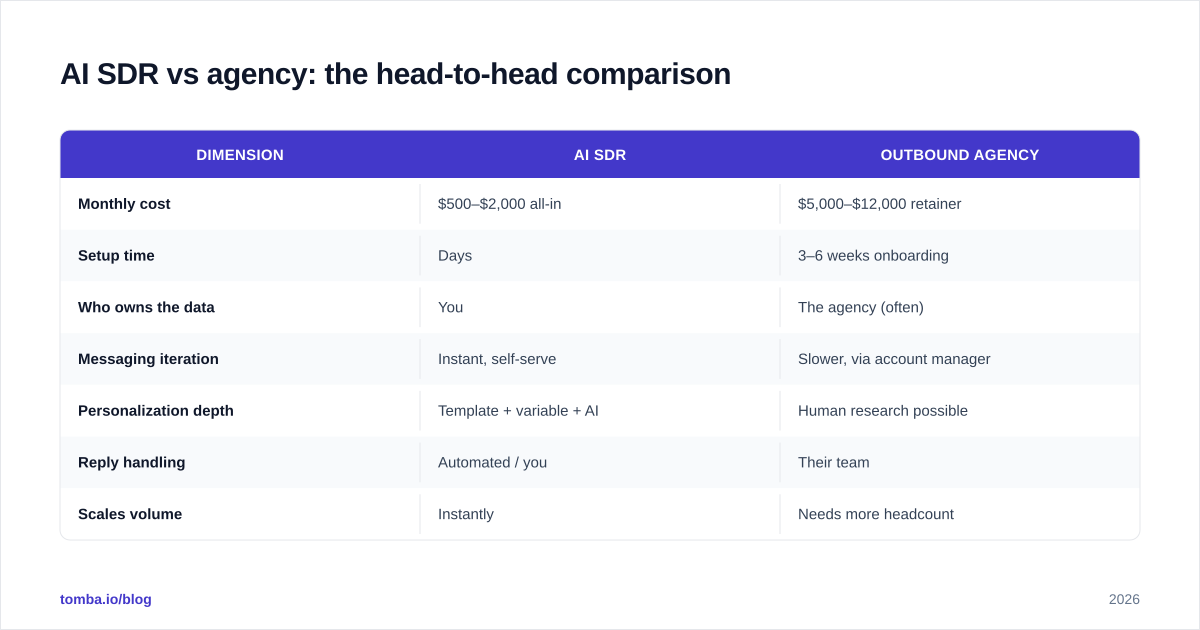
| Dimension | AI SDR | Outbound Agency |
|---|---|---|
| Monthly cost | $500–$2,000 all-in | $5,000–$12,000 retainer |
| Setup time | Days | 3–6 weeks onboarding |
| Who owns the data | You | The agency (often) |
| Messaging iteration | Instant, self-serve | Slower, via account manager |
| Personalization depth | Template + variable + AI | Human research possible |
| Reply handling | Automated / you | Their team |
| Scales volume | Instantly | Needs more headcount |
| Domain expertise | None — you supply it | High (good agencies) |
| Lock-in | Month-to-month typical | 3–6 month contracts common |
| Best for | Lean teams, fast iteration | Hands-off, complex offers |
The pattern: AI SDRs trade expertise for cost and control; agencies trade cost and control for expertise and execution.

Is an AI SDR cheaper than an agency?#
Yes, by a wide margin — but only on the line item. Total cost of ownership is closer than it looks.
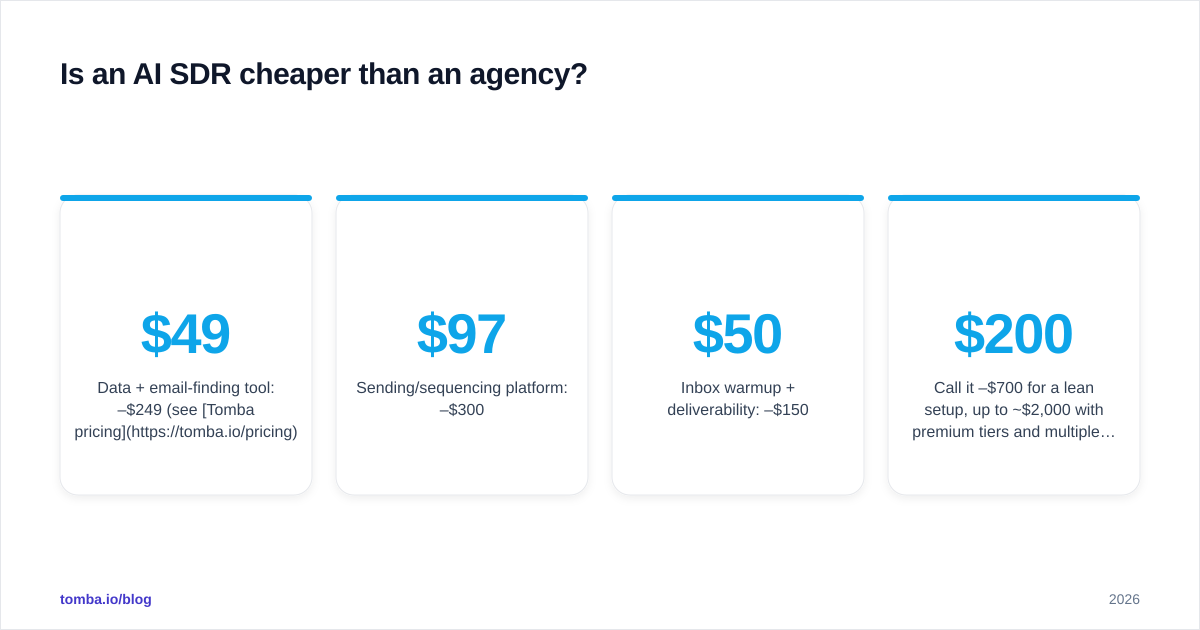
A self-serve AI SDR stack in 2026 typically runs:
- Data + email-finding tool: $49–$249/mo (see Tomba pricing for a concrete example — Free, Starter at $49/mo, Growth at $99/mo, Pro at $249/mo)
- Sending/sequencing platform: $97–$300/mo
- Inbox warmup + deliverability: $50–$150/mo
Call it $200–$700/mo for a lean setup, up to ~$2,000 with premium tiers and multiple inboxes. But that price assumes someone on your team runs it: building lists, writing the offer, reading replies, fixing deliverability. Tally that labor and the gap narrows.
An agency at $8,000/mo looks expensive until you remember it includes the strategist, the copywriter, the SDR hours, the tooling, and the management overhead — all bundled. You're paying a premium for not hiring, not learning, and not babysitting deliverability.
Rule of thumb: if you have someone who can own outbound 10–15 hours a week, AI SDR wins on cost decisively. If nobody on the team can or will, the agency's "expensive" retainer is often cheaper than a bad in-house attempt.
Which produces higher-quality leads?#
Neither, inherently. Lead quality is a function of three things that have nothing to do with whether a human or a bot presses send:
- Targeting accuracy — is your ICP and account list right?
- Data quality — are the emails real, current, and deliverable?
- Offer relevance — does the message earn a reply?
A good agency can out-research an AI on a small, high-value account list — genuine 1:1 personalization still beats spun-template "personalization." But at volume, that edge collapses; agency SDRs fall back on the same templates and the same databases your AI SDR uses.
Where most outbound dies is data, not copy. Bounced emails wreck sender reputation and torch email deliverability before your offer is ever read. This is true for both models, which is why your verification layer matters more than the source. Running lists through an email verifier and screening risky domains with a catch-all verifier protects deliverability whether an AI or an agency is sending.
The uncomfortable truth: many agencies use the same off-the-shelf data and AI tools you'd license directly — and mark them up inside the retainer.
When should you choose an AI SDR?#
Pick the AI SDR path when most of these are true:
- You have product-market fit signals and a repeatable offer — you're scaling something that works, not searching for it
- Someone internal can own the loop (a founder, a growth hire, an ops person)
- You want to iterate messaging weekly, not wait on an account manager
- Budget is tight and you'd rather spend on tools than headcount
- You want to own your data and process as a durable asset
The strategic case: outbound competence compounds. Every week you run it in-house, your team learns your market's objections, what subject lines land, which segments convert. With an agency, that learning walks out the door if you churn. Pairing an AI SDR with a solid B2B database and a clean data enrichment flow turns outbound into an owned capability instead of a rented one.
When should you choose an agency?#
Pick the agency path when:
- Nobody can own outbound internally, and won't for 6+ months
- Your offer is complex or technical and needs senior judgment to position
- You're entering a new market and want borrowed pattern recognition fast
- You need meetings this quarter and can't afford a learning curve
- You're testing whether outbound works at all before committing headcount
A strong agency is essentially a fractional outbound team plus a playbook you couldn't write yet. For a founder-led company with no sales hire, that's often worth the premium — for a defined window. The mistake is treating it as permanent. Smart teams use an agency to bootstrap a motion, document what works, then bring it in-house on AI SDR tooling once the playbook is proven.
Vet agencies hard. Ask for client references in your industry, look them up on G2, and demand to see the actual sequences and data sources they'll use. If they won't show you the engine, they're selling a black box.
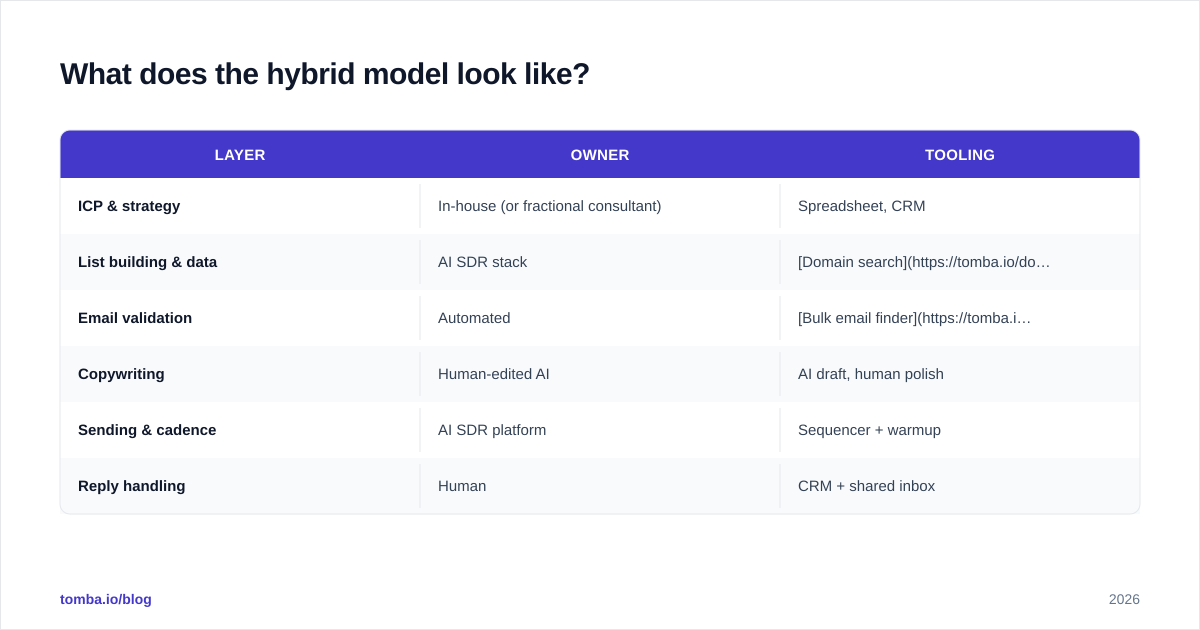
What does the hybrid model look like?#
The answer most 2026 teams land on isn't "AI SDR or agency" — it's a stack where AI does the mechanical work and a human owns judgment.
A common hybrid:
| Layer | Owner | Tooling |
|---|---|---|
| ICP & strategy | In-house (or fractional consultant) | Spreadsheet, CRM |
| List building & data | AI SDR stack | Domain search, email finder |
| Email validation | Automated | Bulk email finder + verifier |
| Copywriting | Human-edited AI | AI draft, human polish |
| Sending & cadence | AI SDR platform | Sequencer + warmup |
| Reply handling | Human | CRM + shared inbox |
This keeps cost near the AI SDR end of the range while preserving the human judgment that agencies charge for. You're not paying a markup on tools you could license, and you keep the learning in-house. A fractional outbound consultant at a few hours a week can supply the strategic layer an agency would otherwise bundle — at a fraction of the retainer.
The connective tissue is data quality. Both the AI and the human depend on contact records being real and current, which is why a dependable email-finding and verification foundation underpins the whole stack regardless of who's doing the strategy.
What are the hidden costs of each?#
AI SDR hidden costs:
- Deliverability management — warmup, domain rotation, monitoring blacklists. Ignore it and your main domain gets burned.
- Learning curve — the first 4–6 weeks are rough while you find your offer
- Tool sprawl — data, sending, warmup, and enrichment can fragment across vendors
- Time — "self-serve" still means someone serves it
Agency hidden costs:
- Ramp period — you often pay full retainer for weeks before meetings flow
- Misaligned incentives — agencies optimize for meetings booked, not pipeline closed; a "qualified meeting" by their definition may not be by yours
- Data ownership — when you leave, the lists, sequences, and learnings may not come with you
- Variance — the senior person who sold you may not be the junior who runs you
Read the contract for who owns the data and what happens to it on exit. That single clause separates a partner from a hostage situation.
AI SDR vs agency: which wins in 2026?#
There's no universal winner — there's a winner for your situation. Map yourself:
- Lean, technical, iterative team with someone to own it → AI SDR. You'll spend less and own more.
- No internal capacity, complex offer, need meetings now → Agency, ideally boutique and industry-specific, on a defined runway.
- Most growing B2B teams → Hybrid. AI SDR tooling for the mechanical 80%, a human for the strategic 20%.
The market trend is unambiguous: as AI SDR tooling gets cheaper and better, the pure done-for-you agency model is squeezed toward the high end — complex, high-ACV, senior-judgment work. Commodity outbound is moving in-house onto AI stacks because the tools that used to require an agency now cost less than a single SaaS seat.
Whichever path you choose, the foundation is the same: accurate contact data and protected deliverability. Start there. If you want to build the in-house side of the equation, Tomba's Email Finder gives you verified, professional emails by name, company, or domain — the reliable data layer an AI SDR needs to perform and the asset an agency would otherwise rent back to you. Pair it with the email verifier to keep bounces low, and you've got the core of an outbound engine you actually own. Spin up the free tier and pressure-test your list quality before you commit a dollar to either model.
// get started
Find, verify and enrich your first contacts today
Start on the free plan with 25 searches a month, then scale when your team is ready.
Free plan · No credit card required · GDPR & CCPA
Get the Tomba newsletter
Product and data updates
// about the author