AI Spintax Writer: How to Scale Cold Email Copy in 2026
Spintax used to mean clunky {hello|hi} swaps that read like a robot wrote them. An AI spintax writer changes the math. Here is how to use one without nuking deliverability.

Spintax has a bad reputation, and most of it is earned. For a decade it meant stuffing {hi|hey|hello} into a template, generating a thousand near-identical emails, and hoping spam filters wouldn't notice. They noticed. An AI spintax writer flips the problem: instead of you hand-writing every alternative, a language model produces variations that actually read like a human wrote them — different sentence structure, different framing, same intent.
This guide explains what an AI spintax writer is, how the syntax works, when variation actually helps deliverability (and when it's theater), and how to pick a tool that won't make your copy sound worse.
TL;DR#
- Spintax is a markup syntax —
{option A|option B|option C}— that expands one template into many unique message variants. - An AI spintax writer generates those alternatives for you with an LLM, so variations differ in structure, not just synonyms, and don't read like a thesaurus exploded.
- Variation helps deliverability mainly by reducing identical-content footprints across a sending pool; it is not a substitute for proper authentication, warmup, and list hygiene.
- The biggest risk is quality drift: bad spin produces grammatically broken or off-tone sentences that hurt reply rates more than duplicate content ever would.
- Pair spin with accurate targeting data — a perfectly varied email to the wrong person still fails. Start with a clean list from a real email finder.
What is an AI spintax writer?#
An AI spintax writer is a tool that takes a single piece of copy and produces multiple natural-sounding versions of it, either by outputting spintax markup you paste into a sending platform, or by generating fully-expanded unique variants directly.
Think of spintax like a recipe with substitutions written into it. A normal recipe says "add basil." A spintax recipe says "add {basil|oregano|thyme}." Each time you cook, you pick one. Traditional spinners stop there — they swap words. An AI spintax writer rewrites the whole sentence: "add basil," "a handful of fresh basil works here," or "finish with torn basil leaves." Same dish, genuinely different prose.
The syntax itself is simple. Curly braces wrap the options, pipes separate them, and they can nest:
{Hi|Hey|Hello} {{first_name}},

I {noticed|saw|came across} that {{company}} {is hiring|just raised|recently launched}.
One template like that expands into dozens of combinations. The AI layer is what decides which alternatives are worth offering — and, crucially, rejects the ones that produce broken grammar like "Hey Hello there."
How does spintax syntax actually work?#
Spintax is parsed at send time. The sending tool walks the template, and for every {a|b|c} group it randomly selects one option, then assembles the final message. Nesting lets you vary inside a variation:
{I'd love to {chat|connect}|Would you be open to a {quick call|short chat}} this week?That single line can resolve to four distinct sentences. Multiply a few of these across an email and the unique-combination count climbs into the thousands fast — which is the entire point: no two recipients get a byte-identical message.
A few syntax rules that trip people up:
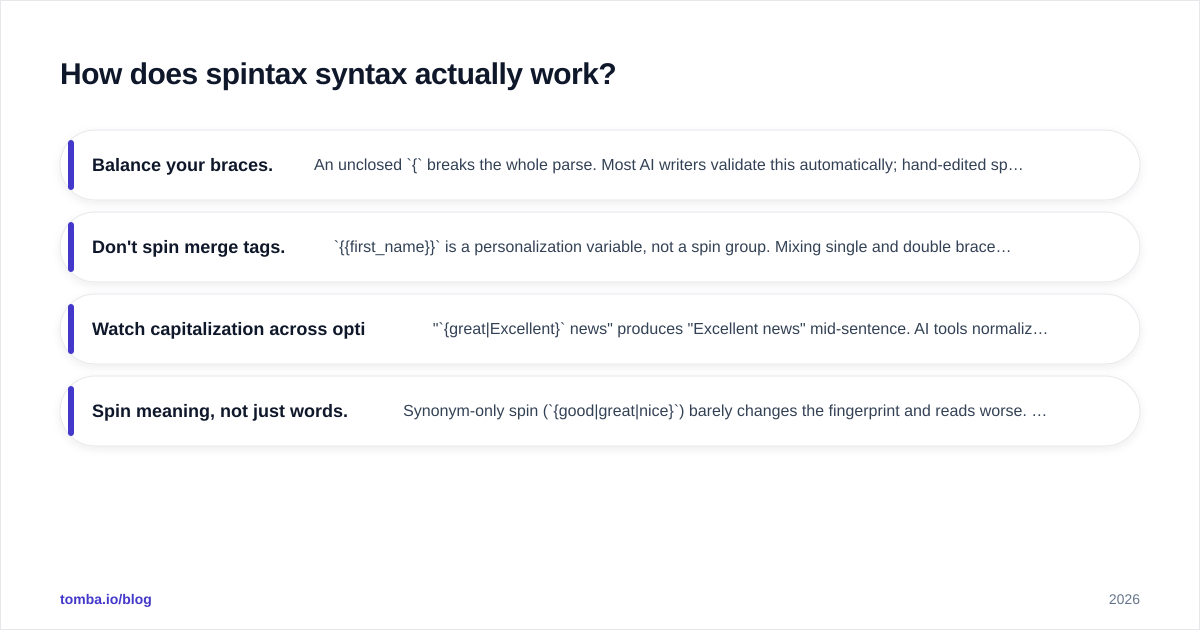
- Balance your braces. An unclosed
{breaks the whole parse. Most AI writers validate this automatically; hand-edited spintax often doesn't. - Don't spin merge tags.
{{first_name}}is a personalization variable, not a spin group. Mixing single and double braces is the most common bug. - Watch capitalization across options. "
{great|Excellent}news" produces "Excellent news" mid-sentence. AI tools normalize this; manual spin rarely does. - Spin meaning, not just words. Synonym-only spin (
{good|great|nice}) barely changes the fingerprint and reads worse. Structural spin changes sentence shape.
Why does email variation matter for deliverability?#
Short answer: mailbox providers treat large volumes of byte-identical messages from a young or mid-reputation domain as a spam signal. Variation reduces that footprint. But variation is a supporting actor, not the lead.
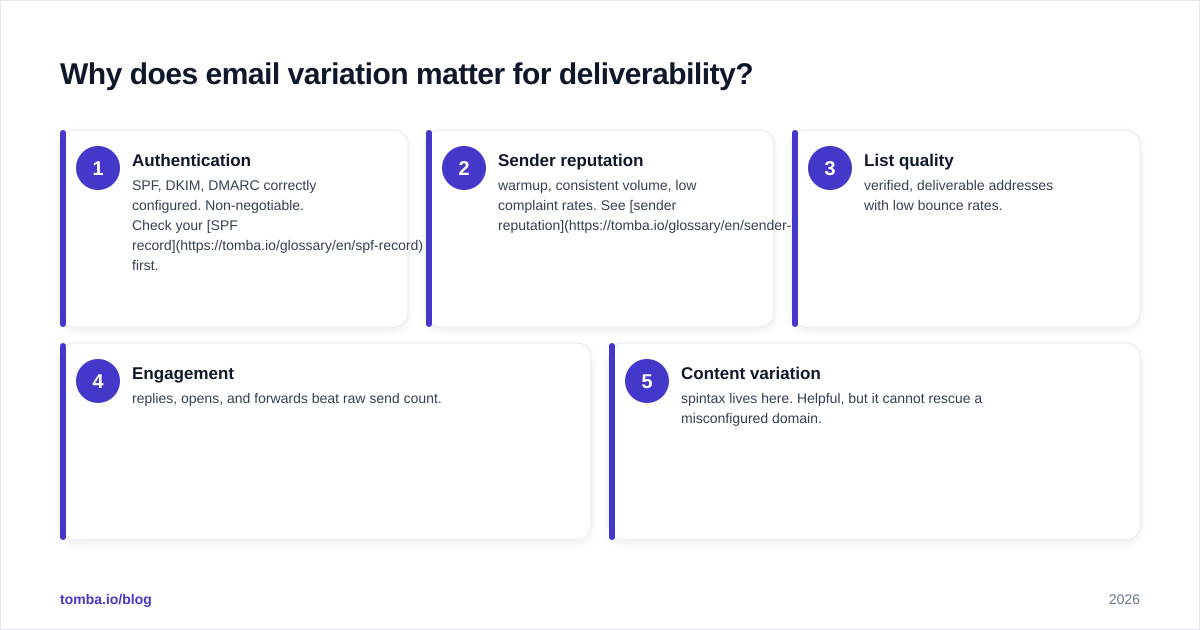
Here's the honest hierarchy of what protects your inbox placement, in order of impact:
- Authentication — SPF, DKIM, DMARC correctly configured. Non-negotiable. Check your SPF record first.
- Sender reputation — warmup, consistent volume, low complaint rates. See sender reputation.
- List quality — verified, deliverable addresses with low bounce rates.
- Engagement — replies, opens, and forwards beat raw send count.
- Content variation — spintax lives here. Helpful, but it cannot rescue a misconfigured domain.
If you spin copy beautifully but send to a list full of dead addresses, your bounce rate spikes and the variation is irrelevant. That's why content variation and data quality are two sides of the same workflow. Run your list through an email verifier before you spin a single word. For the underlying mechanics, the email deliverability glossary is a good primer, and providers like HubSpot publish solid deliverability fundamentals.
Is an AI spintax writer better than manual spintax?#
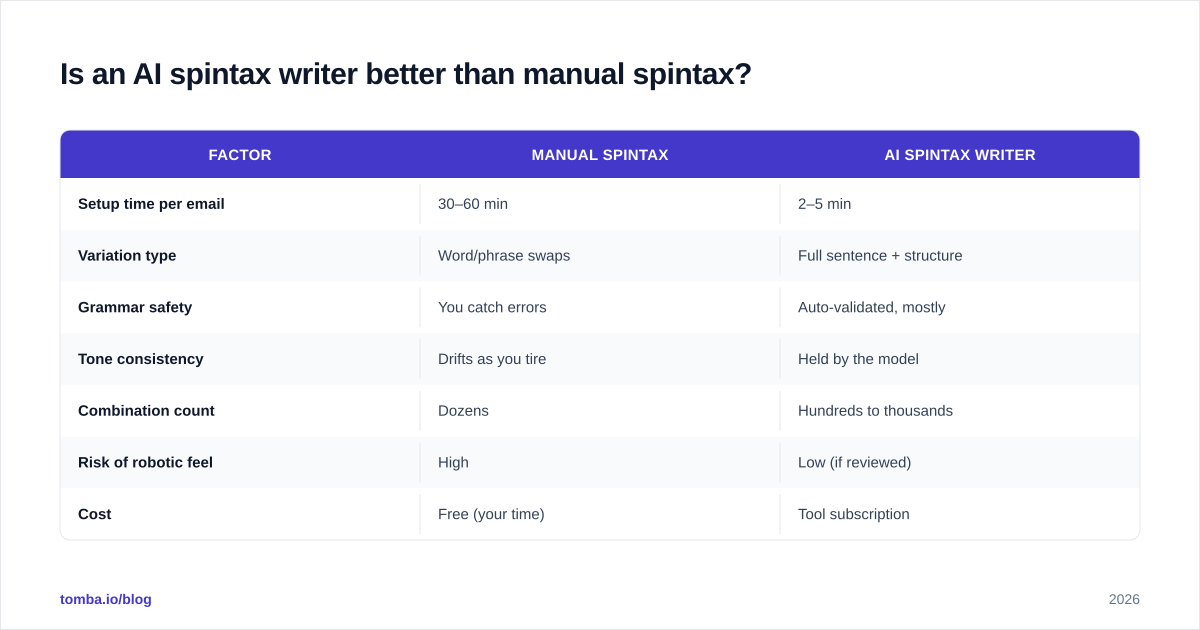
For anything beyond trivial swaps, yes — but the gap is about quality, not just speed. Manual spintax is fine when you have three greetings and a tight deadline. The moment you want structural variation across an entire email, hand-writing every branch becomes a slog and the quality degrades as you tire.
| Factor | Manual spintax | AI spintax writer |
|---|---|---|
| Setup time per email | 30–60 min | 2–5 min |
| Variation type | Word/phrase swaps | Full sentence + structure |
| Grammar safety | You catch errors | Auto-validated, mostly |
| Tone consistency | Drifts as you tire | Held by the model |
| Combination count | Dozens | Hundreds to thousands |
| Risk of robotic feel | High | Low (if reviewed) |
| Cost | Free (your time) | Tool subscription |
| Best for | One-off, simple | Scaled, multi-segment |
The catch with AI spin is the opposite of manual: it's too easy to generate variants you never read. A model can quietly produce a sentence that's grammatical but off-brand, or subtly changes your offer. The non-negotiable step is human review of the variant pool before it ships. Treat the AI as a fast first draft, not a finished campaign.
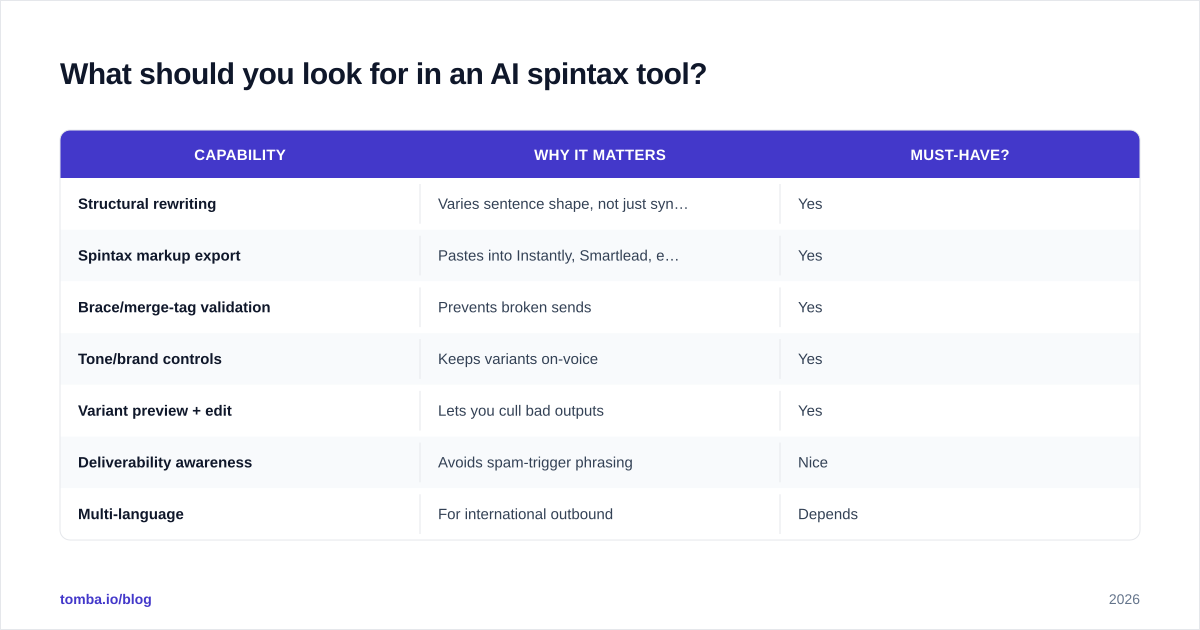
What should you look for in an AI spintax tool?#
Not all "AI spinners" are built for cold email. Many are SEO article spinners repurposed, and they optimize for keyword density, not human reply rates. Here's what actually matters for outbound.
| Capability | Why it matters | Must-have? |
|---|---|---|
| Structural rewriting | Varies sentence shape, not just synonyms | Yes |
| Spintax markup export | Pastes into Instantly, Smartlead, etc. | Yes |
| Brace/merge-tag validation | Prevents broken sends | Yes |
| Tone/brand controls | Keeps variants on-voice | Yes |
| Variant preview + edit | Lets you cull bad outputs | Yes |
| Deliverability awareness | Avoids spam-trigger phrasing | Nice |
| Multi-language | For international outbound | Depends |
| CRM/data integration | Feeds personalization | Nice |
If you already write with an AI assistant, a dedicated cold email AI writer that understands outbound structure will outperform a generic article spinner every time. Pair it with a subject line generator so your subjects vary alongside the body — a spun body with one static subject line still leaves an obvious fingerprint.

How do you use spintax without sounding like a robot?#
The robot-voice problem is the number one reason spintax campaigns flop. Here's the workflow that avoids it.
1. Write one excellent base email first. Spin amplifies whatever you start with. If the base is bland, you get a thousand bland variants. Nail the hook, the relevance, and the single clear ask before you spin anything. Browse proven structures in the email templates library if you need a starting point.
2. Spin the low-risk parts, freeze the high-risk parts. Vary greetings, transitions, and sign-offs freely. Be conservative with your value proposition and call to action — those carry meaning you don't want drifting across variants.
3. Cap your variation depth. You don't need 10 options per group. Three to four strong alternatives per spin point already produce hundreds of combinations. More options means more chances for a weak variant to ship.
4. Read a random sample of expanded outputs. Generate 15–20 full expansions and read them as a recipient would. If any sounds awkward, fix the source spin group. This five-minute check catches most quality problems.
5. Keep personalization separate from spin. A {{first_name}} merge tag or a custom first line referencing the prospect's company does more for reply rates than any amount of synonym variation. Spin makes you different; personalization makes you relevant. You need both, and relevance wins.
6. Don't over-spin to chase volume. If you're spinning aggressively to send 10,000 cold emails a day off three domains, the spin isn't your problem — the volume-to-reputation ratio is. Fix the foundation.
How does spin fit into a real outbound stack?#
Spintax is one stage in a pipeline, and it only pays off when the stages around it are solid. A realistic flow:
- Source contacts — pull verified, role-matched prospects. Garbage targeting can't be spun into relevance. A domain search finds the right people at each company.
- Verify — drop invalid and risky addresses to protect bounce rate.
- Segment — group by persona so your base copy is relevant to each.
- Write base copy — one strong email per segment.
- Spin — AI generates the variation layer on top.
- Validate — check braces, merge tags, and read samples.
- Send with warmed domains — authenticated, reputation-built, sane volume.
- Measure replies, not sends — iterate the base copy based on what books meetings.
Notice that spin sits in the middle and depends entirely on steps 1–2. This is why teams that obsess over spintax while ignoring data quality plateau fast. The variation layer is cosmetic if the targeting is wrong. Industry review sites like G2 make this clear in their outbound tooling categories: data and deliverability features consistently outrank "copy variation" in buyer priorities, and tools like Instantly treat spintax as one feature among many, not the headline.
What are the limits and risks of AI spin?#
A few things an AI spintax writer will not do for you:
- It won't fix bad authentication. Spammy-looking spin on an unauthenticated domain still lands in spam.
- It won't make irrelevant offers relevant. Variation is not personalization.
- It can introduce subtle factual drift. A model rewriting your offer might change a number or a claim. Review high-stakes lines.
- Over-aggressive spin reads worse than no spin. Twelve synonym options per word produces uncanny, generic prose. Restraint beats volume.
- Some filters now score "spun-text" patterns. Heavy synonym substitution has a detectable statistical signature. Structural variation from a good AI writer is far safer than old-school word spinning.
Used with judgment, spin is a useful tool. Used as a crutch for poor fundamentals, it's a fast way to torch a domain. For more on the underlying technique and its SEO-era history, the Wikipedia entry on article spinning is a fair, neutral overview of why crude spinning fell out of favor.
Frequently asked questions#
Does spintax actually improve deliverability? It reduces the identical-content footprint across your sending pool, which removes one spam signal. It does not replace authentication, warmup, or list hygiene — those matter far more.
How many variations do I need? Enough that recipients in the same campaign don't receive byte-identical messages. Three to four options across a handful of spin points gets you into the hundreds of combinations, which is plenty for most volumes.
Will AI spin make my emails sound generic? It can, if you over-spin or skip review. Strong base copy plus a quick read-through of sampled outputs keeps the quality high.
Is spintax against email provider rules? Variation itself is allowed. The deceptive intent behind high-volume unsolicited mail is what gets penalized. Spin a legitimate, permissioned campaign and you're fine; spin a spam blast and the spin won't save you.
Where to start#
If you're building an outbound motion in 2026, sequence it correctly: clean data first, copy second, spin last. A flawless spun email to a verified, well-targeted prospect outperforms a thousand spun emails to a scraped, unverified list every time.
Start by building a list you can trust. The Tomba Email Finder gives you accurate, verified professional emails by name, company, or domain — so the variation layer you build on top actually reaches real people. It starts free with 25 searches a month, and paid plans begin at $49/mo on the Starter tier; see full Tomba pricing for Growth, Pro, and Enterprise options. Get the targeting right, write one great email, then let your AI spintax writer scale the variation — in that order.
// get started
Find, verify and enrich your first contacts today
Start on the free plan with 25 searches a month, then scale when your team is ready.
Free plan · No credit card required · GDPR & CCPA
// about the author