AI Tools for B2B Marketing in 2026: The Complete Stack
A no-hype breakdown of the AI tools for B2B marketing that actually move pipeline in 2026 — by use case, price, and where each one breaks down.
You can buy 40 AI marketing tools and still miss your number. The teams that win in 2026 aren't the ones with the longest stack — they're the ones who matched a handful of AI tools to the exact jobs that were slowing pipeline down. This guide is the short version of how to do that.
TL;DR#
- AI tools for B2B marketing fall into five jobs: content, ABM/targeting, data and enrichment, marketing ops/automation, and analytics. Buy by job, not by hype.
- The biggest ROI in 2026 is rarely "AI writes my blog." It's clean data feeding everything downstream — bad contact data poisons every AI workflow on top of it.
- Most "AI marketing platforms" are a thin layer over GPT-class models. Pay for proprietary data, integrations, and workflow — not for a chat box you already have.
- A lean stack beats a sprawling one. Five tools you actually operate outperform fifteen you half-configured.
- Start with the data layer, then content, then automation. Tools like Tomba's data enrichment sit at the bottom of the stack because everything above depends on accurate contacts.
What counts as an "AI tool for B2B marketing" in 2026?#
Short answer: any tool where a model does meaningful work a human used to do — generating copy, scoring accounts, predicting intent, cleaning data, or routing leads.
Think of your marketing stack like a kitchen. The AI isn't the chef — it's the set of power tools. A stand mixer doesn't decide the menu; it just does the heavy mixing faster so the chef ships more plates. The marketers who get value treat AI the same way: it accelerates a defined job, it doesn't define the strategy.
That framing matters because vendors blur it on purpose. "AI-powered" now appears on roughly every B2B SaaS landing page. The useful question isn't does it have AI — it's which job does it do, and does it do that job better than what I already own?
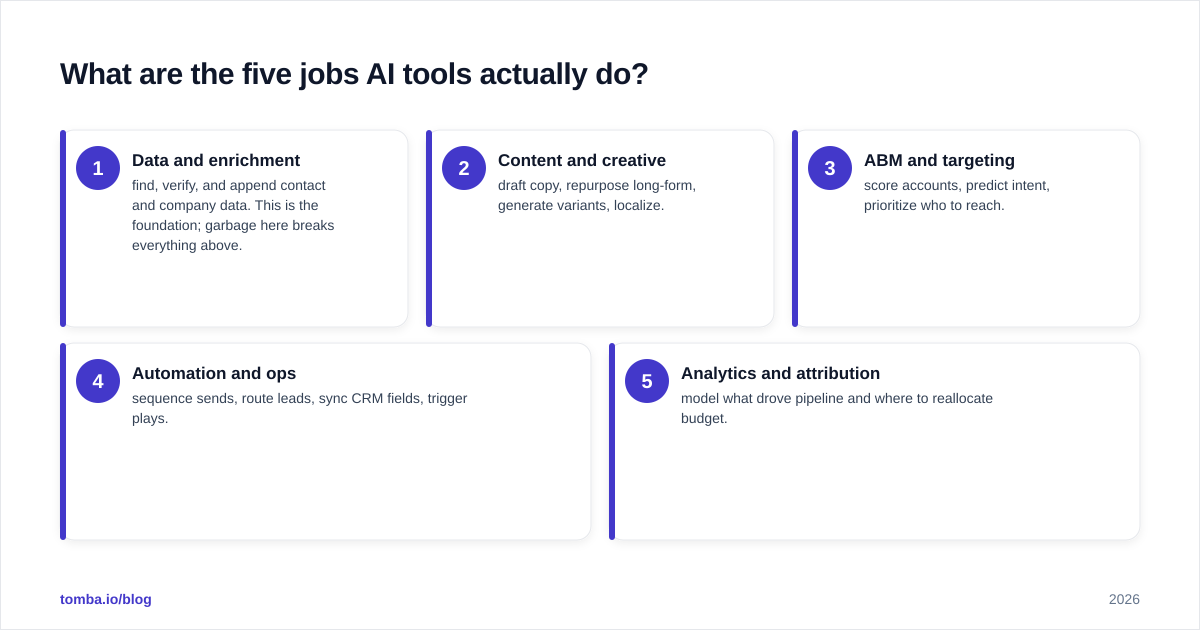
What are the five jobs AI tools actually do?#
Every credible tool maps to one of five layers. Buy top-down by strategy, build bottom-up by dependency.
- Data and enrichment — find, verify, and append contact and company data. This is the foundation; garbage here breaks everything above.
- Content and creative — draft copy, repurpose long-form, generate variants, localize.
- ABM and targeting — score accounts, predict intent, prioritize who to reach.
- Automation and ops — sequence sends, route leads, sync CRM fields, trigger plays.
- Analytics and attribution — model what drove pipeline and where to reallocate budget.
The order is deliberate. A team that buys a slick content generator before fixing its contact database just produces personalized emails to wrong addresses faster.
)
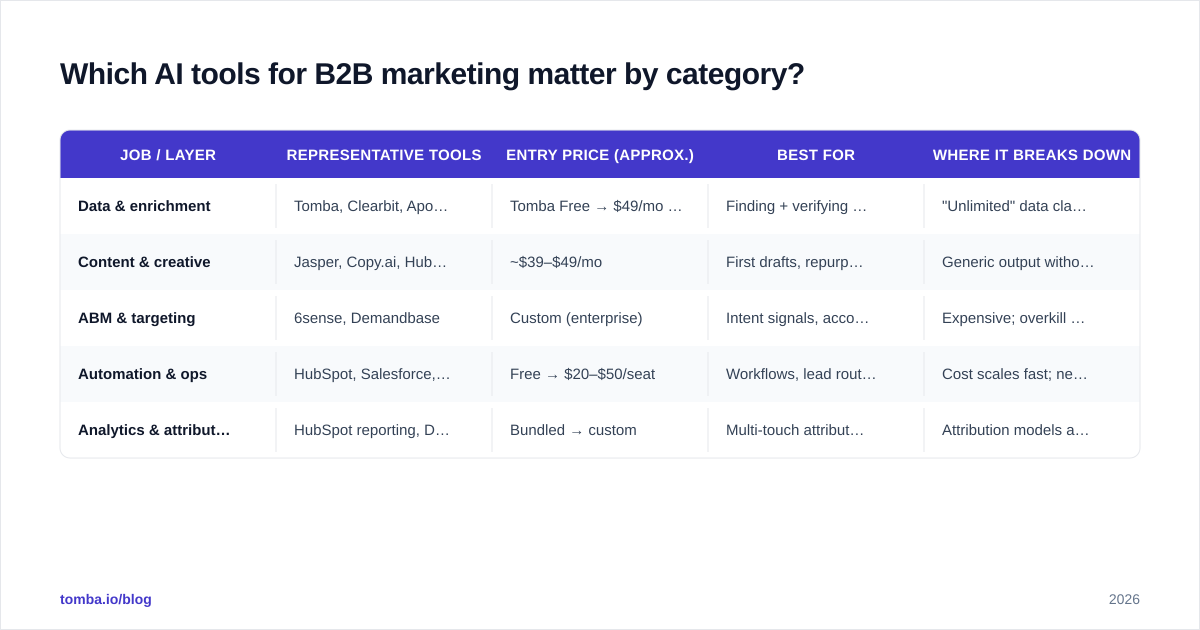
Which AI tools for B2B marketing matter by category?#
Here's a concrete map. Prices are list prices for the entry paid tier as of mid-2026 and move often — always confirm on the vendor's own pricing page before you commit budget.
| Job / Layer | Representative tools | Entry price (approx.) | Best for | Where it breaks down |
|---|---|---|---|---|
| Data & enrichment | Tomba, Clearbit, Apollo | Tomba Free → $49/mo Starter | Finding + verifying decision-maker emails and firmographics | "Unlimited" data claims; verify accuracy before scaling |
| Content & creative | Jasper, Copy.ai, HubSpot AI | ~$39–$49/mo | First drafts, repurposing, variant testing | Generic output without strong brand prompts and human edit |
| ABM & targeting | 6sense, Demandbase | Custom (enterprise) | Intent signals, account prioritization | Expensive; overkill below a few hundred target accounts |
| Automation & ops | HubSpot, Salesforce, Make | Free → $20–$50/seat | Workflows, lead routing, CRM sync | Cost scales fast; needs an owner who actually configures it |
| Analytics & attribution | HubSpot reporting, Dreamdata | Bundled → custom | Multi-touch attribution, spend reallocation | Attribution models are estimates, not ground truth |
A few honest notes on this table. The enterprise ABM tools (6sense, Demandbase — see their listings on G2 for current reviews) deliver real lift when you have a defined account list and a sales team to act on signals. Below that scale, the intent data is noise you'll pay five figures to ignore. And the content tools are increasingly commoditized — the model underneath is usually the same GPT-class engine, so you're really paying for the workflow, templates, and brand controls around it.
Where does AI deliver the highest ROI in B2B marketing?#
The highest ROI is the least glamorous layer: clean, verified data feeding everything else.
Here's the mechanism. Every AI workflow downstream — personalized sequences, lead scoring, intent routing — multiplies whatever it's given. Feed it a list that's 30% stale or unverified, and you don't get a 30% haircut; you get bounced sends that damage sender reputation, polluted analytics, and reps chasing ghosts. The error compounds at every layer.
That's why teams that fix the data layer first see disproportionate returns. When you reliably reach the right person, modest content and a simple sequence outperform brilliant copy sent to bad addresses. If you're building or cleaning a target list, an email verifier and a bulk email finder do more for pipeline than another content subscription.
The second-highest ROI is repurposing, not net-new generation. One strong webinar or report can become a dozen LinkedIn posts, an email series, and a landing page. AI is genuinely good at that transformation, and it's low risk because a human already validated the source idea.
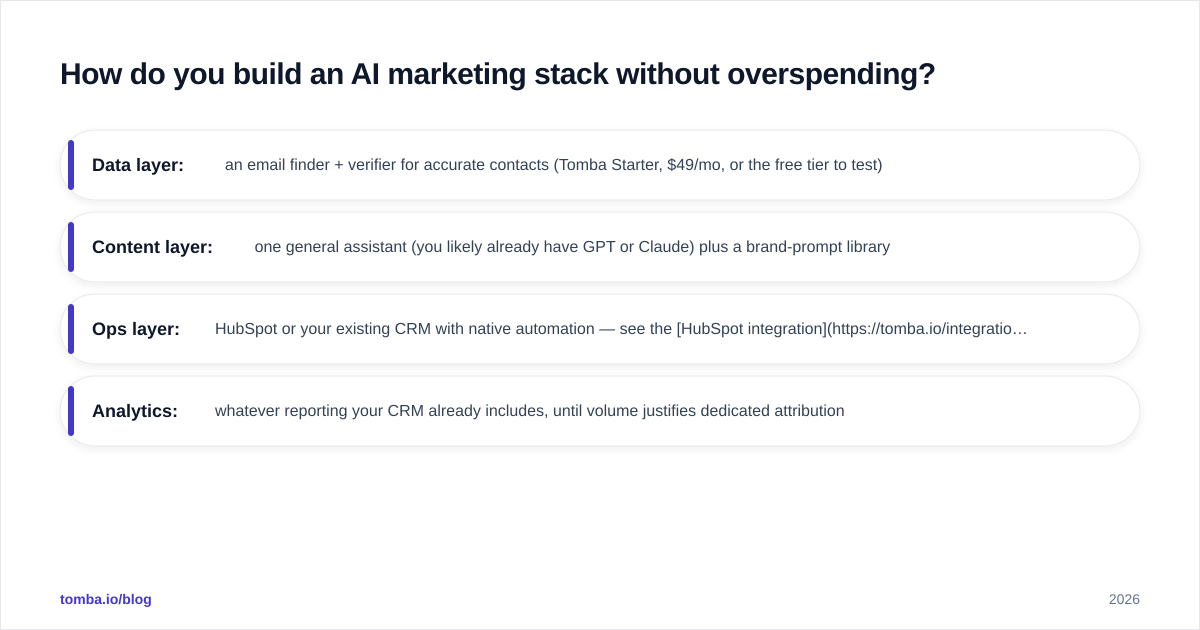
How do you build an AI marketing stack without overspending?#
Pick one tool per job, master it, then expand. Most stack bloat comes from buying the second tool in a category before extracting value from the first.
A practical 2026 starter stack for a lean B2B team:
- Data layer: an email finder + verifier for accurate contacts (Tomba Starter, $49/mo, or the free tier to test)
- Content layer: one general assistant (you likely already have GPT or Claude) plus a brand-prompt library
- Ops layer: HubSpot or your existing CRM with native automation — see the HubSpot integration to push enriched contacts straight in
- Analytics: whatever reporting your CRM already includes, until volume justifies dedicated attribution
That's three to four tools. Add ABM intent data only when you have a named account list and sales capacity to work the signals — otherwise you're paying enterprise prices for a dashboard nobody acts on.
Resist the temptation to chase every launch. The shiny new tool is almost never the constraint on your pipeline; execution on the tools you own usually is.
Is an all-in-one AI platform better than best-of-breed tools?#
It depends on your team size and how much you value integration over depth.
All-in-one (HubSpot, Salesforce Marketing Cloud, Adobe) wins when you're small enough that integration overhead hurts and you'd rather have one login, one data model, and decent-everything. The trade-off is that the AI features in suites tend to lag specialist tools by a release cycle or two.
Best-of-breed wins when a specific job is your bottleneck and a focused tool does it dramatically better — say, data accuracy or intent scoring. The cost is integration work and more vendors to manage.
| Decision factor | All-in-one suite | Best-of-breed |
|---|---|---|
| Setup speed | Fast — one platform | Slower — multiple integrations |
| Depth per feature | Good enough | Best in category |
| Data unification | Native | Requires syncing (Zapier, Make) |
| Cost at scale | Predictable, climbs with seats | Variable, per-tool |
| Best for | Teams under ~20 in marketing | Teams with a clear, costly bottleneck |
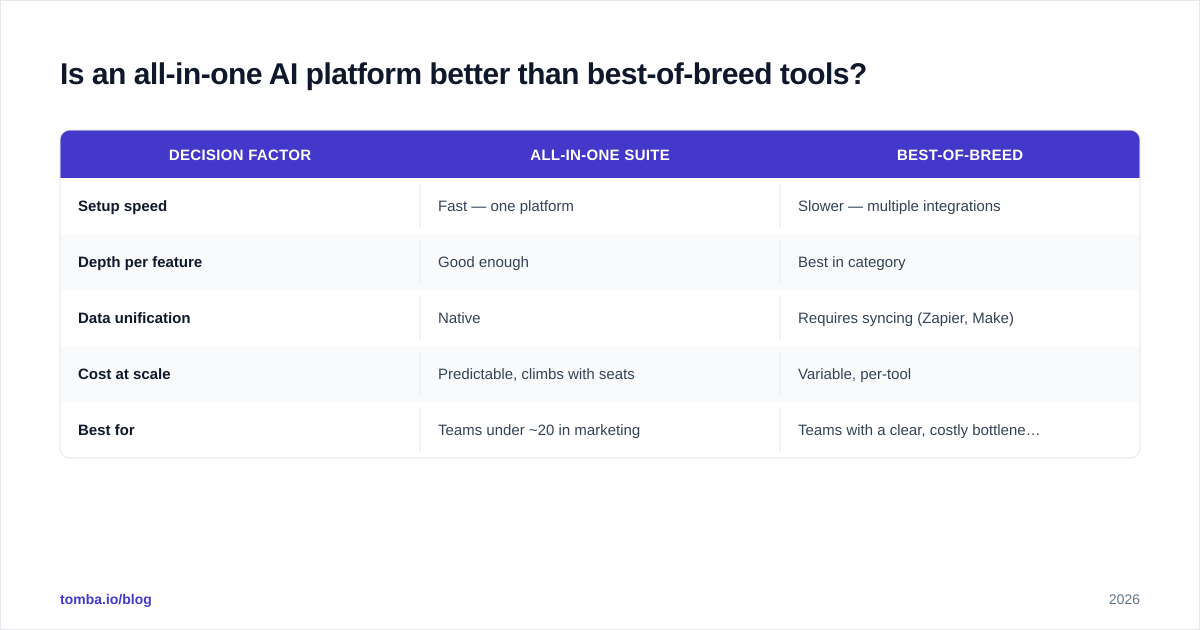
The pragmatic answer for most mid-market teams in 2026: a suite as the backbone, plus one or two best-of-breed tools where you have a real, measurable bottleneck. Data is the most common place to go best-of-breed, because suite-native enrichment is usually shallow. You can wire a specialist source into your suite through Tomba's integrations — Zapier, Make, HubSpot, or Salesforce — and keep one source of truth.
)
What should you avoid when buying AI marketing tools?#
A short list of the traps that drain budgets:
- "Unlimited" data plans. Volume without verified accuracy is a liability. Ask for accuracy benchmarks and test on your own known contacts.
- Buying the model, not the moat. If a tool's only value is calling a public LLM, you can do that yourself for a fraction of the price. Pay for proprietary data, integrations, and workflow.
- Tools without an owner. Every tool needs someone accountable for configuring and operating it. An unowned tool is a recurring charge, not a capability.
- Attribution as gospel. AI attribution models are useful directional estimates. Treating them as ground truth leads to confident bad reallocation.
- Skipping verification on AI-generated lists. Models will happily invent plausible-looking email patterns. Always run generated or scraped contacts through verification before sending.
If you want to sanity-check a single address fast, a free email checker catches the obvious misses before they ever hit a sequence.
How will AI tools for B2B marketing change over the next year?#
Three shifts worth planning for, stated plainly — and I'd treat these as informed expectations, not certainties.
Agents move from demo to daily use. Tools that don't just draft but execute — building a list, enriching it, sequencing outreach, and updating the CRM — are maturing. The teams that benefit will be the ones whose data is clean enough to trust an agent with.
The model layer keeps commoditizing. As frontier models converge, differentiation moves to data and distribution. Expect content-generation prices to fall and data-quality vendors to hold value.
Privacy and deliverability tighten. Inbox providers keep raising the bar. Maintaining email deliverability will depend more on list hygiene and verification than on clever copy — another reason the data layer keeps winning.
For a broader vendor landscape and current user reviews, Gartner's marketing technology coverage and category pages on Capterra are reasonable neutral starting points before any purchase.
The bottom line#
Buy AI tools for B2B marketing by job, build the stack from the data layer up, and stay lean. Five well-operated tools beat fifteen half-configured ones, and accurate contact data is the foundation every other layer multiplies — for better or worse.
If you're fixing that foundation first, start where the leverage is highest. The Tomba Email Finder finds and verifies decision-maker emails by name, company, or domain, with a free tier (25 searches/month) to test against your own known contacts and paid plans from $49/mo when you scale. Check current Tomba pricing, feed clean data into your stack, and let the rest of your AI tools do their jobs on contacts that are actually real.
Ready to find emails that actually work?
Join 150,000+ professionals who stopped guessing and started sending. Free credits on signup — no credit card required.
Get the Tomba newsletter
Practical outbound tactics and product updates — once every two weeks.
About the author