AIDA Email Template: The 2026 Cold Email Framework
The AIDA email template turns cold outreach into a four-step persuasion flow. Get copy-paste examples, a comparison vs other frameworks, and the metrics that matter in 2026.
TL;DR
- The AIDA email template structures cold outreach into four moves — Attention, Interest, Desire, Action — so every line earns the next one.
- It works because it mirrors how a busy prospect actually reads: a hook in the subject and first line, relevance in the body, proof of value, then one clear ask.
- AIDA outperforms feature-dump emails on reply rate because it leads with the reader's world, not your product.
- Below: copy-paste templates for cold sales, follow-ups, and re-engagement, plus a comparison against PAS, BAB, and the 4 Ps.
- A framework is only as good as the contact data behind it — a clean, verified list is what makes the "Action" step convert.
What is the AIDA email template?#
The AIDA email template is a four-part writing structure that walks a reader from "who is this?" to "I'll reply" in a single message. AIDA stands for Attention, Interest, Desire, Action — a copywriting model that's been around since the late 1800s and still maps cleanly onto a cold email today.
Think of it like a conversation at a conference. You don't open by reciting your pricing tiers. You say something that makes the other person look up (Attention), connect it to a problem they have (Interest), show them what life looks like solved (Desire), then suggest a next step — "want me to send the deck?" (Action). AIDA just enforces that order on the page.
The model predates email by a century; it was first described for advertising and sales by E. St. Elmo Lewis and is documented in detail on Wikipedia's AIDA marketing entry. What changed in 2026 is the attention budget: the average B2B buyer scans a cold email in under three seconds before deciding to read or archive. AIDA is built for exactly that triage.
Why does the AIDA structure get more replies?#
Because it front-loads relevance and ends with one decision. Most failed cold emails break one of two rules: they lead with the sender ("We're a platform that...") or they end with three competing asks ("reply, or book a call, or check our site"). AIDA fixes both by design.
Here's the psychology behind each stage:
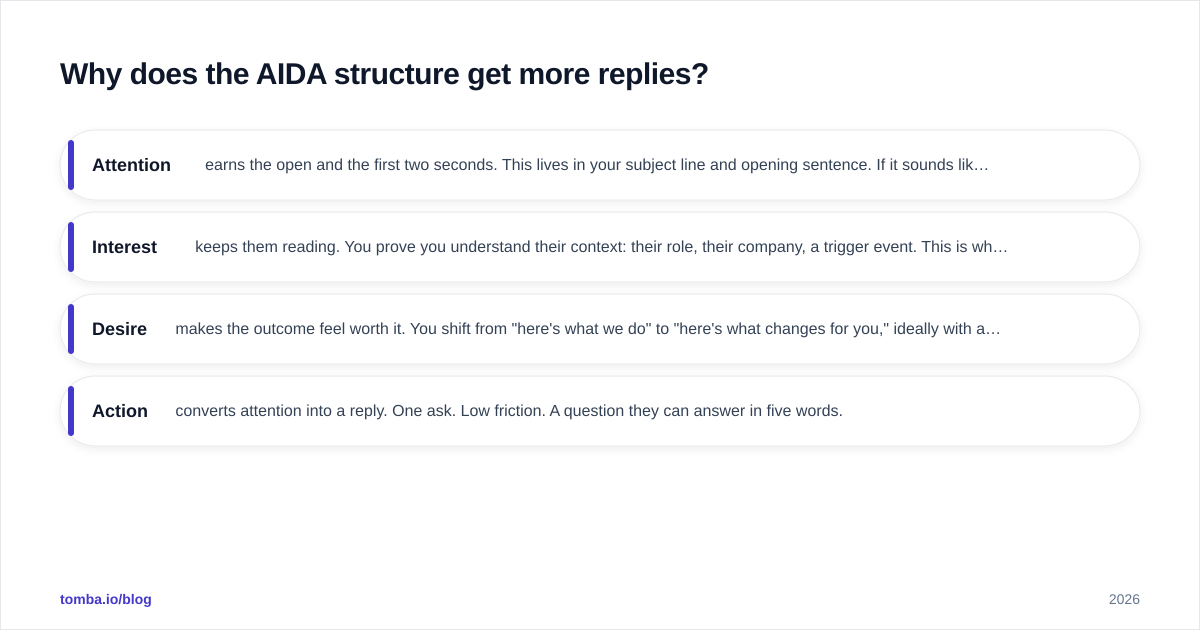
- Attention — earns the open and the first two seconds. This lives in your subject line and opening sentence. If it sounds like a template, the reader pattern-matches it to spam.
- Interest — keeps them reading. You prove you understand their context: their role, their company, a trigger event. This is where personalization does its work.
- Desire — makes the outcome feel worth it. You shift from "here's what we do" to "here's what changes for you," ideally with a number or a peer example.
- Action — converts attention into a reply. One ask. Low friction. A question they can answer in five words.
The reason it beats a feature dump is altitude. A feature list asks the reader to do the translation work — to figure out why a capability matters to them. AIDA does that translation for them, so the cognitive cost of replying drops.
)
What does each AIDA stage look like in a real email?#
Let's break a single cold email into its four parts so you can see the seams.
Subject (Attention): Quick question about [Company]'s onboarding flow
Opening line (Attention → Interest):
Noticed [Company] shipped self-serve signup last month — congrats on the launch.
Body (Interest → Desire):
Most teams that move to self-serve see a spike in trial signups but a dip in activation, because the human handoff disappears. We helped [Peer Company] recover 18% of stalled trials by triggering a single behavior-based email at the right moment.
Close (Action):
Worth a 10-minute look at how that'd map to your funnel? Just reply "send it" and I'll share the teardown.
Notice what's missing: no company boilerplate, no nine-line signature, no "I hope this email finds you well." Every sentence either earns attention, builds interest, stokes desire, or asks for action. That's the discipline AIDA enforces.
If you want a head start on the wording, Tomba's cold email templates library and AI cold email writer both default to this kind of structure.
Copy-paste AIDA email templates#
Steal these and swap in the brackets. Keep them under 120 words — AIDA rewards brevity.
1. Cold outbound (problem-led)
Subject: [Trigger event] usually breaks [process]
Hi [First name],
Saw [Company] just [trigger — raised a round / opened a new market / hired a VP of Sales]. That usually means [specific problem] gets louder fast.
We help [role] teams fix [problem] without [common objection]. [Peer] cut [metric] by [number] in [timeframe] doing it.
Open to seeing how it'd work for [Company]? Reply "yes" and I'll send a 2-minute Loom.
[Your name]
2. Follow-up (no reply)
Subject: Re: [original subject]
Hi [First name],
Floating this back up — figured [problem] might not be top of your list this week.
One number that might change that: [peer] saw [result] in [timeframe]. Happy to show the exact play.
Still a no? A one-word "not now" and I'll stop. [Your name]
3. Re-engagement (cold lead)
Subject: Bad timing before — better now?
Hi [First name],
We spoke in [month] about [problem] and the timing was off. Since then we shipped [new capability], which is the piece you flagged as missing.
Want the 90-second version? Reply and I'll send it over. [Your name]
Each one runs Attention → Interest → Desire → Action in order. The follow-ups compress the stages but never skip the single ask at the end.
How does AIDA compare to other email frameworks?#
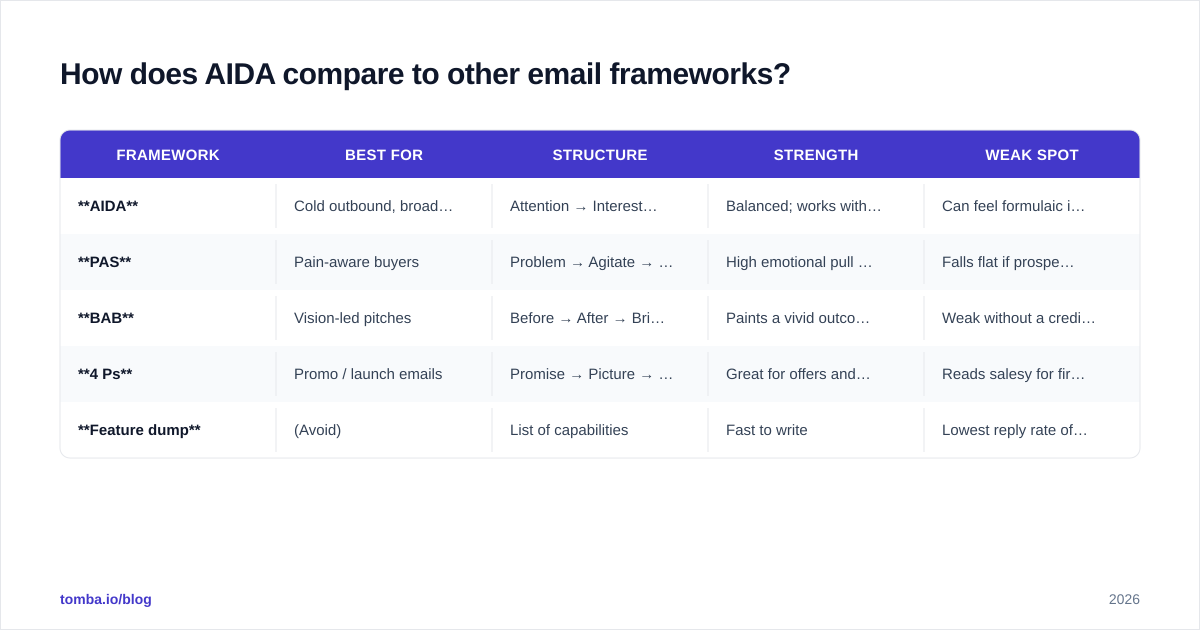
AIDA isn't the only persuasion model. PAS, BAB, and the 4 Ps each have a niche. Here's how they stack up for cold email specifically.
| Framework | Best for | Structure | Strength | Weak spot |
|---|---|---|---|---|
| AIDA | Cold outbound, broad audiences | Attention → Interest → Desire → Action | Balanced; works without deep research | Can feel formulaic if over-used |
| PAS | Pain-aware buyers | Problem → Agitate → Solution | High emotional pull on known pains | Falls flat if prospect isn't pain-aware |
| BAB | Vision-led pitches | Before → After → Bridge | Paints a vivid outcome | Weak without a credible "bridge" proof |
| 4 Ps | Promo / launch emails | Promise → Picture → Proof → Push | Great for offers and deadlines | Reads salesy for first-touch cold |
| Feature dump | (Avoid) | List of capabilities | Fast to write | Lowest reply rate of the group |
The honest takeaway: AIDA is the best default when you don't know how pain-aware your prospect is. PAS wins when you're certain the problem is already keeping them up at night. Many strong sequences alternate — AIDA for the first touch, PAS for the second. For a deeper menu of structures, HubSpot's sales email templates and the framework breakdowns on G2 are worth a read.
)
How do you write each AIDA stage well?#
Attention: earn the open, then the first line. Your subject line is 40% of the battle. Keep it under 50 characters, make it specific, and never use clickbait you can't pay off. Lowercase, question-style subjects often beat title-case "announcement" subjects in cold contexts. If you're stuck, a subject line generator can give you ten angles to test in seconds. The opening line should reference them — a trigger event, a recent post, a mutual connection — never "My name is X and I work at Y."
Interest: prove relevance in one sentence. This is where generic emails die. "We help companies scale" is not interest — it's noise. "Teams that just moved to self-serve usually lose activation" is interest, because it names a problem the reader recognizes. Tie it to something true about their situation.
Desire: show the gap, with a number. Desire is the delta between where they are and where they could be. Quantify it. "Recover 18% of stalled trials" beats "improve your funnel." If you don't have a hard number, use a named peer: social proof from a recognizable company in their space does the same job.
Action: one ask, near-zero friction. The fastest way to kill reply rate is to ask for a 30-minute call in a cold email. Ask for a reply instead. "Reply 'send it'" or "worth a look?" lowers the commitment to a single word. You can escalate to a meeting once they've engaged. Tracking your email response rate per template tells you which asks actually work.
What kills an AIDA email even when the structure is right?#
The framework is necessary but not sufficient. Three things sink a structurally perfect AIDA email:
- Bad data. If the email bounces, none of the four stages matter. A polished AIDA email sent to a stale address is wasted effort — and worse, bounces erode your sender reputation and push future emails to spam.
- Over-templating. When every line is a bracket-fill, prospects feel it. Personalize the Attention and Interest stages by hand even if the rest is templated.
- Stage bleed. Putting the ask in the middle, or stacking three desires, breaks the flow. Each stage should do its one job and hand off.
The first point is the silent killer. You can A/B test copy forever, but if 20% of your list is invalid, your reply rate is capped before you write a word. This is why list hygiene sits upstream of copywriting: verify addresses before the sequence runs, not after the bounces roll in. Tomba's email verifier and bulk email finder exist for exactly this step — clean the list, then let AIDA do its job.
How do you test and improve AIDA emails?#
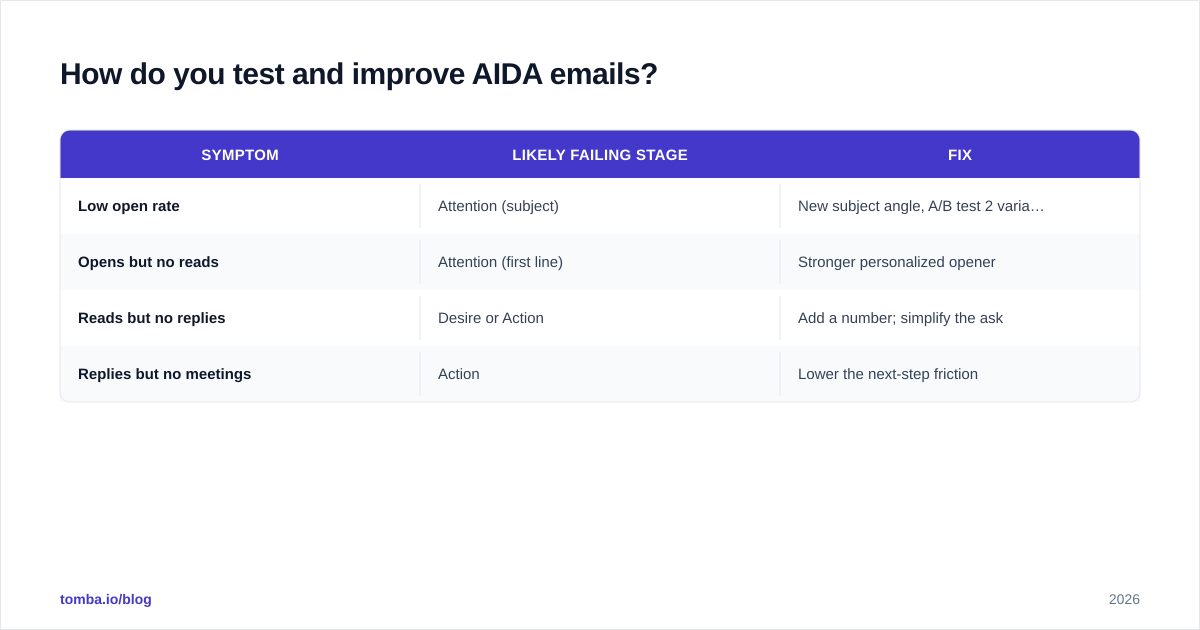
Treat each stage as an independent variable. Don't rewrite the whole email when one number is off — diagnose which stage is leaking:
| Symptom | Likely failing stage | Fix |
|---|---|---|
| Low open rate | Attention (subject) | New subject angle, A/B test 2 variants |
| Opens but no reads | Attention (first line) | Stronger personalized opener |
| Reads but no replies | Desire or Action | Add a number; simplify the ask |
| Replies but no meetings | Action | Lower the next-step friction |
Run one change at a time across a statistically meaningful batch — at least 100 sends per variant before you trust the delta. Log results per template so your best-performing AIDA structures compound over time instead of getting lost.
Is AIDA still relevant in 2026?#
Yes — arguably more than ever. As inboxes get noisier and AI-generated outreach floods them, the emails that win are the ones that respect the reader's time and lead with relevance. That's precisely what AIDA encodes. The framework didn't survive 130 years by accident; it survived because it matches how humans decide.
What's changed is the bar for the Attention and Interest stages. Generic AIDA emails now read as obviously templated and get filtered. The winning move in 2026 is AIDA structure plus genuine, data-backed personalization — a real trigger event, a real peer example, a verified recipient who actually owns the problem you're naming.
Where to start#
Pick one template above, fill the brackets for ten real prospects, and send. Track opens, reads, and replies by stage. Iterate on the weakest number. That loop — structure, send, measure, fix — is how AIDA stops being a theory and starts being your highest-reply-rate email.
But none of it fires without accurate contacts. Before you write a single subject line, build a verified list: Tomba's Email Finder locates professional email addresses by name, domain, or company, and pairs with the email verifier to strip out bounces before they touch your sender reputation. Start on the free tier (25 searches a month), and scale to a paid plan when your AIDA sequences start converting — see Tomba pricing for the Starter ($49/mo) and Growth ($99/mo) tiers. Clean data first, then let AIDA do the persuading.
// get started
Find, verify and enrich your first contacts today
Start on the free plan with 25 searches a month, then scale when your team is ready.
Free plan · No credit card required · GDPR & CCPA
// about the author