AIDA Model Examples: B2B Copywriting Guide for 2026
See real AIDA model examples for cold email, landing pages, and ads — plus a copy-paste template and the metrics that prove the framework still converts in 2026.
TL;DR
- AIDA stands for Attention, Interest, Desire, Action — a four-stage sequence that mirrors how a buyer's mind actually moves from "what's this?" to "I'll click."
- The framework is 130+ years old and still works because the psychology hasn't changed; what changed is the channel (cold email, LinkedIn DMs, paid ads).
- This guide gives you nine concrete aida model examples across email, landing pages, ads, and sales calls — not theory.
- A copy-paste AIDA cold email template is included, plus the three mistakes that flatten most AIDA copy.
- AIDA fails fast when your list is wrong. Accurate contact data is the multiplier — a great hook sent to a bounced address converts zero.
What is the AIDA model?#
AIDA is a marketing and copywriting framework that breaks any persuasive message into four ordered stages: Attention, Interest, Desire, Action. You earn attention, hold it with relevance, turn relevance into wanting, then ask for one clear next step.
Think of it like a first date. You notice someone (attention), you find something in common (interest), you start imagining a second date (desire), and someone finally suggests dinner Friday (action). Skip a stage and it feels off — jump straight from "hi" to "marry me" and you get a no. Most bad cold emails are exactly that: a stranger proposing marriage in line one.
The model dates back to advertising pioneer Elias St. Elmo Lewis in the 1890s and has outlived nearly every tactic invented since. You can read the full lineage on Wikipedia's AIDA entry. The reason it survives is simple: it maps to attention spans, not to platforms. The buyer's brain still triages messages in that order whether the message arrives by telegram or by Slack.
Why does the AIDA model still work in 2026?#
Because it solves the one problem every channel shares: you have about three seconds before the reader decides to keep going or bail. AIDA front-loads the work into that window.
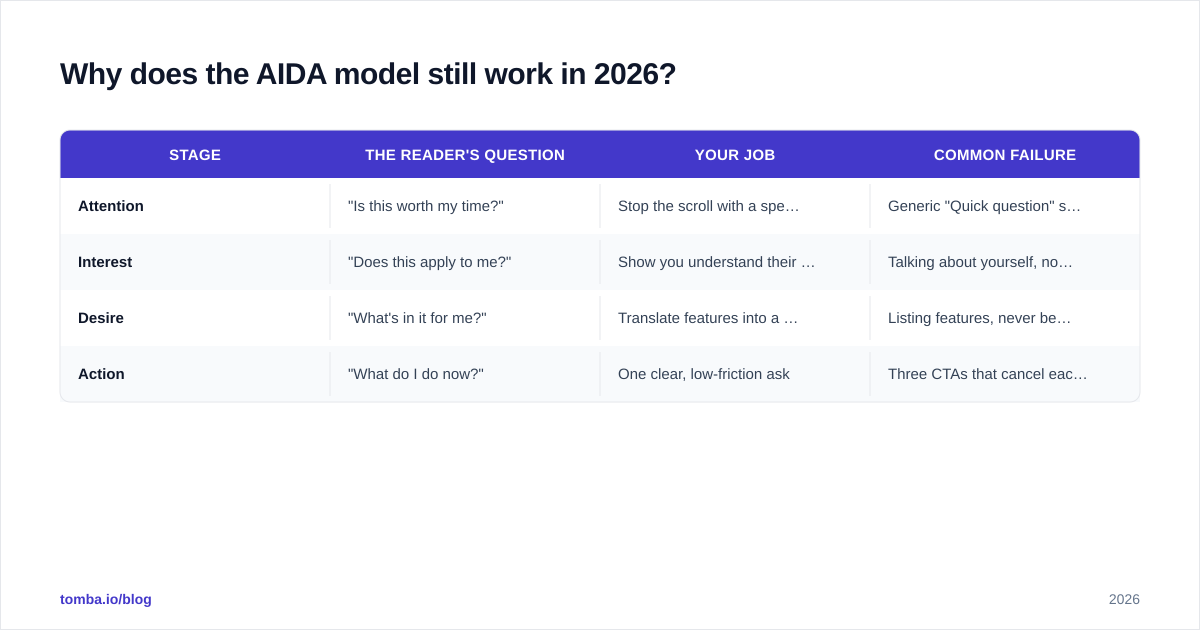
Here's the stage-by-stage job of each letter, and where most writers slip.
| Stage | The reader's question | Your job | Common failure |
|---|---|---|---|
| Attention | "Is this worth my time?" | Stop the scroll with a specific, relevant hook | Generic "Quick question" subject lines |
| Interest | "Does this apply to me?" | Show you understand their exact situation | Talking about yourself, not them |
| Desire | "What's in it for me?" | Translate features into a vivid outcome | Listing features, never benefits |
| Action | "What do I do now?" | One clear, low-friction ask | Three CTAs that cancel each other out |
Notice the Desire row. That single distinction — feature versus benefit — is where the most copy dies. "Our tool has a catch-all verifier" is a feature. "You stop torching your sender reputation on risky addresses" is a desire. One describes the product; the other describes the reader's better life.
What does an AIDA cold email example look like?#
Below is a full AIDA cold email, annotated by stage. This is the format most B2B reps reach for because it forces brevity.
Subject: Cut your bounce rate before the next send (Attention)
Hi Maria, (Interest) I noticed your team just opened SDR roles in Berlin and Austin — usually a sign outbound volume is about to spike.
Most teams scaling sends that fast watch their bounce rate climb past 8% and their domain reputation tanks within a quarter. (Desire) Tomba customers running the same playbook keep bounces under 2% because every address is verified before it hits the sequence — which means more replies land and fewer go to spam.
(Action) Worth a 12-minute call Thursday to see if it fits? Reply "Thursday" and I'll send a slot.
Four stages, ninety words, one ask. Each sentence earns the next. The subject line promises a specific outcome (not "checking in"), the opening line proves you did homework, the middle paints a believable future, and the close asks for one frictionless thing.
If writing these from scratch is slowing you down, a cold email AI generator can draft the AIDA skeleton and you refine the specifics. And before you obsess over the body, fix the subject — most opens are won or lost there. A subject line generator helps you A/B the Attention stage in seconds.
What are AIDA model examples across other channels?#
Cold email isn't the only place AIDA earns its keep. Here are eight more concrete examples, two per channel, so you can see the pattern flex.
Landing page hero#
- SaaS analytics tool — Attention: "You're guessing where revenue leaks." Interest: "Most finance teams reconcile in spreadsheets and miss 6-figure errors." Desire: "See every dollar move in real time." Action: "Start free — no card."
- Project management app — Attention: "Your team ships late because nobody owns the deadline." Interest: "Sound familiar after every sprint?" Desire: "Clear owners, automatic nudges, on-time launches." Action: "Try it with your team this week."
Paid social ad#
- Recruiting platform — Attention: "47 applicants. Zero qualified." Interest: "Hiring managers waste 11 hours a week screening." Desire: "Get a shortlist of 5 pre-vetted candidates." Action: "Book a demo."
- Fitness app — Attention: "You skipped the gym again." Interest: "Motivation runs out by week three." Desire: "Workouts that fit a 20-minute lunch." Action: "Download free."
Sales call opener#
- Outbound discovery — Attention: "I'll be quick — 30 seconds and you can hang up." Interest: "You run RevOps at a Series B; data hygiene is probably eating your week." Desire: "Teams your size cut list cleanup from days to minutes." Action: "Can I send a one-pager?"
- Renewal call — Attention: "Your contract renews in 40 days." Interest: "I noticed you've only activated two of five seats." Desire: "Let's get the other three driving pipeline before renewal." Action: "15 minutes Friday?"
Subject lines only (Attention stage isolated)#
- Event invite — "Your competitor is speaking. Are you?"
- Re-engagement — "Did I lose you, or just bad timing?"
- Product update — "The feature you asked for shipped."
Read those back to back and the spine is identical: specific stop, relevant pull, vivid want, single ask. The channel changes the length and tone, never the order.
How do you write your own AIDA copy? (Template)#
Use this fill-in-the-blank structure. It works for email, a landing section, or a LinkedIn message — trim the length to the channel.
ATTENTION:  [Specific trigger event or sharp pain — name a number]
INTEREST:   [One sentence proving you understand THEIR situation]
DESIRE:     [The outcome they get, in their words, not your feature list]
ACTION:     [One low-friction ask with a concrete time or verb]
Three rules make the template land:
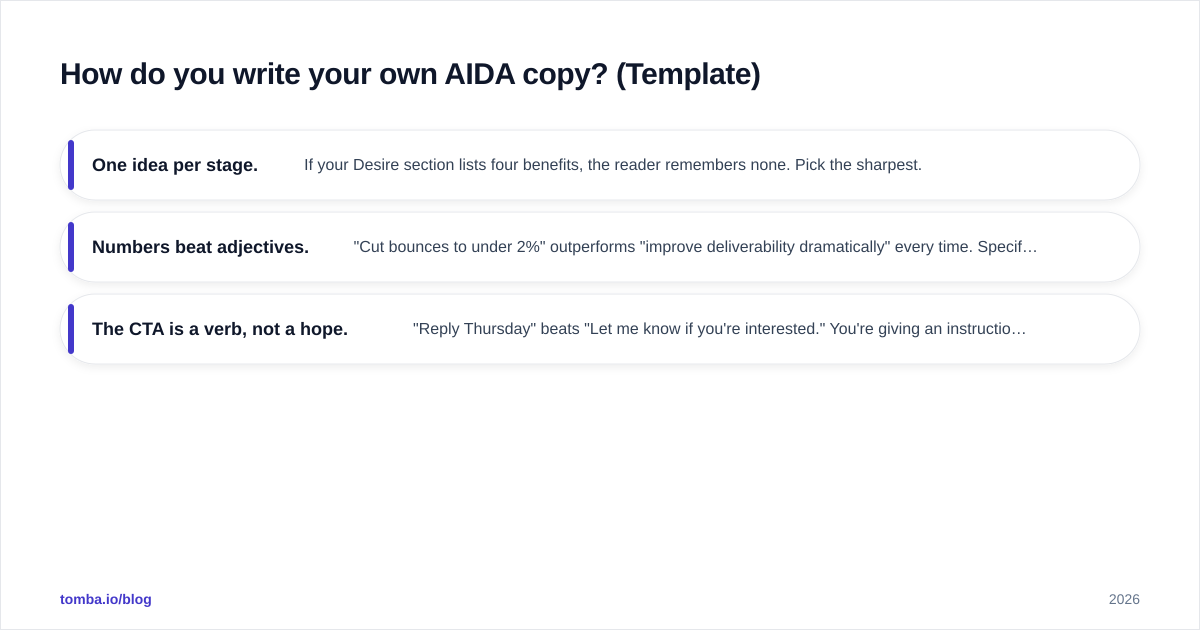
- One idea per stage. If your Desire section lists four benefits, the reader remembers none. Pick the sharpest.
- Numbers beat adjectives. "Cut bounces to under 2%" outperforms "improve deliverability dramatically" every time. Specificity reads as proof.
- The CTA is a verb, not a hope. "Reply Thursday" beats "Let me know if you're interested." You're giving an instruction, not requesting permission.
For the Desire stage especially, keep a swipe file of proven structures. Tomba's library of cold email templates is a good starting bank — adapt, don't copy verbatim, because reused templates get pattern-matched into spam folders.
What are the most common AIDA mistakes?#
Three failure patterns show up in nearly every weak AIDA draft. Fix these and your copy jumps a tier.
Mistake 1: Attention that's loud but irrelevant. "🚨 URGENT 🚨" grabs the eye and instantly loses trust. Relevance is the real attention magnet, not volume. A subject line referencing the reader's recent funding round beats any all-caps gimmick.
Mistake 2: Skipping Interest. Writers rush from a punchy hook straight to the pitch. Without the Interest beat — the sentence that proves this is about you — the reader feels ambushed. That bridge is what separates a relevant message from a blast.
Mistake 3: A Desire stage made of features. "Our platform offers domain search, bulk verification, and an API." Nobody desires a feature list. They desire the result: more meetings booked, fewer bounces, a clean CRM. Run every feature through "...which means you can ___" and write what comes after.
A fourth, quieter killer: sending great AIDA copy to a bad list. The framework optimizes the message, not the delivery. If 15% of your addresses bounce, your sender reputation drops and even your best Action stage never gets seen. That's why list accuracy sits upstream of copy — covered next.
How does data quality affect AIDA performance?#
Your AIDA copy can only convert the people who actually receive it. The whole framework is downstream of one thing: does the message reach a real inbox?
Here's the chain. A bounced email doesn't just fail to convert — it signals to mailbox providers that you're sending to dead addresses, which drags down your response rate on the messages that do land. Industry benchmarks from HubSpot's email research consistently tie list hygiene to deliverability and reply rates. Polished AIDA copy on a dirty list is a Ferrari with no fuel.
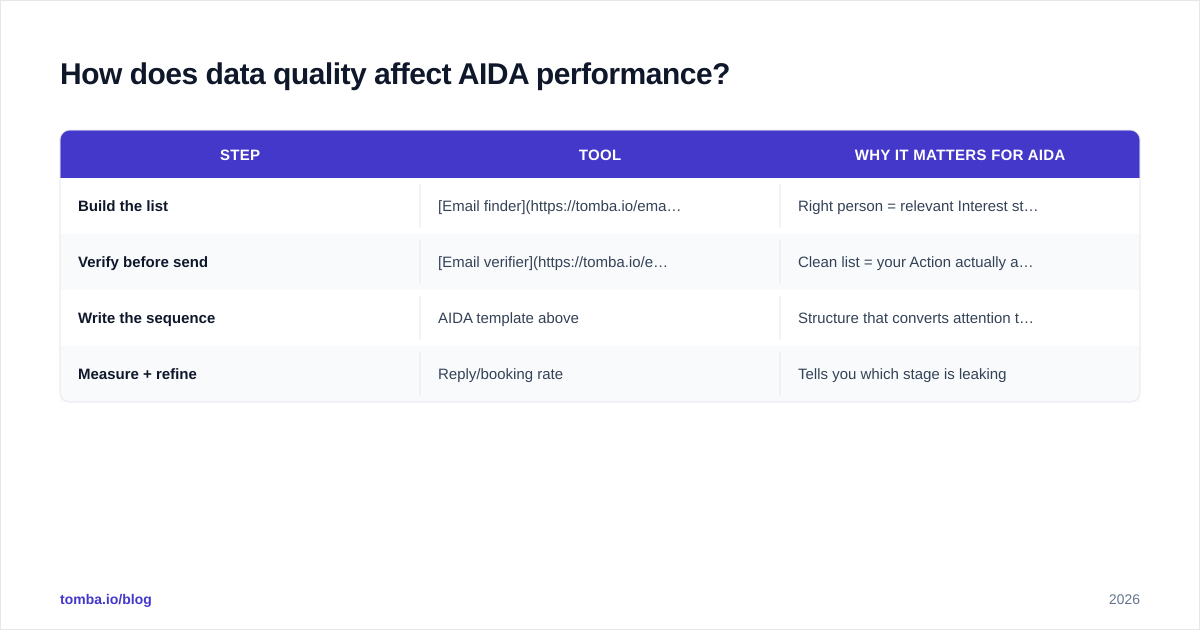
So the workflow that actually compounds looks like this:
| Step | Tool | Why it matters for AIDA |
|---|---|---|
| Build the list | Email finder | Right person = relevant Interest stage |
| Verify before send | Email verifier | Clean list = your Action actually arrives |
| Write the sequence | AIDA template above | Structure that converts attention to clicks |
| Measure + refine | Reply/booking rate | Tells you which stage is leaking |
That first column is where most teams underinvest. You can write the sharpest Desire line in your category, but if the address is wrong or the inbox is dead, AIDA never gets a vote. Accurate sourcing — by name, company, or domain search — is the unglamorous half of conversion.
Is AIDA better than PAS or other frameworks?#
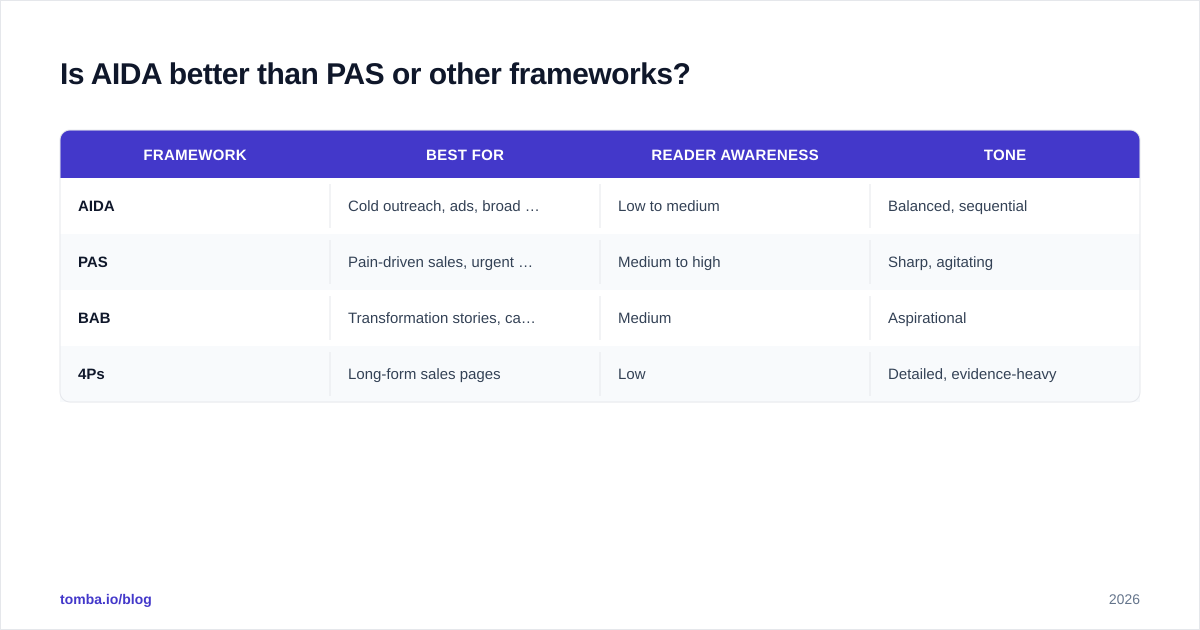
It depends on your buyer's awareness. AIDA, PAS (Problem-Agitate-Solution), and BAB (Before-After-Bridge) are tools for different jobs, not rivals.
| Framework | Best for | Reader awareness | Tone |
|---|---|---|---|
| AIDA | Cold outreach, ads, broad funnels | Low to medium | Balanced, sequential |
| PAS | Pain-driven sales, urgent problems | Medium to high | Sharp, agitating |
| BAB | Transformation stories, case studies | Medium | Aspirational |
| 4Ps | Long-form sales pages | Low | Detailed, evidence-heavy |
Reach for AIDA when the reader doesn't yet know they have a problem — its Attention-first structure earns the right to keep talking. Reach for PAS when the pain is already obvious and you want to twist the knife before offering relief. Many strong sales sequences alternate: an AIDA opener, a PAS follow-up, a BAB case study. You can compare how vendors position these approaches on review sites like G2 where buyers describe what actually moved them.
The point isn't loyalty to one acronym. It's matching the structure to where the buyer's head is.
Frequently asked questions#
Does AIDA work for B2B or just B2C? Both. B2B cycles are longer, so you often run AIDA across a sequence of touches rather than one message — Attention in email one, Desire built over emails two and three. The stages still fire in order.
How long should each AIDA stage be? As short as it can be while doing its job. In a cold email, one to two sentences per stage. On a landing page, a stage might be a whole section. Channel sets the length; the order never changes.
Can I use AIDA on LinkedIn? Yes, and it's underused there. A connection note is pure Attention; the follow-up message handles Interest and Desire; the Action is a soft "open to a chat?" Keep it shorter than email — DMs punish length.
Start with a list AIDA can actually convert#
Great AIDA copy is wasted on the wrong inbox. Before you polish another Desire line, make sure the person on the other end exists and the address is live. The Tomba Email Finder sources verified professional emails by name, company, or domain — so your Attention hook lands in a real inbox and your Action button gets a fair shot. Pair it with verification on the way out and your best-written sequences finally get the audience they deserve. Check Tomba pricing — the free tier gives you 25 searches a month to test the workflow before you commit, with Starter at $49/mo when you're ready to scale. Write the copy that converts; send it to the people who can convert.
// get started
Find, verify and enrich your first contacts today
Start on the free plan with 25 searches a month, then scale when your team is ready.
Free plan · No credit card required · GDPR & CCPA
// about the author