AIDA Model Marketing in 2026: The Copywriting Framework
The AIDA model still runs the best cold emails, landing pages, and ads in 2026. Here's how to use Attention-Interest-Desire-Action without sounding like a 1900s ad man.
The AIDA model is the oldest survivor in marketing for one reason: it maps to how people actually decide. More than a century after a salesman named E. St. Elmo Lewis sketched it out, Attention → Interest → Desire → Action still structures the cold emails, landing pages, and ad scripts that convert in 2026. This guide shows you how to apply it without sounding like a Victorian newspaper.
TL;DR#
- AIDA stands for Attention, Interest, Desire, Action — a four-stage model for moving a prospect from "who are you" to "I'll buy."
- It works best for short-form persuasion: cold emails, ad copy, landing pages, and sales scripts — not for nurturing long, complex deals on its own.
- The most common failure is leading with features (Interest) before you've earned Attention, or pitching Action with no Desire built.
- In 2026, AIDA pairs well with personalization data — a great hook needs an accurate name, role, and trigger event, which is where tools like a B2B database earn their keep.
- We include a full email template, a stage-by-stage table, and a comparison against PAS, BAB, and the 4Ps so you pick the right framework for the job.
What is the AIDA model in marketing?#
AIDA is a linear funnel for a single piece of persuasive communication. Think of it like asking someone on a date: you can't open with "will you marry me" (Action) before you've gotten them to notice you (Attention), found common ground (Interest), and made them actually want it (Desire). Skip a stage and the whole thing feels creepy.
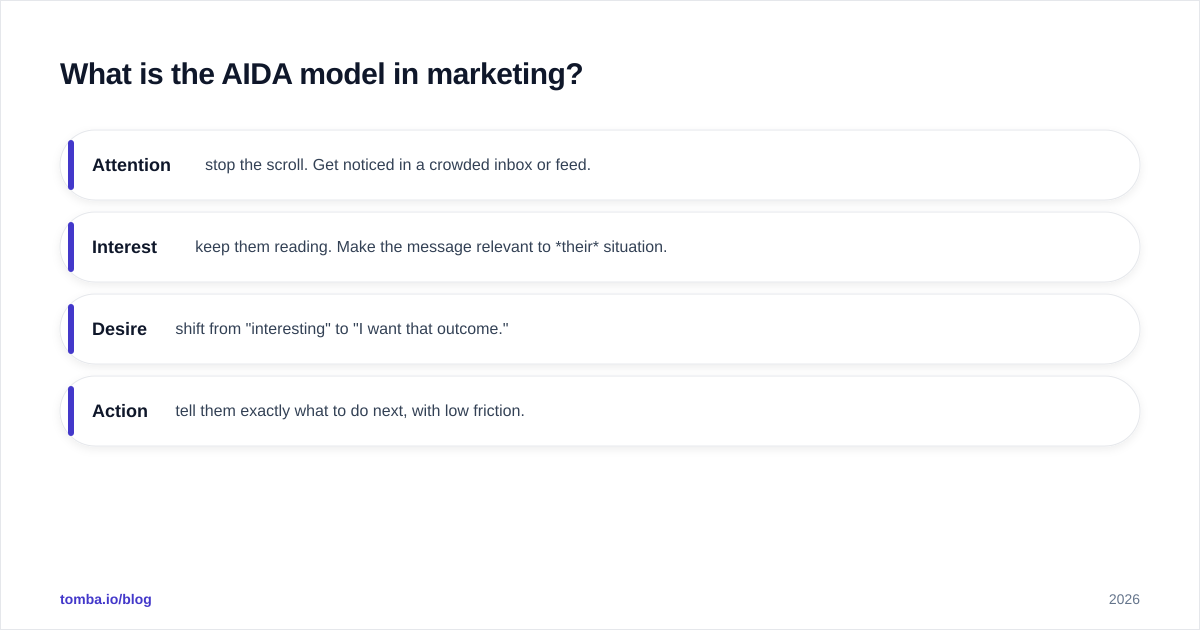
The acronym breaks down like this:
- Attention — stop the scroll. Get noticed in a crowded inbox or feed.
- Interest — keep them reading. Make the message relevant to their situation.
- Desire — shift from "interesting" to "I want that outcome."
- Action — tell them exactly what to do next, with low friction.
Technically, AIDA is a hierarchy-of-effects model: it assumes buyers pass through cognitive (Attention, Interest), affective (Desire), and behavioral (Action) stages in sequence. The original 1898 formulation by Lewis predates modern advertising, yet it underpins most direct-response copy you'll read today. You can dig into the history on Wikipedia if you want the full lineage.
Why does AIDA still work in 2026?#
Short answer: human attention got more scarce, not less, so a model built around earning attention first is more relevant than ever.
The average professional gets over 120 emails a day. Buyers research independently before they ever talk to sales. Algorithmic feeds reward the first 1.5 seconds. In that environment, a message that opens with "I hope this email finds you well" and a paragraph about your company is dead on arrival — it violates the Attention stage entirely.
AIDA forces a discipline most copy lacks: earn each stage before moving to the next. You don't get to talk about your product (Desire) until you've proven relevance (Interest). You don't get to ask for the meeting (Action) until the reader actually wants the outcome.
How do the four AIDA stages work, stage by stage?#
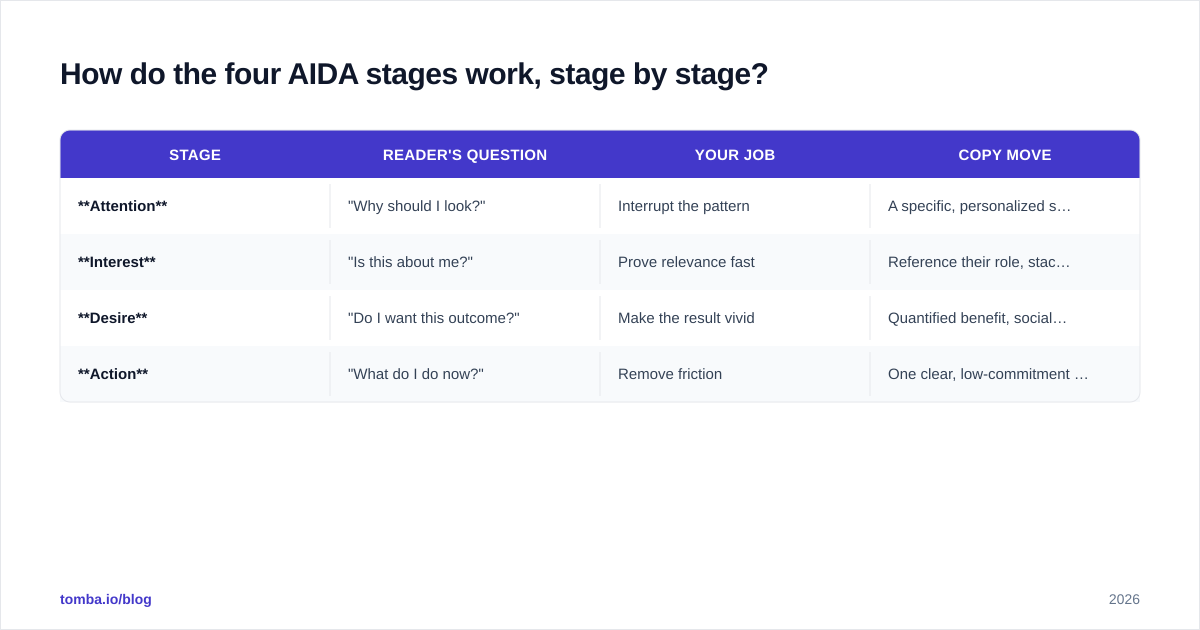
Here's each stage with what it does, the question it answers in the reader's head, and a concrete copy move.
| Stage | Reader's question | Your job | Copy move |
|---|---|---|---|
| Attention | "Why should I look?" | Interrupt the pattern | A specific, personalized subject line or first line — a trigger event, a number, a name |
| Interest | "Is this about me?" | Prove relevance fast | Reference their role, stack, or recent change; one tight insight |
| Desire | "Do I want this outcome?" | Make the result vivid | Quantified benefit, social proof, a before/after — not a feature dump |
| Action | "What do I do now?" | Remove friction | One clear, low-commitment CTA ("worth a 15-min look?") |
Notice that Desire is about benefits, not features. This is the single biggest mistake in B2B copy. "Our platform has SOC 2 compliance and a REST API" is a feature list (Interest, at best). "Your reps stop wasting 6 hours a week on manual data entry" is Desire.
What does an AIDA cold email actually look like?#
Here's the model applied to a real B2B cold email. Each line is labeled with its stage so you can see the structure.
Subject: Quick one about [Company]'s Q3 hiring spike (Attention)
Hi Sara, (Attention — real name, not "Hi there")
Saw you opened 12 SDR roles last month — usually that means the team's outpacing the data they have to work with. (Interest — relevant trigger)
Most teams scaling that fast lose 20–30% of rep time to bad or missing contact data. The fix isn't more reps, it's clean data feeding them. (Desire — quantified outcome)
We help teams like [peer company] cut that to near-zero. Worth a 15-minute look next week? (Action — single low-friction CTA)
The whole thing is under 80 words. That's not an accident — AIDA in email rewards brevity, because every extra sentence is a chance for the reader to drop out before Action.
The hardest part to get right is Attention, and it depends entirely on data quality. A personalized first line needs a verified email, the right name, the right company, and ideally a trigger event. That's why prospecting and copywriting are now the same workflow: you can't write the hook without the data. If you're building lists at scale, an email finder that returns verified addresses keeps your Attention line from bouncing into a spam folder. For inspiration on the body, our cold email templates library is organized by use case.
How is AIDA different from PAS, BAB, and the 4Ps?#
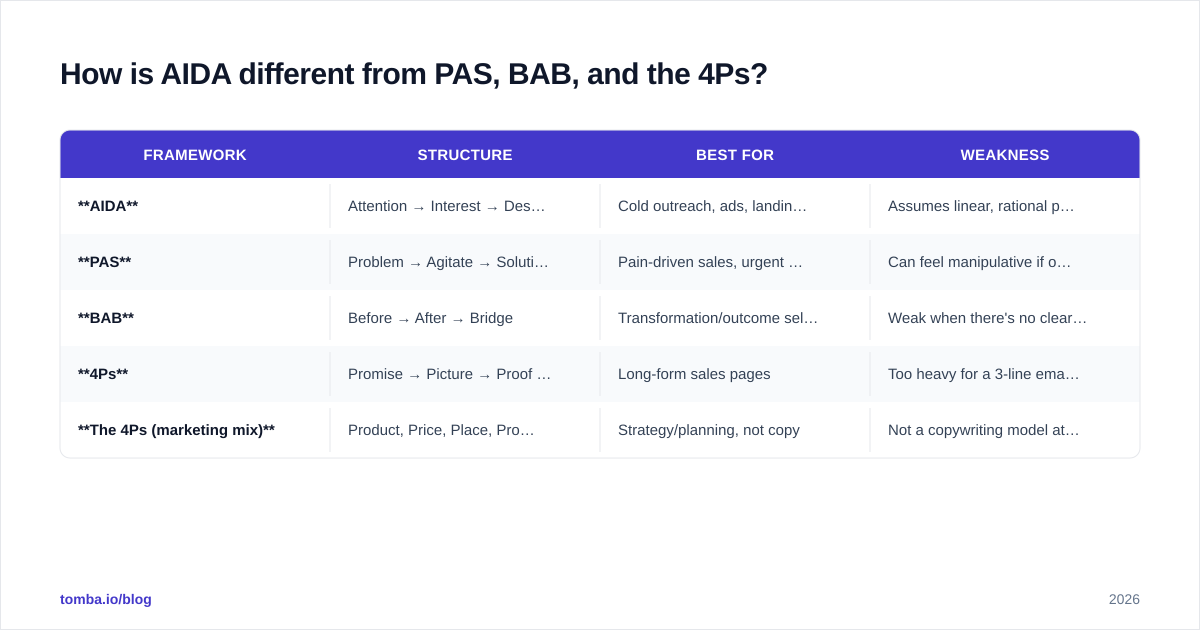
AIDA isn't the only copywriting framework, and it isn't always the best fit. Here's how it stacks against the other big ones.
| Framework | Structure | Best for | Weakness |
|---|---|---|---|
| AIDA | Attention → Interest → Desire → Action | Cold outreach, ads, landing pages | Assumes linear, rational progression |
| PAS | Problem → Agitate → Solution | Pain-driven sales, urgent problems | Can feel manipulative if overdone |
| BAB | Before → After → Bridge | Transformation/outcome selling | Weak when there's no clear "after" |
| 4Ps | Promise → Picture → Proof → Push | Long-form sales pages | Too heavy for a 3-line email |
| The 4Ps (marketing mix) | Product, Price, Place, Promotion | Strategy/planning, not copy | Not a copywriting model at all |
A useful rule: AIDA for the cold open, PAS when the pain is sharp, BAB when the transformation is the whole story. Many top performers blend them — an AIDA skeleton with a PAS-style Agitate inside the Interest stage. Marketing teams at companies like HubSpot and Salesforce document these frameworks heavily in their own playbooks because the structure travels across channels.
Where does AIDA break down?#
AIDA is a model, not a law. Know its limits.
It assumes a linear journey. Real B2B buyers loop — they reach Desire, then circle back to Interest when a new stakeholder enters. For complex, multi-month deals, AIDA structures individual touches well but doesn't model the whole account journey. Pair it with a proper sales pipeline view for that.
It's weak on retention. AIDA ends at Action. It says nothing about onboarding, renewal, or advocacy. Modern variants tack on stages — AIDAR adds "Retention," and the full-funnel crowd extends it to loyalty and referral. If you live in RevOps, treat AIDA as the acquisition slice only.
It can encourage hype. Because the Desire stage rewards emotional pull, weak copywriters inflate claims to manufacture want. That backfires in B2B, where buyers fact-check. Keep Desire honest: quantified, sourced, and specific. The G2 and Capterra review ecosystems exist precisely because buyers no longer trust unverified Desire claims — you can see how buyers cross-check vendors on G2.
How do you apply AIDA across channels?#
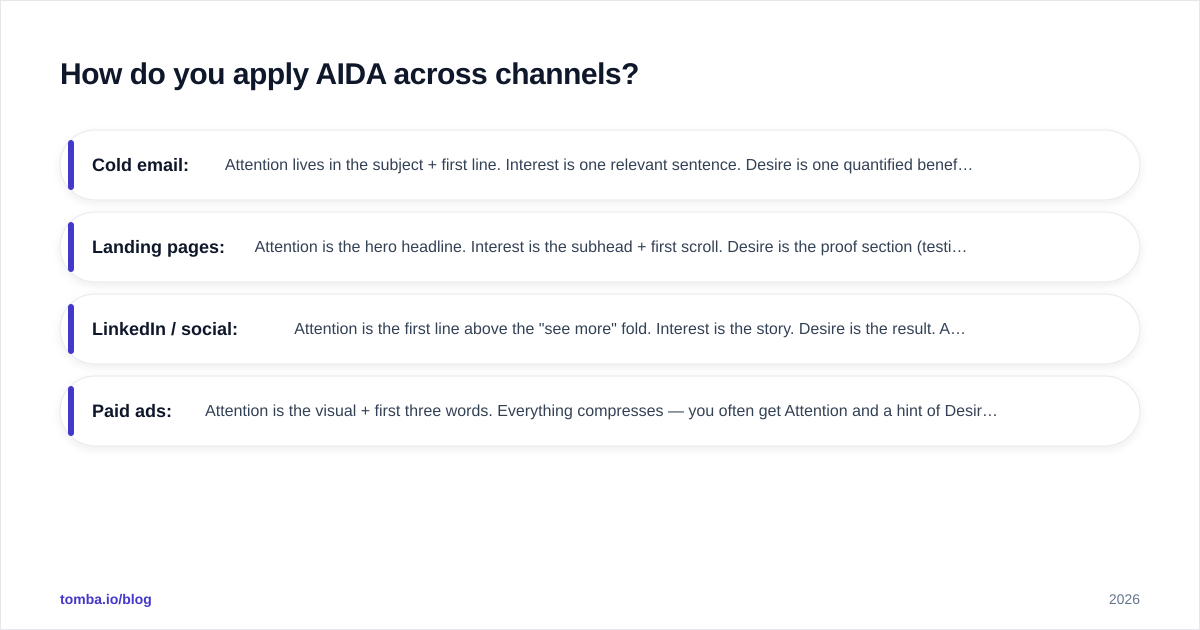
The four stages stay constant; the execution changes per channel.
- Cold email: Attention lives in the subject + first line. Interest is one relevant sentence. Desire is one quantified benefit. Action is one CTA. Total: under 90 words. Test your hooks with a subject line tester before sending at volume.
- Landing pages: Attention is the hero headline. Interest is the subhead + first scroll. Desire is the proof section (testimonials, numbers, logos). Action is the form or button — repeated, because long pages need multiple Action points.
- LinkedIn / social: Attention is the first line above the "see more" fold. Interest is the story. Desire is the result. Action is a comment prompt or DM ask.
- Paid ads: Attention is the visual + first three words. Everything compresses — you often get Attention and a hint of Desire, with the click being the Action.
The constant across all four: Attention is gated by data. A landing page headline can be A/B tested, but a cold email's Attention line depends on knowing something true and specific about the recipient. That's why enrichment and verification sit upstream of copywriting now, not beside it.
What's the fastest way to start using AIDA?#
Audit one existing asset. Take your current best-performing cold email or landing page and label each line with its stage. You'll almost always find one of three problems:
- No Attention — it opens with you, not them.
- Interest bloat — three paragraphs of "relevance" no one reads.
- Premature Action — asking for the meeting before building Desire.
Fix the weakest stage first. Then rebuild the whole asset from a clean AIDA skeleton and split-test it against the original. Track your response rate — that's the metric AIDA most directly moves.
The bottom line#
AIDA endures because it's not a trick — it's a description of how attention, relevance, want, and action stack in a reader's mind. In 2026, the framework hasn't changed; the inputs have. The best Attention line in the world fails if it's sent to a stale, unverified address. Great Desire copy wastes itself on the wrong persona.
So the workflow that wins is: get the data right, then write to the four stages. Start by building a clean, verified list with the Tomba Email Finder — search by domain, name, or company, get verified addresses, and feed your AIDA-structured outreach with the accurate names and trigger data that make the Attention stage actually land. The free tier gives you 25 searches a month to test it; see full Tomba pricing when you're ready to scale. Good copy plus good data is the whole game.
// get started
Find, verify and enrich your first contacts today
Start on the free plan with 25 searches a month, then scale when your team is ready.
Free plan · No credit card required · GDPR & CCPA
// about the author