AIDA Sales Funnel: The 2026 Framework to Convert Leads
The AIDA sales funnel turns cold attention into closed deals in four stages. Here's how to map, measure, and fix every step in 2026 — with templates and a stage-by-stage scorecard.
TL;DR
- The AIDA sales funnel breaks every buyer journey into four stages — Attention, Interest, Desire, Action — so you can see exactly where deals stall instead of guessing.
- It works because it mirrors how people actually decide: they notice you, get curious, start wanting the outcome, then commit. Skip a stage and the next one collapses.
- Each stage needs a different asset and a different metric. Treating a "desire" prospect like a stranger (or vice versa) is the most common reason pipelines leak.
- In 2026, AIDA still beats trendier models for cold outbound because it's simple enough to audit on a whiteboard and rigorous enough to attach numbers to.
- Pair it with clean contact data and stage-matched copy, and a mediocre funnel routinely doubles its conversion rate without more leads.
What is the AIDA sales funnel?#
The AIDA sales funnel is a four-stage model — Attention, Interest, Desire, Action — that maps how a stranger becomes a customer. Think of it like a staircase: a prospect can't reach the top (buying) without stepping on each tread in order. Most reps try to leap from "hello" to "buy now" and wonder why people fall off.
The acronym dates back to 1898, when advertising pioneer E. St. Elmo Lewis sketched it out. Over a century later it's still the backbone of cold email, landing pages, and sales decks because the underlying human psychology hasn't changed. You can read the full lineage on the AIDA model Wikipedia entry, but the practical version is what matters here.
Here's the staircase in plain terms:
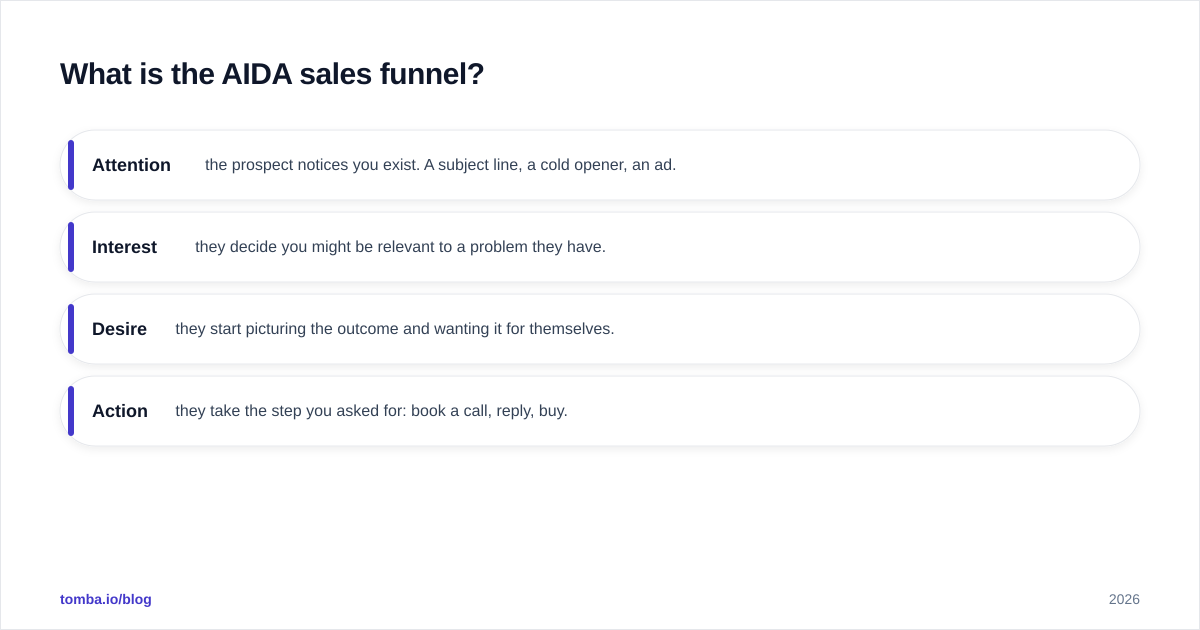
- Attention — the prospect notices you exist. A subject line, a cold opener, an ad.
- Interest — they decide you might be relevant to a problem they have.
- Desire — they start picturing the outcome and wanting it for themselves.
- Action — they take the step you asked for: book a call, reply, buy.
The power of the model isn't the four words — it's that each stage demands a different job from your message. Attention copy that screams works terribly at the Desire stage, where the prospect already knows you and wants proof, not noise.
Why does AIDA still work in 2026?#
Because buyers are more distracted, not less. The newer "flywheel" and "bowtie" models are useful for revenue teams thinking about retention, but they're heavy. AIDA is light enough to audit any single email or call against in thirty seconds: Did this grab attention? Did it build interest? Did it create desire? Did it ask for action?
Three reasons it survives every trend cycle:
- It's diagnostic. When conversion drops, AIDA tells you which stage broke. A flat reply rate is an Attention problem; lots of replies but no booked calls is a Desire-or-Action problem. You stop fixing random things.
- It maps to assets you already own. Subject lines, case studies, demos, and CTAs each live at a specific stage. AIDA just organizes them.
- It scales from one email to a whole campaign. A single cold email contains a mini-AIDA. So does a 6-touch sequence. So does a quarter-long account-based play.
The catch in 2026: attention is brutally expensive. Inboxes are crowded, email deliverability is tighter, and generic outreach gets filtered before a human sees it. That raises the bar on stage one and makes accurate targeting non-negotiable — you can't earn attention from the wrong person.
How do the four AIDA stages map to sales actions?#
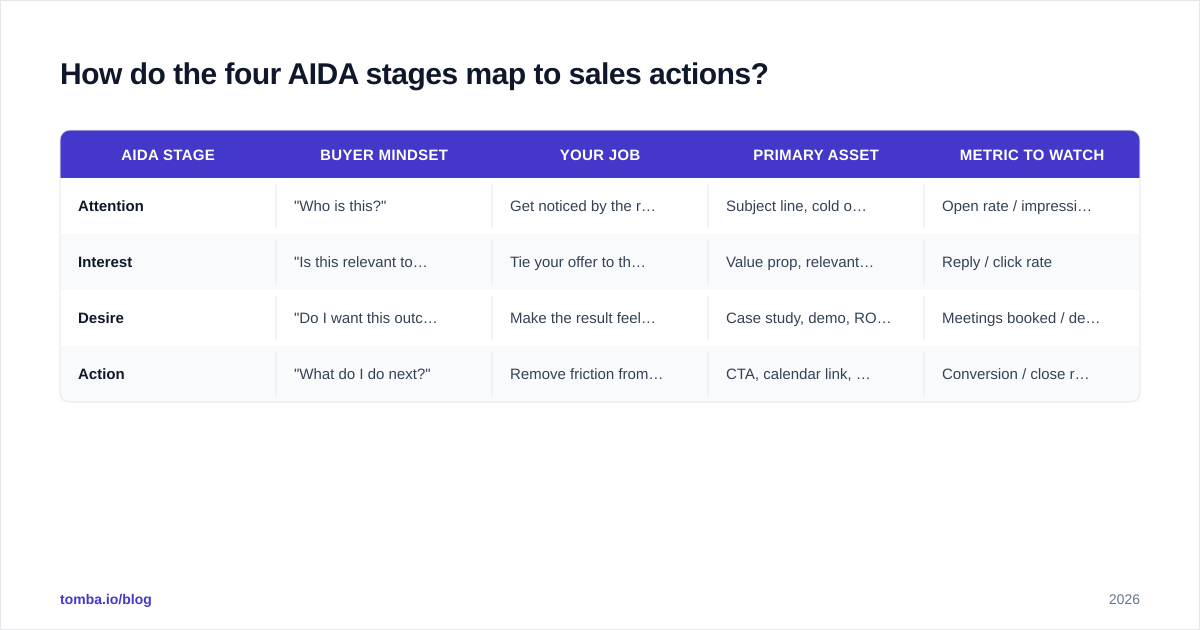
Each stage has a goal, a primary asset, and a number you watch. Mismatching them is where most funnels bleed.
| AIDA stage | Buyer mindset | Your job | Primary asset | Metric to watch |
|---|---|---|---|---|
| Attention | "Who is this?" | Get noticed by the right person | Subject line, cold opener, ad hook | Open rate / impressions |
| Interest | "Is this relevant to me?" | Tie your offer to their problem | Value prop, relevant proof point | Reply / click rate |
| Desire | "Do I want this outcome?" | Make the result feel real and safe | Case study, demo, ROI math | Meetings booked / demo rate |
| Action | "What do I do next?" | Remove friction from one clear step | CTA, calendar link, offer | Conversion / close rate |
Read that table as a leak detector. If your open rate is healthy but replies are flat, your Attention works and your Interest copy doesn't. If you book demos but they don't close, your Desire stage oversold and Action under-delivered, or your pricing surprised them. You fix the specific tread, not the whole staircase.
Stage 1 — Attention#
You have a subject line and one sentence. That's it. The goal is a single micro-yes: this is worth two more seconds. Personalization beats cleverness — referencing the prospect's company, role, or a recent trigger event outperforms witty one-liners. This is also where data quality decides everything. A perfect opener sent to a bounced or wrong address scores zero. Verify before you send; a tool like Tomba's email verifier keeps your list clean so Attention copy actually reaches a human.
Stage 2 — Interest#
Now bridge from you to them. The mistake here is talking about your features. Interest lives in their problem, not your product. One sharp, relevant proof point — "we cut SDR research time 40% for three companies in your space" — does more than a paragraph of capabilities. If you need help structuring this, a cold email AI writer can draft stage-matched variants you then sharpen by hand.
Stage 3 — Desire#
Desire is where logic meets emotion. The prospect now believes you're relevant; your job is to make the outcome vivid and the risk small. Case studies, specific numbers, social proof, and risk-reversal ("no setup, cancel anytime") do the heavy lifting. Vendor research backs this up — buyers consistently rate peer proof above vendor claims, which is why third-party sites like G2 carry so much weight in B2B deals.
Stage 4 — Action#
One CTA. Always one. A "book a call OR reply OR check the deck OR start a trial" message splits attention and kills conversion. Pick the single next step that matches how warm they are, make it one click, and remove every other choice. The lower the friction, the higher the action rate.
What's the difference between AIDA and a full sales pipeline?#
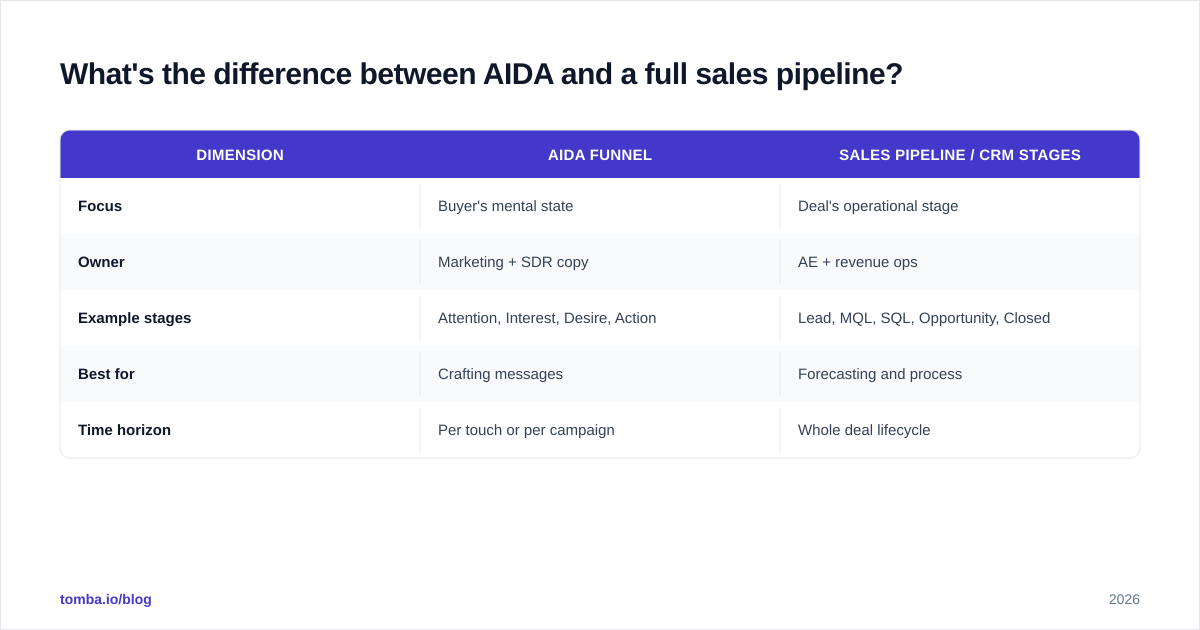
Short answer: AIDA is the psychology; your pipeline is the operations. They line up but they're not the same thing.
| Dimension | AIDA funnel | Sales pipeline / CRM stages |
|---|---|---|
| Focus | Buyer's mental state | Deal's operational stage |
| Owner | Marketing + SDR copy | AE + revenue ops |
| Example stages | Attention, Interest, Desire, Action | Lead, MQL, SQL, Opportunity, Closed |
| Best for | Crafting messages | Forecasting and process |
| Time horizon | Per touch or per campaign | Whole deal lifecycle |
A healthy team runs both. The pipeline tracks where a deal is; AIDA decides what the message at that point should do. When you connect the two — say, mapping AIDA stages onto your sales pipeline stages in HubSpot or Salesforce — you get a system where every CRM stage has a matching message job. HubSpot's funnel guidance is a solid reference for wiring the operational side once your AIDA messaging is set.
How do you build an AIDA sales funnel step by step?#
Here's the build order that actually sticks. Don't skip the targeting step — it's the one most teams shortcut and the one that quietly caps every downstream number.
- Define the one buyer. Pick a single role at a single company type. AIDA copy aimed at "anyone in sales" lands on no one. Specificity is what makes Attention possible.
- Source accurate contacts. You can't grab attention from a contact you can't reach. Build a verified list — name, role, company, and a deliverable email. The email finder and domain search are built for exactly this: turn a target account into reachable decision-makers.
- Write the Attention layer. Draft 3–5 subject lines and openers per segment. Test them. Keep the winners.
- Write the Interest bridge. One sentence connecting their problem to your offer. Cut every "we" you can.
- Stack the Desire proof. Choose the single most relevant case study or number per segment. More isn't better; relevant is better.
- Set one Action per touch. Map a single CTA to each message based on warmth. Early touches ask small; later touches ask for the meeting.
- Sequence it. A typical cold sequence is 5–7 touches over 2–3 weeks, each one advancing the prospect one AIDA stage, not restarting at Attention every time.
- Instrument every stage. Attach the metric from the table above to each step so leaks are visible within a week, not a quarter.
A note on sequencing: every follow-up should assume the prior touch happened, even if it got no reply. Touch two builds Interest on the Attention you already earned. Resetting to "Hi, I'm reaching out because…" on every email is the most common AIDA failure in cold outreach — it traps the whole sequence on stage one.
What are the most common AIDA funnel mistakes?#
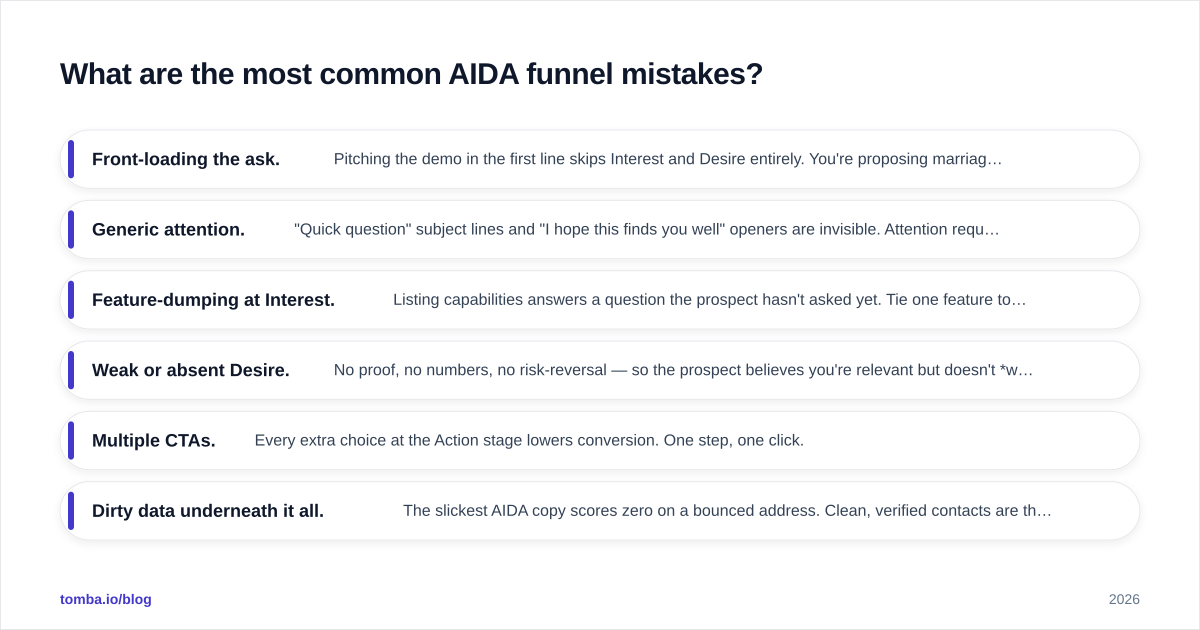
- Front-loading the ask. Pitching the demo in the first line skips Interest and Desire entirely. You're proposing marriage on a first hello.
- Generic attention. "Quick question" subject lines and "I hope this finds you well" openers are invisible. Attention requires relevance to them.
- Feature-dumping at Interest. Listing capabilities answers a question the prospect hasn't asked yet. Tie one feature to one pain.
- Weak or absent Desire. No proof, no numbers, no risk-reversal — so the prospect believes you're relevant but doesn't want it badly enough to act.
- Multiple CTAs. Every extra choice at the Action stage lowers conversion. One step, one click.
- Dirty data underneath it all. The slickest AIDA copy scores zero on a bounced address. Clean, verified contacts are the floor the whole funnel stands on — which is why bulk verification belongs in the build, not as an afterthought.
If you only fix one thing this quarter, instrument the four stages so you know which one leaks. Most teams optimize the stage that feels broken rather than the one the data says is broken — and those are rarely the same.
How do you measure and improve each AIDA stage?#
Improvement is a loop: measure the stage metric, change one variable, compare. Because AIDA isolates stages, you never have to guess which lever moved the result.
- Attention down? Test subject lines and verify your list. Half of "low open rate" problems are deliverability and bad addresses, not copy. Check your sender reputation before blaming the words.
- Interest down? Rewrite the first body line to lead with their problem. A/B one proof point against another.
- Desire down? Swap in a more relevant case study or add risk-reversal. Make the outcome concrete with a number.
- Action down? Simplify the CTA to one click. Move the calendar link higher. Remove competing asks.
Run one experiment per stage per week and the compounding is real: a 20% lift at each of four stages roughly doubles end-to-end conversion (1.2⁴ ≈ 2.07). That's the quiet superpower of AIDA — small, stage-isolated wins multiply instead of cancel out.
Putting it together#
The AIDA sales funnel endures because it's the rare framework that's both simple enough to sketch on a napkin and rigorous enough to attach a dashboard to. Map your messages to Attention, Interest, Desire, and Action; give each stage its own asset and its own number; fix the stage the data points at, not the one your gut points at. Do that consistently and you'll convert more from the leads you already have — no extra volume required.
But none of it fires if your outreach lands in nowhere. Every AIDA funnel sits on top of one assumption: that your message reaches a real, reachable human. Start there. Use the Tomba Email Finder to build verified, decision-maker-level contact lists by domain, name, or company — so the attention-grabbing copy you worked hard on actually gets seen. Start free with 25 searches a month, then scale on the Starter plan at $49/mo when your funnel is filling. Get the data right, and AIDA does the rest.
// get started
Find, verify and enrich your first contacts today
Start on the free plan with 25 searches a month, then scale when your team is ready.
Free plan · No credit card required · GDPR & CCPA
// about the author