AIDA Sales Model: How to Use It in B2B Sales in 2026
The AIDA sales model still drives replies in 2026 — if you apply it right. Here's how to turn Attention, Interest, Desire, and Action into cold emails that convert.
The AIDA sales model is over 120 years old, and it still decides whether your cold email gets a reply or a delete. Most reps know the acronym. Far fewer apply it in a way that survives a crowded 2026 inbox. This guide fixes that.
TL;DR#
- AIDA = Attention, Interest, Desire, Action — a four-stage model that maps how a buyer moves from "who is this?" to "yes, let's talk."
- It works because it forces you to earn each stage in order; skip Attention and the rest never gets read.
- In B2B, AIDA shines in cold email, LinkedIn messages, sales decks, and landing pages — anywhere you have seconds to convince a stranger.
- The biggest mistake reps make: leading with Desire (your product's features) before earning Attention and Interest.
- Pair AIDA with accurate contact data and a tight follow-up cadence, and reply rates climb without you writing more emails.
What is the AIDA sales model?#
AIDA is a hierarchy-of-effects model that breaks a buying decision into four sequential stages: Attention, Interest, Desire, and Action. The idea is that a prospect has to clear each rung before climbing to the next. You grab attention, hold interest, build desire, then ask for action.
Think of it like a first date that you only get one shot at. You can't propose marriage in the first sentence (Action) before the other person even knows why you're interesting (Attention) or what you have in common (Interest). Rush it and you get ghosted. The same psychology governs a stranger reading your cold email at 8:47 a.m. between two meetings.
The model was first articulated by advertising pioneer Elias St. Elmo Lewis in 1898 and has outlived nearly every marketing fad since. You can read the full lineage on Wikipedia's AIDA entry. The reason it endures is simple: human attention still works in stages, no matter how much the channels change.
What does each stage of AIDA actually mean in sales?#
Here's what each letter demands from you, translated out of marketing-textbook language into things a sales rep does on a Tuesday.
Attention. You interrupt the scroll. In email, this is your subject line and first sentence. The job is not to describe your product — it's to earn the next five seconds of reading time. A specific observation about the prospect's company beats any clever wordplay.
Interest. Now that they're reading, you make the message relevant to them. This is where you connect a real problem they likely have to something you've seen or solved. Interest is about their world, not your feature list.
Desire. You shift from "this is relevant" to "I want this outcome." Desire is built with proof — a result, a number, a peer who got the win. This is where benefits replace features.
Action. You ask for one clear, low-friction next step. Not "let me know your thoughts." A specific ask: a 15-minute call, a reply with a yes/no, a link to pick a time.
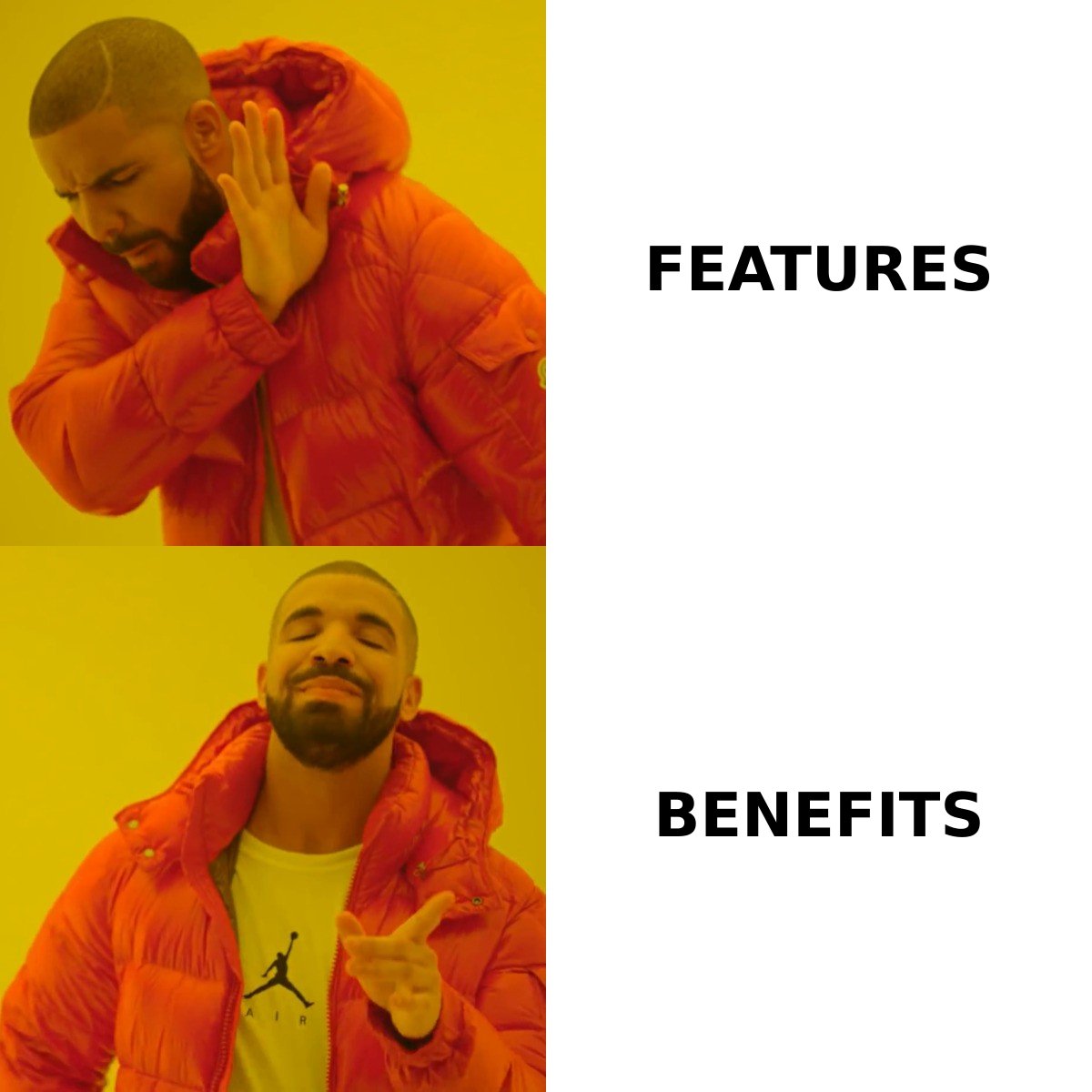
The meme is a joke, but it's the single most common AIDA failure. Reps love their features. Buyers only care about the benefit those features produce. AIDA forces the translation.
How do you write a cold email with the AIDA sales model?#
Let's build one email, stage by stage, for a fictional rep selling a deliverability tool to a VP of Sales.
Attention (subject + opener):
Subject: Your team's emails are landing in spam, Maria
Maria, I ran a quick check on [company] outbound domain and three of your subdomains are flagged on two blacklists.
That opener works because it's specific and slightly alarming in a useful way. It's about her, not you.
Interest:
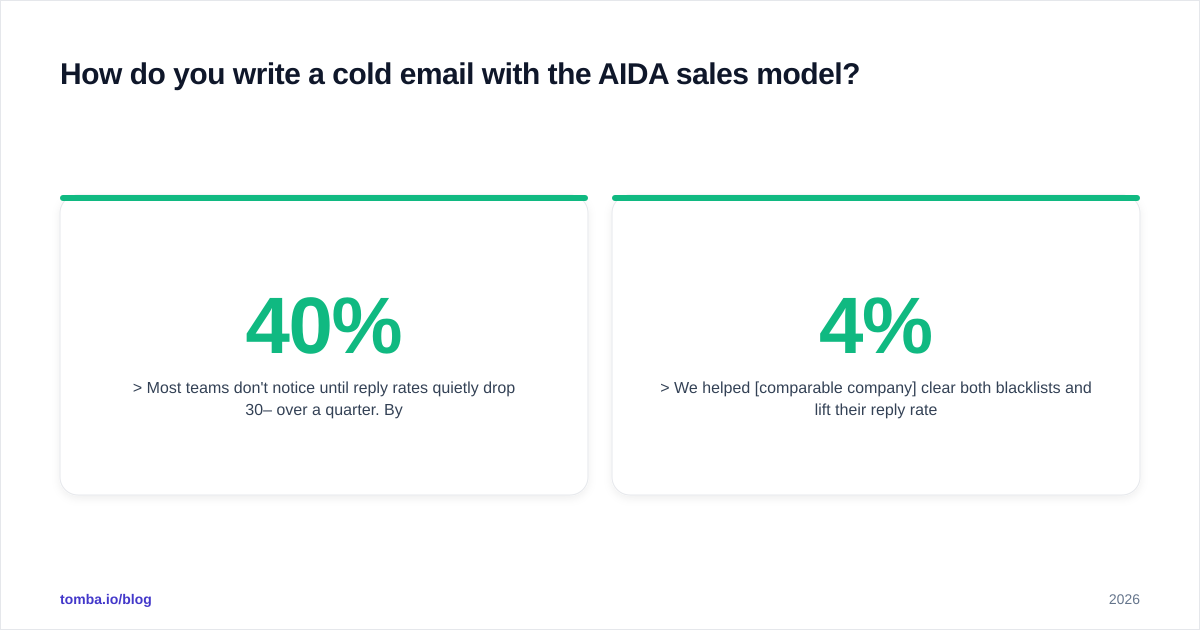
Most teams don't notice until reply rates quietly drop 30–40% over a quarter. By then the domain reputation is already damaged and recovery takes weeks.
You've connected the observation to a consequence she cares about: pipeline.
Desire:
We helped [comparable company] clear both blacklists and lift their reply rate from 4% to 9% in six weeks — without changing their copy or their list.
Proof. A peer, a number, a timeframe. This is desire built on evidence, not adjectives.
Action:
Worth a 15-minute call Thursday to walk through your domain's current standing? Here's my calendar: [link]
One ask, low friction, specific day. Done.
That entire email is under 90 words. AIDA is not about writing more — it's about sequencing what you write. If you want pre-built starting points, our library of cold email templates is already structured around this flow, and the cold email AI writer can draft AIDA-shaped variants for you to edit.
Is the AIDA sales model still relevant in 2026?#
Yes — but with two important caveats.
First, attention is harder to win than ever. The average B2B buyer gets more outreach than they did even two years ago, and AI-generated spam has trained people to delete faster. The Attention stage now carries more weight than the original model assumed. If your first line reads like a template, the other three stages never load.
Second, the buying journey is rarely linear. A modern buyer might feel Desire from a podcast, lose Interest after a bad demo, then circle back via a colleague's referral. AIDA is still a useful map for a single message, but for a whole deal you should treat it as a checklist of jobs to be done across many touches, not a strict one-email funnel.
The practical takeaway: use AIDA to structure individual assets (each email, each call opener, each landing page), and use a broader pipeline model to manage the whole relationship. The two are complementary, not competing.
How does AIDA compare to other sales frameworks?#
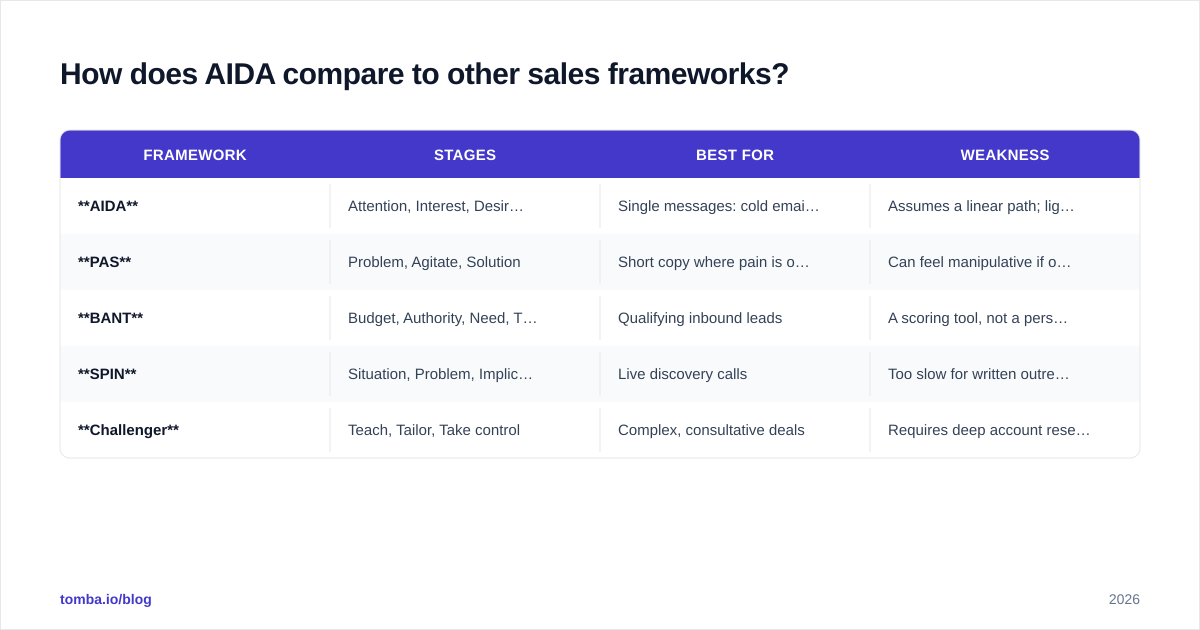
AIDA is one of several models reps reach for. Here's how it stacks up against the common alternatives so you can pick the right tool for the job.
| Framework | Stages | Best for | Weakness |
|---|---|---|---|
| AIDA | Attention, Interest, Desire, Action | Single messages: cold email, ads, landing pages | Assumes a linear path; light on objection handling |
| PAS | Problem, Agitate, Solution | Short copy where pain is obvious | Can feel manipulative if overdone |
| BANT | Budget, Authority, Need, Timing | Qualifying inbound leads | A scoring tool, not a persuasion model |
| SPIN | Situation, Problem, Implication, Need-payoff | Live discovery calls | Too slow for written outreach |
| Challenger | Teach, Tailor, Take control | Complex, consultative deals | Requires deep account research |
The honest answer most playbooks won't give you: these overlap heavily. AIDA's Interest and Desire stages are essentially PAS's Problem and Solution. SPIN is what AIDA's Interest stage looks like when you have 30 minutes on a call instead of 80 words in an email. Pick AIDA when you're writing; pick SPIN when you're talking; use BANT to decide who's worth either.

What are the most common AIDA mistakes?#
After reviewing thousands of cold emails, the failures cluster into a short list.
Leading with Desire. "We're the #1 platform for X" is a Desire-stage statement dropped into the Attention slot. Nobody cares about your ranking before they care about themselves. Earn the read first.
Confusing Interest with a feature dump. Interest is the prospect's problem, described in their language. Three bullet points about your integrations is not Interest — it's a brochure.
A weak or absent Action. "Let me know if you'd like to learn more" puts all the work on the prospect. A good Action is specific and binary: yes/no, this time or that time, one link.
Treating one email as the whole funnel. A single message rarely carries a buyer through all four stages. Your sequence does the heavy lifting. The first email earns Attention and Interest; follow-ups build Desire with new proof and ask for Action again. Reply rates live and die on follow-up — see our breakdown of what drives email response rate for the data.
Skipping the research. Every AIDA stage gets sharper with information about the prospect. The Attention line that references a real trigger event will always beat a generic one. That research depends on reaching the right person in the first place — which is a data problem before it's a copy problem.
How do you scale AIDA across an outbound campaign?#
Writing one perfect AIDA email is easy. Sending 500 that still feel personal is the real challenge. Here's the operational version.
1. Build a clean, accurate list. AIDA collapses if the email bounces or the contact is wrong. Verify addresses before you send so your Attention-stage subject line actually reaches a human. A bounced email never clears stage one.
2. Segment by trigger, not just title. Your Attention line should reference something true about a group — a funding round, a hiring spree, a tech-stack change. Segment first, then write one AIDA email per segment.
3. Template the structure, personalize the variables. Keep the four-stage skeleton fixed. Swap only the specifics: the observation (Attention), the consequence (Interest), the proof point (Desire). This is how you stay personal at volume.
4. Sequence the stages across touches. Email one: Attention + Interest. Email two (3 days later): a new proof point for Desire. Email three: a direct, easy Action. Each touch advances one rung.
5. Measure per stage. Open rate tells you if Attention worked. Reply rate tells you if Interest and Desire landed. Meeting-booked rate tells you if your Action was frictionless. Diagnose by stage, fix by stage.
The data foundation under all of this matters more than the copy. The most elegant AIDA email in the world fails if it lands in the wrong inbox. Tools like HubSpot's sales email guidance and peer reviews on G2's sales engagement category are useful for benchmarking your tooling, but they all assume you've solved the contact-accuracy problem first.
What does a full AIDA cold email template look like?#
Here's a reusable skeleton you can adapt. Keep it under 100 words.
Subject: [specific, prospect-focused observation]
Hi [First name],
[Attention] [One specific, true observation about their company or role.]
[Interest] [The likely consequence of that observation — a problem they probably feel.]
[Desire] [A concrete result you produced for a comparable company: a number, a timeframe, a peer name.]
[Action] [One specific, low-friction ask — a 15-min call on a named day, or a yes/no question.]
[Your name]
Fill the brackets, send, measure by stage, iterate. That's the entire system. For subject lines specifically, our subject line generator can produce Attention-stage variants to A/B test.
Bringing it together#
The AIDA sales model isn't a clever trick — it's a discipline. It forces you to earn the read before you earn the reply, and to lead with the buyer's world before your own. In 2026, with inboxes more hostile than ever, that discipline is the difference between a 2% reply rate and a 9% one. Get the sequence right, back it with verified contacts and a real follow-up cadence, and the model does what it's done for over a century.
But none of it fires if your email never reaches a real person. Before you write a single Attention line, make sure you're reaching out to the right inbox. Tomba's Email Finder lets you find verified, professional email addresses by name or company domain, so every AIDA email you craft actually lands. Start free with 25 searches a month, and check Tomba pricing when you're ready to scale your outbound — because the best copy in the world is worthless if it bounces.
Ready to find emails that actually work?
Join 150,000+ professionals who stopped guessing and started sending. Free credits on signup — no credit card required.
Get the Tomba newsletter
Practical outbound tactics and product updates — once every two weeks.
About the author