Aidentified Pricing, Reviews, Pros and Cons (2026 Guide)
A neutral 2026 breakdown of Aidentified pricing, real user reviews, and the honest pros and cons of its relationship-intelligence platform for advisors and B2B sales teams.
TL;DR
- Aidentified is a relationship-intelligence and wealth-data platform aimed at financial advisors, wealth managers, and B2B sales teams who sell on warm introductions.
- Aidentified pricing is not published publicly — it runs on custom quotes tied to seat count, data modules, and contract length, so expect a sales call before you see a number.
- The strengths are relationship mapping, wealth and life-event signals, and CRM enrichment. The weaknesses are opaque pricing, a learning curve, and US-centric data coverage.
- For teams that just need accurate work emails and direct dials at a transparent price, a dedicated email finder covers most of the prospecting job for a fraction of the cost.
- Read the pros, cons, reviews, and the comparison table below before you book that demo.
What is Aidentified?#
Aidentified is a relationship-intelligence platform that maps the hidden connections between people and surfaces buying or wealth signals around them. Think of it as a "who-knows-who" engine: instead of handing you a cold list, it tells you which of your existing contacts can warm-introduce you to a target prospect, and it layers on data like estimated net worth, job changes, and life events.
The product is built mostly for financial services — registered investment advisors (RIAs), wealth managers, insurance producers — but the same machinery works for any B2B team that closes through referrals and relationships. Its core modules are usually described as relationship mapping (the graph of who is connected to whom), wealth and demographic data, and trigger events that tell you when to reach out.
In plain terms: a normal prospecting tool answers "what is this person's email?" Aidentified tries to answer "who on my team already knows this person, how wealthy are they, and what just changed in their life that makes now the right time to call?" That is a bigger, more expensive promise — and it is the lens you should keep while reading the rest of this guide. You can see the company's own framing on the official Aidentified site.
How much does Aidentified cost in 2026?#
The honest answer: Aidentified does not publish its pricing. There is no public price page with a $X/month tier you can sign up for on a credit card. Instead, you request a demo, talk to sales, and receive a custom quote based on a handful of variables.
From user reports and third-party listings, pricing typically scales on:
- Seats — number of advisors or reps who get logins.
- Data modules — relationship mapping alone costs less than the full wealth-signal and trigger-event stack.
- Contract length — annual commitments are the norm; month-to-month is rare or unavailable.
- Record volume / enrichment — how many contacts you push through enrichment and CRM sync.
Most published estimates put Aidentified in the low-to-mid four figures per seat per year, with team and enterprise deals climbing well beyond that once you add modules and integrations. Because none of this is official, treat any specific dollar figure you see online — including ranges quoted on review aggregators — as a starting point for negotiation, not a fixed rate.
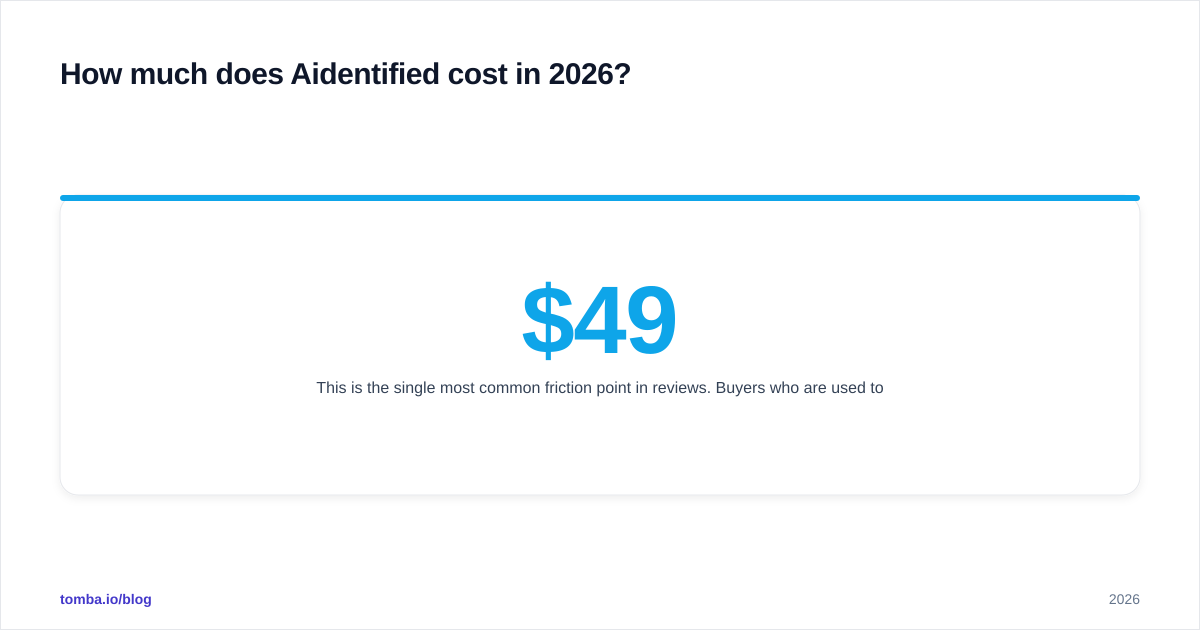
This is the single most common friction point in reviews. Buyers who are used to transparent, self-serve SaaS pricing find the "book a call to learn the price" model slow. If you want to benchmark Aidentified against tools you can price instantly, compare it to a published rate card like Tomba pricing, where the Free, Starter ($49/mo), Growth ($99/mo), and Pro ($249/mo) tiers are listed up front.

What you actually pay for#
It helps to separate what Aidentified sells into two buckets:
- Data — emails, phone numbers, wealth estimates, demographics, and life events on individual contacts.
- Intelligence — the relationship graph and the timing signals that tell you who to contact and when.
Plenty of cheaper tools sell bucket one. Aidentified's premium pricing is justified almost entirely by bucket two. If your team does not actually run a referral-and-relationship motion, you may be paying enterprise prices for data you could get elsewhere for far less.
What do Aidentified reviews say?#
Aidentified holds generally positive ratings on the major software review sites, though the volume of reviews is smaller than mass-market sales tools. You can read current scores on G2 and Capterra; here is the recurring pattern across them.
What reviewers praise:
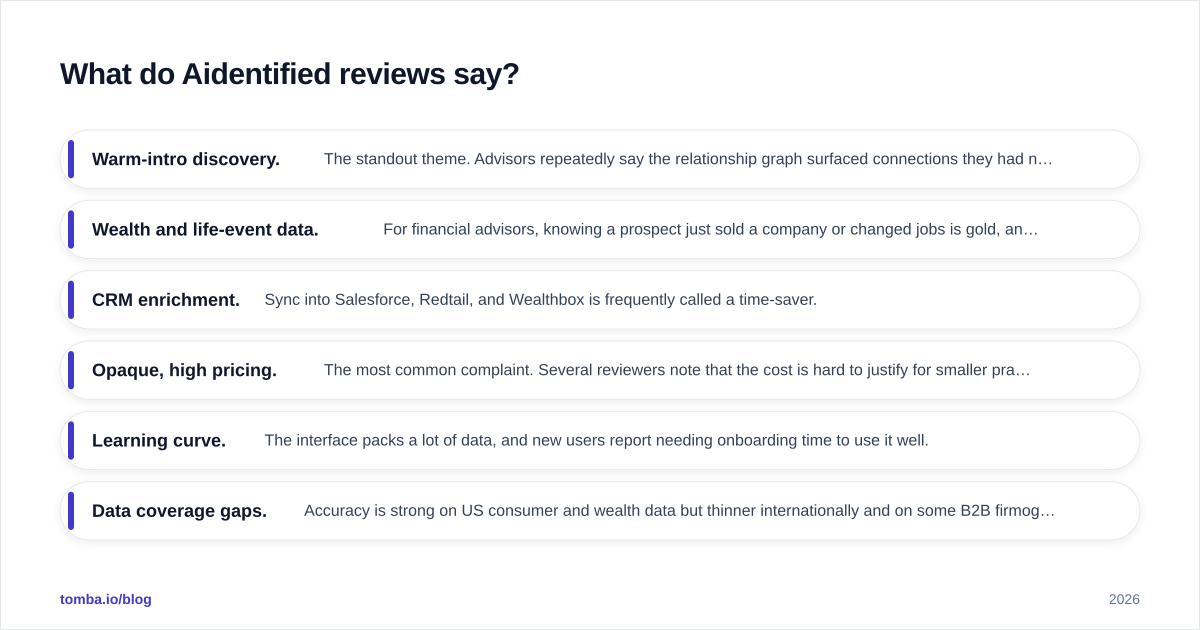
- Warm-intro discovery. The standout theme. Advisors repeatedly say the relationship graph surfaced connections they had no idea existed — a client who sits on a board with a target prospect, for example.
- Wealth and life-event data. For financial advisors, knowing a prospect just sold a company or changed jobs is gold, and reviewers credit Aidentified for catching those triggers.
- CRM enrichment. Sync into Salesforce, Redtail, and Wealthbox is frequently called a time-saver.
What reviewers criticize:
- Opaque, high pricing. The most common complaint. Several reviewers note that the cost is hard to justify for smaller practices.
- Learning curve. The interface packs a lot of data, and new users report needing onboarding time to use it well.
- Data coverage gaps. Accuracy is strong on US consumer and wealth data but thinner internationally and on some B2B firmographics.
- Contract rigidity. Annual lock-in and renewal terms come up as a friction point.
The net read: people who fit the ideal-customer profile (US-based advisors selling on relationships) tend to love it. People who bought it expecting a cheap email-and-phone database tend to feel it was overkill.
What are the pros and cons of Aidentified?#
Here is the balanced view, stripped of marketing language.
Pros#
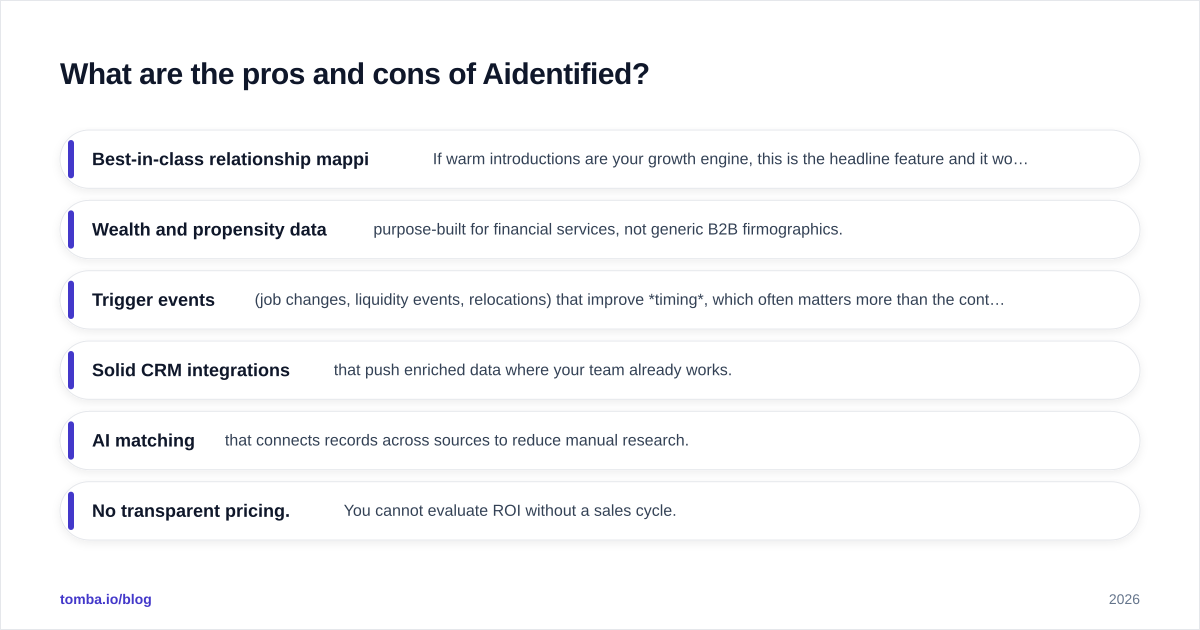
- Best-in-class relationship mapping. If warm introductions are your growth engine, this is the headline feature and it works.
- Wealth and propensity data purpose-built for financial services, not generic B2B firmographics.
- Trigger events (job changes, liquidity events, relocations) that improve timing, which often matters more than the contact data itself.
- Solid CRM integrations that push enriched data where your team already works.
- AI matching that connects records across sources to reduce manual research.
Cons#
- No transparent pricing. You cannot evaluate ROI without a sales cycle.
- Premium cost that prices out solo advisors and small teams.
- US-centric data. Coverage weakens outside the United States.
- Overkill for simple prospecting. If you just need verified emails and dials, you are paying for a relationship engine you may not use.
- Onboarding overhead. Expect ramp time before the platform pays off.
How does Aidentified compare to email-finder alternatives?#
This is where many buyers get stuck, because Aidentified competes in two categories at once: relationship intelligence and contact data. If you only need the second, the math changes a lot.
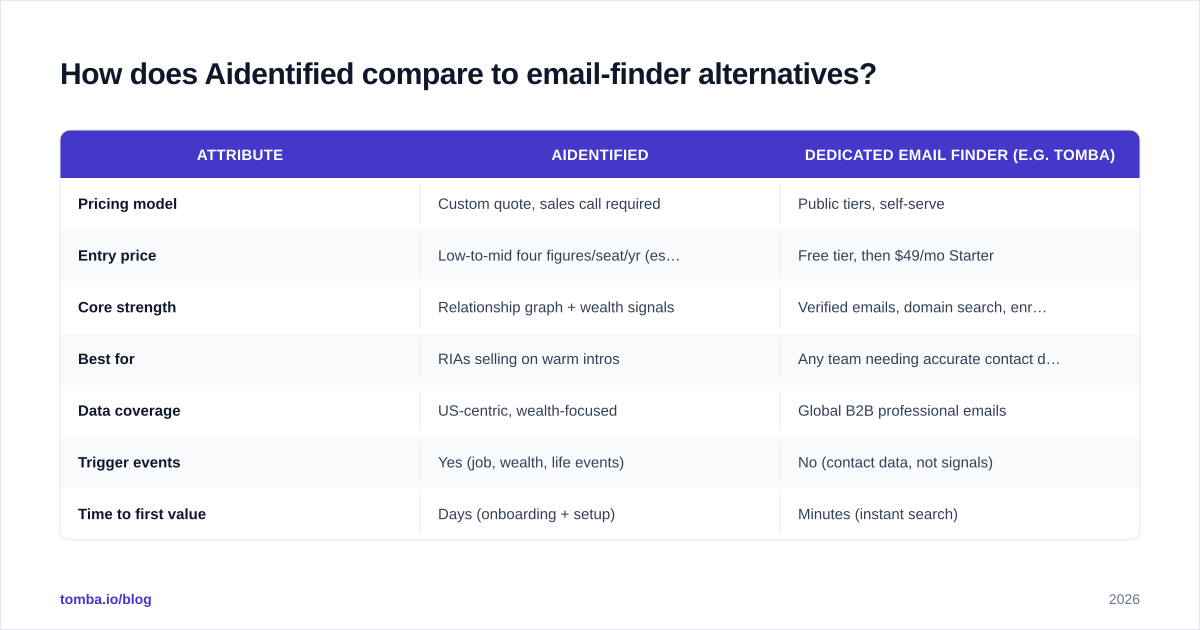
The table below compares Aidentified against a transparent, contact-data-first approach. It is not apples-to-apples — that is the point. You are deciding whether you need the full relationship engine or just reliable, verified contact data.
| Attribute | Aidentified | Dedicated email finder (e.g. Tomba) |
|---|---|---|
| Pricing model | Custom quote, sales call required | Public tiers, self-serve |
| Entry price | Low-to-mid four figures/seat/yr (est.) | Free tier, then $49/mo Starter |
| Core strength | Relationship graph + wealth signals | Verified emails, domain search, enrichment |
| Best for | RIAs selling on warm intros | Any team needing accurate contact data |
| Data coverage | US-centric, wealth-focused | Global B2B professional emails |
| Trigger events | Yes (job, wealth, life events) | No (contact data, not signals) |
| Time to first value | Days (onboarding + setup) | Minutes (instant search) |
| Contract | Annual lock-in typical | Monthly or annual, cancel anytime |
The decision framework is simple. If your revenue genuinely depends on mapping who-knows-who and timing outreach to liquidity events, Aidentified's premium is defensible. If your reps mostly need to reach the right person with a deliverable email and a working phone number, a focused email finder plus an email verifier does that job at a published price — and you can layer in data enrichment only where you actually need it.
A hybrid approach many teams land on#
You do not have to pick one religion. A common, cost-conscious setup looks like this:
- Use a transparent contact-data tool for day-to-day prospecting volume — finding and verifying emails by domain search across target accounts.
- Reserve a relationship-intelligence platform like Aidentified for your highest-value, referral-driven accounts where a warm intro is worth four figures.
That way you are not paying enterprise data prices for routine top-of-funnel work, and you still get the relationship edge where it actually moves a deal. Pair this with a clean process around email deliverability so the contacts you find actually land in the inbox.
Who should buy Aidentified — and who shouldn't?#
Buy it if:
- You are a US-based RIA, wealth manager, or insurance producer.
- Warm introductions and referrals are a core part of how you win clients.
- You can absorb a four-figure-plus annual per-seat cost and want timing signals around wealth events.
- You have the team bandwidth to onboard and actually work the relationship graph.
Skip it (or start cheaper) if:
- You are a solo advisor or small team watching every dollar.
- You sell internationally, where its data thins out.
- Your real need is "find and verify the right person's email and phone," not "map the social graph."
- You want to evaluate price before committing to a sales cycle.
For that second group, the fastest path to value is a tool you can try today without a demo. Many teams start with a free tier, validate the data quality on their own target accounts, and scale up only when the numbers justify it — a workflow that simply is not available with a quote-only vendor.
Is Aidentified worth it in 2026?#
Conclusion first: Aidentified is worth it for a specific buyer — the relationship-driven US financial advisor — and overkill for nearly everyone else.
The platform does the hard thing well. Relationship mapping and wealth-triggered timing are genuinely difficult to build, and Aidentified's reviews reflect that the core product delivers. The friction is entirely commercial: opaque pricing, premium cost, and annual lock-in that make it a poor fit for smaller teams or anyone whose need is really just accurate contact data.
So run the test that the pricing model tries to avoid: define exactly what job you are hiring the tool to do. If that job is "warm-introduce me to wealthy prospects at the right moment," book the Aidentified demo. If that job is "get my reps in front of the right people with deliverable contact data," you can solve it today, transparently, and far more cheaply.
Start with accurate contact data, scale intelligence later#
Before you commit to a four-figure relationship-intelligence contract, make sure your foundation — accurate, verified contact data — is solid and affordable. The Tomba Email Finder lets you find professional email addresses by name, company, or domain, verify them, and enrich your CRM, starting with a free tier and a published $49/mo Starter plan. Test it on your own target accounts in minutes, prove the data quality, and add heavier relationship tooling only when your pipeline actually demands it. Transparent pricing, instant results, no sales call required — that is the right place to start, and the smartest hedge against overpaying for features you may never use.
Ready to find emails that actually work?
Join 150,000+ professionals who stopped guessing and started sending. Free credits on signup — no credit card required.
Get the Tomba newsletter
Practical outbound tactics and product updates — once every two weeks.
About the author