Aidentified vs DealSignal 2026: B2B Data Platform Compared
Aidentified and DealSignal both sell B2B contact data, but they solve different problems. Here is a neutral 2026 breakdown of accuracy, coverage, pricing, and best-fit use cases.
TL;DR
- Aidentified is a relationship-intelligence platform built around people graphs, wealth signals, and warm-introduction paths — strongest for financial advisors, wealth management, and referral-driven sales.
- DealSignal is a verified B2B contact and account database with on-demand, human-and-AI-validated records — strongest for demand gen, outbound, and ABM teams that need clean lists at scale.
- They overlap on "we sell contact data," but they are not the same category: one optimizes for who you can reach through warm ties, the other for accurate records you can email or call today.
- Pricing for both is quote-based and seat- or record-driven, which makes side-by-side cost hard to predict without a sales call.
- If your real bottleneck is finding and verifying work emails by name or domain, a dedicated email finder is cheaper and faster than either platform.
If you searched "aidentified vs dealsignal," you are probably deciding which data engine to plug into your go-to-market motion. The honest answer is that the right pick depends less on a feature scorecard and more on whether your pipeline is built on relationships or reach. This guide breaks down both, where each wins, and when a leaner tool beats both.
What is Aidentified?#
Aidentified is a B2B and B2C relationship-intelligence platform. Instead of just handing you a contact record, it maps the connective tissue around a person: who they know, where they have worked, their estimated net worth and wealth events, and — critically — which of your team members already has a path to them.
That design comes straight from its origin market. Aidentified built its reputation among financial advisors, wealth managers, and insurance professionals, where a warm introduction through a mutual connection converts far better than a cold touch. The platform layers consumer wealth data (estimated assets, liquidity events, property, professional history) on top of a people graph so you can prioritize prospects by both fit and reachability.
In practice, you use Aidentified to answer questions like: "Which of my book of business knows this newly liquid executive?" or "Show me high-net-worth individuals in my territory who just had a job change." It is less a list-building tool and more a referral and signal engine. You can read more on the official site at aidentified.com.
What is DealSignal?#
DealSignal is a B2B data provider focused on verified, on-demand contact and company records. Its pitch is accuracy: rather than serving a static database that decays month over month, DealSignal refreshes and re-verifies records — using a blend of machine validation and human research — at the point you need them.
The platform covers the standard demand-gen wishlist: firmographics, technographics, intent signals, direct dials, and verified business emails. It also offers data enrichment and "list build" services where you describe an ideal customer profile and DealSignal returns a deduplicated, validated set of accounts and contacts. That makes it a fit for marketing ops, SDR teams, and ABM programs that live or die by CRM hygiene.
Where Aidentified asks "who can introduce me," DealSignal asks "is this record real, current, and complete." You can see its positioning at dealsignal.com.
Aidentified vs DealSignal: how do they compare?#
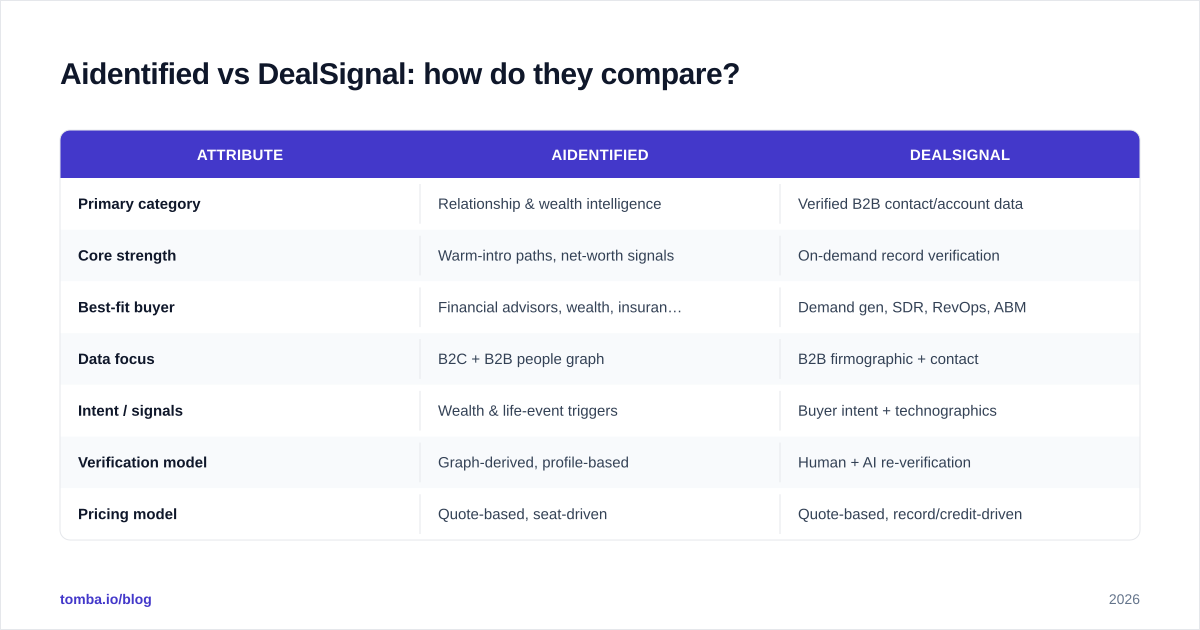
Here is the side-by-side. Treat the pricing rows as directional — both vendors quote based on seats, record volume, and contract length, so your number will vary.
| Attribute | Aidentified | DealSignal |
|---|---|---|
| Primary category | Relationship & wealth intelligence | Verified B2B contact/account data |
| Core strength | Warm-intro paths, net-worth signals | On-demand record verification |
| Best-fit buyer | Financial advisors, wealth, insurance | Demand gen, SDR, RevOps, ABM |
| Data focus | B2C + B2B people graph | B2B firmographic + contact |
| Intent / signals | Wealth & life-event triggers | Buyer intent + technographics |
| Verification model | Graph-derived, profile-based | Human + AI re-verification |
| Pricing model | Quote-based, seat-driven | Quote-based, record/credit-driven |
| Free self-serve tier | No | No |
| API / enrichment | Available | Available |
| Typical entry point | Sales-led demo | Sales-led demo + list build |
The pattern is clear: these tools sit in adjacent lanes of the B2B data and intelligence space, but they were designed for different jobs. Picking the "winner" without naming your use case is meaningless.
Which one has better data accuracy?#
Accuracy means two different things here, and conflating them is the most common mistake buyers make.
DealSignal competes on record-level freshness. Its model re-verifies emails and phone numbers close to delivery time, which is the right design when your KPI is bounce rate, connect rate, or CRM completeness. If you are loading 10,000 contacts into a sequencer, decayed data quietly destroys deliverability — and re-verification is the antidote.
Aidentified competes on relationship and signal accuracy. Its value is not "this email is 98% deliverable"; it is "this person is connected to your colleague and just had a liquidity event." For a wealth advisor, a slightly stale email attached to a strong warm path beats a perfect email with no relationship behind it.
So the accuracy question splits cleanly:
- Outbound at volume (cold email, dialers, ABM lists): DealSignal's verification model is the better mechanical fit. Pair it with an email verifier step in your pipeline regardless of vendor — no provider is immune to decay.
- Referral-driven, high-ACV selling: Aidentified's signal layer is the differentiator, and raw email deliverability matters less because you are warming the intro first.
A neutral note: both vendors publish accuracy claims, and no third-party benchmark covers them identically. Validate with a sample. Ask each for a 200-record test set in your exact territory, run it through an independent verifier, and measure the real bounce rate yourself before signing.
How should you choose? A simple framework#
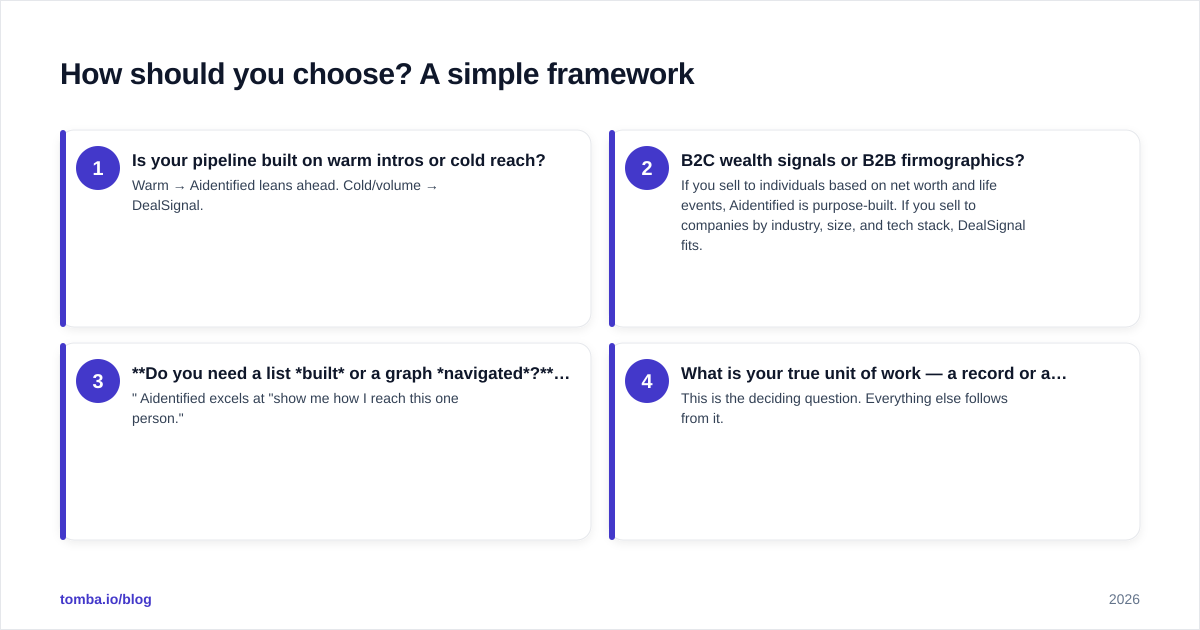
Before comparing logos, score your own motion against four questions. The diagram below summarizes the decision path.
- Is your pipeline built on warm intros or cold reach? Warm → Aidentified leans ahead. Cold/volume → DealSignal.
- B2C wealth signals or B2B firmographics? If you sell to individuals based on net worth and life events, Aidentified is purpose-built. If you sell to companies by industry, size, and tech stack, DealSignal fits.
- Do you need a list built or a graph navigated? DealSignal excels at "give me 5,000 matching contacts." Aidentified excels at "show me how I reach this one person."
- What is your true unit of work — a record or a relationship? This is the deciding question. Everything else follows from it.
If you answered "records, B2B, cold, at volume" to most of these, keep reading — there is a cheaper path worth considering before you commit to either enterprise contract.
Where do both tools fall short — and what's the leaner alternative?#
Both platforms are sales-led, quote-based, and built for teams that have budget for an annual data contract. That is fine if you are a 40-rep org with a RevOps function. It is overkill if your actual job is narrower: find the verified work email for a list of named people or a set of target domains.
For that specific job, a dedicated email-finding tool is faster to start, transparent on price, and self-serve. You do not sit through a demo cycle to find out it costs more than your tooling budget. A few concrete gaps where a focused tool wins:
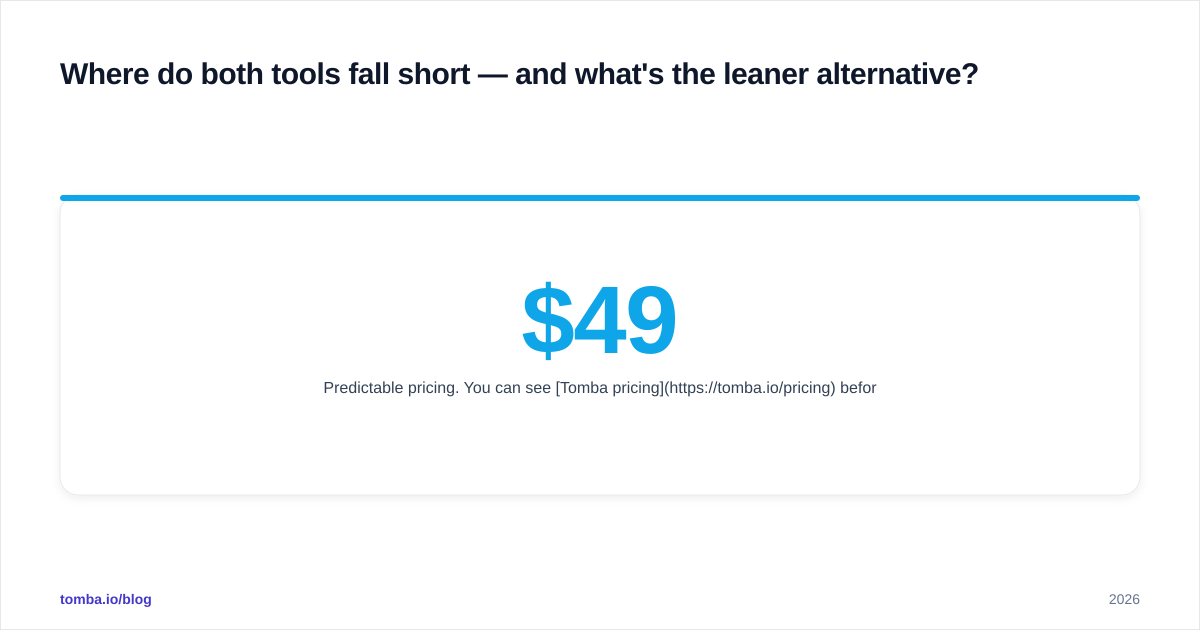
- Predictable pricing. You can see Tomba pricing before talking to anyone — Free (25 searches/mo), Starter $49/mo, Growth $99/mo, Pro $249/mo, Enterprise custom. No "request a quote" wall for the entry tiers.
- Domain-first prospecting. A domain search returns every discoverable email pattern at a company in seconds — useful when you know the account but not the person.
- Verification built in. Catch-all detection and SMTP checks ship alongside the finder, so you are not bolting on a second vendor.
- Enrichment when you need it. For deeper records, data enrichment fills firmographic and social fields onto a thin list.
This is not "Tomba replaces an enterprise data platform." It does not map relationship graphs like Aidentified, and it is not a full managed list-build service like DealSignal. It is the right tool when your bottleneck is email discovery and verification, not relationship intelligence or managed data ops. Many teams run a lightweight finder for day-to-day prospecting and reserve the heavy platform budget for the use case that genuinely needs it.
When is each tool the obvious winner?#
To make this concrete, here is who should pick what — stated plainly.
Pick Aidentified if:
- You are a financial advisor, wealth manager, or insurance producer.
- Warm introductions are your highest-converting channel.
- You sell to individuals and care about net worth, liquidity events, and life triggers.
- Your team's existing relationships are an underused asset you want to surface.
Pick DealSignal if:
- You run demand gen, ABM, or an SDR team at volume.
- Your CRM is decaying and you need re-verified records, not a static dump.
- You want a managed list-build against a defined ICP.
- Buyer intent and technographic targeting are part of your motion.
Pick a dedicated email finder if:
- Your core need is finding and verifying work emails by name or domain.
- You want self-serve, transparent pricing and a free tier to test.
- You are a founder, solo SDR, recruiter, or small team without enterprise data budget.
- You already have a target list and just need accurate contact points.
There is also a credible middle path: use a focused finder for everyday discovery and layer a platform only for the slice of your motion that truly needs relationship graphs or managed verification. You will spend less and keep your data stack honest. For a broader market view, cross-check vendor reviews on G2 before committing — peer reviews surface the support and onboarding realities that demos hide.
Frequently asked questions#
Is Aidentified a CRM? No. It is a relationship-intelligence and prospecting layer that integrates with CRMs. It surfaces who to contact and how to reach them warmly; it does not replace your system of record.
Does DealSignal offer a free trial? DealSignal is sales-led and typically runs a sample or pilot rather than an open free tier. Ask for a verified test set in your territory so you can measure accuracy independently.
Can I use both together? Yes, and some teams do — Aidentified for warm-path prioritization, DealSignal for clean B2B records to fuel campaigns. Just watch for overlapping cost; two enterprise contracts add up fast.
What about straightforward email finding? If that is the whole job, neither enterprise platform is the most economical starting point. A self-serve finder with built-in verification covers it at a fraction of the cost.
The bottom line#
Aidentified and DealSignal are not really competitors so much as neighbors. Aidentified wins when your pipeline runs on relationships, wealth signals, and warm introductions. DealSignal wins when you need verified, current B2B records built and refreshed at scale. Score your own motion on the four-question framework above and the choice usually makes itself.
But if you strip the requirement down to its core — find the right person's verified email and reach them — you do not need a quote-based enterprise contract to start. Try the Tomba Email Finder free with 25 searches a month: search by name, company, or domain, get built-in verification, and scale up only when you are ready. Start with the job in front of you, prove the ROI, and add heavier platforms when your motion actually demands them.
Ready to find emails that actually work?
Join 150,000+ professionals who stopped guessing and started sending. Free credits on signup — no credit card required.
Get the Tomba newsletter
Practical outbound tactics and product updates — once every two weeks.
About the author