Aidentified vs Leadzenai 2026: B2B Data Tools Compared
A hands-on 2026 breakdown of Aidentified vs Leadzenai — data coverage, relationship intelligence, pricing, and which platform fits your go-to-market motion.
Aidentified vs Leadzenai: Which B2B Intelligence Platform Wins in 2026?
Bottom line up front: Aidentified is the stronger pick if your edge comes from warm relationships and wealth/affinity signals — it maps who already knows whom. Leadzen.ai wins if you need raw prospecting volume, real-time lookups, and India-plus-global contact discovery at a lower entry price. Most teams that test both end up pairing a relationship-graph tool with a dedicated email finder to close the data-quality gap.
TL;DR#
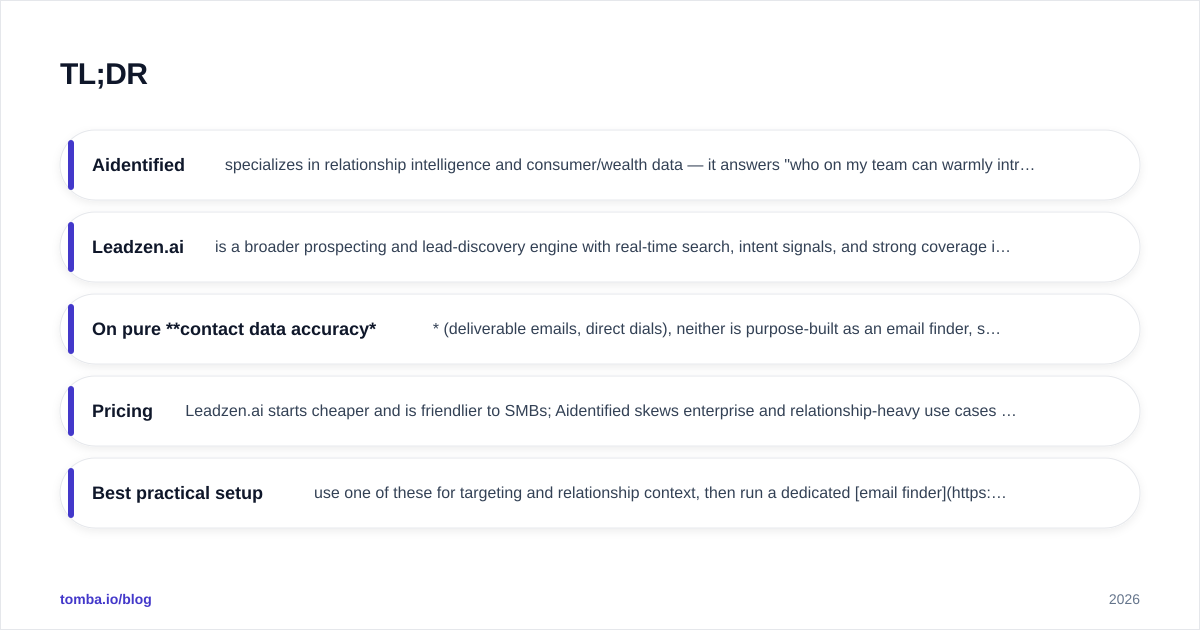
- Aidentified specializes in relationship intelligence and consumer/wealth data — it answers "who on my team can warmly introduce me to this buyer?"
- Leadzen.ai is a broader prospecting and lead-discovery engine with real-time search, intent signals, and strong coverage in APAC markets.
- On pure contact data accuracy (deliverable emails, direct dials), neither is purpose-built as an email finder, so verification leakage is the common complaint.
- Pricing: Leadzen.ai starts cheaper and is friendlier to SMBs; Aidentified skews enterprise and relationship-heavy use cases (wealth management, recruiting, partnerships).
- Best practical setup: use one of these for targeting and relationship context, then run a dedicated email finder and email verifier before you send.
What Are Aidentified and Leadzenai?#
Both tools sit under the umbrella of B2B data and intelligence, but they solve different halves of the same problem.
Aidentified is a relationship-intelligence platform. Its core asset is a graph of professional and personal connections layered with demographic, firmographic, and wealth attributes. Think of it like a social map of your entire company's combined network: instead of cold-calling a stranger, Aidentified surfaces the colleague who went to college with that prospect or sat on a board with them. It's heavily used by financial advisors, wealth managers, and partnership teams where a warm intro is worth more than a thousand cold emails.
Leadzen.ai is a lead-discovery and prospecting engine. It's closer to an Apollo or Lusha in spirit: you define a target profile (industry, title, geography, company size), and it returns matching contacts with emails, phone numbers, and enrichment fields. It leans on real-time search rather than only a static database, and it has notably deep coverage in Indian and broader Asia-Pacific markets where many Western tools thin out.
The simplest way to frame it: Aidentified tells you who you should talk to and how you're connected. Leadzen.ai tells you who exists in your market and how to reach them.
How Do Their Data Models Differ?#
This is the fault line that decides everything else.
Aidentified's model is relationship-first. Every record is a node, and the value is in the edges — shared employers, schools, events, board memberships, and household links. Because it blends professional data with consumer and wealth signals, it can tell a wealth manager that a prospect recently had a liquidity event. That's powerful for affinity-based selling, but it also means the database is optimized for connection density, not necessarily for having a current, verified work email on every contact.
Leadzen.ai's model is profile-first. It indexes companies and people, then exposes filters so you can build a list fast. Its real-time lookup tries to fetch fresh data at query time rather than serving you a stale cached row. That helps recency, but real-time scraping-style pipelines are also where deliverability problems creep in — a freshly assembled email guess is not the same as a verified one.
Neither platform is a substitute for a dedicated verification layer. If you're pushing thousands of contacts into sequences, route them through a catch-all verifier first — both tools will hand you addresses that look fine but bounce.
Aidentified vs Leadzenai: Feature Comparison#
Here's the head-to-head on the attributes buyers actually evaluate.
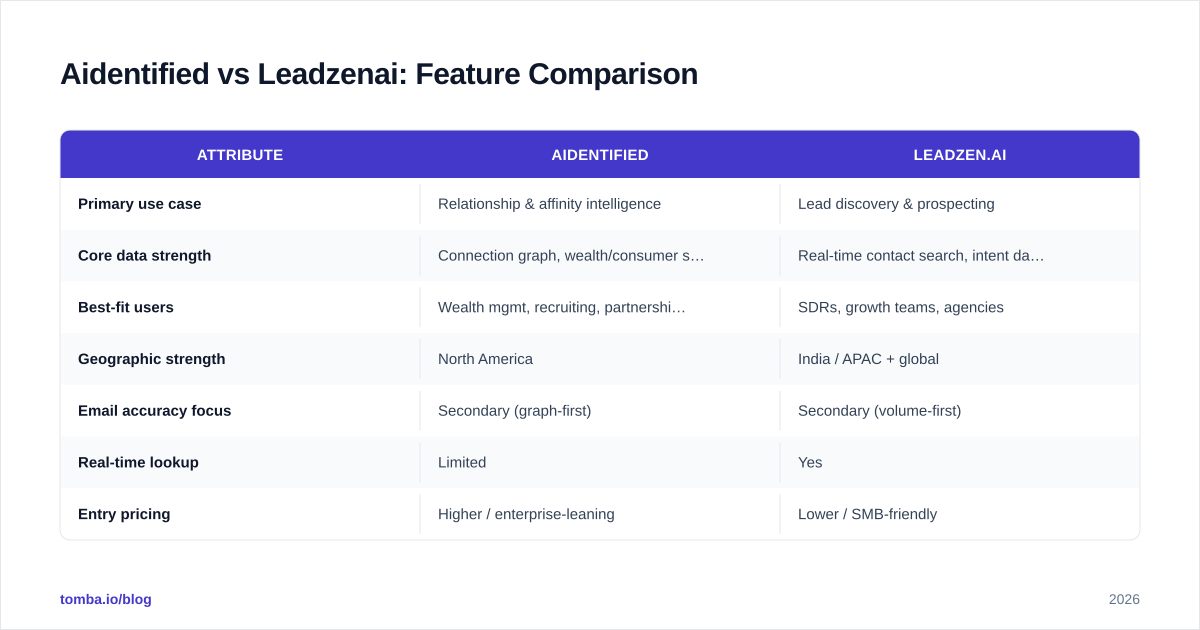
| Attribute | Aidentified | Leadzen.ai |
|---|---|---|
| Primary use case | Relationship & affinity intelligence | Lead discovery & prospecting |
| Core data strength | Connection graph, wealth/consumer signals | Real-time contact search, intent data |
| Best-fit users | Wealth mgmt, recruiting, partnerships | SDRs, growth teams, agencies |
| Geographic strength | North America | India / APAC + global |
| Email accuracy focus | Secondary (graph-first) | Secondary (volume-first) |
| Real-time lookup | Limited | Yes |
| Entry pricing | Higher / enterprise-leaning | Lower / SMB-friendly |
| Free trial | Demo-gated | Limited free credits |
| CRM integrations | Salesforce, Wealthbox, Redtail | Salesforce, HubSpot,Zapier |
| Verification built in | Minimal | Minimal |
The pattern is consistent: each tool is excellent at its specialty and merely adequate at contact-data hygiene. That's not a knock — it's a category reality. Relationship and prospecting platforms optimize for breadth and signals; verified deliverability is a different engineering problem that dedicated finders like Tomba and verifiers solve.
Which Tool Is More Accurate?#
Short answer: it depends on what you mean by "accurate," and you should verify regardless.
If accuracy means "is this connection real and current?", Aidentified is strong — its graph is its product, and stale edges undermine the whole value proposition, so it invests there. If accuracy means "will this email land in the inbox?", both tools sit in the same middle tier as most all-in-one platforms. Independent reviews on G2 and Capterra for tools in this category consistently flag the same thing: great targeting, inconsistent email/phone validity.
The fix is not to abandon either platform. It's to stop treating "found" as "verified." A practical pipeline looks like this:
- Use Aidentified or Leadzen.ai to build your targeted list and capture context.
- Export and run every address through an email verification pass.
- Flag and quarantine catch-all domains separately so they don't tank your bounce rate.
- Only then load the survivors into your sequencing tool.
That third step matters more than people expect. Catch-all domains accept everything at the SMTP handshake, so a naive "valid" check passes them — and then half still bounce. Treating them as their own bucket is the difference between a 1% and a 6% bounce rate.
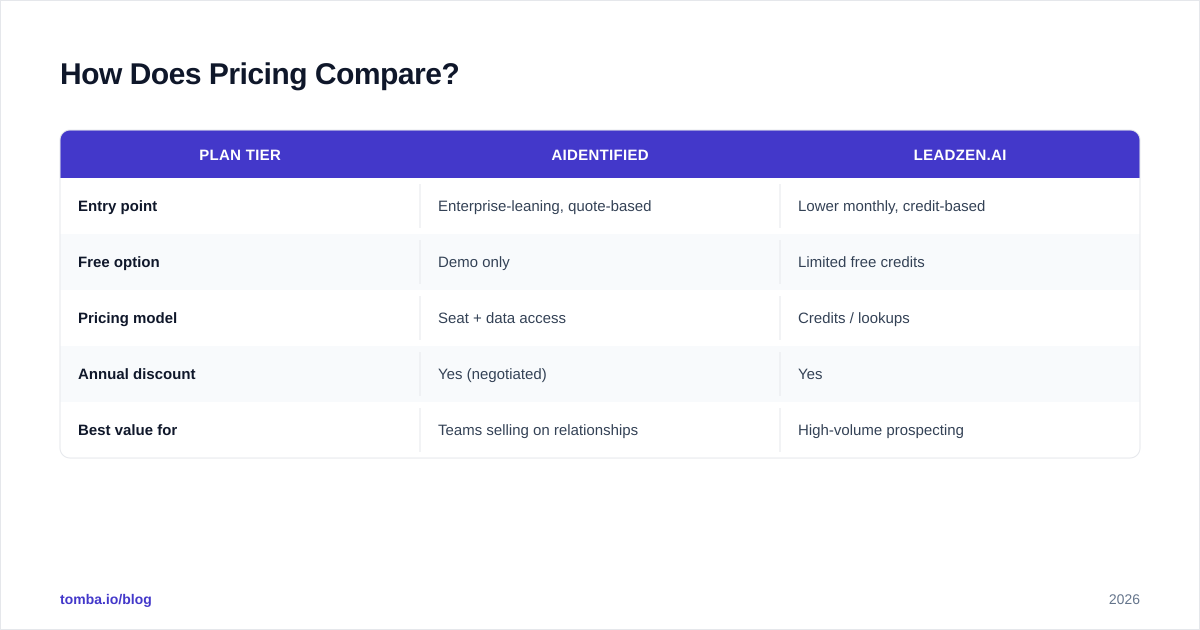
How Does Pricing Compare?#
Both vendors gate exact numbers behind sales conversations, but the shape of their pricing is clear.
| Plan tier | Aidentified | Leadzen.ai |
|---|---|---|
| Entry point | Enterprise-leaning, quote-based | Lower monthly, credit-based |
| Free option | Demo only | Limited free credits |
| Pricing model | Seat + data access | Credits / lookups |
| Annual discount | Yes (negotiated) | Yes |
| Best value for | Teams selling on relationships | High-volume prospecting |
Aidentified's pricing reflects its enterprise positioning — you're paying for a proprietary relationship graph that's hard to replicate. Leadzen.ai's credit model is friendlier if you're a smaller team or agency that wants to scale spend with usage.
For comparison, a purpose-built finder is far cheaper per verified contact. Tomba pricing runs a free tier at 25 searches/month, Starter at $49/mo, Growth at $99/mo, and Pro at $249/mo — so adding a verification layer on top of either platform costs less than most people assume, and it directly protects sender reputation.
When Should You Choose Aidentified?#
Pick Aidentified when warm beats cold in your motion:
- You're in wealth management, financial advisory, or private banking, where introductions and affinity data drive deals.
- You run partnerships or business development and need to know which mutual connection can open a door.
- You're a recruiter mapping passive candidates through second-degree relationships.
- Your team's combined network is large and currently invisible — Aidentified makes that latent asset searchable.
Aidentified is less compelling if you're a high-velocity SDR team that just needs volume. Its strength is depth of relationship context, and you pay for that depth whether or not you use it.
When Should You Choose Leadzenai?#
Pick Leadzen.ai when coverage and speed matter most:
- You need high prospecting volume across many segments and want to spin up lists quickly.
- You sell into India and APAC markets, where Leadzen.ai's coverage outperforms most Western-built databases.
- You want intent and real-time signals layered onto discovery without a separate intent vendor.
- You're an agency or SMB that prefers a credit model that scales with output.
Leadzen.ai is the more conventional prospecting tool of the two, which also makes it a natural comparison against the broader field — if you're shopping this category, it's worth also reviewing Apollo alternatives and RocketReach alternatives before committing.
Can You Use Both Together?#
Yes — and for some teams that's the optimal answer. Aidentified handles the relationship layer (who to approach and through whom), while Leadzen.ai handles the discovery layer (filling the top of funnel with net-new accounts). The two don't directly conflict.
The risk is cost stacking and overlapping data. If you run both, define clear lanes: Aidentified for named, high-value accounts where a warm path exists; Leadzen.ai for broad outbound where you're starting cold. Then unify everything through one verification and enrichment step so your CRM doesn't fill up with three conflicting versions of the same contact. A single data enrichment pass at the end keeps records consistent regardless of which source produced them.
What's the Smartest 2026 Stack?#
The most resilient setup separates three jobs that buyers often wrongly expect one tool to do:
- Targeting & context — Aidentified or Leadzen.ai (or both), depending on whether your edge is relationships or reach.
- Contact discovery & verification — a dedicated finder + verifier so what you send actually lands. This is where a domain search and bulk verification earn their keep.
- Sequencing & deliverability hygiene — warmup, SPF/DKIM, and bounce monitoring downstream.
Decoupling these means you can swap any single layer without rebuilding your whole motion. If Leadzen.ai's pricing changes or Aidentified's coverage gaps hurt you in a region, you replace one block — not the entire stack.
Final Verdict: Aidentified vs Leadzenai#
There's no universal winner, because they're not really the same product.
- Choose Aidentified if relationships are your moat and you'll pay enterprise pricing for a connection graph nobody else has.
- Choose Leadzen.ai if you need affordable prospecting volume and strong APAC coverage with real-time lookups.
- Choose neither as your source of truth for email deliverability — both are targeting tools, not verification engines.
Whichever you land on, the leak is almost always at the contact-data layer. Aidentified and Leadzen.ai are excellent at deciding who to reach, but the addresses they hand off still need to be confirmed before you send.
That's exactly the gap the Tomba Email Finder fills. Use Aidentified or Leadzen.ai to build your relationship map and target list, then run those contacts through Tomba's email finder and verifier to turn "probably right" into "confirmed deliverable." Start free with 25 searches a month, scale to Starter at $49/mo when you're ready, and stop letting bounced emails undo your best targeting work.
// get started
Find, verify and enrich your first contacts today
Start on the free plan with 25 searches a month, then scale when your team is ready.
Free plan · No credit card required · GDPR & CCPA
// about the author